

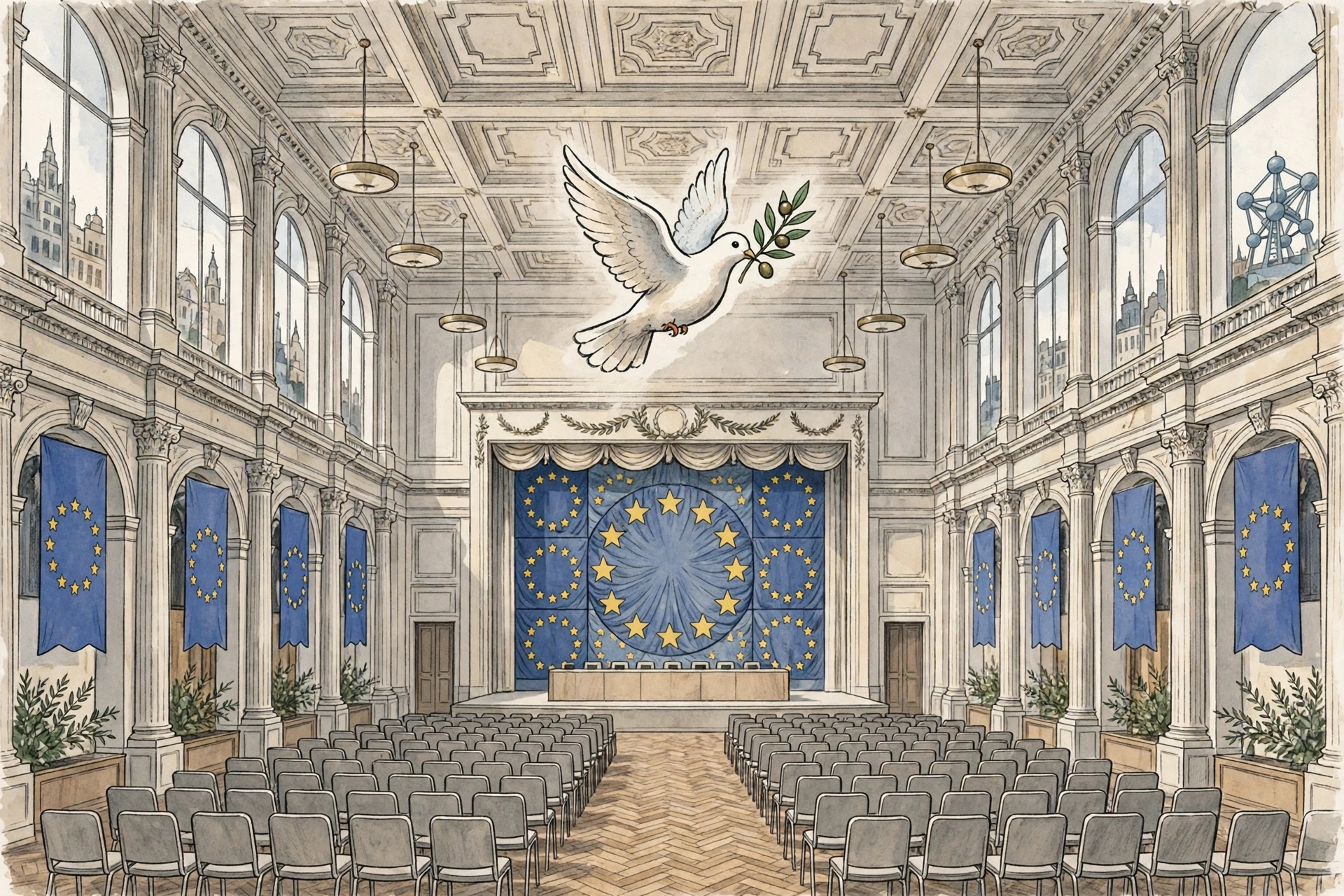
Representatives from more than 60 nations gathered in Brussels on Monday 2 November 2026 for talks with Palestinian Prime Minister Mohamed Mustafa on restoring stability, security and lasting peace in Gaza and the West Bank. The meeting, co-hosted by Belgian Foreign Minister Maxime Prévot and European Union foreign policy chief Kaja Kallas, put the Palestinian Authority at the centre of a conversation about who governs Gaza after the war, how security will be organised, and how reconstruction will be paid for.
The gathering took place while global attention was also fixed on crises in Iran and Lebanon, but the organisers insisted that the Palestinian question could not wait for a quieter moment. Ongoing violence in the West Bank and continued devastation in Gaza, Prévot said ahead of the meeting, are making a two-state solution increasingly difficult to achieve — which is precisely why, in his argument, the international community needs to act now rather than later.
For the European Union, the conference was also a statement of intent. The 27-nation bloc is the largest single donor to the Palestinian Authority, yet it has often been described as a payer rather than a player in Middle East diplomacy, present in funding but sidelined in decision-making. Monday’s meeting was an attempt to change that balance, bringing donors, Arab states, international organisations and financial institutions into the same room as the Palestinian leadership.
What the Gaza and West Bank peace talks covered
The agenda was deliberately broad: stability, security and long-term peace across Israel, Gaza and the West Bank. In practice, that broke down into three linked questions. First, what political authority will govern Gaza and the West Bank as a single unit. Second, how security will be organised so that armed groups do not operate outside that authority. Third, how the enormous task of early recovery in Gaza — water, health, food, debris clearance — will be funded and delivered.
Mustafa’s message on the first question was unambiguous. Gaza requires, in his words, one state, one government, one law and one goal. He told the conference that Gaza and the West Bank are one political and geographical unit, inseparable parts of the state of Palestine, and that reunifying them under one legitimate government, one law and one administration is not a slogan but the only workable path to stability.
That framing matters because it pushes back against any arrangement that would treat Gaza as permanently separate from the West Bank, or as a territory administered indefinitely by an outside body without Palestinian political ownership. The Palestinian Authority, based in Ramallah and led by President Mahmoud Abbas, insists it must play a central part in running Gaza in the future, even though it has not governed the territory since Hamas seized control there in 2007.
On security, Mustafa called for a single security structure under the legitimate authority, coordinated between the International Stabilization Force, the Palestinian Authority, its security institutions and other international actors. He said security must not be fragmented, and he called for the gradual and responsible collection of arms from all armed groups, alongside a full Israeli withdrawal from Gaza.
Those two demands — disarmament of armed groups and withdrawal of Israeli forces — are the hardest parts of any Gaza settlement, and Mustafa presented them as paired steps rather than alternatives. A single authority, in his argument, cannot function while rival armed groups operate independently, and it cannot establish itself while foreign forces remain in control of the territory.
Who was in the room in Brussels
The scale of attendance was itself part of the message. More than 60 countries sent representatives, alongside international organisations and financial institutions. The meeting was co-hosted by Belgium’s foreign minister and the EU’s top diplomat, and it drew senior figures from across Europe, the Arab world and beyond.
Among those present was Nikolay Mladenov, the director of the Board of Peace created by United States President Donald Trump. The Board is a technocratic body intended to manage Gaza’s civil affairs during a transitional period, and Mladenov is a well-known figure in Brussels diplomatic circles. His presence linked the Brussels conference to the separate American-led peace framework, even though the EU has not formally joined that framework and continues to emphasise a multilateral approach through the United Nations and international law.
Also present, according to reporting on the wider donor effort, were representatives of the National Committee for the Administration of Gaza and senior advisers to the Board of Peace. The mix of attendees reflected the reality that no single body currently controls Gaza’s future: the Palestinian Authority, the Board of Peace, donor governments, international financial institutions and the United Nations all claim a role, and Monday’s meeting was an attempt to coordinate those roles rather than let them compete.
Spanish Prime Minister Pedro Sánchez has separately urged the EU to reconsider its long-standing Association Agreement with Israel, a sign of the divisions inside the bloc over how much pressure to apply. Belgium, along with many European and Arab countries, continues to describe the two-state solution as the only practical route to lasting peace for both Israelis and Palestinians and to regional stability.
The Team Gaza Initiative and the 900 million euro pledge
The most concrete outcome of the Brussels effort was financial. The Team Gaza Initiative, launched at the Palestine Donor Group meeting in Brussels, brings together about 900 million euros — roughly one billion dollars, with the precise figure reported as 883.6 million euros — in coordinated funding for early recovery in Gaza.
Contributors include the European Commission, the European Investment Bank and the World Bank, together with governments including Spain, France, Denmark, the United Kingdom, Germany, Norway, Finland, Italy, the Netherlands, Japan, Switzerland, Sweden and Belgium. The initiative is designed to coordinate international support rather than letting each donor run a separate programme, so that projects fit together instead of overlapping or leaving gaps.
The money is earmarked first for restoring basic services for civilians: water and sanitation infrastructure, debris and solid waste removal, health services, energy systems, and agriculture and food systems. Those priorities reflect the state of Gaza after more than two years of war, where about half of the territory’s roughly two million residents are living in tents and where water, health and food networks have been severely damaged.
The initiative also carries a political signal. By pooling funding under a single framework, donors are, in effect, endorsing a model in which recovery is coordinated, civilian-focused and linked to a political process, rather than simply a series of bilateral aid projects. Whether that coordination survives contact with conditions on the ground — access restrictions, security arrangements and the unresolved question of governance — will be the test of Monday’s pledges.
The West Bank: violence, settlements and the other half of the plan
While much of the Brussels discussion focused on Gaza, the West Bank was present throughout the talks as the other half of the Palestinian question. Violence by Israeli settlers against Palestinians has continued, and the conference heard repeated calls for that violence to stop and for the rule of law to be applied equally. For the Palestinian leadership, any plan that addresses Gaza while ignoring the West Bank would fail its own test of unity: one state, one government, one law.
The West Bank also raises a different set of practical questions. Unlike Gaza, it is not a post-war reconstruction zone in the same sense, but a territory under Israeli military occupation where settlements have expanded and where Palestinian communities face restrictions on movement, land and services. A peace plan that does not address those conditions, critics argue, will not produce stability even if Gaza’s immediate humanitarian needs are met.
That is why the conference’s emphasis on a single Palestinian authority matters beyond Gaza. If Gaza and the West Bank are to be governed as one unit, the authority that governs them must be credible in both places, and the international community must be willing to support it in both places. Monday’s meeting was, in that sense, as much about the West Bank’s future as it was about Gaza’s present.
What happens next, and what remains unresolved
The Brussels conference did not produce a final peace agreement, and no one in the room claimed it had. It produced a framework, a funding pledge and a set of shared principles: one Palestinian authority, a single security structure, a full Israeli withdrawal from Gaza, and coordinated international support for recovery. Those principles are now the reference point for the next round of talks, but they are also the points on which disagreement remains sharpest.
The hardest questions are still open. How will disarmament actually happen, and who will enforce it? What is the timetable for Israeli withdrawal, and what happens if it slips? What role will the Board of Peace play alongside the Palestinian Authority, and who decides when the transitional period ends? And how will the international community respond if settler violence in the West Bank continues or if access to Gaza remains restricted?
For the people of Gaza, the immediate test is more practical: whether the pledged money reaches the ground, whether water, health and food systems improve, and whether the tents that now house about half the population begin to empty. For the people of the West Bank, the test is whether the international attention focused on Gaza translates into pressure to address violence and restrictions closer to home.
Brussels also sits within a wider diplomatic picture. The conference took place as attention was focused on other crises, including tensions over Iran and violence in Lebanon, and as the United States pursued its own peace framework through the Board of Peace. The EU’s attempt to assert a distinct, multilateral role — as a donor, a coordinator and a political actor — will be judged by whether Monday’s gathering leads to sustained engagement or fades into a series of pledges without follow-through.
USN has also been following the wider regional picture, including the political aftermath of Israel’s recent election, where Netanyahu’s bloc leading Israel’s 26th Knesset count at 53 seats as certification still awaits. That result, and the government it produces, will shape how Israel responds to the Brussels framework and to the calls for withdrawal and for a single Palestinian authority.
For now, the Brussels conference stands as a marker: more than 60 nations, a Palestinian leadership insisting on unity, and a funding pledge intended to turn principles into services. Whether it becomes a turning point will depend on what happens after the delegates leave Brussels — in Gaza’s streets, in the West Bank’s villages, and in the next round of negotiations.
Sources
USN reviewed reporting from multiple outlets for this story. Read more from Naharnet, Bangladesh Post and Times of Oman.