

FATF Removes Bulgaria, Monaco, Congo and Ivory Coast From Grey List
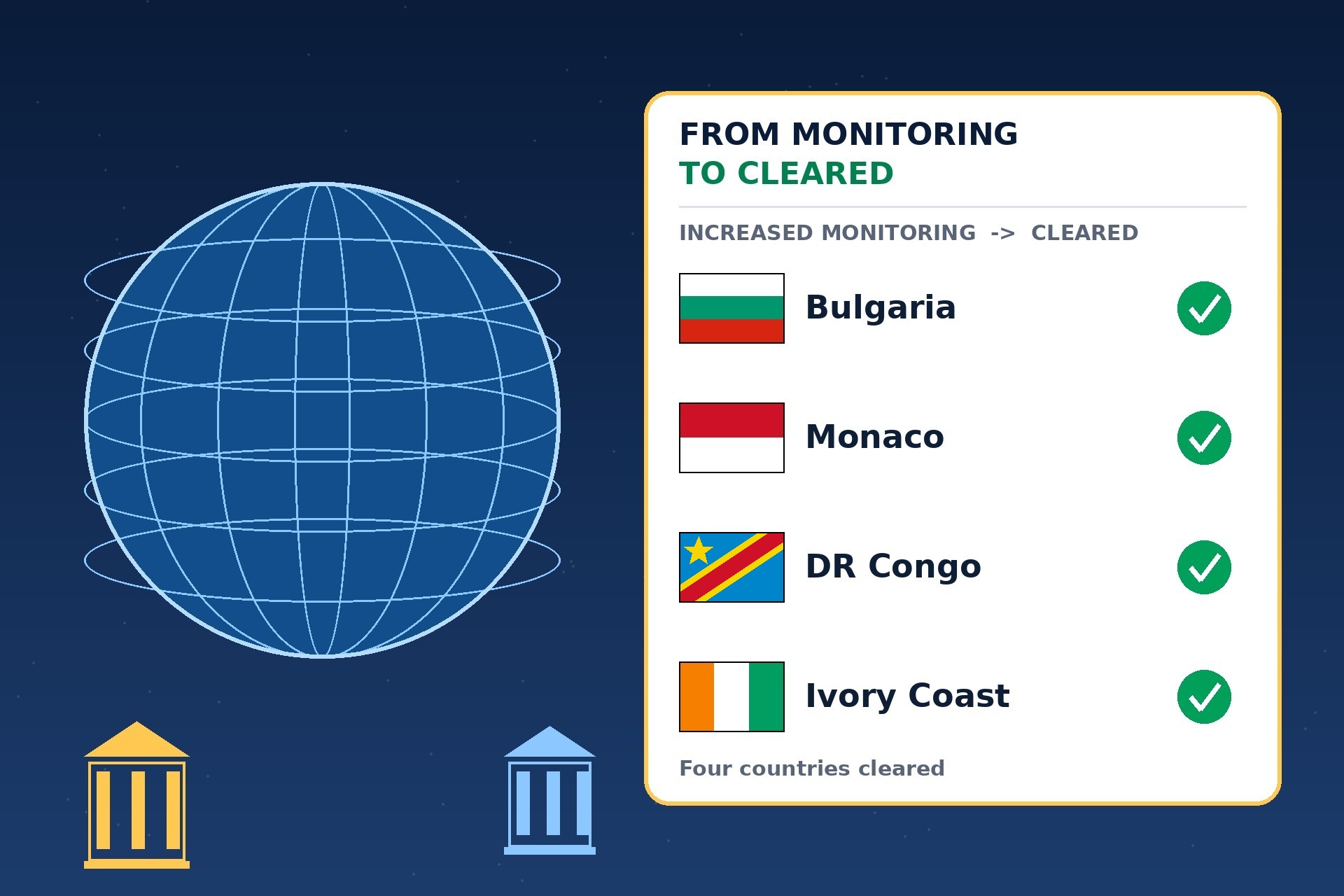
The Financial Action Task Force, the global body that sets standards against money laundering and terrorist financing, has removed Bulgaria, Côte d’Ivoire — commonly known as Ivory Coast — the Democratic Republic of the Congo and Monaco from its list of jurisdictions under increased monitoring, commonly called the grey list. The decision was taken at the FATF plenary held in Paris from October 26 to 30, 2026. The FATF said the four jurisdictions had made positive progress in addressing the strategic deficiencies in their anti-money-laundering and countering the financing of terrorism and proliferation financing systems — known by the shorthand AML/CFT/CPF — that had been identified in their mutual evaluations. With the four removals, the grey list fell from 22 jurisdictions to 18. The decision is significant for the four countries concerned, for the banks and businesses that deal with them, and for the wider system of international financial standards, but it should not be overstated: grey-listing carries no formal sanctions, and removal does not automatically end all scrutiny.
To understand the decision, it helps to understand what the FATF grey list is, and what it is not. The FATF is an intergovernmental body, founded in 1989 and based at the OECD in Paris, that sets global standards for combating money laundering, terrorist financing and the financing of weapons proliferation. Its members include major economies, the European Commission and Gulf Cooperation Council, and its standards are implemented through national laws and through regional bodies. When the FATF identifies strategic deficiencies in a jurisdiction’s AML/CFT/CPF system, it may place that jurisdiction on its list of jurisdictions under increased monitoring. Placement on that list means the jurisdiction has committed to an action plan to address the deficiencies within an agreed timeframe, and that its progress is monitored by the FATF. It is not a sanction, and it does not legally prohibit banks or businesses from dealing with the jurisdiction. In practice, however, banks typically apply enhanced due diligence — tighter checks on customers, transactions and beneficial owners — when dealing with grey-listed jurisdictions, which can increase costs, slow transactions and deter some business.
Removal from the grey list, known as delisting, follows a process. A jurisdiction must complete the items in its action plan, demonstrate that reforms are not only adopted on paper but are working in practice, and undergo an on-site assessment by FATF assessors. Only when the FATF plenary is satisfied that the strategic deficiencies have been addressed does it agree to removal. The FATF’s statement on the October 2026 plenary, as reported, cited positive progress by Bulgaria, Côte d’Ivoire, the Democratic Republic of the Congo and Monaco in addressing the deficiencies identified in their mutual evaluations — the peer reviews through which FATF-style regional bodies assess a country’s compliance with FATF standards. That language, while formal, signals that the four countries had met the specific benchmarks set for them, rather than simply promising future reforms.
Each of the four removals has its own context, and it is worth considering them separately, even though the FATF announcement grouped them together. Bulgaria, a European Union member state, had been grey-listed in 2023, a notable event because it was the first EU member to be placed on the list. Its grey-listing reflected concerns about the effectiveness of its anti-money-laundering supervision, its handling of complex financial crime cases, and its beneficial ownership transparency, among other issues. Removal is therefore significant not only for Bulgaria’s financial sector, but for the EU’s reputation: it suggests that an EU member can be grey-listed, work through an action plan, and be removed, which reinforces the FATF process as a technical rather than purely political exercise.
Monaco, a small principality on the French Mediterranean coast, is a major financial centre relative to its size, with a large private banking and wealth management sector. Its grey-listing in 2024 drew attention because of Monaco’s reputation as a destination for wealthy individuals and its historic association, in public debate, with financial secrecy. Removal suggests that Monaco has strengthened its supervision, its financial intelligence, and its cooperation on financial crime cases to the FATF’s satisfaction. However, reporting noted that Monaco remained on the European Union’s separate list of high-risk third countries as of October 30, 2026. That distinction is important: the FATF list and the EU list are separate instruments, with separate criteria and separate processes. A jurisdiction can leave one list while remaining on the other, and banks operating under EU rules must continue to apply the EU’s requirements even after FATF delisting.
Why the FATF Grey List Removals Matter for Banks and Business
Côte d’Ivoire, known in English as Ivory Coast, is West Africa’s largest economy after Nigeria and Ghana in some measures, and a major exporter of cocoa, cashew nuts and other commodities. Its grey-listing reflected concerns about its AML/CFT framework, including supervision of its financial sector and its handling of terrorist financing risks in a region affected by insecurity in the Sahel. Removal may make it easier for Ivorian banks and businesses to maintain correspondent banking relationships — the relationships through which banks in one country process payments for banks in another — and to attract investment, although any such improvement will depend on how banks in practice adjust their risk assessments. The Democratic Republic of the Congo, by contrast, is a vast Central African country rich in minerals, including cobalt and copper critical to the global energy transition, but with a long history of governance and corruption challenges. Its grey-listing reflected deficiencies in its AML/CFT system, and its removal suggests progress on the specific action plan items agreed with the FATF, even though broader governance challenges in the country remain.
For banks, the practical effect of grey-list removal is often described in terms of “de-risking” in reverse. When a jurisdiction is grey-listed, some banks reduce their exposure to it, close correspondent accounts, or apply such intensive checks that transactions become slow and expensive. That can affect trade finance, remittances and investment, particularly for smaller economies that depend on cross-border payments. Removal does not automatically restore every banking relationship that was closed or restricted, and claims that banks will reopen relationships or that investment will surge should be treated as analyst expectations, not confirmed outcomes. Banks make their own risk decisions, based on their own assessments, their regulators’ requirements, and their commercial interests, and they may move cautiously even after delisting. But removal does remove one formal signal of heightened risk, and it allows banks to justify a more normal risk assessment if their own due diligence supports it.
For the countries themselves, removal also has a reputational and economic dimension. Grey-listing can affect a country’s creditworthiness, its ability to borrow on international markets, and its attractiveness to foreign investors, even though it is not a sanction. It can also affect the cost of remittances sent home by citizens working abroad, if banks apply extra checks to payments involving the country. Delisting therefore matters beyond the technical world of AML compliance: it is a signal to investors, to correspondent banks, and to international institutions that a country’s financial crime framework has improved to a standard the FATF regards as acceptable. That signal, however, is not a guarantee of broader economic improvement, and it does not resolve other challenges — such as corruption, political instability or infrastructure gaps — that may still affect investment decisions.
The reduction of the grey list from 22 to 18 jurisdictions is also a measure of the FATF system’s overall direction. At its peak, the grey list has included more than two dozen jurisdictions. A smaller list does not mean that global money laundering risks have fallen; it means that, on the FATF’s assessment, fewer jurisdictions currently have the specific strategic deficiencies that warrant increased monitoring. New jurisdictions can be added, and existing ones can be returned to the list if reforms stall or regress. The list is therefore dynamic, and delisting should be seen as a milestone in an ongoing process of supervision, not as a permanent graduation from scrutiny.
FATF Grey List Falls to 18 as Vietnam Faces Warning
While four jurisdictions left the grey list in October 2026, the FATF plenary also sent a warning to a jurisdiction that remains on it. Vietnam, which remains listed, was the subject of significant concern from the FATF about the pace of its progress, according to reporting on the plenary. The FATF warned that further action could follow if Vietnam does not show tangible progress by the next plenary, scheduled for February 22 to 26. That warning illustrates the other side of the FATF process: jurisdictions that do not complete their action plans within the agreed timeframe face the possibility of escalation, which can include a public statement of concern, additional monitoring, or, in extreme cases, consideration for the blacklist — the FATF’s list of high-risk jurisdictions subject to a call for action.
Vietnam’s situation also highlights the diversity of the grey list. Unlike Bulgaria or Monaco, Vietnam is a large, fast-growing Southeast Asian economy with extensive trade and manufacturing links, and its AML/CFT challenges are tied to its financial sector supervision, its handling of virtual assets, and its enforcement of financial crime cases, among other areas identified in its evaluation. The FATF’s concern about pace suggests that, while Vietnam may have taken some steps, the FATF did not regard them as sufficient or as implemented quickly enough. The February 2026 plenary deadline — more precisely, the February 22 to 26 plenary — gives Vietnam a defined window to demonstrate tangible progress, but it also creates a clear test: if progress is not shown, the FATF has signalled that it is prepared to act.
The blacklist, by contrast, was unchanged at the October plenary. North Korea, Iran and Myanmar remain the high-risk jurisdictions subject to a call for action. That category is distinct from the grey list in both severity and consequence. Blacklisted jurisdictions are called upon to apply countermeasures, and other jurisdictions are called upon to apply enhanced due diligence and, where appropriate, countermeasures against them. The fact that the blacklist did not change suggests that, in the FATF’s assessment, the situations in those three jurisdictions had not improved to a degree that would justify removal, and that no new jurisdiction met the threshold for blacklisting at this plenary. The stability of the blacklist, alongside the movement on the grey list, underscores the FATF’s two-tier approach: increased monitoring for jurisdictions working through action plans, and a call for action for those with the most serious, unaddressed deficiencies.
It is also important to distinguish the FATF lists from other lists that are sometimes confused with them. The European Union maintains its own list of high-risk third countries, which is based on EU assessments and which, as noted for Monaco, does not automatically change when the FATF list changes. The United Kingdom, the United States and other jurisdictions also maintain their own advisories and requirements. Businesses operating internationally must therefore navigate multiple lists, not just the FATF’s, and a FATF delisting, while significant, does not by itself harmonise all of those requirements. Compliance officers in banks and multinational companies will need to check each relevant list and each regulator’s guidance before changing their risk approach to a newly delisted jurisdiction.
What FATF Delisting Does Not Change
Perhaps the most important clarification about the October 2026 delistings is what they do not do. They do not impose or lift sanctions. Grey-listing never carried formal sanctions, and delisting does not lift any sanctions that may apply for other reasons, such as UN sanctions, EU sanctions or US sanctions on specific persons, entities or activities. They do not automatically end all scrutiny. A delisted jurisdiction remains subject to ongoing monitoring through the FATF’s regular follow-up process, through its regional body, and through its own national supervision. If deficiencies re-emerge, or if reforms are reversed, a jurisdiction can be returned to the grey list. They do not, by themselves, change a country’s EU list status, as Monaco’s case illustrates. And they do not guarantee that banks will immediately restore relationships, reduce checks, or increase lending. Those are commercial decisions that will be made bank by bank, based on risk appetite and regulatory expectations.
For Bulgaria, Côte d’Ivoire, the Democratic Republic of the Congo and Monaco, the immediate task after delisting is to sustain the reforms that led to removal. FATF action plans are designed to produce lasting changes in law, supervision and enforcement, not temporary fixes to pass an assessment. Sustaining those changes requires continued investment in financial intelligence units, in supervisory capacity, in prosecution of financial crime, and in transparency of beneficial ownership — the real people who ultimately own companies and trusts. If those investments lapse, the deficiencies that led to grey-listing can return, and the FATF process can begin again. The history of the grey list includes jurisdictions that have been listed, delisted and relisted, which is a reminder that delisting is a point in a cycle, not the end of it.
For the wider financial system, the October plenary is a reminder of how global standards work in practice. The FATF does not have direct enforcement power over banks or over national governments. Its influence comes from peer pressure, from the reputational and practical consequences of listing, and from the fact that its standards are incorporated into national laws and into the requirements of international financial institutions. When four jurisdictions are removed at once, it suggests that the system of action plans, monitoring and on-site assessment is functioning as intended for those countries. When another jurisdiction is warned about pace, it suggests that the system is also willing to escalate when progress stalls. Both messages — progress rewarded, delay warned — are part of how the FATF maintains the credibility of its lists.
The next test will come at the February 22 to 26 plenary, when the FATF will review Vietnam’s progress and consider whether any other jurisdictions should be added or removed. Until then, the grey list stands at 18 jurisdictions, with Bulgaria, Côte d’Ivoire, the Democratic Republic of the Congo and Monaco no longer on it. For those four countries, the removal is a tangible achievement, earned through the completion of specific reforms. For banks, businesses and investors, it is a signal to reassess risk, but not a instruction to ignore it. And for the FATF itself, it is evidence that its process, for all its technical complexity, can produce movement — in both directions — when jurisdictions engage with it seriously.
Sources
USN reviewed reporting from multiple outlets for this story. Read more from Sowetan, FinTech Global and FN News.