

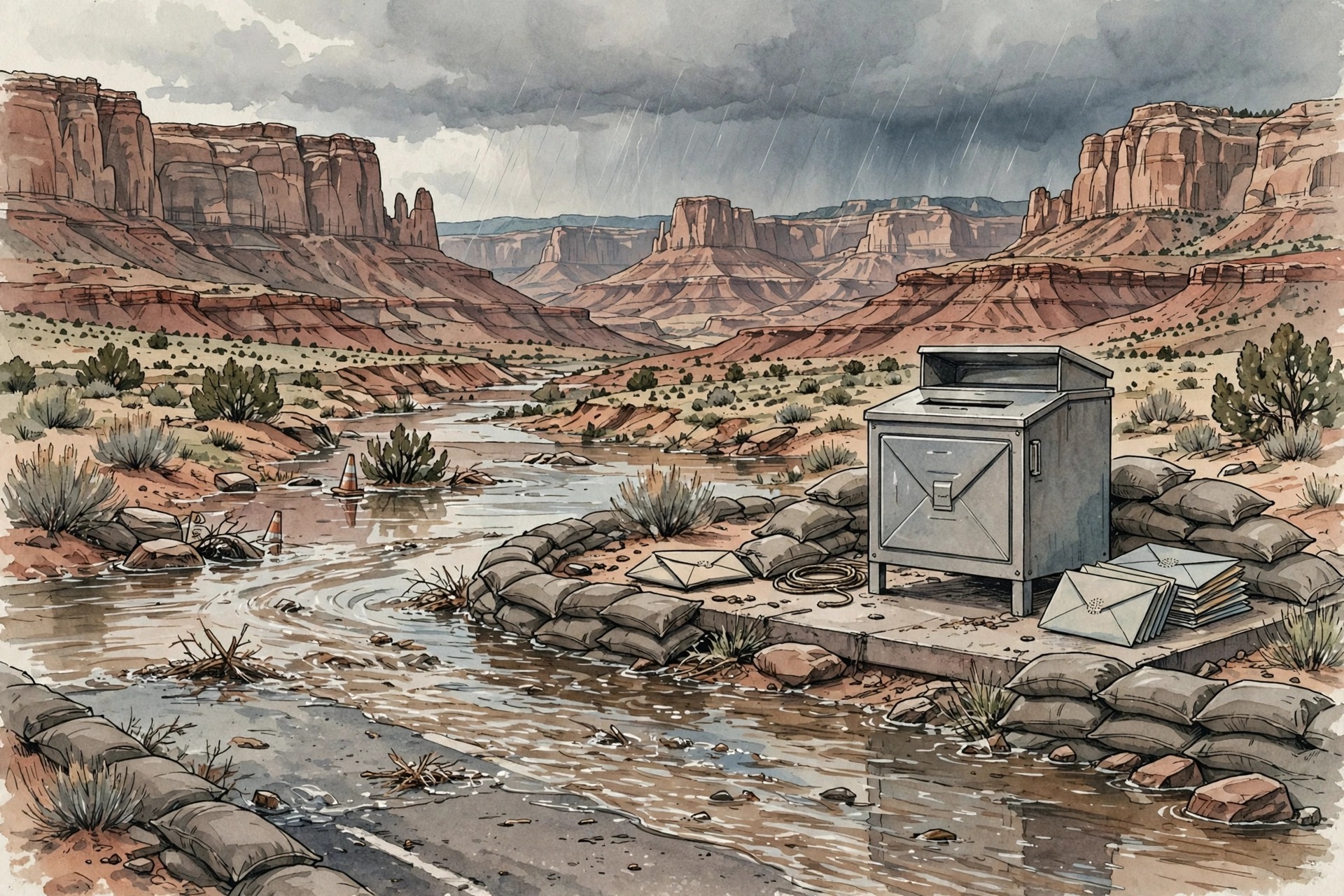
In the high desert of southeastern Utah, where the San Juan River winds past red rock mesas and small communities spread across vast distances, Election Day arrived on Tuesday, 3 November 2026, with an unusual problem. Some voters could not safely reach a polling place or a ballot drop box at all, because floodwater had cut roads and reshaped the journeys they would normally make to vote. Rather than leave those votes without a route to cast a ballot, Utah’s lieutenant governor issued an emergency accommodation the day before, allowing a narrowly defined group of San Juan County residents to receive and return their ballots electronically.
The order, issued on Monday, 2 November 2026, by Lieutenant Governor Deidre Henderson, applies only to voters in San Juan County who have not yet voted and who cannot reasonably travel to a drop box or an in-person polling location on Election Day because of the flooding. It does not change voting rules for the rest of Utah, and it does not apply to voters who have already cast a ballot. For the people it does cover, it creates a practical alternative on a day when the ordinary trip to vote may be blocked by water, debris, or a washed-out road.
San Juan County is one of the largest counties by area in the United States and one of the most sparsely populated parts of Utah. Its communities include Blanding, Monticello, Bluff, Monument Valley, Montezuma Creek, Aneth, Red Mesa, and Navajo Mountain, along with the town of Moab’s southern approaches. Distances between settlements can be long, roads can be the only link to a polling place, and when a desert wash or river crossing floods, there may be no short detour. That geography is central to understanding why a flooding emergency in this county can become a voting-access emergency as well.
How San Juan County voters blocked by flooding can vote electronically
Under the emergency arrangement, affected voters who have an email address on their voter record were to receive an email on the morning of Election Day explaining how to obtain and return a ballot electronically. Voters who had not yet voted and did not receive such an email were told they could call the county clerk before 5 p.m. on Election Day to request an accommodation. The phone number published with the announcement was 385-587-3223, extension 4.
Timing mattered. Requests received after 5 p.m. would not be accepted, and all electronic ballots had to be submitted no later than 8 p.m. on 3 November, when polls closed in Utah. Officials strongly encouraged voters who needed the electronic option to ask early in the day, rather than waiting until the afternoon, when flooded roads, patchy phone service, or a queue of requests could make an already difficult day harder.
The lieutenant governor’s office stressed that the electronic route was an addition, not a replacement. Poll workers were still to be present at all previously scheduled in-person polling locations through 8 p.m. on Election Day, and voters who could reach those locations safely were expected to vote in the usual way. The accommodation was designed for the specific group that could not reasonably travel, not as a general invitation to vote from home.
That distinction also answers a question many voters outside the county may ask: whether electronic ballot return is new. It is not entirely new in Utah. The same route is already used for overseas and military voters, and for some voters covered by disability-access provisions. What is unusual here is its extension, on an emergency and county-specific basis, to voters blocked by a natural disaster on Election Day itself.
What the flooding did to roads, rivers, and polling access
The flooding in San Juan County came from a weekend storm system that dropped far more rain than this arid region normally sees in a whole month. Reports from the storm described between two and four inches of rain falling over the weekend in parts of the county, roughly triple the area’s average rainfall for the whole of November. In desert country, where dry ground and narrow washes can turn a sudden downpour into a fast-moving wall of water, that volume was enough to flood the San Juan River near the Four Corners border region and to leave roads unsafe or impassable.
Photographs shared by the lieutenant governor’s office showed floodwater around Bluff, a small town on the San Juan River that serves as a gateway to Monument Valley and a hub for river trips. Bluff is not a large place, but its position on the river and on the road network makes it important for residents of surrounding communities, including Navajo Nation chapter communities such as Aneth, Red Mesa, and Mexican Water. When routes around Bluff flood, the effect ripples outward to voters who depend on those roads to reach services, including polling places.
San Juan County’s voting map reflects its settlement pattern. Drop boxes and polling places are placed in chapter houses, libraries, community centres, and county buildings, because those are the places people already gather. On Election Day, drop boxes at the Aneth Chapter House on Highway 162, the Bluff Community Center, the Mexican Water Chapter House on Highway 191 south of Bluff, the Red Mesa Chapter House, and the San Juan Health Spanish Valley Clinic near Moab were listed as open until 3 p.m. Polling places and drop boxes open from 7 a.m. to 8 p.m. included the Blanding Library, the Montezuma Creek Dine Professional Plaza Building, the Monument Valley Welcome Center, the Navajo Mountain Chapter House, and the San Juan County Administration Building in Monticello.
Those locations tell their own story about access. A voter in Navajo Mountain or Monument Valley may face a long drive even on a dry day. Add floodwater, a closed crossing, or a road reduced to a single passable lane, and the journey can become unreasonable or unsafe. The emergency was written with exactly that voter in mind: someone who wants to vote, has not yet done so, and cannot reasonably make the trip.
A wider Southwest storm, and why Utah acted before Election Day
San Juan County was not the only place in the Southwest dealing with floodwater at the start of Election Week. A powerful storm system brought historic flooding, evacuations, and rescues across parts of Arizona, Colorado, New Mexico, and Utah, before pushing east toward the central United States. In Arizona, a man was found dead early on Monday after reportedly falling into floodwater the previous evening near Flagstaff, and the state’s governor declared a statewide emergency to help local authorities clear roads, repair infrastructure, and assist displaced residents.
In Colorado, evacuations were ordered along the San Juan River in Pagosa Springs, where the river surged past major flood stage for the second time in about ten days. A voting centre and a ballot drop box there were relocated ahead of Election Day, and voters affected by flooding could request an emergency ballot online or go to another voting centre, though voting outside a home county could limit them to statewide races. In New Mexico, officials said all polling locations would open as planned for Election Day, while evacuations were ordered along the San Juan River in parts of that state as well.
Utah’s approach differed in its mechanism but shared the same goal: keep the vote accessible when nature interrupts the normal plan. By issuing the order on Monday, rather than waiting until Tuesday morning, the lieutenant governor’s office gave county officials, poll workers, and voters a full day to understand the new option, to check voter records for email addresses, and to prepare for calls from voters who had not received an email. That advance notice mattered, because an accommodation only works if voters know about it before the 5 p.m. request deadline.
The storm’s scale also helps explain why a county-level problem drew state-level action. More than twenty trillion gallons of rain were estimated to have fallen on the Four Corners states and Nevada over the preceding two weeks, according to calculations cited in national storm coverage. In a region where November is normally dry, that volume overwhelmed washes, rivers, and drainage channels that are rarely tested so severely, and it left emergency managers watching water levels that were still high as Election Day began.
What this means for voters, and what it does not change
For voters in the affected areas, the practical message was straightforward. If you had already voted, nothing changed. If you had not voted and could reach a polling place or drop box safely, you were expected to do so in person. If flooding made that trip unreasonable, and you had not yet voted, the electronic option offered a way to cast a ballot before the 8 p.m. deadline, provided you requested it before 5 p.m.
For election administrators, the episode is a reminder of how much of American voting still depends on physical access. Ballot boxes, polling places, and the roads between them are part of the voting system, even though they are rarely discussed in those terms. When a road closes, the system does not automatically offer an alternative; someone has to create one, quickly, and communicate it clearly enough that voters can use it.
Utah’s solution also sits within a wider national picture of Election Day 2026. Across the country, federal monitors were present at polling places, and the administration’s attention to election procedures was a prominent theme of the cycle. USN’s coverage of that national context includes USN’s report on federal election monitors heading to polls in all 50 states. That national monitoring effort and Utah’s local accommodation address different parts of the same question: how to keep voting both secure and accessible on a single day, under very different local conditions.
There are also limits to what an emergency accommodation can fix. An electronic ballot still requires a phone or internet connection, an email address, and a way to receive instructions, all of which can be harder to guarantee during a flood. The order addressed the road problem, not every problem a storm creates, and voters without an email address on file had to rely on calling the clerk’s office before the deadline.
As Election Day continued, the key questions for San Juan County were practical ones: how many voters used the electronic route, whether the 5 p.m. request deadline and 8 p.m. return deadline proved workable, and whether any polling locations had to close or move because of rising water. Those answers would determine whether the emergency accommodation was a footnote to a difficult day or a model for how states handle voting when a disaster strikes on Election Day itself.
For the communities along the San Juan River, the flooding itself will remain the longer story after the ballots are counted. Roads will need repair, homes and businesses will need assessment, and the river’s course through the Four Corners region will be watched for further rises. But for one day, the question was simpler and more immediate: whether a voter cut off by water could still vote. Utah’s answer, issued the day before, was to offer a different route to the ballot box, one that did not require crossing a flooded road.
Sources
USN reviewed reporting from multiple outlets for this story. Read more from Gephardt Daily, WIO News and KION.