

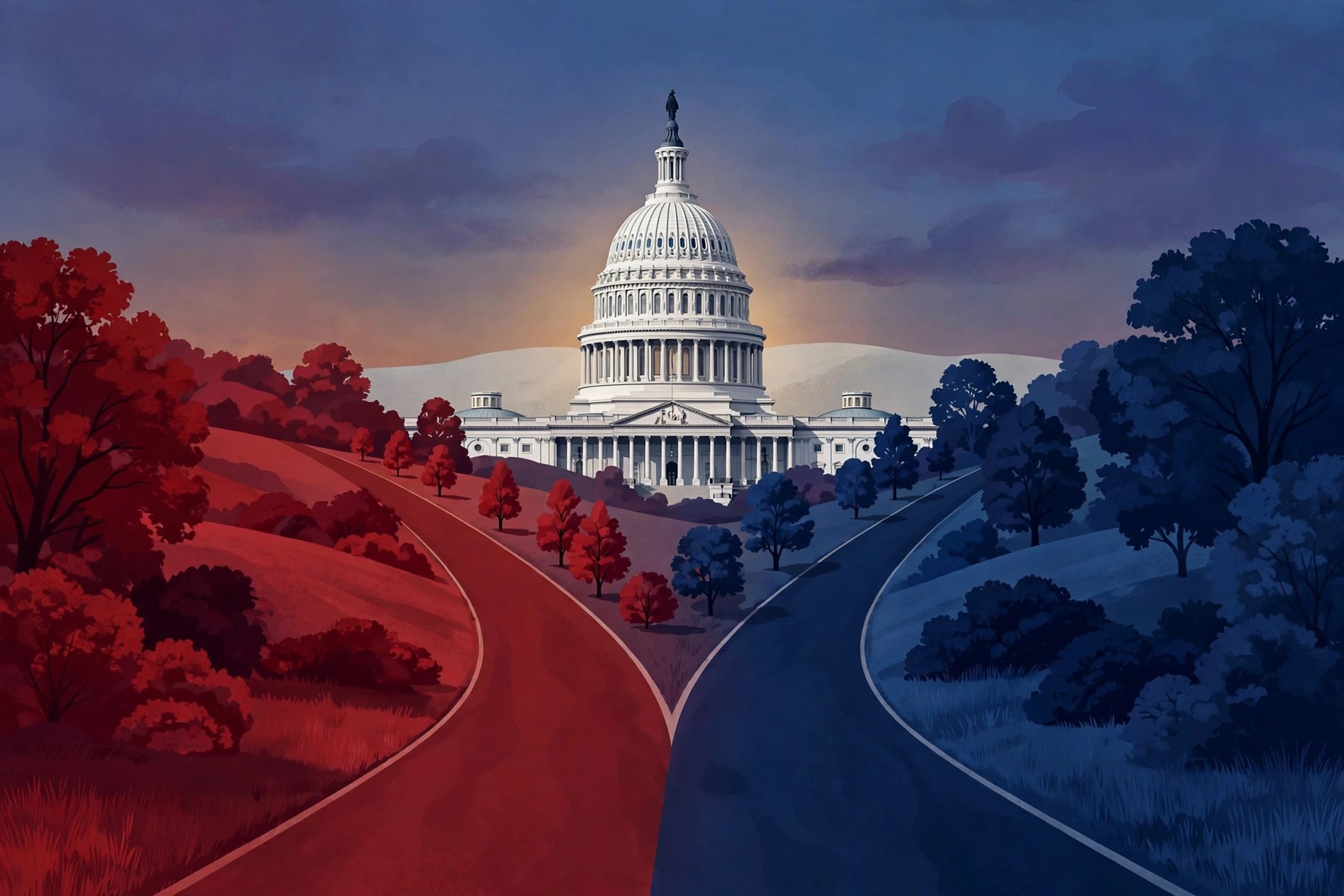
Within hours of the first projections on election night, the Republican Party began a familiar post-defeat argument: who was to blame for losing the Senate, and what the losses mean for the party’s future. The argument is not yet a formal split, and it has not produced a single agreed explanation. Instead, two broad camps have emerged in reporting since November 3, each offering a different account of the same results. Trump allies argue that the president was not on the ballot, that midterms historically punish the party in power, and that individual candidates, not the president’s leadership, explain the defeats. Critics inside the party argue that the president’s endorsements, campaign style and policy record shaped the races, that voters used the midterms to register discontent with the direction of the country and the cost of living, and that the party must change its approach if it is to win back a majority. Both accounts are political interpretations, attributed here to those camps and to reporting of their positions, not established facts about why any individual voter cast a ballot.
The scale of the defeat gives the argument its urgency. Democrats entered the 2026 cycle needing a net gain of four Senate seats to take control. In the projected results, they gained six, flipping seats in North Carolina, South Carolina, Texas, Ohio, Kansas and Iowa, and reaching a projected 51-seat majority according to Nikkei and Associated Press reporting. The House, in projections from CNN and Decision Desk HQ, also moved toward a Democratic majority, although one major outlet had not yet formally called House control in early November reporting. A loss of that size, in a single night, inevitably triggers a search for explanations, and in a party still dominated by Donald Trump, that search quickly becomes a debate about Trump himself.
Republicans blame game midterm losses: endorsement defeats in South Carolina and Texas
Two Senate defeats have become focal points in the blame debate, because both involved candidates associated with the president’s endorsement orbit and both occurred in states Republicans have long considered safe. In South Carolina, Democrat Annie Andrews defeated Darline Graham. In Texas, Democrat James Talarico defeated Ken Paxton. Reporting since the election has described both contests as endorsement losses for the president’s camp, meaning that candidates backed by Trump, or closely identified with his movement, lost races that Republicans expected to win. That framing is itself contested: allies of the president argue that endorsements do not guarantee victory, that state-level factors and candidate quality matter, and that a loss in a single state should not be read as a national verdict on the president. Critics argue that the pattern — losses in states as different as South Carolina and Texas, alongside flips in North Carolina, Ohio, Kansas and Iowa — points to a broader problem than any one candidate.
The South Carolina result is particularly striking because the state has not been a regular Democratic target in Senate races. A Democratic win there suggests, to critics of the current Republican approach, that the party’s appeal has narrowed in ways that leave it vulnerable even in its traditional strongholds. To allies of the president, the same result can be presented as evidence that the Democratic candidate ran a strong, locally focused campaign, that the Republican candidate faced specific local challenges, and that nationalising the race around Trump obscures those local factors. Both readings draw on the same vote total but emphasise different causes, and without detailed post-election surveys and voter-file analysis, neither can be proved from the result alone.
Texas presents a parallel argument with a different local history. Texas has been a Republican state in statewide races for decades, and a Democratic Senate win there, if confirmed by certification, would be a major breakthrough. Critics inside the party present Texas as a warning that demographic change, suburban shifts and voter concern about the cost of living are eroding the Republican advantage even in large, traditionally red states. Allies present Texas as a contest shaped by the specific candidates, by high Democratic spending, and by national issues such as the economy and the Iran war’s costs, rather than by the president’s leadership alone. Again, the disagreement is about interpretation, and it is important not to present either camp’s claim as a proven fact about voter motivation.
Distancing from Trump: a quiet shift, not yet a break
A second feature of the post-election period, reported in the days after November 3, is a quiet distancing from Trump by some Republicans, particularly those facing competitive races in 2028 or seeking to position themselves for future leadership contests. Distancing, in this context, does not mean public denunciation. It means a change in emphasis: less frequent invocation of the president’s name in campaign material, more focus on local issues and economic concerns, and a willingness, in private conversations reported by journalists, to question whether the president’s endorsement helps or hurts in a general election. That kind of distancing is common after a midterm defeat, because politicians who must win again in two years have a strong incentive to adapt to the electorate that just voted.
Trump allies, for their part, push back against the distancing narrative. They argue that the president remains the party’s most popular figure with its base, that distancing risks demoralising the voters who turn out in primaries, and that the 2026 losses should be attributed to the normal midterm penalty for the party in power and to economic headwinds, including the costs associated with the Iran war and high petrol prices on Election Day, rather than to Trump himself. They also point to Trump’s own post-election argument — that he was not on the ballot and would have won in a landslide if he had been — as evidence that his personal standing is distinct from the party’s performance. Critics respond that a president who urged supporters to vote as if he were on the ballot cannot easily separate himself from the result, and that the distancing, however quiet, reflects a recognition inside the party that the current approach did not work in 2026.
What is not in dispute is that the distancing, if it continues, will shape the Republican primary landscape. Candidates who distance themselves may appeal to swing voters and suburban voters who were dissatisfied with the direction of the country, according to CBS exit polls in which about three-quarters of voters expressed dissatisfaction. Candidates who remain closely aligned with Trump may appeal to the base voters who dominate low-turnout primaries. The tension between those two electorates — the primary electorate and the general electorate — is a long-standing challenge for both parties, but it is sharpened for Republicans in 2026 because the party must defend its record in power while also presenting itself as a vehicle for change after losing the Senate.
What the losses mean for 2028 jockeying
The 2028 presidential contest is still more than two years away, but the 2026 results have already altered its early dynamics. Potential Republican candidates, governors, senators and other figures who might seek the nomination must now answer a question they could previously defer: how do they explain 2026, and what would they do differently? Some will argue, in the Trump-allied camp’s terms, that the party needs to double down on the president’s agenda, improve its candidate selection, and focus on economic messaging. Others will argue, in the critics’ terms, that the party needs to broaden its appeal, moderate its tone on issues where it lost ground, and present a forward-looking economic plan that addresses the cost-of-living concerns that nearly nine in ten voters, in Reuters and SSRS exit polling, called crucial or major.
That jockeying will not be resolved by a single statement or a single leadership election. It will play out in the choice of the next Senate Republican leader in the minority, in the House Republican leadership if the House flips as projected, in fundraising, in the 2027 state and local elections, and in the early primary states. It will also be affected by Trump’s own plans. His suggestion that he will become a “political pundit” on why candidates won and lost signals that he intends to remain an active voice in that debate, praising allies and criticising candidates he believes failed. That role could help his favoured candidates, or it could complicate the efforts of Republicans who want to move beyond the 2026 result.
Democrats, meanwhile, will watch the Republican blame debate with interest, but they face their own challenge: converting a projected Senate majority and a projected House majority into a governing record that voters reward in 2028. A narrow Senate majority of 51 seats, if confirmed, leaves little room for defections, and a House majority, whatever its final size, will have to negotiate with a president who holds the veto. That veto dynamic — Trump’s earlier stated willingness to block Democratic bills — remains relevant to the divided-government period ahead. The Republican debate about blame, in other words, is only one half of the post-midterm story. The other half is whether the new Democratic majorities can govern effectively enough to hold their gains.
For now, the blame game should be understood for what it is: a normal, if unusually public, phase after a major defeat, in which rival camps offer rival explanations, each with some evidence and each with obvious self-interest. The certified results will confirm who won and by how much. They will not, by themselves, tell the party why it lost. That answer will emerge, if at all, from a combination of voter surveys, demographic analysis, fundraising data and the results of the next elections. Until then, any claim that a single factor — Trump, the economy, candidate quality, spending or any other single cause — explains the 2026 losses should be treated as opinion, attributed to the camp that offers it, and weighed against the counter-argument from the other camp.
Sources
USN reviewed reporting from multiple outlets for this story. Read more from Gulf News, Moneycontrol and Economic Times.