

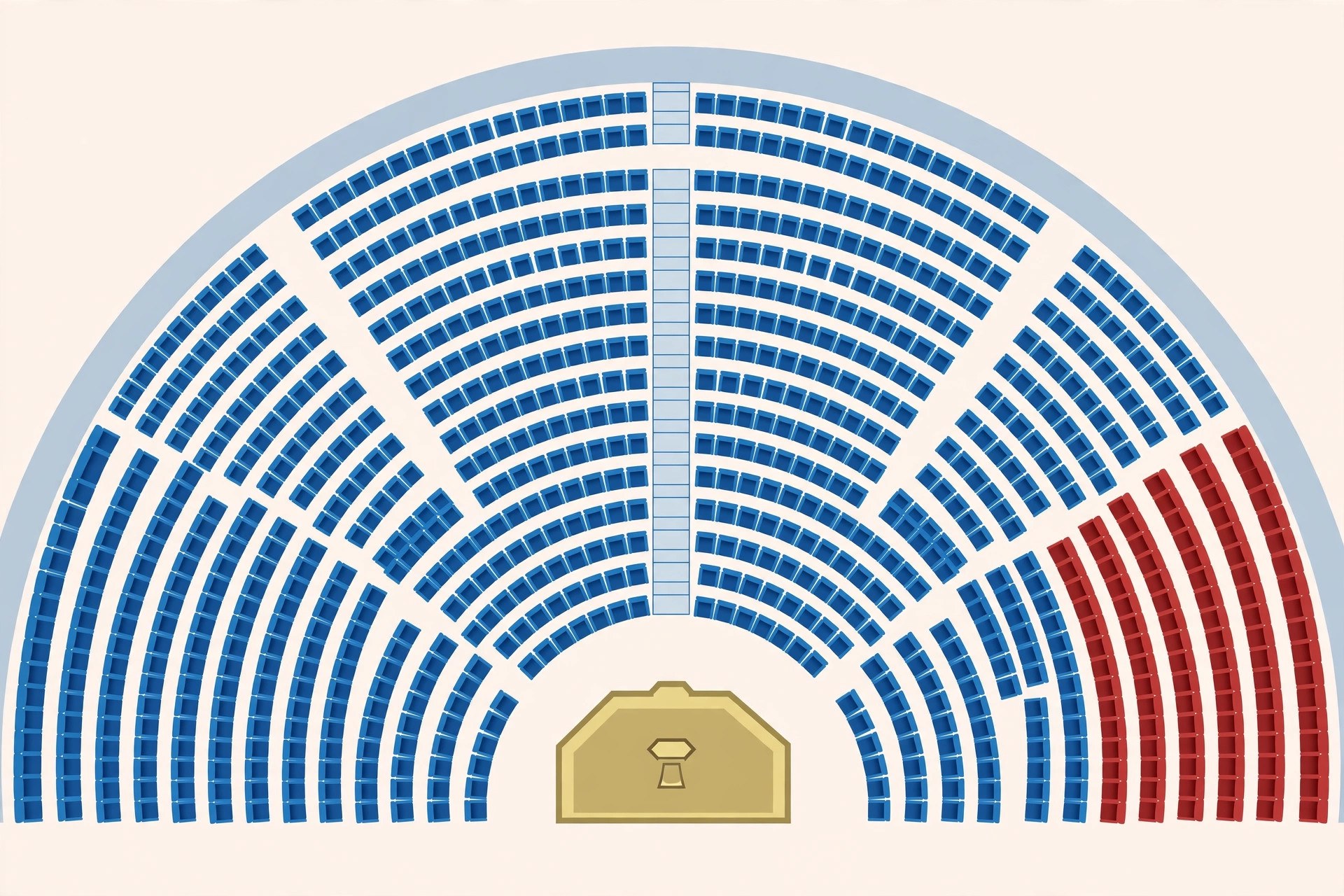
The size of the Democratic edge in the United States House of Representatives, rather than the projection of a majority alone, has become the central question in the days after the 2026 midterm elections. Projections pointed to Democratic control, but the margin remained unsettled while votes were still being counted in a number of districts. That distinction matters a great deal in the House, where a handful of seats can determine whether a Speaker can pass legislation comfortably, whether a small group of dissenters can block a bill, and whether committees reflect a commanding majority or a fragile one.
News organisations did not speak with one voice on the exact shape of the result in early reporting on November 4. CNN and Decision Desk HQ projected a Democratic House majority. CBS projected Democrats at at least 208 seats against at least 160 for Republicans, with 218 seats needed for a majority. The Associated Press had not yet formally called House control in that early reporting. CNN sources also said Democrats were on course for at least 230 seats, possibly approaching 240. Those figures should be read for what they were: projections based on called races and trends in uncalled races, not a certified final tally. A projection of at least 230 seats is not the same as a final count of 230 seats, and the difference between those two ideas is important for anyone trying to understand what comes next.
The reason for the caution is structural. House races are decided district by district, and counting rules, postal ballots, curing periods and close margins vary by state. Some districts report quickly, others take days, and a small number can take longer still when the margin is narrow. Election officials must then check, canvass and certify results, a process that runs into December in many states. Until that work is complete, seat totals remain provisional in the strict sense, even when the overall direction of control looks clear from projections. That is why responsible reporting in this period separates what has been projected from what has been certified, and why readers should be wary of any claim that presents an early seat total as final.
Within that uncertainty, the range of possible outcomes still tells a story. A majority in the low 220s would give Democrats control, but with very little room for error. A majority around 230 or above would give them more breathing space, though not the kind of dominance that makes internal disagreement irrelevant. In both cases, the majority party controls the floor schedule, the Rules Committee and the chairmanships of standing committees. The question is how much friction it faces in using that power day to day. A narrow majority magnifies every absence, every illness, every member with a different view on a particular bill, and every district-level political calculation. A wider majority does not remove those pressures, but it absorbs them more easily.
For Representative Hakeem Jeffries, the prospective Speaker in a Democratic House, the margin will shape his leadership in practical ways that have little to do with titles and much to do with arithmetic. A Speaker must assemble 218 votes on the floor for most legislation, assuming all members are present and voting. If the majority is, for example, 222 seats, losing more than four votes on a party-line measure is enough to defeat it, unless votes come from the other party. If the majority is closer to 235 seats, the same Speaker can lose more than a dozen votes and still prevail. That difference changes negotiations inside the caucus, the leverage of individual members and factions, and the willingness of leadership to bring controversial bills to a vote at all.
Party discipline is therefore not an abstract virtue in this context. It is a daily management problem. Members from competitive districts may face different electoral pressures from members in safe districts. Members from different regions may weigh the same national bill differently because of local industry, housing costs, energy prices or attitudes toward federal spending. In a narrow majority, leadership must often negotiate with each of those groups in turn, offering changes, sequencing votes carefully or accepting that a bill must be narrowed to survive. In a wider majority, leadership still negotiates, but it can afford to lose a bloc on a given vote without losing the bill. The result is often a faster floor process and a broader legislative agenda, although it can also create its own tensions if members who feel ignored become less cooperative over time.
How the House majority margin 2026 affects committee power and floor control
Committee ratios are another place where margin size shows up quickly. The majority party holds more seats than the minority on each committee, and the size of that advantage usually tracks the size of the overall majority. A larger majority can mean larger majorities on committees, which makes it easier to advance bills, issue subpoenas, hold hearings on the majority’s terms and control the markup process. A narrower majority still gives the majority party control, but committee votes can be closer, and a single defection or absence can matter more. That is particularly relevant for committees that handle spending, taxation, oversight and national security, where partisan disagreement is often sharpest.
The same logic applies to the discharge of business that divides the caucus. When a bill is popular with most of the majority but opposed by a vocal minority within it, a Speaker with a wide margin can move forward and accept the dissent. A Speaker with a narrow margin may need to delay, amend or set the bill aside, not because the bill lacks majority support in the chamber as a whole, but because it lacks support within the governing party plus whatever cross-party votes can be found. Opposition parties, meanwhile, watch that arithmetic closely. If they can peel away only a few majority members, they can block legislation in a narrow House. If the majority is wider, they need a much larger break to have the same effect, which is harder to achieve and often requires a bill that is itself broadly unpopular.
There is also a question of agenda-setting. A larger majority tends to encourage a more ambitious programme, because leadership can plausibly promise action on several fronts at once and still expect to deliver on at least some of them. A narrower majority tends to encourage prioritisation: leaders choose a smaller number of bills, focus on measures with broad support, and use oversight, messaging votes and must-pass legislation as vehicles for priorities that cannot pass on their own. Neither approach guarantees success, because the Senate and the White House remain separate centres of power, but the House majority’s size affects which strategy looks realistic from the start.
That point is especially important in a period of divided government. The projections after the midterms pointed to Democratic control of the Senate as well, with Democrats reported at 51 Senate seats after flipping six Republican-held seats, including contests in North Carolina, South Carolina, Texas, Ohio, Kansas and Iowa. Democrats had entered the election needing a net gain of four seats in the Senate. If both chambers are under Democratic control while the White House remains in Republican hands, the House majority’s size will still matter, because a bill must pass both chambers in identical form before it reaches the President. A House majority that can pass its version cleanly still needs Senate agreement, and the President can veto legislation. The House margin therefore affects negotiating strength, but it does not by itself determine the final outcome of a legislative fight.
It is also worth separating the House picture from individual races that drew national attention. In Georgia, Jon Ossoff was re-elected to the Senate. In New Hampshire, Chris Pappas held his seat. In Florida, Ashley Moody was re-elected to the Senate. In Minnesota, Ilhan Omar was re-elected to the House for a fifth term, and Peggy Flanagan, the state’s lieutenant governor, was elected to the Senate, reported as the first Native American woman senator. In Florida’s 22nd House district, Pia Dandiya won. In New Jersey, Rebecca Bennett defeated Tom Kean. In Pennsylvania, Republican incumbents Ryan Mackenzie, Scott Perry and Rob Bresnahan lost re-election. In Iowa’s 1st House district, Christina Bohannan defeated Mariannette Miller-Meeks, reversing a loss by 799 votes two years earlier. Those results help explain the national shift, but the House margin is the sum of all 435 districts, including many less publicised contests whose final counts were still being resolved.
Uncalled seats deserve particular attention, because they are not random. They often include districts with large numbers of postal ballots, districts where counting takes longer by law, and districts where the margin is genuinely close. A projection that Democrats are on course for at least 230 seats reflects an assessment of how those uncalled races are trending, but trends can narrow as more ballots are counted. Conversely, a race that looks close on election night can widen as later ballots are processed. That is a normal feature of American elections, not evidence of irregularity, and it is why election officials and news decision desks urge patience until counting and certification are complete. Claims that treat an early projection as a final result, or that treat a later shift in a close race as suspicious, both misunderstand the process.
The political consequences of the margin will also be felt in how the two parties talk about the result. A wider Democratic majority would allow Democrats to argue that voters delivered a clear mandate for change, while Republicans would be more likely to emphasise the seats they held and the limits of the Democratic win. A narrower majority would give Republicans a stronger argument that the country remains closely divided, and would give Democrats less room to claim a sweeping mandate. Those arguments matter because they shape expectations in Washington, influence donor and activist energy, and affect how the media frames the next Congress. But they should not be confused with the legal reality: control of the House is determined by the certified results, not by the rhetoric that follows them.
There is a further institutional consequence that is often overlooked. A larger majority makes it easier to sustain a Speaker through difficult votes, because leadership can survive occasional defeats without losing control of the floor. A narrower majority makes every difficult vote a test of leadership, and increases the incentive for members to use their vote as leverage on unrelated issues. That dynamic can produce more transactional politics, in which individual members extract concessions on local projects, committee assignments or future votes in exchange for support on a major bill. That is not necessarily corrupt or unusual; it is how narrow majorities have often operated. But it does make the legislative process slower, more opaque and more vulnerable to breakdown when trust between leadership and members frays.
For voters, the most useful way to read the House margin in this period is to ask three questions. First, has control been formally called by the Associated Press, or is it still a projection from other organisations? Second, how many seats remain uncalled, and are they concentrated in a way that could move the total by several seats in either direction? Third, what does the plausible range of final totals imply for the governing party’s ability to pass its programme without help from the opposition? Those questions keep the focus on process and arithmetic, rather than on premature claims about a final number that has not yet been certified.
Looking ahead, the margin will also influence the relationship between the House and the Senate. If Democrats hold both chambers, coordination between House and Senate leadership becomes central, because the two chambers must agree on text. A House with a wide majority may be willing to pass more ambitious bills and then negotiate downward in the Senate. A House with a narrow majority may be more cautious from the outset, passing bills that are already closer to what the Senate can accept. Either way, the House margin does not remove the need for compromise between chambers, but it changes where that compromise happens and who bears the political cost of it.
The coming weeks will therefore be a period of counting, checking and careful language. News organisations will update their projections as more races are called. Election officials will certify results state by state. Party leaders will count their own members, test support for leadership positions and begin to map out which bills can move and which cannot. By the time certification is complete, the final House margin will be known, and the debate can move from projection to governing reality. Until then, the honest description is that Democrats were projected to hold a House majority, with a possible total at least in the 230s according to CNN sources, with CBS projecting at least 208 seats at an earlier stage of counting, and with the Associated Press not yet formally calling control in early November 4 reporting. That projected range, and its consequences for discipline, committees and agenda-setting, is the story of the margin — not a single number presented as final before the count is done.
Sources
USN reviewed reporting from multiple outlets for this story. Read more from USA Today, Nikkei Asia and Economic Times.