

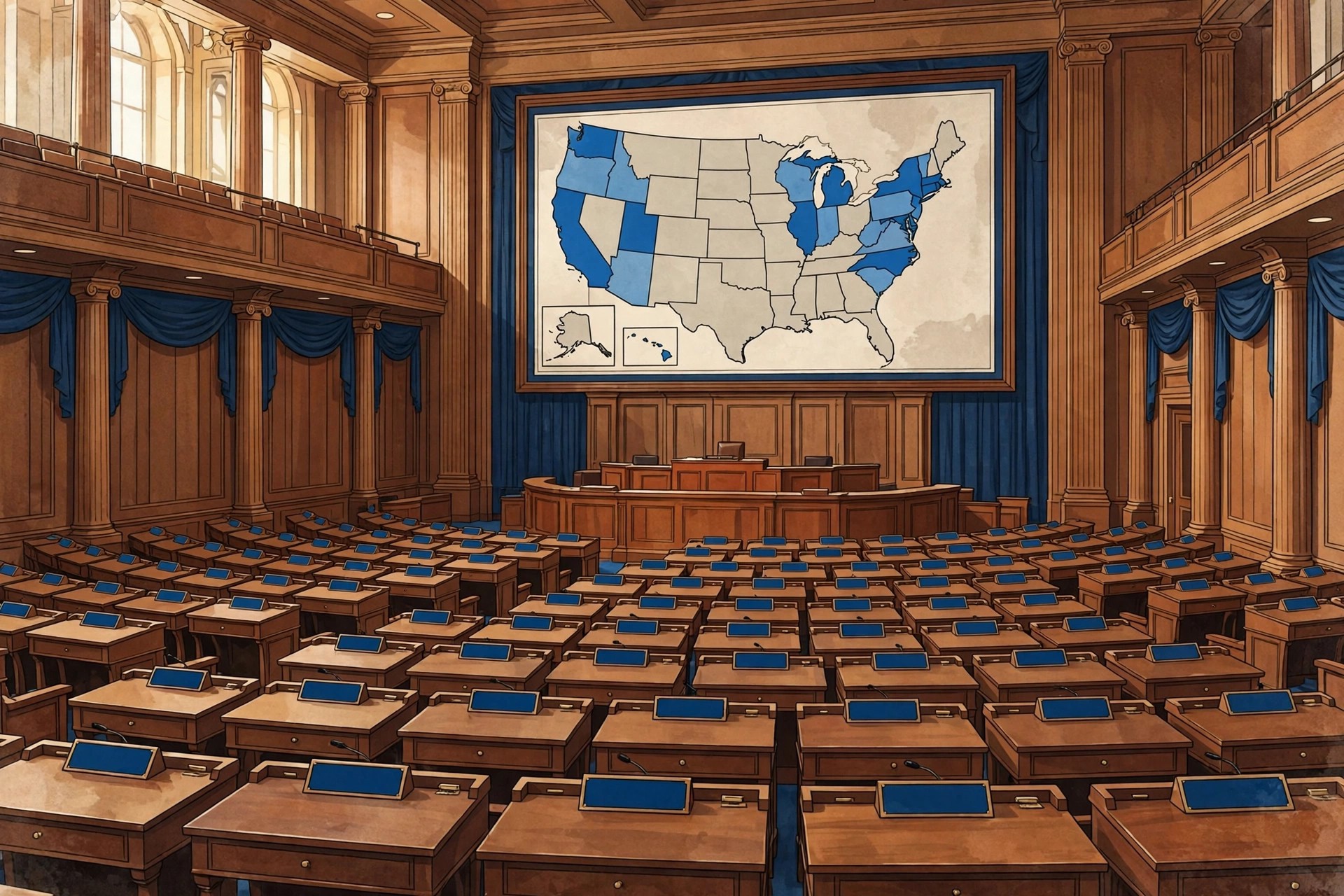
Democrats are projected to win control of the United States Senate in the 2026 midterm elections, according to projections by Decision Desk HQ and NBC News reported on election night, in what would be the most consequential Senate result of the cycle. Democrats entered the election needing a net gain of four seats to overturn a 53-47 Republican majority, a target that required winning in states President Donald Trump had carried, some of them by large margins, in 2024. On the night, projections showed Democrats flipping Republican-held seats in South Carolina, North Carolina, Texas, Ohio, Kansas and Iowa, while holding the battleground seats they already held in Georgia and elsewhere. If those projections hold through certification, the Senate will change hands in January, and with it the power to confirm judges and executive nominees, to set the Senate’s legislative calendar, and to decide which bills ever reach a vote.
As with the House result, the Senate projection must be described carefully. A projection is not a certification, and at the time the national projections were reported, several Senate races remained uncalled in the Associated Press count, including a competitive race in Michigan. State officials must still count outstanding ballots, including mail ballots in some states, and certify results under state law. That process can take days, and in a race where no candidate reaches the required threshold under state law, a runoff could follow. The responsible summary on November 4 is therefore this: decision desks projected Democratic control, based on the combination of called flips and the remaining arithmetic, while the final certified margin, and the fate of the last uncalled races, remained to be confirmed. That distinction does not diminish the scale of the night, but it is the difference between a projected majority and a finished count.
The Senate result was the harder prize, and forecasters had treated it as such for months. Democrats needed to gain seats in a map where they were defending 13 seats and Republicans were defending 22, but where the seats Democrats needed to flip were disproportionately in Republican-leaning states. Republicans, by contrast, needed to hold their ground and could retain control with 50 seats, because the vice president breaks a tie in the Senate. That arithmetic is why a net gain of four was the threshold: it would move Democrats from 47 to at least 51, removing the tie-break advantage altogether. The fact that projections showed Democrats reaching that threshold, rather than falling one seat short, is what turned a good night into a change of control.
The flips that changed the Senate map
The most striking flip of the night came in South Carolina, where Democrat Annie Andrews, a pediatrician, defeated Republican Senator Darline Graham, according to projections by the Associated Press, Decision Desk HQ and NBC News. Graham had been appointed to the seat after the death of her brother, longtime Republican Senator Lindsey Graham, earlier in 2026, and had won a special Republican primary with President Trump’s backing. Andrews had originally launched her campaign to challenge Lindsey Graham before his death, and the race tightened sharply in its final weeks. Reporting on election night put Andrews ahead by roughly 51 percent to about 47 percent with most votes counted. The result made Andrews the first woman elected to the Senate from South Carolina and the first Democrat to win a Senate race in the state since Fritz Hollings won his final term in 1998, a gap of 28 years. It also illustrated a central theme of the night: a Democrat winning in a state Trump had carried by about 18 percentage points just two years earlier.
In North Carolina, Democrat Roy Cooper, the former governor, defeated Republican Michael Whatley for an open seat vacated by retiring Republican Senator Thom Tillis. Cooper’s victory was the first major flip called on election night and was significant for a different reason: it was a pickup in a large, fast-growing swing state where both parties had invested heavily, and it gave Democrats a seat without having to defeat an incumbent. Cooper’s statewide profile as a former governor, in a state where governors often build broader coalitions than Senate candidates, was central to the Democratic strategy there, and the result suggested that strategy worked.
In Texas, Democrat James Talarico defeated Republican Attorney General Ken Paxton, according to projections by Decision Desk HQ and NBC News. Talarico became the first Democrat to win a Texas Senate seat since 1988, ending a drought of nearly four decades in a state that has been the largest Republican prize in Senate politics. The Associated Press count later showed Talarico with a clear lead in votes counted, but the significance of the race lay less in its margin than in its location. Texas has long been treated as a state Democrats could contest for the presidency in the future but could not yet win statewide. A Senate victory there, if certified, challenges that assumption and will reshape how both parties allocate resources in Texas in 2028 and beyond.
In Ohio, Democrat Sherrod Brown defeated Republican Senator Jon Husted to recapture a seat Brown had lost two years earlier. Brown, a former senator who had chaired the Senate Banking Committee, ran as a populist voice on manufacturing, trade and workers’ rights, while Husted ran as the incumbent with the backing of the Trump administration. The Associated Press count showed a close race, with Brown ahead by a modest margin in votes counted. For Democrats, Brown’s return matters beyond the single seat: it restores one of the party’s most distinctive voices on economic policy to the Senate, and it gives the party a senior figure with committee experience at a moment when committee chairs are about to change hands.
Two further flips completed the projected path to a majority. In Kansas, Democrat Adam Hamilton defeated Republican Senator Roger Marshall, becoming the first Democrat to win a Kansas Senate seat since 1932, according to projections by CNN and Decision Desk HQ. That 94-year gap was the longest active Democratic losing streak for a Senate seat in any state, and its end was treated on election night as a symbol of how broad the Democratic movement had become. In Iowa, Democrat Josh Turek won the Senate race in an upset projected by USA Today’s live coverage, adding another Republican-held seat to the Democratic column. Together, the six flips, if all are certified, would be more than the four Democrats needed, giving the party a cushion against any single uncalled race going the other way.
Holds that protected the Democratic path
Flips alone do not win a majority if a party loses seats it already holds, and Democrats’ holds on election night were therefore as important as their gains. In Georgia, Democratic Senator Jon Ossoff won re-election, defeating Republican Representative Mike Collins, with the Associated Press calling the race after Ossoff built a clear lead in counted votes. Georgia had been one of the most closely watched Senate races in the country, and a loss there would have forced Democrats to flip an additional Republican seat elsewhere. Ossoff’s hold removed that burden. In New Hampshire, Democrat Chris Pappas won the open seat vacated by retiring Democratic Senator Jeanne Shaheen, defeating former Republican Senator John Sununu and keeping the seat in Democratic hands. In Illinois, Democrat Juliana Stratton won election to the Senate, succeeding a retiring Democrat and keeping that seat blue. In Virginia, Democratic Senator Mark Warner won re-election to a fourth term, defeating Republican Bert Mizusawa, in one of the earliest calls of the night.
One prominent race remained uncalled as projections of overall control were reported: Michigan, where Democrat Abdul El-Sayed was seeking to keep the seat in Democratic hands against Republican Mike Rogers. Michigan mattered for two reasons. First, it was a Democratic-held seat, so a loss there would have reduced the Democratic net gain by one. Second, it was a race where internal Democratic divisions, including a late endorsement dispute involving outgoing Representative Haley Stevens, had drawn national attention. The fact that control was projected even with Michigan uncalled suggests decision desks judged the Democratic path to be secure without it, but the final margin, and the composition of the new Senate, will not be known until Michigan and the other outstanding races are called and certified. Readers should therefore treat any exact final seat count published on election night as provisional.
Other Senate races called on the night followed the expected pattern in safe states. In Florida, Republican Ashley Moody won the special election to complete the term of Marco Rubio, who had left the Senate to become Secretary of State. In Kentucky, Republican Andy Barr won the open seat to succeed Mitch McConnell, defeating Democrat Charles Booker, according to the Courier-Journal’s election-night reporting. In Tennessee, Republican Senator Bill Hagerty won re-election. Those Republican holds did not alter the overall trajectory, because Democrats’ path to a majority never required winning in Florida, Kentucky or Tennessee. It required winning in the six states they flipped, and holding the seats they already had, and on election night projections indicated they had done both.
What a Democratic Senate majority means for confirmations
The Senate’s most distinctive power is confirmation. Unlike the House, the Senate must confirm federal judges, including Supreme Court justices, as well as cabinet secretaries, ambassadors and other senior executive officials. The majority party controls the committees that hold confirmation hearings, sets the timetable for floor votes, and, in practice, decides which nominees advance and which stall. A Democratic majority therefore gives Democrats a direct check on the president’s ability to reshape the federal judiciary and the executive branch in his final two years. Before the election, Senate Minority Leader Chuck Schumer had pledged to oppose what he called “MAGA justices” if Democrats regained control, while Senate Majority Leader John Thune had warned that Democrats would pursue tax increases and what he called a socialist agenda. Those are partisan characterisations, and the reality will be more specific: each nominee will be judged on record, qualifications and politics, but the party that controls the calendar will have the stronger hand.
Confirmation politics also cuts the other way. A Democratic Senate does not automatically block every nominee, and Democrats have in the past confirmed nominees from Republican presidents where they judged the candidate qualified and mainstream. Senator Peter Welch of Vermont, for example, said before the election that he remained open to confirming qualified candidates, arguing that the administration’s choices would determine whether they could secure bipartisan support. That nuance matters for readers trying to predict the next two years: a change of majority changes who sets the terms of the confirmation debate, but it does not remove the incentive for a president to choose nominees who can attract votes beyond his own party, especially for lifetime judicial appointments where a failed nomination wastes months.
Beyond confirmations, a Democratic Senate changes the legislative calendar in a second way. The majority leader decides which bills reach the floor, and a Democratic leader will prioritise Democratic bills, including any House-passed legislation on affordability, health care or voting rights, while Republican priorities that passed the House in the first two years will face a Democratic filter. That does not mean those bills become law: they would still need House approval, which Democrats are projected to hold, and presidential approval, which is far from guaranteed. But it does mean the Senate will no longer be a reliable conduit for the White House agenda, and that the president will need to negotiate with Democratic leaders, or accept stalemate, on major legislation.
There is also a limit to what a narrow Senate majority can do, and it is an important one. Most legislation in the Senate requires 60 votes to overcome a filibuster, a threshold neither party will hold in the new Congress on the projected numbers. That means a Democratic majority of 51 or 52 seats can confirm nominees, who require only a simple majority, and can use the budget reconciliation process for certain fiscal bills, but cannot by itself pass sweeping legislation over unified Republican opposition. Democrats who campaigned on bold promises will therefore face the same institutional constraint Republicans faced when they held a narrow majority: control of the Senate is necessary for many things, but it is not sufficient for everything. Voters who expect immediate, transformative legislation from a change of majority alone are likely to be disappointed by the Senate’s rules, whatever party is in charge.
Leadership, committees and the January transition
If the projected majority is certified, Chuck Schumer, the current Democratic leader, is positioned to return as Senate Majority Leader, with John Thune moving to minority leader, subject to the formal leadership elections within each party conference. As with the House Speaker’s race, those leadership votes are internal party decisions, not public elections, and they normally ratify the existing leaders. The more visible change will be in committee chairs: Democrats will take the gavels on committees including Judiciary, Finance, Foreign Relations, Armed Services and Appropriations, while Republicans will become ranking members. That swap affects everything from hearing topics to subpoena decisions to the drafting of spending bills, and it will be felt well before the first major floor vote of the new Congress.
The transition itself follows a fixed calendar. The new Congress will be sworn in on January 3, 2027, and the outgoing Congress will first complete a lame-duck session, returning on November 9 with a government funding deadline on December 11. Readers can follow that calendar in our earlier report on Congress returning on November 9 to a crowded lame-duck session. The lame-duck session will be a test of how the two parties handle the handover: outgoing Republican leaders may try to complete priorities while they still hold the gavels, while incoming Democratic leaders may prefer to defer contentious items to January. Funding the government past December 11 will require agreement regardless of who holds the majority in January, because a shutdown in December would be owned by the current Congress.
Official reaction on election night was still emerging as projections were reported, and USN has not relied on any single social-media post as the basis for this story. Leadership accounts, including those associated with Speaker Mike Johnson, House Democrats, Senate Republicans, Senate Democrats, Leader John Thune, Senator Chuck Schumer and Representative Hakeem Jeffries, were checked as a signal for reaction, but the story rests on outlet projections and Associated Press race calls, not on posts alone. That discipline matters on election night, when posts can outrun counting and when a celebratory or concessive message can be misread as a certified result. Where leaders have spoken on the record, in speeches or interviews, this article attributes those remarks to the outlet that reported them, rather than presenting them as USN’s own findings.
What to watch before the new Senate is seated
Three things will determine the final shape of the new Senate. The first is certification in the flipped states, where margins in Ohio and South Carolina were not landslides and where recount or audit procedures, if triggered under state law, could take time. The second is the outcome in Michigan and any other races still uncalled in the Associated Press count at the time of the national projection. A Democratic win in Michigan would widen the majority; a Republican win would narrow it, though not, on the projected flips, reverse control. The third is whether any race heads to a runoff under state law, a possibility that applies in states requiring an outright majority and that would delay final seating for that state until December. None of these steps is unusual, and none should be treated as evidence of irregularity on its own. They are the normal, if slow, machinery of American elections, and they are why election-night projections always carry the caveat that results are unofficial until certified.
The political consequences, however, are already clear enough to state. A Democratic Senate, combined with a projected Democratic House, ends unified Republican government and restores divided government for the remainder of the Trump presidency. That changes the negotiating balance on funding, on nominations, on oversight and on any major legislation, and it gives Democrats a platform from which to shape the 2028 presidential campaign. It also raises the stakes of the next two years for both parties: Democrats must show that a majority can govern, not merely block, while Republicans must show that opposition can be constructive rather than merely obstructive. Voters, who told exit pollsters they were dissatisfied with the country’s direction and concerned above all about costs, will judge both parties on whether daily life improves, not on who holds which gavel.
For readers who followed the Senate campaign, the result also reframes the map for 2028, when a different set of Senate seats will be contested. A Democratic win in Texas, if certified, will encourage Democrats to invest more heavily there in future cycles, while a Democratic win in South Carolina will prompt a reassessment of which states are truly out of reach. Conversely, Republican holds in Florida, Kentucky and Tennessee show that the party’s base in safe states remains intact, even as its position in swing and formerly safe Republican states weakened. The 2026 Senate result is therefore not just a verdict on the last two years; it is a preview of where the next Senate battle will be fought, and USN will update this story as certifications confirm the final margin and as leadership elections formalise the new majority.
Readers who want the pre-election context for these races can revisit our earlier coverage of Democrats opening leads in Senate battlegrounds and of the five toss-up races that could decide the Senate majority, which set out why Iowa, Kansas, Ohio and Texas were identified before voting as the contests that would decide control.
Sources
USN reviewed reporting from multiple outlets for this story. Read more from USA Today, Reuters and Al Jazeera.