

For Mexico City and Bogota, the most important result of the American midterm elections is not a single headline about who won a particular race, but a shift in the structure of power in Washington that will shape the next two years of United States relations with Latin America. Major American news organisations have projected that Democrats will take control of both the House of Representatives and the Senate, an outcome that, if confirmed, would create divided government for the remainder of President Donald Trump’s term and give a newly empowered opposition a set of tools it did not have before: the ability to investigate, to block legislation, to shape budgets, to hold hearings and to force public debate about immigration, tariffs and trade, even though the president retains broad authority over border enforcement, diplomacy and national security.
That distinction matters for how Latin American capitals read the result. Mexico and Colombia do not expect a Democratic Congress to reverse the broad American consensus on border security, drug enforcement or competition with China, which now spans both parties. What they do expect is a Congress that will scrutinise Mr Trump’s approach more closely, that may try to constrain some of his most disruptive moves, and that could, at moments, offer a different channel for engagement, especially on immigration cooperation, tariff relief and the review of the United States-Mexico-Canada Agreement, known as the USMCA. For policymakers from Mexico City to Bogota, the question is therefore less whether Washington becomes friendly, and more whether it becomes more predictable, more divided, or both at once.
The stakes are visible in the calendar that now governs the relationship. The USMCA is due for a formal review in 2026, with negotiations and political decisions extending into 2027 that will determine whether the agreement is extended, modified or allowed to lapse. At the same time, immigration cooperation between the United States and Mexico, security cooperation with Colombia and tariff arrangements affecting the whole region are all subject to review, renegotiation or political pressure. Latin American leaders are reading the midterms through that timetable: a Congress that must now be consulted, or at least reckoned with, could slow or complicate any deal that Mr Trump tries to strike, but it could also make a deal more durable if it gains broader political support.
Mexico City’s first reading: leverage, not relief
For Mexico, the midterm result is best understood as a source of leverage, not as immediate relief. Mexican President Claudia Sheinbaum has sought to manage the relationship with Washington through a combination of cooperation and firmness, offering to work with the United States on migration, fentanyl and security, while insisting on respect for Mexican sovereignty and on the importance of the USMCA for jobs and investment on both sides of the border. A Democratic Congress that is sceptical of Mr Trump’s tariff strategy, and that is attentive to the costs borne by American consumers and businesses, could be more receptive to that argument, but it could also be more demanding, pressing Mexico on labour rights, environmental standards, energy policy and the rule of law as conditions for any trade relief.
That dual dynamic is familiar to Mexican policymakers, who have long dealt with different centres of power in Washington. In periods of divided government, Mexico has often found that it can work with the White House on security and migration, with Congress on trade and labour, and with state governments and business groups on investment, even as it faces a more complex and less predictable policy environment. A White House that wants to escalate tariffs or to impose new conditions on trade may find itself facing congressional resistance if those measures harm American manufacturers, farmers or consumers. At the same time, a Congress that wants to take a tougher line on migration, on drug enforcement or on Chinese investment in Mexico may push the White House further than it intended to go. For Mexico City, divided government is therefore not a simple good or bad, but a condition that requires careful management of multiple American audiences at once.
There is also a domestic dimension to Mexico’s reading. Ms Sheinbaum has built her political identity around a combination of social spending, public security and national sovereignty, and she has sought to present Mexico as a partner that can deliver results on migration and drugs without accepting humiliation or coercion. A midterm result that produces a divided government in Washington, with a president and a Congress controlled by opposing parties, fits that approach, because it allows Mexico to argue that it is dealing with a United States that is itself divided, and that a durable agreement must reflect a broader American consensus, not just the preferences of one administration. Yet Mexican officials are also aware that such an argument can be misleading, and that American pressure on migration and trade has survived many changes of party control. The more practical question for Mexico City is whether the new Congress will act to constrain Mr Trump, to reinforce his approach, or to pursue its own agenda on Latin America, and on which issues it will choose to do so.
Immigration and security: cooperation with more scrutiny
Immigration is the area where that question will be tested most directly. The United States and Mexico have cooperated closely on migration management, with Mexico deploying its National Guard, accepting the return of certain migrants and working with American authorities to disrupt smuggling networks. That cooperation has been presented by both governments as a success, reducing irregular crossings, but it has also been criticised by human rights groups, by Democrats in Congress and by some Mexican commentators, who argue that it places too great a burden on migrants and on Mexican border communities. A Democratic Congress is likely to scrutinise that cooperation more closely, holding hearings, demanding data and questioning whether American funding and support are being used in ways consistent with American law and values.
At the same time, a Congress controlled by Democrats may be more willing to support legal pathways for migration, to protect long-term residents and to fund development and humanitarian programmes in Central America and Mexico as alternatives to enforcement alone. That could create an opening for Mexico City, which has long argued that migration should be addressed through development, legal pathways and regional cooperation, not only through enforcement. Yet it could also create tension, if Congress demands changes to Mexican policy as a condition for support, or if it seeks to impose new conditions on security cooperation that Mexico views as interference in its internal affairs.
Security cooperation follows a similar pattern. The United States and Mexico have worked together on fentanyl, on organised crime and on border security, but that cooperation has been strained by American threats of unilateral action, by disputes over the role of the Mexican military and by differing views about the best way to address drug trafficking. A Democratic Congress is likely to support security cooperation, but it may also question the costs, the human rights implications and the strategic rationale for particular programmes. For Mexico City, the key question is whether the new Congress will reinforce the administration’s approach, or whether it will seek to reshape it in ways that create openings for a more balanced partnership.
Tariffs and the USMCA review: the 2027 clock
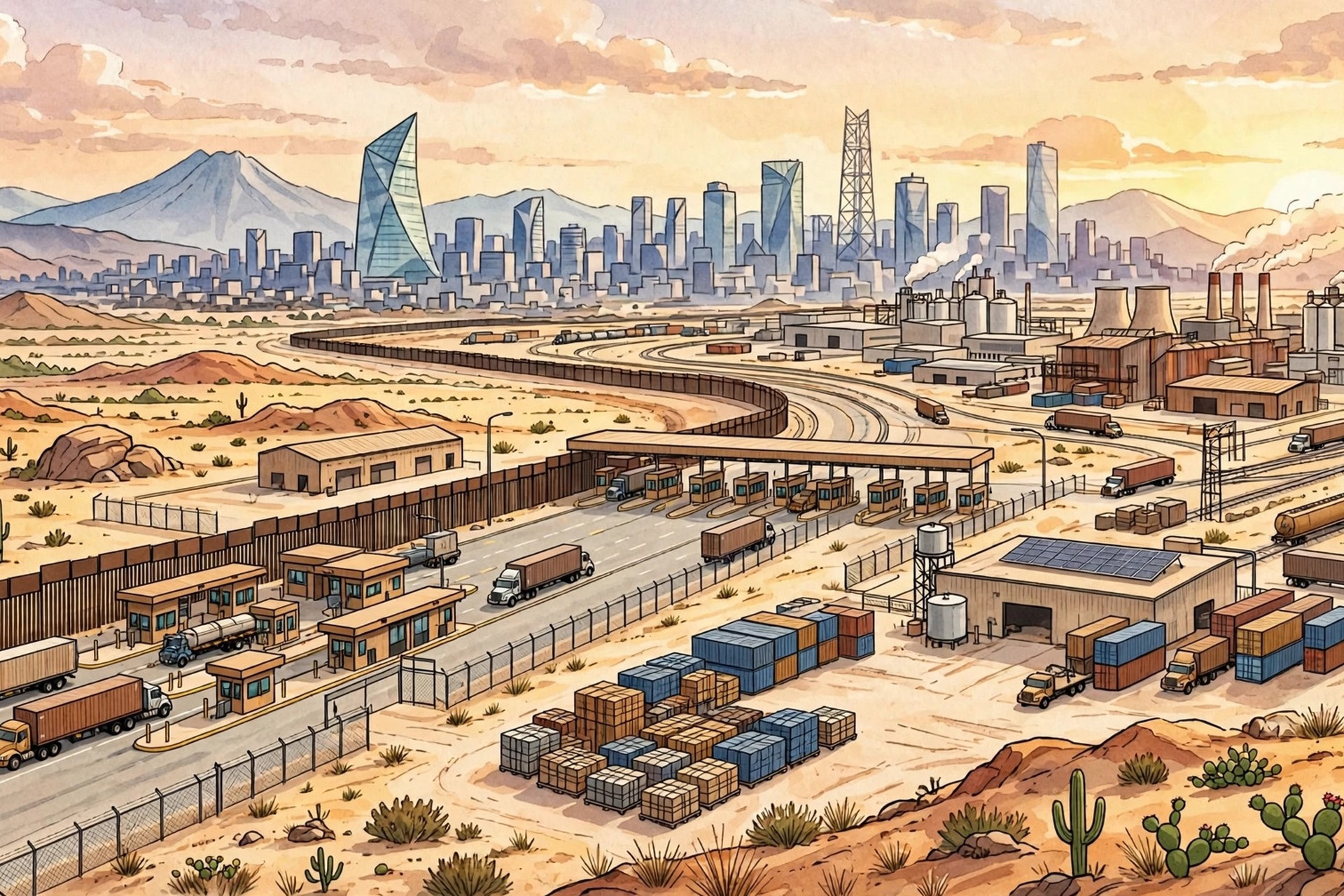
The most consequential test will come in trade, where the calendar is already set. The USMCA is due for a joint review, a process that will determine whether the agreement is extended for another 16 years, modified to address new issues, or allowed to lapse into a period of uncertainty. That review will now take place in a Washington where the president must deal with a Congress that has its own views about labour standards, about rules of origin for automobiles, about digital trade, about energy and about the treatment of Chinese investment in North America.
Mexico’s approach to that review, as described by Mexican trade officials and analysts, is likely to be pragmatic. Mexico has sought to present itself as a reliable partner, to argue that American tariffs harm American consumers and manufacturers as much as Mexican exporters, and to offer targeted measures, such as stronger labour enforcement or greater cooperation on critical minerals, in exchange for relief on tariffs and greater certainty for investors. At the same time, Mexico has used its own leverage, including its role in migration management and its growing importance as a manufacturing hub, to signal that it will not accept a one-sided deal. A Democratic Congress that is sceptical of Mr Trump’s tariff approach could, in principle, be more receptive to that argument, but it could also be more sceptical of Mexican concessions, demanding stronger enforcement mechanisms, greater transparency and firmer commitments on issues such as labour rights, environmental protection and the rule of law.
Canada, the third USMCA partner, adds another dimension. Ottawa has its own concerns about American tariffs, about the review process and about the future of North American integration, and it has sought to coordinate with Mexico where possible, while also pursuing its own bilateral relationship with Washington. A divided Congress could make that coordination more complex, because Mexico and Canada may find themselves dealing with different congressional factions on different issues, even as they seek a common approach to the review. For Latin America more broadly, the USMCA review is a test of whether North American integration can survive political change in Washington, or whether it will be reshaped by a new set of priorities.
From Bogota to the region: a wider Latin American reading
For Colombia, the midterm result is read through a different, but related, lens. Colombia has been a close American partner on security, on drug enforcement and on migration, but that partnership has been strained by political differences, by American criticism of Colombian policy and by disputes over the treatment of migrants and deportees. A Democratic Congress is likely to be more attentive to human rights, to the peace process and to the social and environmental dimensions of American policy toward Colombia, and it may seek to condition security assistance on progress in those areas. That could create an opening for Bogota, which has sought a broader partnership with Washington, focused not only on security but also on climate, on rural development and on regional stability.
At the same time, a Congress controlled by Democrats may be more critical of American pressure on Colombia, more willing to question the administration’s approach to drug policy and more likely to demand a clear strategy for the region. For Bogota, that creates an opportunity to argue for a more balanced relationship, but it also creates a risk, if Congress and the White House pull in different directions, leaving Colombia uncertain about which American policy will actually govern. In a period of divided government, mixed signals from Washington are more likely, and Latin American capitals will need to interpret them carefully to avoid miscalculation.
The wider region faces a similar challenge. Countries from Central America to the Southern Cone are watching Washington for signals about migration, about tariffs, about aid and about American engagement with China and Russia in the region. A Democratic Congress is likely to support development assistance, climate cooperation and democratic governance, but it may also seek to condition that support on human rights, on anti-corruption measures and on respect for democratic norms. For Latin American leaders, the key question is whether the new Congress will act as a counterweight to the White House, as a partner for a broader agenda, or as a source of additional pressure.
What Latin America will watch next
In the weeks and months ahead, Latin American capitals will be watching a series of concrete signals, rather than relying on broad narratives about American decline or renewal. The first is the composition and leadership of key congressional committees, particularly those dealing with foreign affairs, armed services, finance and homeland security, and the statements made by their new chairs about Latin America, immigration and trade. The second is the administration’s approach to the USMCA review, and whether it seeks congressional support for any extension or modification. The third is the budget process, where Congress will have a direct say in funding for foreign assistance, for border security and for development programmes in the region.
Latin American leaders will also watch for signs of how the White House responds to its new constraints. A president who faces a hostile Congress may turn more assertively to foreign policy, where he retains greater freedom of action, as a way of demonstrating leadership and shaping his legacy. That could mean more aggressive moves on tariffs, on migration or on security issues, even as Congress seeks to constrain him. Alternatively, a president who seeks a durable legacy on trade and migration might try to negotiate deals that gain congressional support, even if that requires concessions. Which path Mr Trump chooses will be one of the most important determinants of United States-Latin America relations in the coming year.
There is also the question of direct engagement. Latin American leaders have consistently sought high-level dialogue with Washington, including through summits, bilateral meetings and regional forums, as a way of managing differences and avoiding miscalculation. The next major opportunities for such engagement will come in the months ahead, as the USMCA review process intensifies and as regional leaders seek to present a common agenda on migration, trade and climate. Those meetings will be closely watched in Mexico City and Bogota for signs of whether Washington can agree on a framework for the next phase of the relationship, or whether its internal divisions will make such a framework harder to achieve.
For now, the public message from Latin American capitals remains one of cautious pragmatism: that they are prepared to work with the United States, that they expect to be treated with respect, and that they will defend their interests if they are threatened. Behind that message, policymakers from Mexico City to Bogota are preparing for a more complex Washington, in which the president and Congress may pull in different directions, in which immigration, tariffs and trade will be contested, and in which the USMCA clock will force decisions that cannot be postponed indefinitely. The midterms have not settled the future of United States-Latin America relations, but they have changed the conditions under which that future will be negotiated, and the region is already adjusting to the new reality.
Sources
USN reviewed reporting from multiple outlets for this story. Read more from U.S. Embassy in Mexico and Harvard ReVista.