

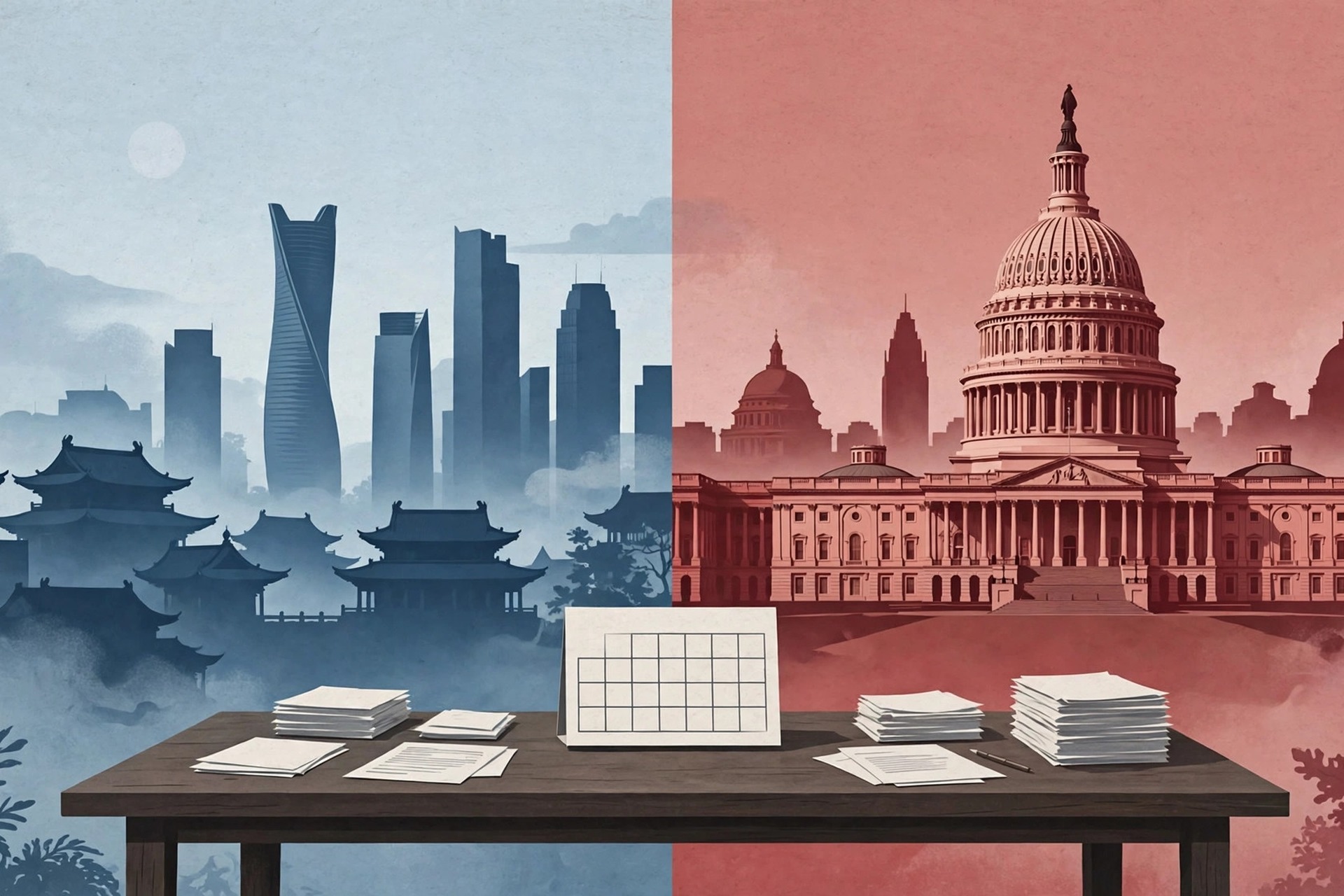
For Beijing, the most important result of the American midterm elections is not a single headline about who won a particular race, but a shift in the structure of power in Washington that will shape the next two years of United States-China relations. Major American news organisations have projected that Democrats will take control of both the House of Representatives and the Senate, an outcome that, if confirmed, would create divided government for the remainder of President Donald Trump’s term and give a newly empowered opposition a set of tools it did not have before: the ability to investigate, to block legislation, to shape budgets and to force public debate about foreign policy, even though the president retains broad authority over diplomacy, tariffs and national security.
That distinction matters for how China reads the result. Beijing does not expect a Democratic Congress to reverse the broad American consensus on competition with China, which now spans both parties and includes concerns about technology, Taiwan, trade, the South China Sea and human rights. What it does expect is a Congress that will scrutinise Mr Trump’s approach more closely, that may try to constrain some of his most disruptive moves, and that could, at moments, offer a different channel for engagement, especially on trade, export controls and the rules that govern technology competition. For Chinese policymakers, the question is therefore less whether Washington becomes friendly, and more whether it becomes more predictable, more divided, or both at once.
The stakes are visible in the calendar that now governs the relationship. A trade truce reached by the United States and China is set to run until November 2026, with key tariff arrangements scheduled to expire or be reviewed in the months that follow. Negotiators on both sides have been working toward a more durable framework, but that work has been complicated by disputes over rare earths, semiconductors, artificial intelligence, agricultural purchases and market access. Beijing’s reading of the midterms is filtered through that timetable: a Congress that must now be consulted, or at least reckoned with, could slow or complicate any deal that Mr Trump tries to strike, but it could also make a deal more durable if it gains broader political support.
Beijing’s first reading: a divided Washington, not a softer one
Chinese state media and analysts have been careful, in the immediate aftermath of the projected result, to avoid claiming a victory for Beijing or a defeat for Washington. The dominant message in official commentary has been that the United States should respect China’s development path, manage differences through dialogue and avoid actions that harm Chinese interests, a formulation that has become familiar in Chinese diplomacy and that leaves room for both cooperation and confrontation. Behind that language, Chinese analysts have offered a more detailed assessment: that a Democratic Congress is likely to be more critical of Mr Trump’s tariff strategy, more attentive to the costs borne by American consumers and businesses, and more willing to use hearings and legislation to question the administration’s China policy, even while sharing its basic concerns about Chinese power.
That assessment is consistent with how Beijing has read previous periods of divided government in the United States. In such periods, China has often found that it can work with different centres of power in Washington on different issues, even as it faces a more complex and less predictable policy environment. A White House that wants to escalate tariffs or export controls may find itself facing congressional resistance if those measures harm American allies or domestic industries. At the same time, a Congress that wants to take a tougher line on Taiwan, on human rights or on technology transfer may push the White House further than it intended to go. For Beijing, divided government is therefore not a simple good or bad, but a condition that requires careful management of multiple American audiences at once.
There is also a domestic dimension to Beijing’s reading. Chinese leaders have repeatedly argued that the United States is in relative decline, that its politics are polarised and that its ability to sustain a coherent strategy toward China is limited by internal divisions. A midterm result that produces a divided government, with a president and a Congress controlled by opposing parties, fits that narrative, and Chinese commentators have not been shy about pointing to gridlock and partisan conflict in Washington as evidence of a system under strain. Yet Beijing is also aware that such a narrative can be misleading, and that American competition with China has survived many changes of party control. The more practical question for Beijing is whether the new Congress will act to constrain Mr Trump, to reinforce his approach, or to pursue its own agenda on China, and on which issues it will choose to do so.
Trade and technology: the 2027 clock
The most immediate test of that question will come in trade and technology policy, where the calendar is already set. Under the truce framework, the United States and China agreed to pause or adjust a series of tariff measures, with a review point in early 2027 that will determine whether the pause is extended, modified or allowed to lapse. That review will now take place in a Washington where the president must deal with a Congress that may have its own views about the terms of any extension, about the treatment of Chinese investment, about the rules for critical minerals and about the pace of decoupling in sensitive technologies.
Beijing’s approach to that review, as described by Chinese analysts and trade officials, is likely to be pragmatic. China has sought to present itself as a defender of multilateral trade rules, to argue that American tariffs harm American consumers as much as Chinese exporters, and to offer targeted concessions, such as agricultural purchases or market-access measures, in exchange for relief on tariffs and export controls. At the same time, China has used its own leverage, including controls on rare earths and other critical materials, to signal that it will not accept a one-sided deal. A Democratic Congress that is sceptical of Mr Trump’s tariff approach could, in principle, be more receptive to that argument, but it could also be more sceptical of Chinese concessions, demanding stronger enforcement mechanisms, greater transparency and firmer commitments on issues such as forced technology transfer and industrial subsidies.
Technology is the area where that tension is sharpest. The United States has imposed increasingly tight controls on the export of advanced semiconductors, semiconductor manufacturing equipment and artificial intelligence technology to China, measures that Beijing views as an attempt to contain its technological development. A new Congress could move in either direction: it could seek to tighten those controls further, arguing that the administration has not gone far enough, or it could seek to soften them, arguing that they harm American companies and allies without stopping Chinese innovation. Beijing’s interest is in a more predictable and less expansive control regime, but it has also invested heavily in domestic alternatives, reducing its vulnerability to American controls over time. The midterm result does not change that long-term strategy, but it could affect the pace and scope of American controls in the near term.
Artificial intelligence adds another layer. Both the United States and China are competing to set standards for AI development, to secure supply chains for advanced chips and to shape the rules for data, privacy and national security. A divided Washington could make it harder to pass comprehensive AI legislation, but it could also make it easier for the administration to act unilaterally through export controls and executive orders, bypassing Congress altogether. For Beijing, that creates uncertainty about which American rules will actually govern AI competition in the years ahead, and about whether Congress will seek to impose its own framework.
Taiwan and security: continuity with more scrutiny
On Taiwan, Beijing’s reading of the midterms is likely to be more cautious than on trade. American support for Taiwan has broad bipartisan backing, and a Democratic Congress is not expected to reduce that support. If anything, some Democrats may seek to strengthen it, through arms sales, through support for Taiwan’s participation in international organisations, or through legislation that reaffirms American commitments. At the same time, a Congress controlled by Democrats may be more attentive to the risks of escalation, more willing to ask whether American policy is contributing to stability or to tension, and more likely to demand a clear strategy from the administration.
That dual dynamic, support for Taiwan combined with scrutiny of the administration’s approach, is familiar to Beijing, which has long sought to distinguish between American policy toward Taiwan and American policy toward China more broadly. Chinese officials have repeatedly warned Washington against crossing red lines on Taiwan, while also seeking to keep communication channels open to manage crises. A divided Washington complicates that task, because Beijing must now assess not only what the White House says, but what Congress does, and whether the two are aligned. In a period of divided government, mixed signals from Washington are more likely, and Beijing will need to interpret them carefully to avoid miscalculation.
The same logic applies to the South China Sea, to American alliances in the Indo-Pacific and to security cooperation with partners such as Japan, South Korea, Australia and the Philippines. A Democratic Congress is likely to support those alliances, but it may also question the costs, the burden-sharing arrangements and the strategic rationale for particular deployments or exercises. For Beijing, the key question is whether the new Congress will reinforce the administration’s approach to the region, or whether it will seek to reshape it in ways that create openings for Chinese diplomacy.
What Beijing will watch next
In the weeks and months ahead, Beijing will be watching a series of concrete signals, rather than relying on broad narratives about American decline or renewal. The first is the composition and leadership of key congressional committees, particularly those dealing with foreign affairs, armed services, finance and intelligence, and the statements made by their new chairs about China policy. The second is the administration’s approach to the trade truce review in early 2027, and whether it seeks congressional support for any extension or modification. The third is the budget process, where Congress will have a direct say in funding for defence, for technology competition and for foreign assistance in the Indo-Pacific.
Beijing will also watch for signs of how the White House responds to its new constraints. A president who faces a hostile Congress may turn more assertively to foreign policy, where he retains greater freedom of action, as a way of demonstrating leadership and shaping his legacy. That could mean more aggressive moves on trade, on Taiwan or on security issues, even as Congress seeks to constrain him. Alternatively, a president who seeks a durable legacy on China might try to negotiate a deal that gains congressional support, even if that requires concessions. Which path Mr Trump chooses will be one of the most important determinants of United States-China relations in the coming year.
There is also the question of direct engagement. Beijing has consistently sought high-level dialogue with Washington, including through summits and leader-to-leader meetings, as a way of managing competition and avoiding miscalculation. The next major opportunity for such engagement will come at the Asia-Pacific Economic Cooperation summit in Shenzhen, where Mr Trump and Chinese President Xi Jinping are expected to meet, although the timing and agenda remain subject to change. That meeting, if it takes place, will be closely watched in Beijing for signs of whether the two leaders can agree on a framework for the next phase of the relationship, or whether their differences remain too wide to bridge.
For now, Beijing’s public message remains one of cautious pragmatism: that China is prepared to work with the United States, that it expects to be treated with respect, and that it will defend its interests if they are threatened. Behind that message, Chinese policymakers are preparing for a more complex Washington, in which the president and Congress may pull in different directions, in which trade and technology policy will be contested, and in which the 2027 clock will force decisions that cannot be postponed indefinitely. The midterms have not settled the future of United States-China relations, but they have changed the conditions under which that future will be negotiated, and Beijing is already adjusting to the new reality.
Sources
USN reviewed reporting from multiple outlets for this story. Read more from South China Morning Post, Moneycontrol and World Affair.