

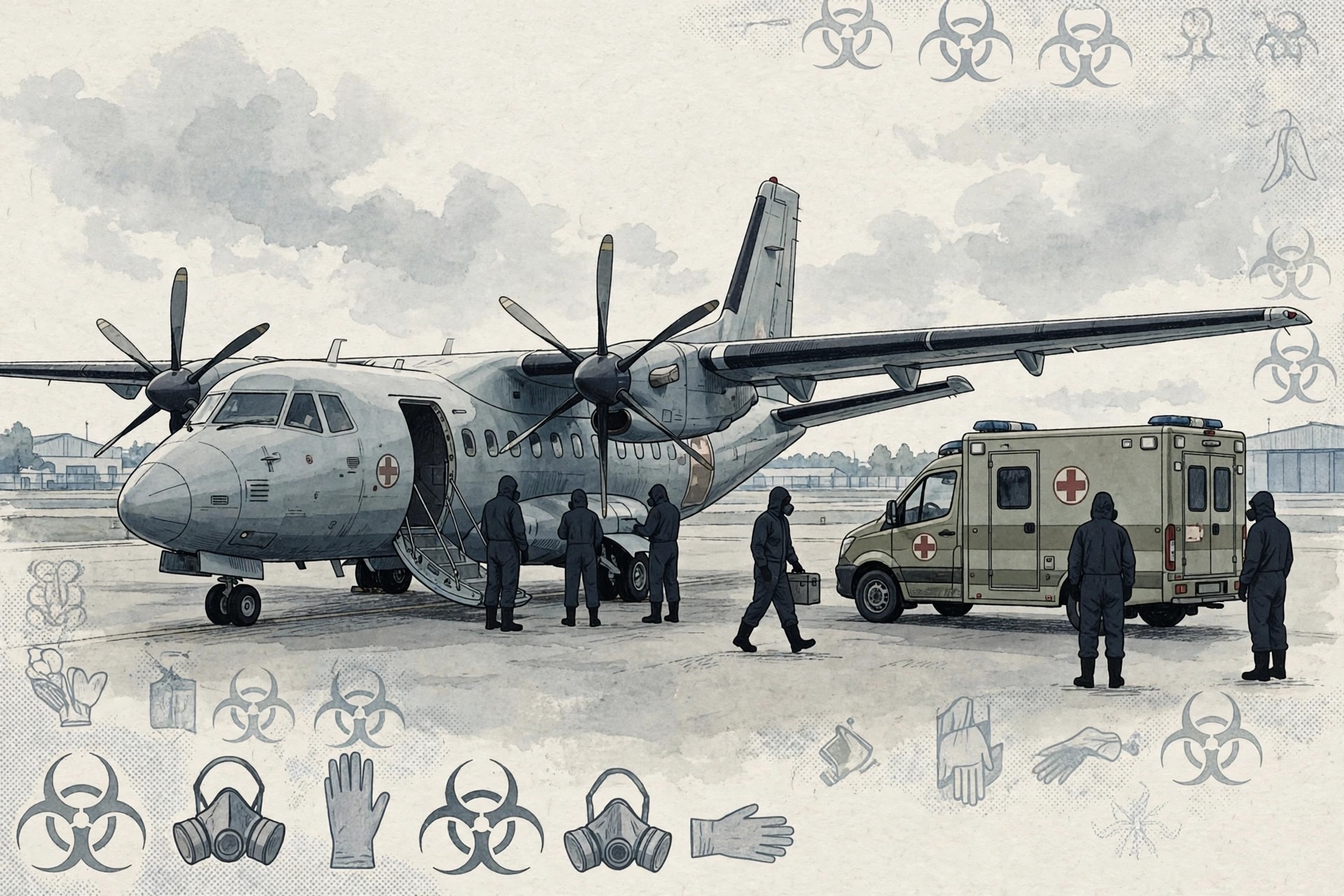
A British healthcare worker who tested positive for Ebola in the Democratic Republic of Congo was being medically evacuated to Britain for specialist treatment, in the first case involving a British national in the current outbreak. The patient, whose identity has not been disclosed, was reported to be in stable condition and was expected to arrive in Britain on Wednesday 4 November or Thursday 5 November, before being transferred by specialist ambulance to a high-consequence infectious disease unit. The UK government confirmed that a British citizen in the DRC had tested positive for Ebola and said the risk to the UK public remains low.
The evacuation is a reminder of both the human cost of the Ebola outbreak in Central Africa and the international effort to contain it. The patient had been sent to Congo by a humanitarian organisation to support the outbreak response, joining health workers from many countries who have travelled to the region to treat patients, trace contacts and support vaccination campaigns. That a health worker deployed to help others has now become a patient is a measure of the risks those workers face, and of the need for the protective systems that surround them.
This article does not name or identify the patient, and readers should be wary of any social media posts that claim to do so. The patient’s identity, age, employer and precise location in the DRC have not been officially confirmed, and the receiving hospital in Britain had also not been confirmed at the time of writing. The arrival day itself was reported as either Wednesday or Thursday, a window rather than a confirmed date, and this article preserves that uncertainty rather than resolving it by guesswork.
British healthcare worker Ebola evacuation: what is confirmed
Reuters reported on 4 November, citing an official document, that the British healthcare worker was being medically evacuated from the DRC to Britain. The UK government, through a Foreign Office spokesperson, confirmed the essential facts in a short statement: “A British citizen currently in the DRC has tested positive for Ebola. The risk to the UK public from Ebola remains low.” That statement is the authoritative public confirmation, and it is deliberately limited. It confirms the case, the nationality and the low public risk, and it says nothing more about the patient.
The patient is reported to be in stable condition, a reassuring detail that should not be overstated. Ebola is a severe illness, and a stable condition at the point of evacuation does not guarantee a smooth course of treatment. What it does mean is that the patient was well enough to be moved, under medical supervision, on a chartered medical flight, and that the receiving team in Britain could plan for an admission rather than an emergency arrival. The transfer by specialist ambulance to a high-consequence infectious disease unit is standard procedure for Ebola patients in Britain, designed to protect both the patient and the staff who will care for them.
British authorities, according to the official document seen by Reuters, did not expect the case to have a serious public health impact in Britain, and did not anticipate disruption to international travel or trade. Those assessments reflect how Ebola spreads. Unlike airborne respiratory viruses, Ebola spreads through direct contact with the bodily fluids of a person who is ill, or with contaminated surfaces and materials. It does not spread through casual contact, through the air over distances, or through food and water in ordinary settings. A single patient, isolated in a specialist unit, therefore poses a very low risk to the general public, even though the illness itself is severe for the individual patient.
The DR Congo Ebola outbreak, second largest on record
The outbreak in the DRC is the second-largest on record, with more than 10,000 confirmed cases and nearly 5,000 deaths reported by late October 2026, according to figures cited in the reporting used for this article. Other datasets give slightly different totals, reflecting the difficulty of counting cases in an outbreak that spans remote areas, crosses borders, and is tracked by several agencies at once. The broad picture, however, is consistent across sources: this is an outbreak of exceptional scale, surpassed only by the West African epidemic of 2014 to 2016.
The current outbreak is caused by the Bundibugyo virus, one of the species of Ebola virus, and it has affected not only the DRC but also neighbouring Uganda and Kenya, according to regional health data. The cross-border dimension complicates the response, because patients, contacts and health workers move across borders that are porous in practice, even when they are controlled on paper. Regional coordination, through the Africa Centres for Disease Control and Prevention and the World Health Organization, has therefore been central to the response, alongside national efforts in each affected country.
The British case is the first involving a British national in the current outbreak, although several other Europeans have been infected. That pattern reflects the international composition of the response: health workers, logisticians, laboratory staff and epidemiologists from many countries have deployed to the region, and some have inevitably been exposed despite protective measures. Each such case is a reminder that the outbreak is not a distant event for the countries whose citizens are helping to fight it, and that those countries have a responsibility to care for their own deployed workers when they fall ill.
An earlier, separate case illustrates the difference between precaution and confirmed illness. In July 2026, the UK Health Security Agency announced that a UK-resident humanitarian worker had been evacuated from the DRC as a precaution after a potential healthcare-related exposure, with no symptoms, and was isolated in a London hospital. That worker did not have Ebola. The November case is different: a confirmed positive test in a healthcare worker, with a medical evacuation for treatment rather than precautionary isolation. Keeping the two cases separate matters, because conflating them would overstate the number of British Ebola patients in this outbreak.
WHO Ebola vaccines trials approved on November 4
Separately on 4 November, the World Health Organization approved clinical trials for two new Ebola vaccines, as doctors fight to control the outbreak. The approval was reported alongside the evacuation news, and the two stories together capture the dual nature of the current moment: individual patients being evacuated for care, and the scientific effort to prevent future cases through vaccination.
Vaccines have already played a role in Ebola responses. The existing Ebola vaccine, developed for the Zaire species of the virus, has been used in ring vaccination strategies, in which contacts of confirmed cases, and contacts of those contacts, are vaccinated to break chains of transmission. The new trials reflect the need for vaccines that cover other species, including Bundibugyo, and for evidence about safety and effectiveness in the populations most at risk. Clinical trials in the middle of an outbreak are complex, requiring ethical approval, community consent and careful monitoring, but they are also the only way to establish whether a new vaccine works.
The trials will not change the outcome for the British patient, whose treatment will rely on supportive care in a specialist unit: fluid and electrolyte management, treatment of symptoms and complications, and close monitoring. There is no specific antiviral drug that cures Ebola, although experimental treatments have been used in some outbreaks. The best available care, delivered early and in a well-equipped unit, offers the best chance of recovery, and Britain’s high-consequence infectious disease units are designed precisely for that purpose.
Ebola UK public risk low: why officials are confident
The UK government’s assessment that the risk to the public remains low rests on several factors. First, the patient will be isolated in a specialist unit, with staff trained in high-consequence infectious disease care and equipped with personal protective equipment. Second, Ebola is not transmitted before symptoms appear, so contacts from before the patient’s illness are not at risk. Third, contact tracing, if needed for fellow travellers or treating staff, is a well-established procedure in Britain, honed through previous Ebola evacuations and through the Covid-19 pandemic.
Britain has treated Ebola patients before, most notably during the West African epidemic, when British health workers evacuated from Sierra Leone were treated in London. Those experiences built the infrastructure and the protocols that are now being used again: specialist ambulances, isolation units, laboratory capacity and public communication plans. The system is designed to handle exactly this kind of case, a single imported infection in a health worker, without disruption to ordinary health services or to public life.
Public communication matters as much as clinical preparation. Ebola provokes fear disproportionate to its actual risk in countries with strong health systems, because the illness is severe and the images from outbreaks are harrowing. Officials have therefore been careful to state the risk plainly, low, and to explain why, rather than either minimising the illness or exaggerating the danger. Residents in Britain do not need to take special precautions because of this case, and travel to and from the region is not expected to be disrupted.
What happens next for the patient and the outbreak
The immediate next steps are the patient’s arrival, admission to a specialist unit, and the start of treatment. The exact arrival day and the receiving hospital had not been confirmed at the time of writing, and this article will be updated when officials confirm them. Further details about the patient’s condition are expected from health authorities after arrival, but the patient’s privacy will continue to be protected, and officials are unlikely to release identifying details at any stage.
For the outbreak itself, the next steps are the continuation of case finding, contact tracing, vaccination and community engagement in the DRC and neighbouring countries, alongside the new vaccine trials. The scale of the outbreak, with thousands of deaths already, means that the response will continue for months, even if new cases begin to fall. The international workers who support that response will continue to face risks, and their home countries will continue to face the responsibility of evacuating and treating them when they fall ill.
The British healthcare worker’s evacuation is, in the end, a story about solidarity and its costs. A person travelled to Congo to help strangers fight a deadly virus, became ill with that virus, and is now being brought home for the best care their country can provide. The public risk is low, the patient’s identity is private, and the outbreak continues. Those three facts, held together, are the honest summary of a difficult week for one patient, one family, and the many health workers still in the field.
Sources
USN reviewed reporting from multiple outlets for this story. Read more from Reuters via 943 Jack FM, Al Jazeera and Manx Radio / Sky News.