

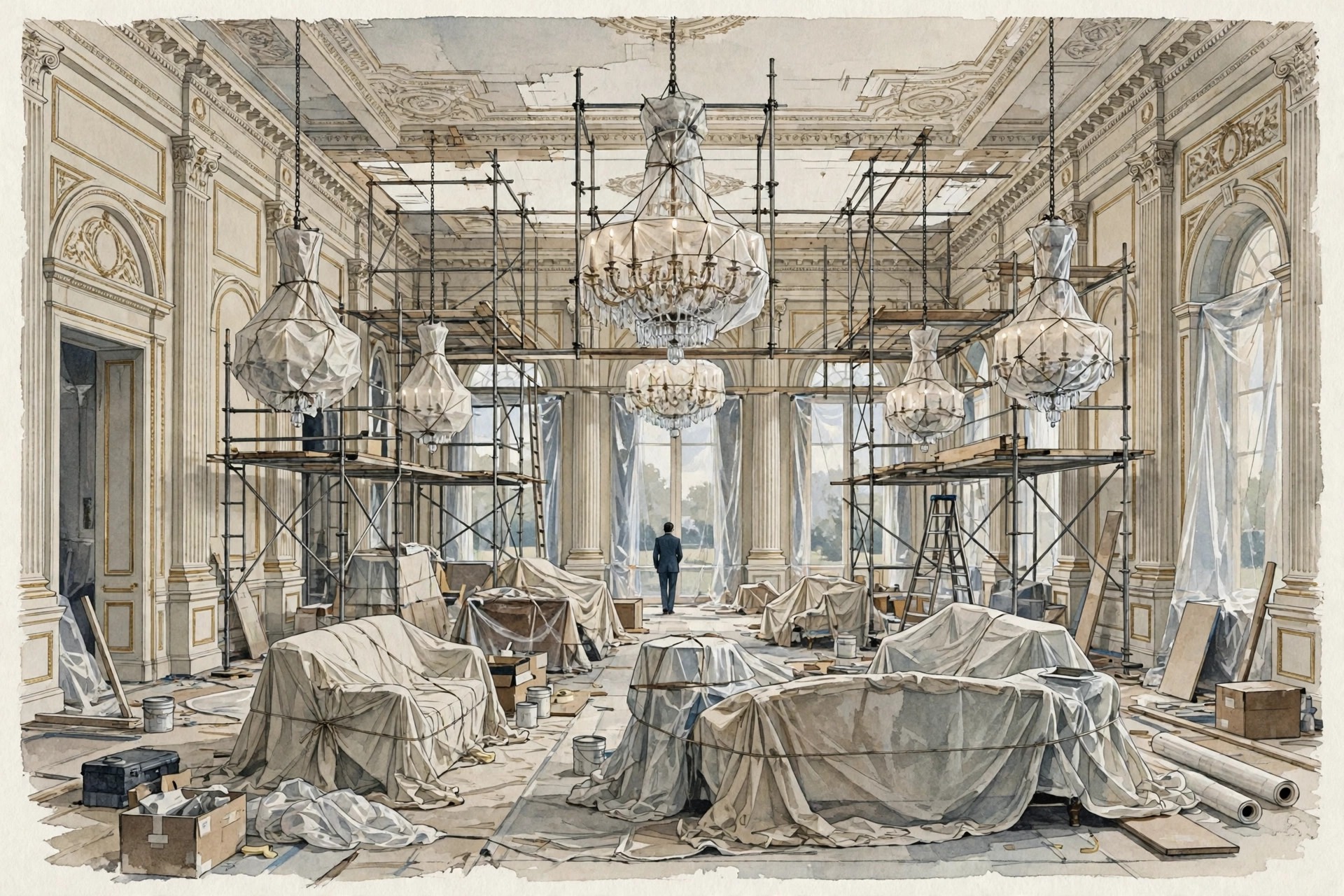
Donald Trump’s first public appearance after the midterm elections was not a concession speech, a news conference, or a rally. It was a tour of a building site. On Wednesday afternoon, the day after voters took control of Congress away from his party, the president invited reporters to look around the construction site of the White House ballroom he is having built, and spent more than 40 minutes talking about marble, columns, chandeliers, and the underground facilities planned beneath the new hall. He turned to the election results only when a reporter asked him about them. The staging was deliberate, and it set the tone for how the White House intends to handle the final two years of his presidency: the president would rather talk about what he is building than about what voters took away.
The results themselves were stark. Democrats won control of both the House of Representatives and the Senate in the November 3 elections, dealing a major setback to Trump’s party and setting up a contentious final two years of his presidency. Seven Senate seats flipped from Republican to Democratic hands, in North Carolina, South Carolina, Texas, Ohio, Kansas, Iowa, and Maine, and Democrats won 229 House seats, 11 more than the 218 needed for a majority, with more victories expected as counting continued. Before the vote, Republicans held 218 House seats and 53 Senate seats. The Democratic capture of both chambers gives the opposition the power to block legislation, launch investigations into the administration, and frustrate the president’s appointments.
Trump, who is 80 years old and whose approval ratings were at record lows going into the vote, struck a strikingly conciliatory tone in his first remarks about the outcome. He told the New York Times that he was absolutely willing to accept the results, a notable departure from his history of rejecting election defeats. He said Democrats did a good job and fought hard, while distancing himself from his party’s poor showing. He also insisted that the defeat was not a verdict on him personally, telling Fox News that he did not view it as a hit on him, and arguing that if he had been on the ballot, Republicans would have won in a landslide. The White House made the same point more bluntly in a post on X that featured a picture of a glaring Trump in the Oval Office and the words: TRUMP IS STILL YOUR PRESIDENT.
Forty minutes on marble before a word about the vote
The ballroom event itself was an unusual piece of stagecraft. Speaking into a handheld microphone in front of a panel signed by construction workers, at an event to sign a beam, Trump spent more than 41 straight minutes on the project and his other building plans. He described the building’s marble floors, Corinthian columns, and elaborate chandeliers, and a planned underground bunker extending five floors beneath the ballroom. His last remarks before the election had a similar feel: on Monday, standing in front of the newly reopened Reflecting Pool, he had again focused on construction and restoration rather than on the campaign.
The choice to lead with the ballroom rather than the election was widely read as a message in itself. The president was showing that he intends to keep governing, and keep building, on his own terms, regardless of who controls Congress. It was also a way of avoiding the ritual of a post-election reckoning in front of the cameras. Reporters had to ask about the vote before he addressed it at all, and when he did, his answers were brief and defensive, returning quickly to the building and to his record.
There was also a practical calculation. The ballroom is one of the most visible physical changes Trump has made to the White House, and it gives him a subject he can discuss at length without engaging with the election. For a president who has always preferred to set the terms of a news event, a construction tour is a far more comfortable setting than a news conference about a defeat. The cameras showed a president in command of a project, rather than a president answering for a loss.
Vance blames the Iran war and Trump agrees
The sharpest exchange of the afternoon came when a reporter asked Trump about a social media post by Vice President JD Vance, who said Republicans lost so badly because of the war in Iran. Vance had written on X that the reason the party lost was the war, and that the president himself had said so the night before. Trump replied that Vance’s assessment was largely true, and that he knew how the vice president felt about it and thought the post was fine. He called the post good, and said he had spoken to Vance but did not say much more about the conversation.
Trump defended the war itself, however, and said that if he had to do it again, he would do it again. The war began in late February with United States and Israeli strikes on Iran, and Trump said it was necessary to prevent Iran from acquiring a nuclear weapon. If Iran got one, he said, much of what could be seen around him might not exist, except perhaps the room he was standing in. He acknowledged that the conflict had hurt Republicans, partly because of its impact on fuel prices, telling Fox News that people agreed with what he was doing on Iran but were probably not willing to accept the short-term consequence of paying more for gasoline. He said he understood that, but did not agree with it.
Vance’s post was significant for reasons beyond its content. The vice president had reportedly been skeptical about the war before it began, and his public break with the administration’s line on the election was widely read as an attempt to distance himself from an unpopular conflict ahead of a possible presidential run in 2028. When Trump was asked about Vance’s possible plans, he said he did not know who would enter the race, and added: Maybe he won’t run; I don’t know who’s going to run. The exchange left open a question that will hang over the Republican Party for the next two years: whether the vice president and the president are still telling the same story about what went wrong.
The veto warning and the new Congress
On the new Democratic Congress, Trump said he would get along probably with the Democrats unless they want to be destructive. The qualification mattered, because he also repeated his threat to use the presidential veto on bills passed by a Democratic Congress, posting a picture of a red baseball cap reading just: VETO. The message was clear: the president may be willing to make deals, but he is also prepared to block whatever the new majorities send him, and overriding a veto requires a two-thirds majority in both chambers, a threshold Democrats are unlikely to reach.
Trump also pushed back against the idea that the results were a rejection of his administration as a whole. He declared that his administration had enjoyed the greatest two years in the history of the presidency, and senior officials echoed that line. Secretary of State Marco Rubio framed the administration’s foreign policy record as decisive despite the political friction caused by regional hostilities and trade disputes. Vance, for his part, cast the election as a standard midterm correction in which voters reacted to international inflation rather than rejecting the administration’s platform, and stressed that the White House accepts the democratic outcome.
The posture across the White House rests on a sharp distinction: praising the president’s core foreign policy and trade agenda as unmatched, while attributing down-ballot losses to temporary fuel inflation and voter anxiety over foreign involvement. Whether that distinction holds up over the next two years will depend on what the new Congress does, and on whether the president can find a way to govern with a legislature controlled by the opposition. For now, the message from the ballroom was that the president does not intend to take a back seat, and that the coming confrontation will be fought on his terms as much as on theirs.
What comes next for the White House
The immediate future is a lame-duck session in which Republicans still control Congress until January 3, followed by two years of divided government. The president retains the veto, broad executive authority over trade, foreign policy, and the federal bureaucracy, and the power to direct agencies without new legislation. Democrats will control the legislative agenda, the power to investigate, and the Senate’s confirmation process. That combination points toward stalemate on most major legislation, punctuated by veto fights and by executive actions that are likely to be challenged in court.
For the White House, the challenge is to show that a president who has lost Congress can still govern. The ballroom tour was the first attempt at an answer: keep building, keep talking about the record, and refuse to treat the election as a verdict on the presidency. Whether voters accept that answer will be tested in the months ahead, as the new Congress takes its seats and the president’s veto pen gets its first real use.
Sources
USN reviewed reporting from multiple outlets for this story. Read more from NDTV, The Times of Israel and Jamaica Observer.