

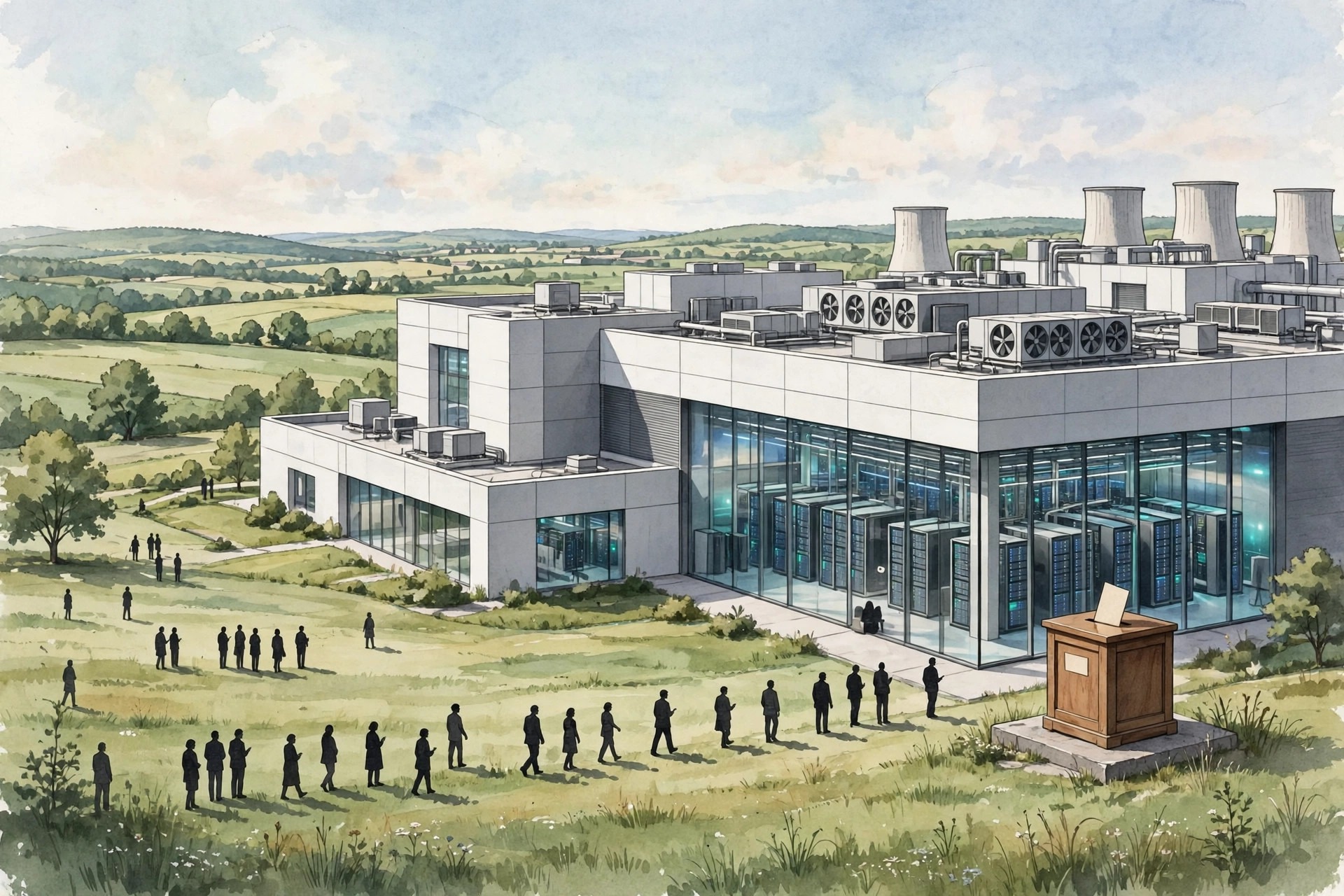
Voters across the United States delivered one of the clearest verdicts of the 2026 midterm elections on Tuesday 3 November, rejecting artificial intelligence data centres in almost every local ballot measure put to them. Of 41 data-centre-related measures tracked by Ballotpedia in 10 states, 40 went the way of tighter limits, according to the final update reported on 5 November. That is a rejection rate of 97.5 percent, a near-sweep that cut across geography, across the size of the community involved, and across the particular form that each local question took.
The count behind that headline was made up of two kinds of result. In 33 cases, voters approved a restriction: a ban, a moratorium, or a new requirement that would make it harder to build a data centre. In seven further cases, voters rejected a measure that would have helped data centres get built, defeating a pro-development plan at the ballot box. Together, those 40 results left only a single measure in which the outcome favoured the easier construction of data centres. The results were reported as unofficial, pending certification by the states concerned, but the scale of the outcome left little doubt about the direction of public feeling.
The votes were local in form but national in meaning. Each measure concerned a particular town, village or city, and a particular project or set of rules. Taken together, however, they added up to a national statement about an industry that has expanded at extraordinary speed, and about the costs that communities say they have been asked to bear for it: the demand for electricity, the pressure on water supplies, the noise and the traffic, the scale of the buildings themselves, and the sense that decisions about them had been taken without enough local say. Voters, given the chance to decide for themselves, decided against.
The result was also a political event. The same election that produced the ballot verdict also produced governor-elects who had campaigned on pausing or restricting new data-centre construction, in Texas and in Georgia among others. And within 48 hours of the votes, OpenAI, the company whose name has become most closely associated with the artificial intelligence boom, responded with a new package of promises on transparency and community oversight, and with a new name for the facilities themselves. The industry, in other words, heard the verdict and moved quickly to answer it.
AI data centers rejected by voters: 40 of 41 measures go against the industry
The 41 measures were spread across 10 states, and they took many different forms. Some asked voters to approve a ban on data centres, or on a particular kind of high-impact facility. Some asked for a moratorium, a pause in construction while new rules were drawn up. Some asked voters to approve new requirements, such as independent review or a public hearing before a large industrial project could go ahead. Others asked voters to approve a rezoning or a change in the terms agreed with a developer, and a vote against the proposal was a vote against the project.
Ohio had the most measures of any state, with 21 across 18 jurisdictions, and opponents of data centres won in every one in which results had been reported. In Wilmington, in that state, four rezoning proposals tied to data-centre projects were rejected by roughly 80 percent to 20 percent, a margin that left no room for doubt about the strength of local feeling. In Ashville, Ohio, more than 83 percent of voters backed a measure challenging the village’s negotiated terms with an EdgeConneX facility, a result that amounted to a direct repudiation of the deal the village had struck.
In El Dorado, Kansas, voters approved a 10-year ban on high-impact data centres by 71 percent to 29 percent, a margin of more than two to one. A 10-year ban is a long pause by any measure, and the size of the majority suggested that voters were not asking for a brief delay while details were worked out, but for a sustained halt to a particular kind of development. In Alhambra, California, 82 percent voted to ban data centres from the city altogether. In Joliet, Illinois, 79 percent said no to an advisory question asking the city to approve artificial intelligence data centres, a result that carried no legal force by itself but carried a clear political message.
The single exception to the pattern was in Harwood, North Dakota. There, voters rejected, by 75 percent, with 325 votes to 105, a charter amendment that would have required independent review and a public hearing before the adoption of large industrial projects, including data centres. Harwood was the one place where the restrictive option lost, and its result stood out precisely because it was alone. In every other community that voted, the outcome went the other way.
Three more data-centre votes are still to come, with two referendums in Clarksville, Arkansas, scheduled for 1 December. Those votes will be watched closely, both for their own local consequences and for whether they confirm or interrupt the pattern established on 3 November. For now, the record stands at 40 of 41, with the results remaining unofficial until the states certify them.
Why voters said no: power bills, local control and a summer of polling
The ballot results did not come out of nowhere. They followed months in which the costs of data centres had become a visible political issue, in particular the pressure they place on electricity supplies and the effect that pressure can have on the bills paid by households. In several states, the argument that data centres were driving up power costs had become a central part of the campaign, and voters had been hearing it for weeks before they went to the polls.
Polling conducted before the election suggested that opposition was already widespread. An August 2026 poll by Embold Research, of 2,045 registered voters, found that 75 percent opposed a new data centre near their home. That figure, three in four voters, was a warning of what was to come, and the ballot results on 3 November confirmed it in practice. Opposition was not a marginal view, and it was not confined to people who lived next to a proposed site. It was a majority view, and in many communities it was an overwhelming one.
Exit polls conducted on election day pointed in the same direction. They found that 57 percent of voters believed artificial intelligence would do more harm than good, and that 56 percent said artificial intelligence and data centres were a crucial or major factor in their vote for Congress. Those figures suggest that the issue was not a side concern for voters, but one of the factors that shaped how they voted for the most important offices on the ballot. The data-centre question, in other words, had become a voting issue, not just a planning issue.
The results also reflected a sense that the pace of the buildout had outrun the process for deciding it. Data centres had been proposed and approved quickly, in many places, as companies raced to secure sites and power supplies. Local planning processes, designed for slower and smaller developments, had struggled to keep up. The ballot measures were, in part, a response to that mismatch: a way for voters to slow the process down, to impose new requirements, and to reclaim a measure of control over decisions that had seemed to be moving too fast for them to follow.
OpenAI answers with compute campuses and a National Community Compact
The most direct corporate response to the votes came from OpenAI. In the days around the election, the company moved quickly to reframe how it talks about its facilities and how it promises to deal with the communities that host them. On 1 November, two days before the votes, OpenAI renamed its data centres “compute campuses”. On 2 November, it launched a Grid Protectors Program. And on 5 November, two days after the votes, it announced a National Community Compact and a Compute Campus Policy Blueprint, promising greater transparency and oversight.
The company said, in explaining the move, that it had “to listen to and react to and respond to” how people had voted. That language was an acknowledgement, in plain terms, that the ballot results mattered to the company and that it could not carry on as before. The renaming was the most visible part of the response, but the Compact and the Blueprint were the more substantial parts, setting out promises about how the company would engage with communities, how it would disclose information, and how it would submit to oversight.
Whether those promises will be enough to change minds in the communities that voted against data centres remains to be seen. A new name does not change the size of a building, the amount of electricity it uses, or the water it needs. A compact does not by itself guarantee that a community will have a veto, or that its power bills will not rise. What the response does show is that the industry has understood the political message of the votes, and that it is trying to answer it before the next round of ballots, and the next round of governor and congressional elections, make the position harder still.
The timing of the response was also significant. The Compact was announced on the same day that Wall Street suffered its worst fall since April 2025, driven in large part by investors reassessing the data-centre buildout. The two events were connected: the votes had changed the political outlook for the buildout, and the market had reacted to that change. OpenAI’s response was, in that context, an attempt to reassure both communities and investors at the same time, by showing that the company had a plan for dealing with the new political reality.
Governors elected on pauses: Texas and Georgia lead the political response
The ballot measures were not the only place where data centres decided an election on 3 November. In Texas, Democrat Gina Hinojosa defeated Governor Greg Abbott after promising a moratorium on new data-centre construction. In Georgia, Keisha Lance Bottoms won the governor’s race after calling for a pause on new data centres. In both states, the issue had been prominent in the campaign, and in both states the candidate who promised to slow the buildout won.
Those results matter because governors have real power over the issue. A moratorium or a pause, if put into effect, would directly affect the ability of companies to build new facilities in the state concerned. Even the promise of one changes the calculations of developers, who must decide whether to commit capital to a project that may be delayed or blocked. The election of governors who had campaigned on that promise was therefore a second, and in some ways more consequential, verdict on the same question that voters had decided in the local ballots.
In Ohio, the political response took a different form. Democrat Amy Acton defeated Vivek Ramaswamy by 52 percent to 44.7 percent, according to NBC News’s count, in a race in which data centres had also been an issue. Ohio was the state with the most ballot measures, and the most consistent opposition, and the governor’s race there was fought in the same atmosphere. The result added a further layer to the political message: that opposition to data centres was not confined to local ballots, but was shaping elections for the highest offices in the states concerned.
The pattern across the three states was the same. Voters who had been asked to decide about data centres in their own communities also voted, in larger numbers, for candidates who promised to restrict them at the state level. The local and the statewide results reinforced each other, and together they suggested that the issue had become a durable part of the political landscape, not a passing concern that would fade once the ballots were counted.
For the industry, the governor results are a longer-term problem than the ballot measures. A local ban affects a single community. A statewide moratorium affects a whole state, and a governor who has campaigned on a pause is under pressure to deliver one. The companies that build data centres will now have to deal with state governments that are, in several important cases, explicitly committed to slowing them down, and with a political environment in which promising a pause has proved to be a winning electoral strategy.
What happens next for data centres and the communities that host them
The immediate future of the data-centre buildout will be shaped by the interaction between the ballot results, the governor elections, and the industry’s response. The votes have given communities a stronger hand in negotiations with developers, and they have given governors a mandate to act. The industry, for its part, has begun to offer new promises on transparency and oversight, and to change the language it uses to describe its facilities. Whether those promises are enough to restore confidence, among voters and among investors, will be tested in the months ahead.
The two referendums in Clarksville, Arkansas, on 1 December, will be the next test at the ballot box. They will show whether the pattern of 3 November holds, or whether the industry’s response has begun to shift opinion. They will also be a reminder that the issue is not settled, and that voters in other communities will continue to be asked to decide about data centres for some time to come.
The longer-term question is whether the industry can find a model for building data centres that communities are willing to accept. That would require addressing the concerns that drove the votes: the cost of electricity, the use of water, the scale of the buildings, and the degree of local control over the decision. It would also require a willingness to share the benefits more visibly, and to accept that some places will say no, and that a no from a community should be respected rather than worked around.
For now, the record of 3 November stands as a striking fact: 40 of 41 measures, in 10 states, went against the industry. It was a verdict delivered not by politicians or by commentators, but by voters themselves, in the places where the facilities would actually be built. The industry has heard it, and has begun to answer. Whether the answer is enough will be decided, as the votes themselves were, by the communities that have to live with the result.
Sources
USN reviewed reporting from multiple outlets for this story. Read more from Inc., Route Fifty and Gadget Review.