

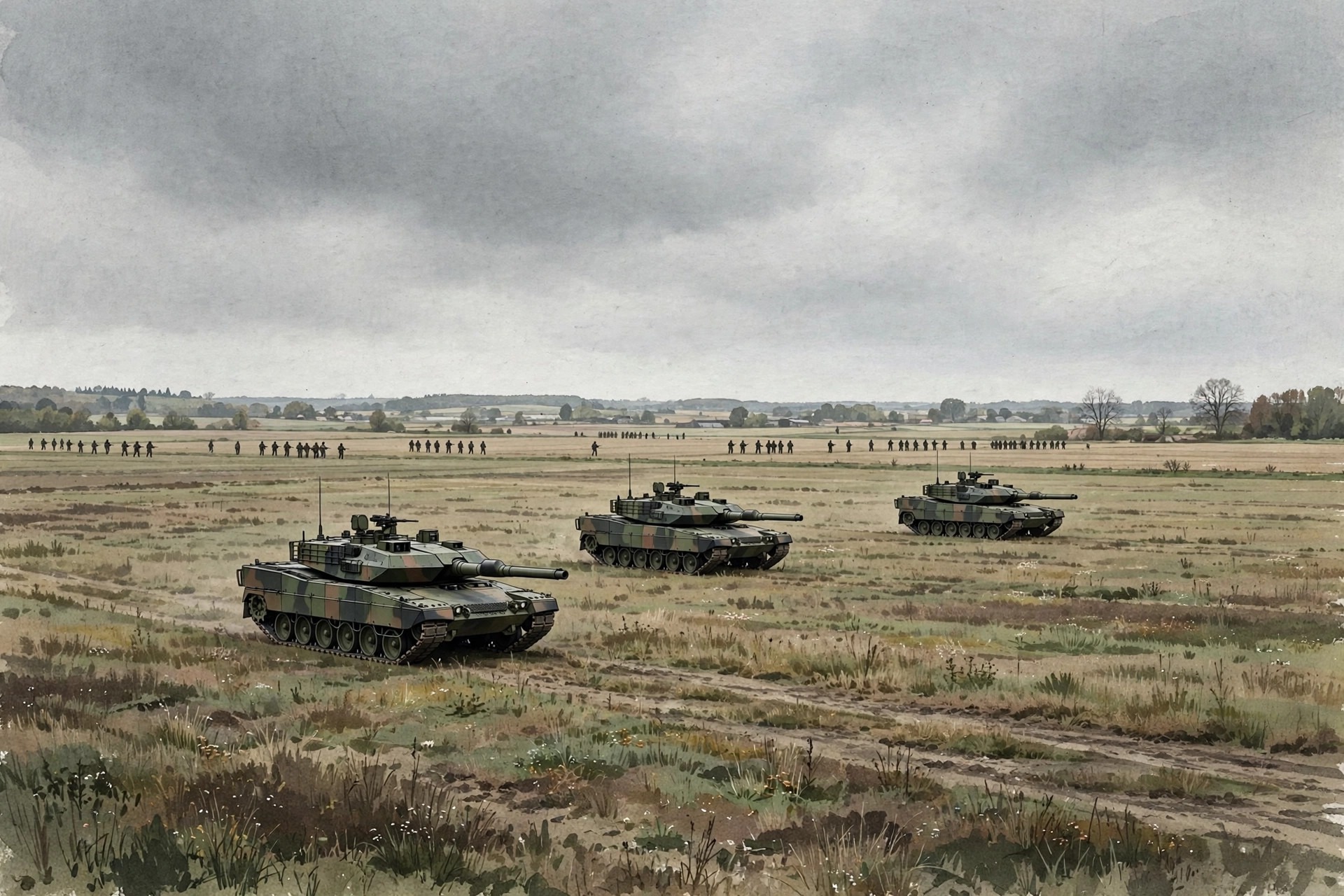
Russia said on Saturday 7 November that any foreign military units deployed in Ukraine will be considered “legitimate targets” by the Russian armed forces. The warning, delivered by Foreign Ministry spokeswoman Maria Zakharova, was a response to “Koalicja 26.2” (Coalition 26.2), a multinational military exercise that begins on 9 November in south-eastern Poland and rehearses the deployment of a European force to Ukraine once the fighting ends. Zakharova said the deployment of foreign contingents in Ukraine was “categorically unacceptable”, and she said Europe had “no place at the negotiating table” in the peace talks that are due to resume in Abu Dhabi on 10 and 11 November.
The statement should be reported for what it is: a Russian government position, stated publicly, days before a new round of negotiations. It is not an independently verified fact about what Russia would do, and it is not a new policy. Russia has repeatedly said that Western troops in Ukraine would be treated as targets. What is new is the timing, and the context: a European exercise that puts troops on the ground in Poland, and a round of talks in Abu Dhabi at which the future of Ukraine’s security will be discussed. The warning, the exercise and the talks are three parts of the same moment, and each of them shapes the others.
Zakharova’s Warning: Foreign Troops as Legitimate Targets
Zakharova’s central claim was direct. Any foreign military units deployed in Ukraine, she said, will be considered legitimate targets by the Russian armed forces. The phrase “legitimate targets” is a term of military art, and its use by a foreign ministry spokeswoman is deliberate: it signals that Russia regards the presence of foreign troops in Ukraine as a military matter, not a diplomatic one, and that it reserves the right to treat those troops as combatants. The statement was carried by the Russian state news agency TASS and reported by outlets that draw on TASS, and it should be attributed to Zakharova and to the Russian Foreign Ministry throughout this article.
The warning was framed as a response to the Coalition 26.2 exercise, but it was also aimed more broadly at the idea of a European military presence in Ukraine. Zakharova said the deployment of foreign contingents was “categorically unacceptable”, whether through the Coalition of the Willing or any other grouping, and she accused Western nations of ignoring Moscow’s security concerns. The language is categorical, and it leaves little room for compromise: in Russia’s stated view, there is no form in which a foreign military deployment in Ukraine would be acceptable, and no grouping under which it could be presented that would change that view.
It is important to be clear about the sourcing here. All three of the outlets cited for this story trace the Zakharova statement to the same TASS-carried account, and no confirmation from Reuters or the Associated Press was found in the reporting reviewed. That does not mean the statement was not made, but it does mean that it has not been independently verified by a second, separate wire service. This article therefore presents the warning as “Russia said”, and treats the details of the exercise and the talks in the same way, as reported rather than as independently established fact.
Coalition 26.2: The Exercise at Nowa Deba
Coalition 26.2 is a multinational exercise running from 9 to 22 November at Nowa Deba in south-eastern Poland. It rehearses the Multinational Force Ukraine, a contingent that Britain and France want ready to deploy once the fighting ends and the rebuilding of Ukraine begins. About 2,800 troops from 11 countries are taking part, alongside roughly 2,000 Polish troops. The contributors include Germany, Spain, Sweden, Estonia, Lithuania, the Netherlands and Belgium. Poland provides the largest core contingent, with Britain and France leading the exercise.
American troops are not taking part in the exercise. Their absence is a notable feature of the event, and it reflects the shape of the coalition behind it: a European-led effort, built around Britain and France, with Poland as the host and the largest contributor. The exercise is not a deployment to Ukraine, and none of the troops taking part are being sent across the border. It is a rehearsal, held on Polish soil, of a force that its organisers hope will one day be ready to deploy. That distinction matters, because the Russian warning treats the exercise and the deployment it rehearses as parts of the same threat, while the exercise’s organisers present it as preparation for a post-war mission.
The choice of Nowa Deba, in south-eastern Poland, is also significant. The town lies in a region that has hosted military training for years, and its selection as the site for an exercise involving 11 countries signals the scale of the undertaking. Nearly 5,000 troops in total, including the Polish contingent, will take part over two weeks, practising the coordination, logistics and command arrangements that a multinational force would need. The exercise figures reported here come from the reporting reviewed, and they should be treated as reported figures rather than as official counts confirmed by the participating governments.
The Multinational Force Ukraine and the Coalition of the Willing
The force being rehearsed at Nowa Deba is the Multinational Force Ukraine, a contingent that Britain and France have proposed to deploy once the fighting ends. Its purpose, as described by its supporters, is to help secure Ukraine after a settlement, to support the rebuilding of the country, and to provide a guarantee that a new Russian attack would be met by more than Ukraine alone. The force is associated with the Coalition of the Willing, the grouping of countries that have said they are prepared to contribute troops, equipment or other support to Ukraine’s security after the war.
Russia’s objection to the force is not new, but Zakharova’s statement restates it in the strongest terms. In Moscow’s view, the deployment of foreign troops in Ukraine, under any flag and through any grouping, would be a direct threat to Russian security, and it would be treated accordingly. That position has been stated repeatedly since the idea of a European force was first raised, and it has not softened as the planning has advanced. The exercise at Nowa Deba is, from Moscow’s perspective, evidence that the planning is continuing despite its objections, and the warning is its response.
The Coalition of the Willing itself is a loose grouping rather than a formal alliance, and its members have not all committed to the same thing. Some have offered troops, others equipment or training, and others political support. The force that is being rehearsed is therefore a work in progress, and its final shape will depend on the outcome of the war and of the negotiations that follow it. What is clear is that Britain and France, the two countries leading the exercise, regard the force as a central part of the post-war settlement they want to build, and that Russia regards it as a red line.
Europe Has No Place at the Table, Russia Says
Zakharova also said that Europe has “no place at the negotiating table”, a remark aimed at the peace talks that are due to resume in Abu Dhabi on 10 and 11 November. She pointed out that the Coalition 26.2 exercise begins just before those talks, and she presented the timing as evidence that Europe is pursuing a military path while negotiations are under way. The remark is part of a wider Russian argument that Europe should not be a party to the settlement of the war, and that the negotiations should be conducted between the United States, Russia and Ukraine.
The Abu Dhabi round was announced by the United States envoy Steve Witkoff, and it is expected to cover security guarantees for post-war Ukraine, de-escalation and humanitarian questions. European delegations, including France, have announced that they will take part. That participation is itself a point of contention: Russia says Europe has no place at the table, while the Europeans say they must be present because the settlement will affect their security directly. The argument over who sits at the table is, in effect, an argument over who gets to decide the terms of the peace, and it will run alongside the substantive negotiations in Abu Dhabi.
The first day of the Abu Dhabi talks ended on 10 November without an agreement, although discussions on a prisoner exchange advanced, and the talks resumed the following day. That outcome was not yet known when Zakharova delivered her warning on 7 November: she was speaking days before the talks opened, and her warning was aimed at the exercise in Poland and at the negotiations that were about to begin. What the first day showed is that the talks are taking place against a background of military activity on both sides, and of public warnings such as Zakharova’s, and that the atmosphere in which they are being held is one of pressure rather than of trust.
Strikes Intensify Before the Talks
Both sides intensified their strikes in the hours before the talks. Overnight on 8 to 9 November, Russia launched 164 drones and three guided missiles at Ukraine, including 112 jet-propelled Shahed drones. Ukrainian air defences intercepted 137 of the drones and missiles, according to the reporting reviewed. One civilian was killed in Odesa, and infrastructure was damaged in the attacks. A Ukrainian drone strike damaged the Mius River bridge in Russia’s Rostov region, in a separate attack on Russian territory.
The pattern is familiar from earlier rounds of negotiation: each side increases its military pressure in the days before talks, in the hope of strengthening its bargaining position. Kyiv says Russia is pressuring it; Moscow says Kyiv is escalating too. The strikes do not, by themselves, determine the outcome of the talks, but they shape the conditions in which the talks take place, and they are a reminder that the war continues while diplomats prepare to meet. The US-Russia-Ukraine talks in Abu Dhabi on 10 and 11 November will be the first test of whether the negotiations can produce a pause in the fighting, and whether the security guarantees that are expected to be discussed can be agreed.
The human cost of the overnight attacks is, for now, limited to the single civilian death reported in Odesa, but the scale of the drone launch, more than 160 aircraft in a single night, is a measure of the intensity of the campaign. The interception rate, 137 out of 167 weapons, shows the strength of Ukraine’s air defences, and the damage that was done despite them shows their limits. Both sides will carry those numbers into Abu Dhabi, along with the warning from Moscow and the exercise in Poland, and the negotiations will have to take account of all three.
What the Warning Means, and What It Does Not
The warning from Zakharova should be understood as a statement of Russian policy, not as a prediction of a specific attack. Russia has said for a long time that Western troops in Ukraine would be targets, and the statement on 7 November repeats that position in the context of a specific exercise. It does not say that Russia will attack troops in Poland, where the exercise is taking place, and it does not set a date or a trigger for any action. What it does is to put on record, days before negotiations, that Russia regards a foreign deployment in Ukraine as unacceptable, and that it will treat any such deployment as a military matter.
The warning also fits a pattern in Russian messaging. Statements of this kind are often timed to coincide with Western military activity or with diplomatic events, and they serve more than one purpose: they warn the countries concerned, they signal to a domestic audience that Russia is standing firm, and they set a marker for the negotiations that follow. Whether the warning changes anything in practice will depend on what happens in Abu Dhabi, and on whether the Multinational Force Ukraine moves from rehearsal to deployment. Until then, it remains a statement, and it should be reported as one, with its sourcing and its limits made clear.
Sources
USN reviewed reporting from multiple outlets for this story. Read more from QNC News, Haberler and Ittefaq.