

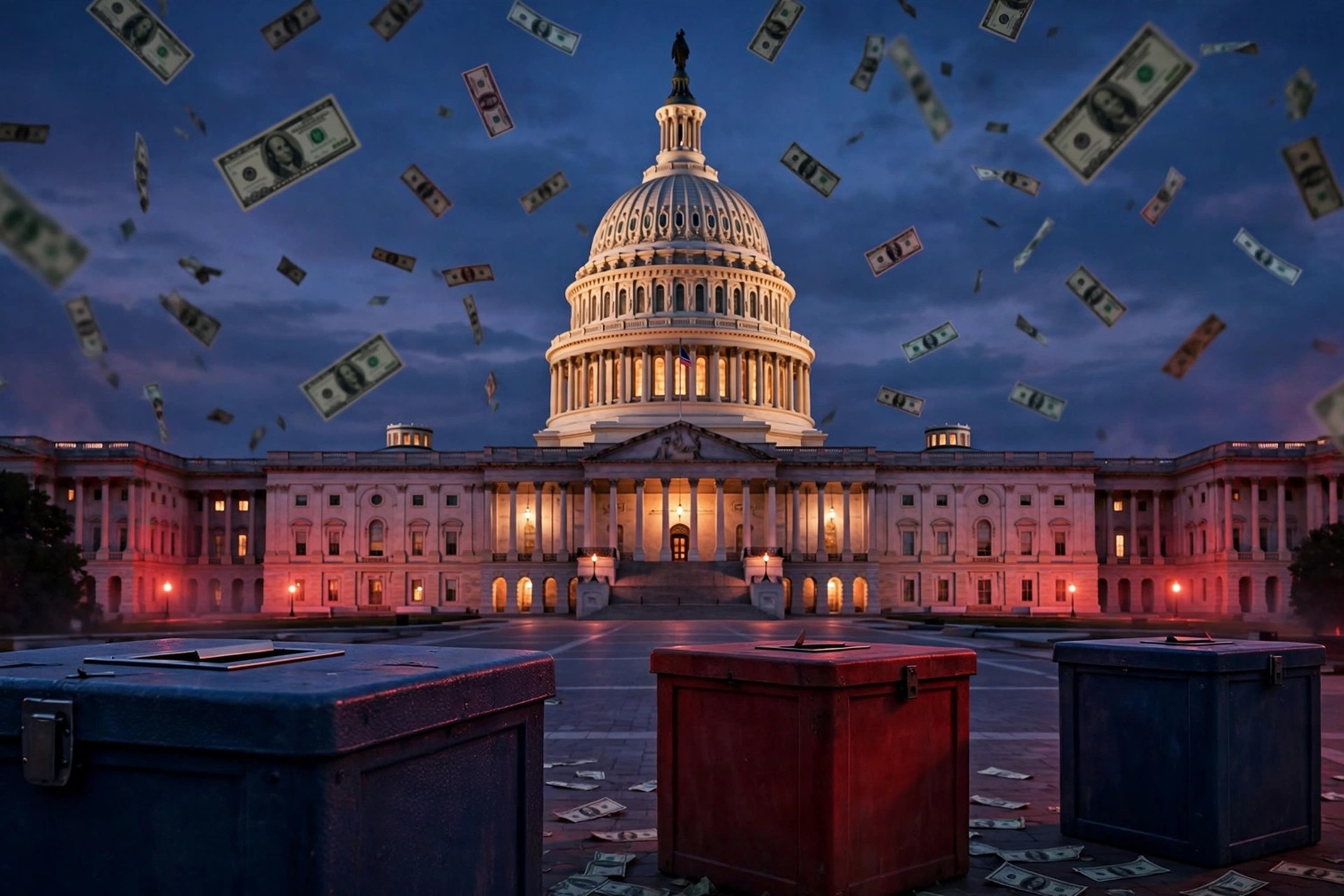
Republicans spent hundreds of millions of dollars on the 2026 midterm elections and lost control of Congress anyway, a result that has turned the most expensive midterm cycle in American history into a case study in the limits of money in politics. Democrats wrested control of both the House of Representatives and the Senate from Republicans on Tuesday night, November 3, 2026, and the scale of the spending that failed to prevent it is only now becoming clear. Elon Musk, the world’s richest man, put about 445 million dollars into federal races alone, according to the nonpartisan campaign finance watchdog OpenSecrets, the largest sum any individual has spent on an American election. A New York Times tally that includes state groups put the total even higher, at about 474 million dollars. And yet, by the count of the candidates he backed, he has almost nothing to show for it.
The pattern repeated itself across the map, in race after race where Republican candidates enjoyed overwhelming financial advantages and lost by double digits. An analysis by Punchbowl News, highlighted by Newsmax, put the pattern in stark terms. The figures in that analysis are Punchbowl’s own, drawn from campaign finance filings, and they tell a story of a party that bought more advertising than any in history and still lost the argument with voters.
A Record Spend and a Sweeping Loss
The 2026 cycle was the most expensive midterm in history before a single vote was counted. OpenSecrets projected record midterm spending of about 12 billion dollars, and advertising spending alone reached 11.21 billion dollars, according to the tracker AdImpact, past the record set in 2024. Money flooded into the battleground states, into television advertising, digital campaigns and get-out-the-vote operations, and the Republican side, backed by Musk and by the party’s traditional donor networks, was never short of it.
And yet the results were decisive. Democrats captured the House and the Senate. In races the Associated Press had called by November 12, Democrats had won 254 House seats to 167 for Republicans, with 14 still uncalled, and 55 Democratic-aligned Senate seats to 44 for Republicans, with only Alaska uncalled. The Associated Press called Mississippi’s Senate race on November 11 for Democrat Scott Colom over Republican Senator Cindy Hyde-Smith, who conceded, giving Democrats their eighth Senate pickup. The question now being asked in Washington is whether there is a point at which more money stops helping and starts hurting, by making a campaign look bought rather than believed.
Where the Midterm Money Went
Musk’s money was the centrepiece of the Republican effort, and it was funnelled through a small number of vehicles. About 216 million dollars went to America PAC, the super PAC Musk founded, which said its only priority was ensuring Republicans keep full control of Washington. About 168 million dollars went to the Senate Leadership Fund, the main super PAC supporting Republican Senate candidates, and 30 million dollars went to the Congressional Leadership Fund for House races. The money was spent on advertising, field operations and voter turnout, and it was concentrated in the races Republicans believed would decide control of Congress.
The returns were poor. Of the 43 Republican House candidates Musk backed, only three had won when Reuters tallied the figures on Wednesday, with 33 having lost and seven races still uncalled at that point. In the Senate, six of the seven Republican candidates he supported had been defeated, with the Alaska race still unresolved. Those figures do not prove that Musk’s spending caused the defeats, and it would be wrong to claim that it did. But they do show that the largest individual political investment in American history bought almost nothing that was not already safe.
Texas: The $230 Million Test Case
Texas was the ultimate test, and it was the most expensive. Musk put almost 230 million dollars into the Senate race alone, according to Reuters, and another 5.5 million dollars into the races below it, including the governor’s race and the lieutenant governor contest. The total spending in the Texas Senate race reached roughly 573.2 million dollars, according to AdImpact, making it the most expensive non-presidential race in American history.
It did not come close. Talarico defeated Paxton by 12 points, 55.1 percent to 43.0 percent, in a traditionally red state, a margin that no amount of advertising could close. Punchbowl News put the pro-Paxton total at more than 230 million dollars, including money routed through a Musk-backed super PAC, and the result was a rout. Talarico, whom Musk targeted with 153.5 million dollars worth of attack ads according to Reuters, told supporters in Austin: We’ve just sent a message to every millionaire mega donor, to every trillionaire mega donor. In this state, in this country, power belongs to the people. Russian AI disinformation videos targeted Senate candidates Sherrod Brown and James Talarico days before the midterm vote, a reminder that money was not the only force at work in the race, but it was the force that failed most visibly.
New Hampshire, Colorado and Texas: The Same Story in Three States
The pattern in Texas was not an isolated case. According to Punchbowl News, the same story played out in race after race where Republicans outspent Democrats and lost by wide margins. In New Hampshire, former Senator John Sununu lost the Senate race by 14 points, according to Punchbowl’s analysis, despite about 34 million dollars spent on his behalf. In Colorado, Representative Gabe Evans lost his House race by 15 points despite about 19 million dollars in support, a figure consistent with the 18.9 million dollars in super PAC spending reported in the state’s 8th District race, including more than 6 million dollars from the Congressional Leadership Fund and 344,000 dollars from Musk’s America PAC. In Texas, Representative Vicente Gonzalez won re-election by 16 points despite about 21 million dollars spent against him, according to Punchbowl, a figure that sits alongside the more than 14 million dollars Republican organisations were reported to have spent trying to defeat him before the election.
These are Punchbowl’s figures, and the precise totals will move as the final campaign finance reports are filed, with the post-general reports due on December 3. The filings so far run only through October 14, and some of Musk’s money went to dark-money groups that do not disclose donors, so the real totals are likely higher. But the direction of the evidence is consistent: in the races where Republicans spent the most, they lost by margins that suggest the spending was not merely ineffective but irrelevant.
What the Filings Show About Musk’s Money
The filings themselves reveal how the money moved and how little it bought. Musk spent nearly 290 million dollars in 2024 to help elect Donald Trump, and then spent more in a midterm, a cycle with no presidential race to justify it. His political action committee, America PAC, and his attorney Alex Spiro did not respond to requests for comment from Reuters. The money flowed through a handful of large committees, and the concentration was extreme: the largest share, about 212 million dollars by the Times tally, went to helping Paxton beat Talarico for the Texas Senate seat formerly held by John Cornyn, and with 12.3 million dollars more to Texas groups, Musk’s total in the state reached roughly 224 million dollars.
What does not change, across any of these tallies, is the conclusion: an extraordinarily large political investment did not produce the electoral results Musk sought. That outcome does not establish that his spending caused Republican defeats, but it does establish that money on this scale cannot guarantee victory, even where one side outspends the other by multiples.
Why Money Did Not Decide These Races
There are several explanations for why the money failed, and they are not mutually exclusive. The first is that voters had already decided. The midterm elections were fought on issues that advertising struggles to move: the cost of living, the war with Iran, and the direction of the country under Trump. When voters have strong views on those questions, more advertising does not change their minds, it only reminds them of what they already believe. The second explanation is backlash. Talarico’s campaign turned Musk’s spending into its central argument, telling voters that a trillionaire was trying to buy their senator, and the message resonated precisely because the spending was so visible.
The third explanation is that the money was spent badly. Much of it went to attack advertising, and in Texas, 112.2 million dollars was spent against Talarico and only 69.7 million dollars for Paxton, a ratio that suggests the campaign was more focused on tearing down the Democrat than on building up the Republican. When the candidate being attacked is more popular than the candidate being promoted, that strategy fails. Democrats, meanwhile, have said that investigations into Musk and his businesses topped their agenda, a promise that will now be tested in a Democratic Congress. After the 2026 midterms, federal agencies face a new accountability test in 2027, and the campaign finance system itself is likely to be part of that reckoning.
What the Loss Means for the Next Congress
The consequences will shape American politics for the next two years. Democrats now control both chambers, which means they control the legislative agenda, the committee chairmanships and the power to investigate the administration. For a party that spent hundreds of millions of dollars to prevent exactly that outcome, the loss is total.
For Musk, the result is a personal and political setback. He spent more than any individual in a single election cycle, and he has little to show for it beyond a handful of safe seats that would have been won without him. The 224 million dollars he spent and lost in Texas is unlikely to hurt his wallet much: he is worth about 902 billion dollars, so he lost roughly one-fortieth of one percent of his wealth. But the political lesson is harder to ignore. Money can buy advertising, organisation and attention. It cannot buy an election, and in 2026, it did not even come close.
Sources
USN reviewed reporting from multiple outlets for this story. Read more from Fast Company, SRN News and Cronista.