

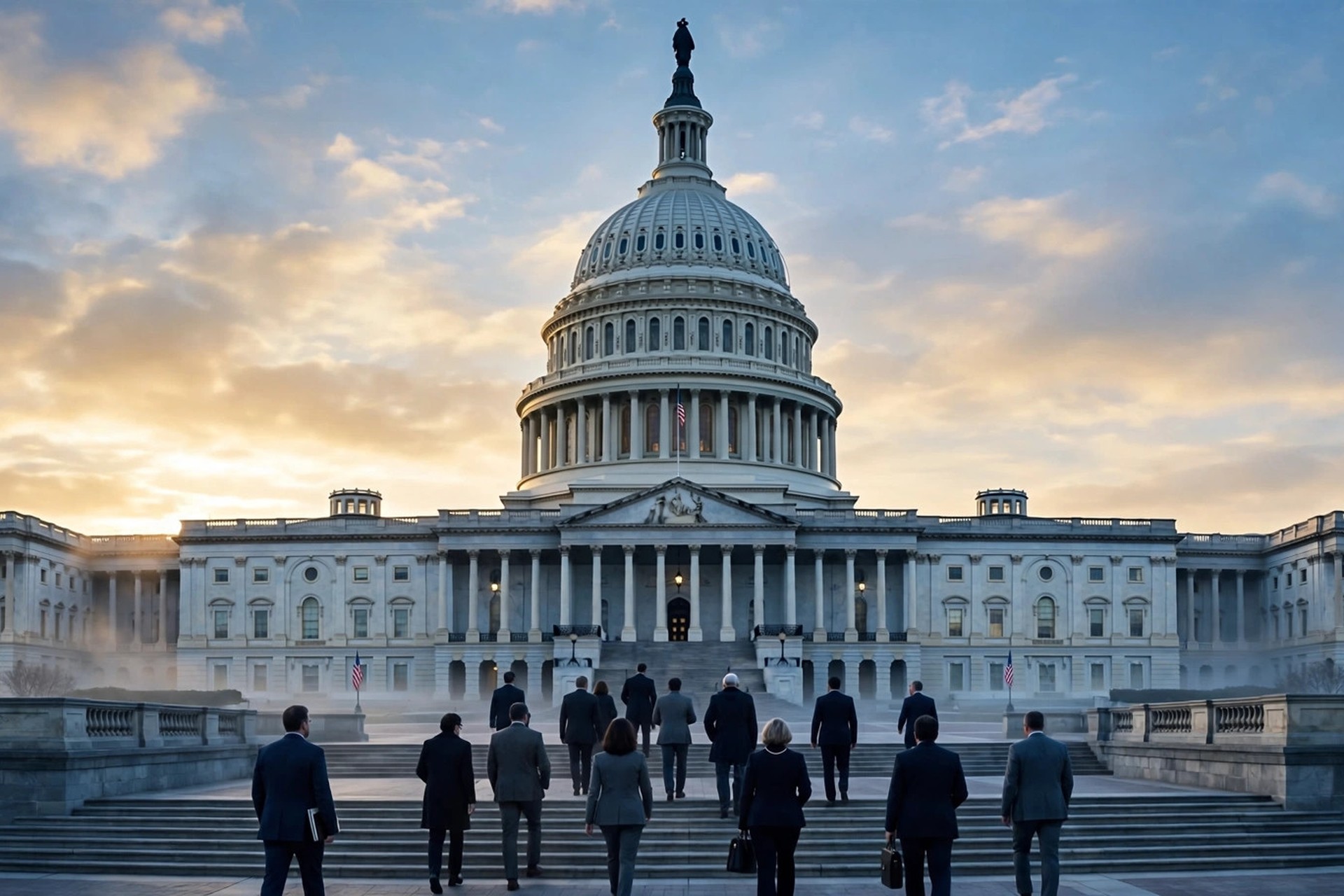
Democrats will take control of both chambers of Congress in January after a sweeping midterm victory that ended two years of unified Republican rule in Washington. The Associated Press called the Senate for Democrats late on Tuesday night and the House early on Wednesday morning, and by November 12 it had called 254 House seats for Democrats to 167 for Republicans, with 14 still uncalled, while NBC News projected Democrats would finish with 259 seats to 176. In the Senate, Democrats flipped eight Republican-held seats and secured a majority of 55 seats, with only Alaska still uncalled. The result sets up two years of divided government for the final half of President Donald Trump’s second term, and it hands Democrats the gavels, the committee chairs and the power to set the agenda in both chambers.
The transfer of power, however, does not happen at once. Under the 20th Amendment, the new Congress is sworn in at noon on January 3, 2027, which means Republicans remain in charge until then. The outgoing 119th Congress returned on November 9 for a lame-duck session, its last weeks in office, with a government funding deadline, a defence bill and other unfinished business still on the table. Speaker Mike Johnson and Senate Majority Leader John Thune stay in charge through that session, and the outgoing Republican majorities have one final window to advance their priorities before the gavels change hands.
The Results: A Democratic House and a Flipped Senate
The scale of the Democratic victory surprised even many forecasters. Democrats had long been expected to win back the House, but the Senate looked far harder, because they needed to flip at least three seats in states that Trump had carried in 2024. In the end they flipped eight: Iowa, Kansas, Maine, Mississippi, North Carolina, Ohio, South Carolina and Texas. Republicans entered the election with 53 Senate seats. By November 12 Democrats had secured 55, according to the Associated Press, with only Alaska still uncalled, leaving open the possibility that the majority could grow to 56 seats.
The individual races told the story of a map that shifted deep into Republican territory. In Texas, James Talarico won the first Democratic Senate seat in the state since 1988, and Democrats also ousted three-term Governor Greg Abbott. In South Carolina, Annie Andrews defeated Senator Darline Graham in an upset. In Kansas, Adam Hamilton was projected to become the first Democrat to win a Senate seat there since 1932. Democrats also flipped governorships in Texas, Georgia, Nevada, Ohio and Iowa, extending the night’s gains beyond Congress itself.
In the House, the Democratic gains were broad. The Associated Press said Democrats crossed the 218-seat threshold early on Wednesday, and by November 12 it had called 254 House seats for Democrats to 167 for Republicans, with 14 still uncalled. NBC News projected a final tally of 259 seats to 176. Democrats have flipped 43 House seats, according to NBC News, winning competitive races across the map, including all 20 of the contests rated as the most competitive that had been decided by Wednesday. Many races were still being counted, so the final margins in both chambers could still shift slightly before states certify their results.
What Democratic Control of Congress Will Change in January
When the 120th Congress convenes on January 3, the change will be structural, not just symbolic. In the House, the majority party decides which bills reach the floor, which committees hold hearings and which investigations move forward. House Democratic Leader Hakeem Jeffries is on track to become the first Black speaker of the House, and he told reporters on Wednesday that the incoming majority would focus on affordability and accountability. “We don’t work for Donald Trump,” Jeffries said. “We work for the American people.”
In the Senate, control brings a different and equally consequential power: authority over confirmations. A Democratic Senate will decide the fate of the president’s nominees for executive branch posts and the federal judiciary, and it will control the committees that oversee the administration. That is a sharp break from the past two years, when a Republican-controlled Congress rarely used its powers to rein in the president, and it means the administration will face sustained oversight for the first time in Trump’s second term.
Democrats have said they intend to use that oversight power. Party leaders have vowed to investigate the Trump administration, the president’s family and his allies, and to demand concessions on major legislation. They have not ruled out impeachment proceedings, though they have not publicly embraced them either, and one early test will be an impeachment vote concerning the defence secretary that is already expected to come before the House when lawmakers return. What is certain is that the president’s domestic legislative plans for his final two years will now have to pass through a Congress controlled by the opposition party, and that the White House will hold the veto as its main defence.
The Lame-Duck Session: What Republicans Can Still Do
Before any of that happens, the outgoing Congress has roughly eight weeks of work left, and the lame-duck session is its last chance to act under Republican control. The term describes the period between an election and the start of the next Congress, when lawmakers who have lost their seats, or who chose not to seek re-election, continue to serve and vote until their terms end. Speaker Johnson acknowledged the loss of the House and said Republicans would use the lame-duck period to keep working, telling reporters, “We’re gonna be ready to build on our record of accomplishment. We still have a lame duck.”
The session is expected to be dominated by two items: government funding and the annual defence authorisation bill. Congress returns with roughly 20 legislative days left before the new Congress is sworn in, and unfinished legislation on healthcare and permitting is also pending. Republicans have one final opportunity to advance priorities under unified control, but their leverage is limited by the calendar and by the knowledge that Democrats, who will hold both gavels in January, have little reason to settle major issues now on Republican terms.
The dynamic cuts both ways. Democrats will want to avoid being blamed for a shutdown or for unfinished business, while Republicans will want to lock in as much of their agenda as they can before losing power. The result is likely to be a session shaped by negotiation under pressure, with the funding deadline acting as the forcing mechanism for whatever deals can still be struck.
The December 11 Funding Deadline
The most immediate item on the lame-duck agenda is money. Government funding runs out on December 11, when the current continuing resolution expires, and Congress must act before then to keep the government open. That deadline falls squarely inside the lame-duck session, which means it will be the outgoing Republican majorities, working with Democrats who are about to take power, who must produce a funding deal.
The deadline gives both parties something they need and something they fear. For Republicans, it is a last chance to shape spending levels before losing control. For Democrats, it is an early test of their leverage: they can demand concessions in exchange for the votes needed to pass funding, knowing that the alternative is a shutdown that would begin just weeks before they take power. The last time the government faced a funding lapse, the politics of blame fell heavily on whichever party was seen as blocking a deal, and neither side will want to carry that into January.
Whether the session produces a full-year funding package or another short-term extension is not yet clear. What is clear is that the December 11 date is fixed, that the votes must be found before it, and that the negotiation will be the first real encounter between the outgoing Republican leadership and the incoming Democratic majority. Readers following the run-up to the election may recall the Senate battleground races that pointed to a Democratic surge and the projection that Democrats would win Senate control after the flips in Texas, South Carolina, Ohio, Kansas, Iowa and North Carolina.
Trump Accepted the Results, Then Questioned Them
President Trump said on election night that he would accept the outcome. In an interview with The New York Times at around 10.30pm on Tuesday, he said he was “absolutely willing” to accept the midterm results, and he repeated the point in an interview with Bret Baier on Fox News, saying, “Yeah, sure I’ll accept.” He congratulated Democrats, said he looked forward to working with them, and told reporters the morning after the election that he would “get along probably with the Democrats, unless they want to be destructive, but I have the power of the veto.”
He also moved quickly to explain the defeat on his own terms. On Tuesday night, as it became clear Republicans were losing their majorities, he wrote on social media, “I wasn’t on the Ballot and if I was, we would have won IN A LANDSLIDE!” He had cast the midterms as a referendum on the first half of his second term, urging his supporters to “pretend I’m on the ballot,” a message Democratic leaders were happy to amplify. The morning after the election, he spent most of a nearly hour-long appearance with reporters showing off the ballroom he is building at the White House, turning only briefly to the results.
The acceptance did not hold for long. On November 9, Trump cast doubt on the results in a social media post, pushing unsubstantiated accusations of rigged election machines after previously accepting the defeat. The claims were described in reporting as baseless assertions of voter fraud, in keeping with a long history of denying election results when he or other Republicans lose. He acknowledged in other interviews that the war with Iran had played a role in his party’s losses, and he conceded that voters’ anger over the cost of living had driven the Democratic wave. But the shift from acceptance to doubt, within six days, showed how quickly the post-election mood in the White House had changed.
What Divided Government Means for the Next Two Years
The deeper story of the midterms is what voters said with their ballots. According to Reuters, a wave of anger over Trump’s policies, particularly the war with Iran and its role in pushing the cost of living higher, helped Democrats take both chambers. The election was widely read as a forceful repudiation of the second term, and the breadth of the Democratic wins, in states Trump had won by double digits just two years earlier, suggested the discontent reached well beyond the usual battlegrounds.
For the next two years, Washington will operate under divided government for the first time in Trump’s second term, and for the first time in his career as president he will face a Democratic-controlled Congress in both chambers. Legislation will need bipartisan support or presidential vetoes will follow. Nominations will face real scrutiny. Investigations will proceed whether the White House cooperates or not. And the 2028 presidential race, already taking shape, will be fought against the backdrop of a Congress that can check the president at every turn.
None of that begins until January 3. Until then, the lame-duck session will decide what the outgoing Congress leaves behind: a funded government or a shutdown fight, a defence bill or a delay, and a set of unfinished items that the new Democratic majority will inherit on its first day. The voters have spoken, the gavels are changing hands, and the eight weeks in between will show how much the outgoing majority can still do, and how much the incoming one is willing to let it.
Sources
USN reviewed reporting from multiple outlets for this story. Read more from WION, SRN News and USA Today.