

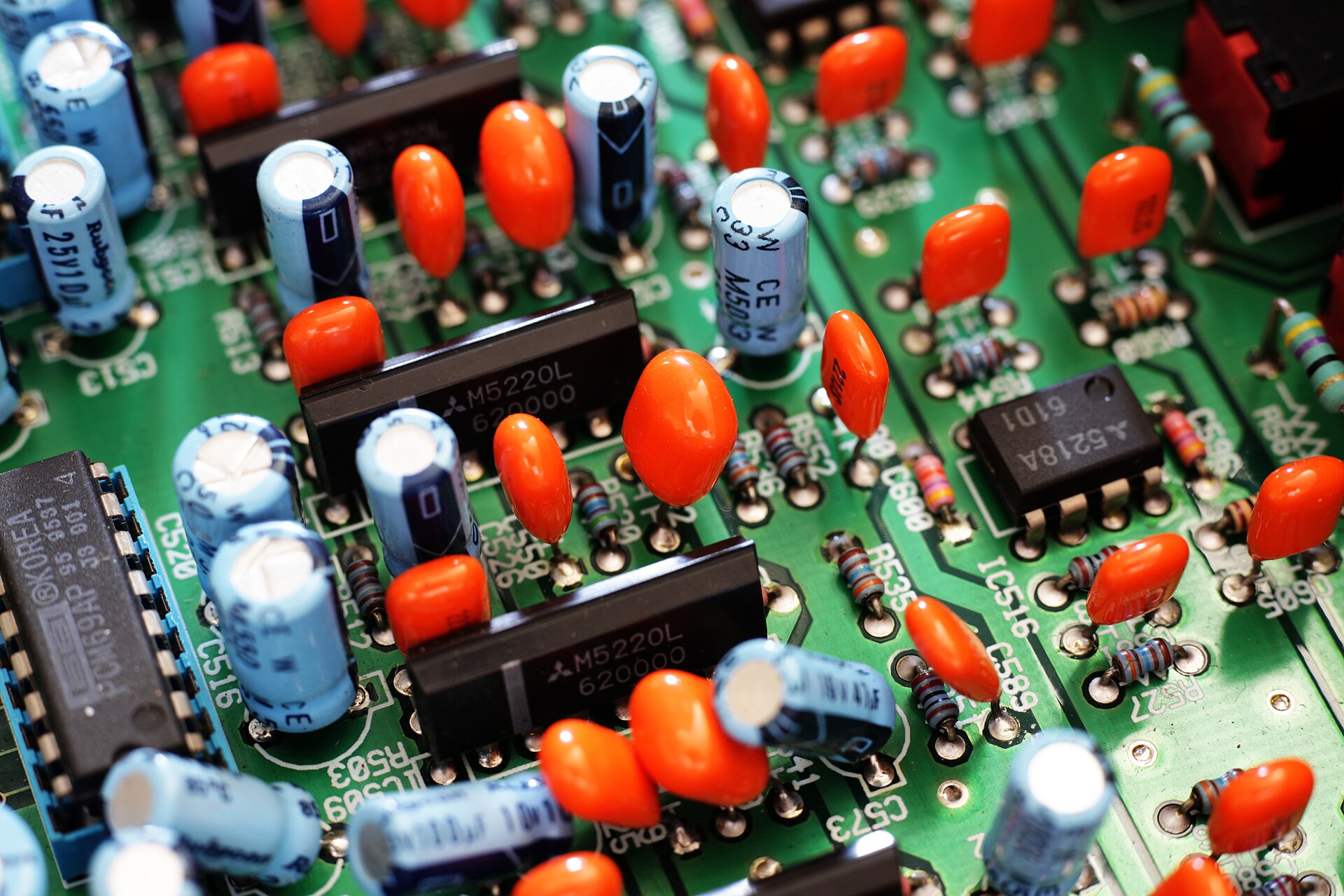
India’s electronic goods exports grew by 44 per cent in the first half of the financial year 2026-27, reaching 31.97 billion dollars between April and September, up from 22.20 billion dollars in the same period a year earlier. The figures, released by the Ministry of Commerce and Industry on 17 November 2026, show that the growth is no longer being carried by smartphones alone. Non-smartphone electronics, from printed circuit boards and memory chips to network equipment and storage devices, grew faster than phones for the first time at this scale, and their share of the export basket rose to 43.2 per cent.
The numbers matter because electronics has become one of the sharpest tests of India’s manufacturing ambitions. For a decade, the story of Indian electronics was largely the story of mobile phone assembly: factories putting together handsets designed elsewhere, with most of the valuable components imported. The latest data suggests that story is changing, at least in direction. Smartphones remain the largest single item in the basket, but the fastest growth is now coming from the parts and pieces that go inside electronic devices, and from the equipment that moves data around the world. Whether that shift lasts, and how much value India actually captures from it, will decide whether this is a durable change in the country’s export profile or a strong half-year built on a low base.
The headline is also part of a broader export performance. Total exports of goods and services were estimated at 479 billion dollars in April-September 2026-27, and at 568.84 billion dollars in April-October, up 16.66 per cent from 487.59 billion dollars a year earlier, according to a government review of trade data published on 14 November. Electronics, growing at 44 per cent in the first six months, is running well ahead of that overall pace. That is why the commerce ministry’s release drew attention well beyond trade specialists: in a year when global demand has been uneven and tariff disputes have unsettled exporters in many countries, one of India’s most import-dependent sectors is posting its strongest export growth on record for a half-year period.
India’s Electronics Exports: The Headline Numbers
The core figures in the Ministry of Commerce and Industry release are straightforward. Total electronic goods exports rose 44.0 per cent, from 22.20 billion dollars in April-September 2025-26 to 31.97 billion dollars in April-September 2026-27, an increase of nearly 9.8 billion dollars in six months. That is a large absolute gain for a single sector in a single half-year, and it came even though smartphones, the biggest item in the basket, grew more slowly than the total.
Smartphone exports increased by 35.8 per cent, from 13.38 billion dollars to 18.17 billion dollars. That alone added 4.79 billion dollars to the total, and it confirms that India’s position as a major phone-making base continues to strengthen. The Ministry of Electronics and Information Technology has described India as the world’s second-largest manufacturer of mobile handsets by volume, a position built over the past decade on assembly plants in Tamil Nadu, Uttar Pradesh, Andhra Pradesh and Karnataka, run by contract manufacturers and by Indian firms.
But the more striking number sits beside it. Non-smartphone electronics exports grew by 56.5 per cent, from 8.81 billion dollars to 13.79 billion dollars. Their share of total electronics exports rose from 39.7 per cent to 43.2 per cent, while the smartphone share fell from 60.3 per cent to 56.8 per cent. In other words, almost half of the growth in the basket is now coming from products other than finished phones. For a sector that has long been criticised for exporting assembled handsets while importing nearly everything inside them, that shift in composition is the real news in the release.
The government framed the data in exactly those terms, saying the growth “reflects an increasingly diversified export basket” and pointing to components, printed circuit boards, communication equipment, memory products and storage devices as the drivers. Independent reporting of the same figures by DD India and Moneycontrol on 17 November confirmed the numbers and the ministry’s reading of them: the story is diversification, not just scale.
Smartphones Still Lead, But Their Share Is Slipping
It would be a mistake to read the falling smartphone share as weakness in phone exports. Smartphone shipments grew by more than a third in value terms, and 18.17 billion dollars in six months puts the category on course for another record full year. What has changed is that the rest of the basket is now growing faster, so phones account for a smaller slice of a much larger total.
That pattern is consistent with how India’s phone industry has matured. The first phase of growth was about assembly: global brands and their contract manufacturers set up plants, imported kits and components, and shipped finished phones. Production-linked incentives for large-scale electronics manufacturing rewarded output, and exports followed. The second phase, now under way, is about what surrounds the phone: the boards, chips, memory and network gear that go into phones and into everything else that is electronic.
There are limits to how far the headline can be pushed. The ministry’s release does not break down how much of the smartphone export value was created in India and how much reflects imported components assembled here. That distinction, known as domestic value addition, is the central question for the sector, and it is not answered by export values alone. A phone exported for 200 dollars may contain 160 dollars of imported parts. The export figure records 200 dollars; the value created in India is far smaller. Any honest reading of the new numbers has to keep that gap in mind, and it is a point this article returns to below.
Even so, the direction of travel is clear. Phone exports are still growing strongly in absolute terms, and they are no longer the only engine of the sector’s export growth. For policymakers who have spent years trying to broaden India’s manufacturing base beyond a single product, that is a welcome development, even if the work of deepening it has barely begun.
The Quiet Surge: Circuit Boards, Memory Chips and Storage
The most dramatic figures in the release are also the ones that need the most careful reading, because they start from very small bases. Exports of parts and accessories comprising mounted printed circuit boards rose from 63.3 million dollars to 2.10 billion dollars, an increase the ministry put at 3,219 per cent. Singapore was the leading destination, taking 1.87 billion dollars of that total, followed by China at 111.5 million dollars.
Exports of populated, loaded or stuffed printed circuit boards rose 304 per cent, from 213.7 million dollars to 864.1 million dollars, with China the leading destination at 789.2 million dollars and exports to Hong Kong rising from 5.9 million dollars to 25.3 million dollars. Network transmission and routing equipment nearly doubled, up 98 per cent from 732.9 million dollars to 1.45 billion dollars, led by Hong Kong, where shipments rose from 264.7 million dollars to 857.7 million dollars, with the United States at 130.9 million dollars and the Netherlands at 124.4 million dollars.
Memory integrated circuits recorded growth of 2,333 per cent, from 23.1 million dollars to 562.4 million dollars, with Malaysia the largest destination at 390.8 million dollars, followed by Singapore at 102.4 million dollars and Hong Kong at 25.2 million dollars. Solid-state non-volatile storage devices rose 1,680 per cent, from 14.6 million dollars to 260.5 million dollars, led by China at 108.6 million dollars, Singapore at 76.8 million dollars, Hong Kong at 22.3 million dollars and the United States at 20.7 million dollars.
These percentage increases run into the thousands because the starting values in 2025-26 were tiny: tens of millions of dollars, not billions. A jump from 23 million to 562 million dollars is a real and important change, but it is not the same as a mature export line growing by a similar percentage. The honest way to read them is as evidence that India has begun exporting these products at meaningful scale for the first time, not as proof that it already dominates those markets. What matters now is whether the second half of the year holds these levels, and whether the next set of figures shows the same products growing from a higher base rather than fading after a few large orders.
That caution applies in particular to the circuit board figures. A single large contract or a shift in a multinational’s sourcing can move a small category by billions of dollars in a few months. The ministry’s data does not identify the companies behind the shipments, so it is not possible to tell from the release alone how many exporters are involved, or how concentrated the growth is. That detail will matter when analysts judge whether the surge is broad-based or driven by a handful of plants.
Where the Goods Are Going: Singapore, China, Hong Kong and Malaysia
The destination data in the release tells its own story about India’s place in Asian electronics supply chains. Singapore, China, Hong Kong and Malaysia appear again and again as the leading buyers of the fastest-growing products, while the United States and the Netherlands feature mainly in network equipment.
Singapore took the largest share of mounted printed circuit boards at 1.87 billion dollars out of 2.10 billion dollars, and was also the second-largest destination for memory chips and for storage devices. China was the largest buyer of populated circuit boards at 789.2 million dollars and of storage devices at 108.6 million dollars, and the second-largest buyer of mounted boards. Hong Kong led the growth in network transmission equipment, taking 857.7 million dollars, and was a significant buyer across several categories. Malaysia was the largest destination for memory integrated circuits at 390.8 million dollars.
This pattern is significant for two reasons. First, it shows Indian electronics feeding into the factories and trading hubs of East and Southeast Asia, rather than going mainly to end consumers in the West. China buying Indian circuit boards, and Singapore buying Indian memory chips, suggests Indian plants are becoming suppliers to the region’s electronics ecosystem, not only assemblers of finished goods for Western brands. Second, it means the growth is exposed to the health of Asian manufacturing demand and to the trade policies of the region. A slowdown in Chinese or Southeast Asian electronics production would show up quickly in these numbers.
The United States, by contrast, remains a smaller direct destination for the new growth categories, taking 130.9 million dollars of network equipment and 20.7 million dollars of storage devices in the period. That is consistent with India’s role as a supplier of components into Asian supply chains, with finished goods then shipped onward. It also means the direct effect of American tariff policy on these particular product lines is limited for now, though tariffs on finished electronics and on other Indian goods continue to shape the wider trade environment.
From Assembly to Components: The Policy Push Behind the Numbers
The export figures did not appear out of nowhere. They follow several years of government incentives aimed first at phone assembly and then, more recently, at the components that go into electronic goods. The production-linked incentive scheme for large-scale electronics manufacturing rewarded companies for making phones and specified electronic goods in India, and it is widely credited with drawing contract manufacturers and their suppliers into the country.
The more recent and more directly relevant policy is the Electronics Components Manufacturing Scheme, known as ECMS. The Union Cabinet approved the scheme on 28 March 2025 with an original outlay of 22,919 crore rupees, and it was notified on 8 April 2025. Unlike the earlier incentives, which mostly rewarded finished products, ECMS targets the inputs: components, sub-assemblies and the capital equipment used to make them. Its stated targets at launch were 59,350 crore rupees of investment, 4,56,500 crore rupees of production and 91,600 direct jobs over its tenure, and the scheme was later expanded, with its outlay raised to 40,000 crore rupees in the Union Budget for 2026-27.
Approvals under the scheme have moved quickly. On 6 November 2026, the government approved 12 more projects, taking the total to 118 approved projects with committed investment of 77,051 crore rupees, according to reporting by The Hindu. The largest of the new projects was a 3,546-crore-rupee copper foil facility in Amreli, Gujarat. Earlier, in January 2026, 22 proposals involving a projected 41,863 crore rupees of investment were cleared, with companies including Samsung, Foxconn, Tata Electronics and Dixon among the applicants, and projected production of about 2.58 lakh crore rupees.
It is important to be precise about what those figures mean. Committed investment is not the same as money already spent, and approved projects are not the same as operating factories. The 77,051 crore rupees represents investment that companies have promised to make if they meet the scheme’s conditions; the factories, jobs and production will follow over years, not months. The export data released on 17 November is therefore better read as an early signal that the component push is beginning to show up in trade figures, rather than as a verdict on the scheme itself. A fair judgement on ECMS will need at least another year of data, and evidence that approved projects are actually producing at scale.
State governments have added their own incentives, from land and power to capital subsidies, and electronics clusters have grown in Tamil Nadu, Karnataka, Uttar Pradesh, Andhra Pradesh and Gujarat. The combination of central incentives and state-level support is part of why manufacturers have kept expanding capacity even as global demand has softened in some segments. The risk, as with any incentive-driven expansion, is that capacity grows faster than genuine competitiveness, leaving plants dependent on subsidies. The export figures are one test of that risk: if Indian-made components can win orders abroad without subsidy, the policy is working; if they cannot, the growth may prove fragile.
What the Numbers Do Not Yet Prove
For all the strength of the headline, there are reasons to treat it with care, and they deserve to be stated plainly. The first is the low base. The most eye-catching growth rates in the release, the thousands of per cent for circuit boards, memory chips and storage devices, come from starting values of a few tens of millions of dollars. They show new export lines switching on, which is genuinely encouraging, but they do not show that India has become a large supplier in those markets. The test will be whether those lines keep growing from their new, higher base in the second half of the year and into 2027-28.
The second is value addition. Industry estimates cited in recent reporting put domestic value addition in Indian electronics at roughly 18 to 20 per cent, meaning that for every 100 dollars of electronics exported, only about 18 to 20 dollars of value is created in India, with the rest paying for imported components and materials. That figure is an estimate, not an official statistic, and it varies by product: phones assembled from imported kits have lower domestic value addition than products where the board, enclosure and packaging are made locally. But it captures the central challenge. Export values can rise sharply while the value captured at home rises much more slowly. Until value addition rises, the export boom will do less for jobs, wages and the trade balance than the headline suggests.
The third is import dependence. India still imports most of the high-value components it uses: displays, advanced chips, camera modules and many passive components. ECMS is designed to close that gap, but building component factories takes years, and some inputs, notably advanced semiconductors, will remain imported for the foreseeable future. The growth in component exports and the continued reliance on component imports are two sides of the same coin: India is moving up the value chain, but it has not yet arrived.
There is also a question about concentration. The ministry’s release gives product and destination data but not company-level detail, so it is not possible to say how many firms account for the growth. If a small number of large plants drive most of the increase, the figures could be vulnerable to a single company’s decisions, a shift in a global supply chain, or a disruption at one facility. Broader participation by small and mid-sized manufacturers would make the growth more resilient. The government has said ECMS aims to draw in a wide range of applicants, and the 118 approvals so far suggest interest is broad, but approvals and export performance are different things.
None of this diminishes the achievement. A 44 per cent rise in electronics exports to nearly 32 billion dollars in six months is a strong result by any standard, and the shift towards components is exactly the direction policymakers have been trying to encourage. But the difference between a good half-year and a lasting transformation is whether the growth survives contact with higher bases, tougher competition and the slow work of building domestic supply chains. The next two quarters will tell us more than the last two have.
What to Watch in the Second Half of the Year
Several things will show whether the first-half performance can be sustained. The first is the full-year total. If electronics exports hold their current pace, the full year could approach or pass 60 billion dollars, a level that would have seemed unlikely only a few years ago. But the second half of the financial year includes the festival and holiday shopping season in Western markets, and order patterns can shift quickly. A single quarter of flat growth would not erase the first half, but it would change the story from a breakout to a strong year with a fast start.
The second is the product mix. The key question is whether non-smartphone electronics keep growing faster than smartphones, and whether the new export lines in circuit boards, memory and storage hold their levels or fall back. If the non-smartphone share keeps rising towards half the basket, the diversification story gains credibility. If smartphones reassert themselves and the component lines fade, the first half will look more like a one-off burst of orders than a structural shift.
The third is the destination mix. Growth driven by Asian factories and trading hubs is real growth, but it ties India’s electronics fortunes to the region’s manufacturing cycle. Any sign that the United States and Europe are buying more Indian electronics directly, whether finished goods or components, would suggest the sector is reaching end markets as well as intermediate ones. The network equipment figures, where the United States and the Netherlands already feature, are worth watching on that front.
The fourth is delivery on the ECMS pipeline. The 118 approved projects and 77,051 crore rupees of committed investment will only matter if factories are built, production starts and output reaches export markets. Announcements of new plants, first production runs and further approvals will be the markers to follow, along with any evidence that domestic value addition is rising. The government has made job creation a condition of the scheme, so employment numbers from the new projects will also be a test of whether the policy is delivering for workers as well as for export statistics.
Finally, the wider trade picture matters. Total exports of 568.84 billion dollars in April-October, up 16.66 per cent, show that electronics is part of a broader export expansion, not an isolated success. The government has set ambitious export goals, and Commerce and Industry Minister Piyush Goyal has spoken of exports reaching new highs. Whether those goals are met will depend on many sectors, not only electronics, and on a global trading environment that remains unsettled. For now, though, the electronics numbers give the government a genuine success to point to: a sector that once symbolised India’s dependence on imports is now one of its fastest-growing export earners, and the fastest growth is coming from the parts of the industry that India most needs to build.
Sources
USN reviewed reporting from multiple outlets for this story. Read more from PIB, DD India and Moneycontrol.