

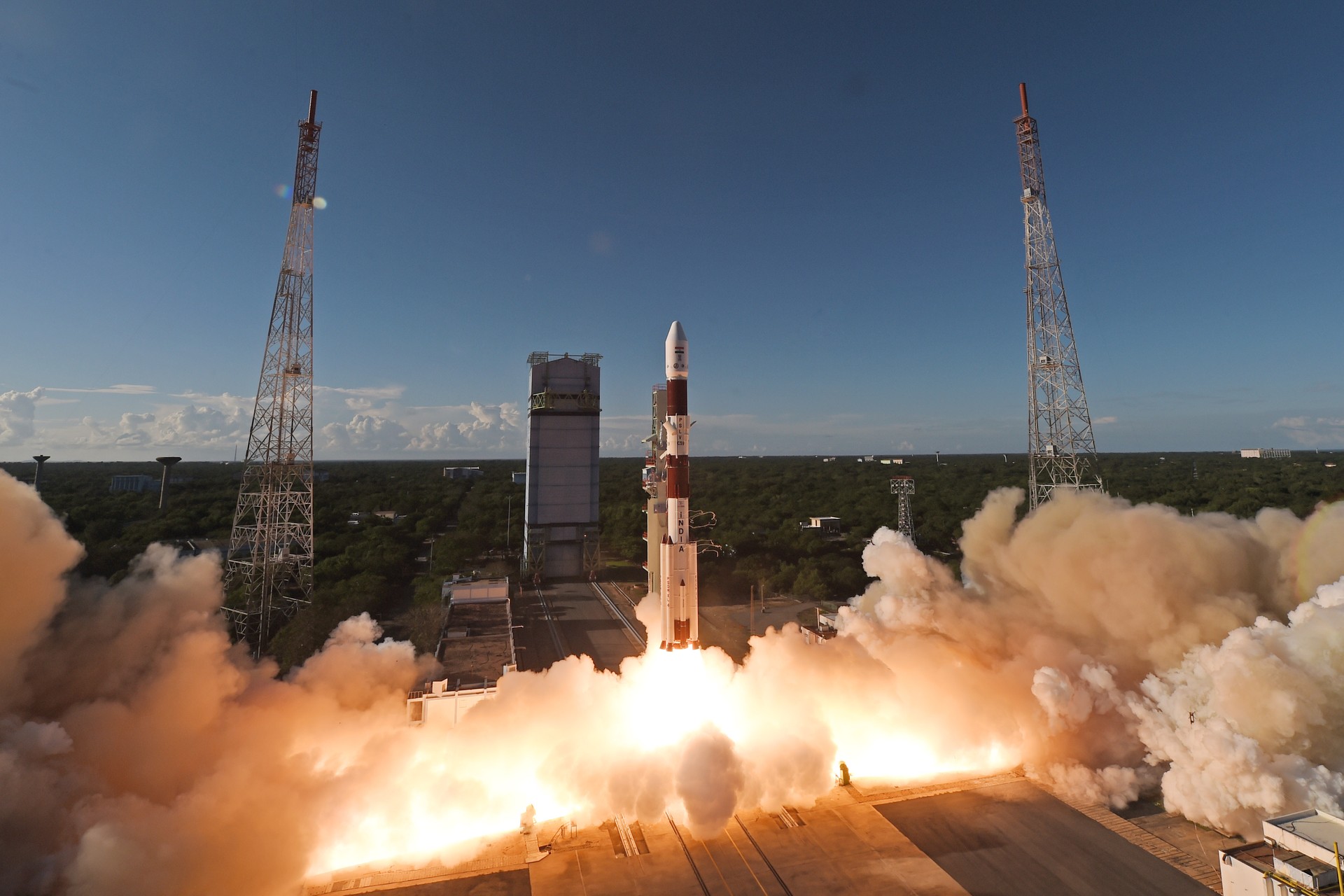
NEW DELHI — India’s space economy, currently valued at nearly 9 billion dollars, is projected to grow to 40 to 45 billion dollars in less than a decade, the Government said on Tuesday, November 24, 2026, setting out one of the most ambitious economic targets ever attached to the country’s space programme. The projection was announced by Union Minister of State for Science and Technology and Space, Dr. Jitendra Singh, as he addressed the fifth India International Space Conclave 2026 in New Delhi, where industry leaders, researchers, investors and international delegates had gathered to discuss how a sector once run almost entirely by the Government is becoming a commercial economy in its own right.
The two-day conclave, organised by the Indian Space Association on November 23 and 24, 2026, was held under the theme of shaping the future of space through innovation, governance, human potential and global collaborations. It brought together policymakers, space agency officials, defence representatives, startups and diplomats from nine countries, according to reporting on the event, and it closed with the release of a new report, Space Economy 2036: The India Blueprint, which examines how the country can finance the growth it has promised. The headline figure is a projection, not a result already achieved, and the debate at the conclave was as much about how to pay for that growth as about the rockets and satellites that will carry it.
The Announcement in New Delhi
Dr. Singh told the conclave that India’s space ecosystem had expanded from a single-digit number of startups to nearly 400 to 500 companies in just a few years, a change he credited to the reforms initiated under Prime Minister Narendra Modi to open the sector to private participation. The growth in company numbers is the most concrete evidence offered for the transformation: a field that was once the preserve of a single government agency now counts hundreds of firms working on launch vehicles, satellites, propulsion, earth observation and data services. The minister described the reforms as among the most transformative policy decisions of recent decades, arguing that they broke a long-standing status quo in which private enterprise had almost no role in space.
The audience for the announcement included Dr. V. Narayanan, Chairman of the Indian Space Research Organisation and Secretary of the Department of Space; Dr. Pawan Kumar Goenka, Chairman of IN-SPACe, the regulator and promoter for private space activity; Lieutenant General Anil Kumar Bhatt (retired), Director General of the Indian Space Association; and Arun T. Ramchandani, along with other senior representatives of the space industry and technology ecosystem. Their presence underlined the point the minister was making: the space economy is no longer a conversation conducted only inside government. It now involves regulators, investors, manufacturers and startups, each with a stake in whether the projected growth materialises.
The 40 to 45 billion dollar figure needs to be read carefully. It is the Government’s projection for the size of the economy in under a decade, and it sits alongside a related but distinct target in the country’s decadal vision: a 44 billion dollar space economy by 2033, including 11 billion dollars in exports. Some reporting on the conclave framed the horizon as 2036, in line with the title of the new Blueprint report. These are not contradictory numbers so much as different ways of describing the same ambition, but they are targets, and whether India reaches them will depend on investment, demand and regulation over the next ten years rather than on any single announcement.
From a Handful of Startups to Hundreds of Companies
The story of the last few years is, above all, a story of opening up. The minister pointed to two institutional milestones: the establishment of NewSpace India Limited, the commercial arm created to market space products and services, followed by the creation of IN-SPACe and the formal opening of the sector to private participation. Together, those steps ended a model in which the Government designed, built, launched and operated almost everything, and replaced it with one in which private firms can build rockets, operate satellites and sell space-based services.
The results most often cited are the private launch companies. Dr. Singh referred to Skyroot’s maiden launch vehicle flight on July 18, 2026, its multi-mission launch agreement and its emergence as a unicorn, a privately held company valued at more than a billion dollars, as significant milestones for the sector. He also cited Agnikul and other companies developing advanced propulsion systems, privately built rocket engines, earth-observation technologies and satellite imaging capabilities as evidence of India’s growing technological depth. The expanding participation of companies from other industrial sectors, he said, further demonstrated the commercial opportunities emerging from the reforms.
That picture comes with a caution noted in the Blueprint report itself. While India now counts more than 400 space startups, the report observes that some of them exist only on paper, and that the real test is whether they can win contracts, raise capital and deliver services at scale. The number of registered companies is a measure of enthusiasm and of a regulatory door that has been opened; it is not yet a measure of revenue. The Government’s case is that the pipeline of firms is the necessary first step, and that demand, finance and procurement must now follow.
The Financing Gap Behind India’s Space Economy Ambitions
The report released at the conclave, Space Economy 2036: The India Blueprint, prepared by Starfleet India Capital Advisors and the Indian Space Association, puts a price on the ambition. It estimates that India’s space sector will need investments of 34 to 37 billion dollars between 2026 and 2036. Public funding, it says, can support only part of that requirement: public budgets may provide 14 to 15 billion dollars, leaving a financing gap of 19 to 21 billion dollars that must come from private capital, banks, insurers, pension funds and capital markets.
That gap is the central problem the report tries to solve. Startup equity currently supplies only a fraction of the roughly 2 billion dollars in annual private capital that will be needed each year through 2036, according to the study. Venture capital alone, the report argues, will not be enough. The next phase of growth must be driven by mainstream finance, with banks, insurers, pension funds, bond markets and institutional investors becoming active participants. As the report puts it, the transition from grants to capital markets is the moment when India’s space ambition stops being a government programme and becomes an economy.
The report’s baseline is sobering. India’s space economy was valued at about 8.4 billion dollars in 2022-23 and accounted for roughly 2 percent of the global space economy, a small share for a country with India’s technical capability. The difference between that 8.4 billion dollar figure for 2022-23 and the minister’s figure of nearly 9 billion dollars today reflects different reference years rather than any disagreement: the sector has grown since 2022-23, and the Government’s current estimate is the more recent one. The proposed remedies in the report include a growth-stage fund for space companies, a dollar-denominated India Space Growth Fund at GIFT City, service procurement models similar to the American space agency’s commercial cargo and crew programmes, expanded infrastructure financing, green bonds for climate observation satellites and the development of domestic space insurance capabilities. The export ambition behind all of this is substantial, and it sits alongside India’s record export performance in goods trade, which the Government has pointed to as evidence that Indian industry can compete globally when the conditions are right.
Beyond Rockets: Space Technology in Everyday Governance
One of the minister’s most repeated arguments at the conclave was that the economic contribution of space technology must be measured not only through rocket launches, satellite manufacturing and commercial revenues, but also through the savings, efficiencies and improved outcomes it generates on the ground. A satellite that helps a railway plan a route, a farmer assess a crop or a disaster agency track a flood may never appear in a launch manifest, but its value is real, and it is the kind of value that justifies public investment in space.
He cited the PM Gati Shakti National Master Plan as the clearest example, saying space-based applications help improve infrastructure planning, maintain project timelines, reduce costs and minimise wastage and leakages. Space technology, he said, has applications across virtually every ministry, including infrastructure, construction, communication, education, healthcare, railways and defence. That breadth is why the Government treats space as a whole-of-government concern rather than the preserve of a single department, and why the Prime Minister’s emphasis on inter-ministerial collaboration was cited as an important enabler for expanding the use of space technology across sectors.
During the interactive question-and-answer session, Dr. Singh was asked about generating greater demand for the space industry. He responded that the perceived lack of demand was largely linked to insufficient awareness about the practical applications of space technology, and that its potential extended far beyond rocket launches and satellite missions, with significant opportunities in infrastructure, communication and public service delivery. The implication is that the space economy will not grow on supply alone: ministries, states and businesses must be persuaded to buy space-based services, and that requires demonstration, procurement and trust as much as it requires engineering.
Sovereignty, Partnerships and the Quantum Link
Asked about balancing strategic sovereignty with international cooperation, the minister said technological sovereignty and global collaboration were not contradictory. India must continue to strengthen indigenous capabilities, he said, with the guiding approach centred on indigenous sources, indigenous technology and indigenous projects, while remaining open to mutually beneficial international partnerships. The formulation captures a tension that runs through the entire space programme: the desire for self-reliance in a strategically sensitive domain, and the recognition that no country builds a modern space economy alone.
The minister also linked space to three other frontier fields: quantum technologies, semiconductors and nuclear science. He referred to progress under the National Quantum Mission, launched by Prime Minister Modi in 2023 with an eight-year mandate, saying India had achieved 1,000 kilometres in secure quantum communication in just three years, against the original target of 2,000 kilometres over eight years. The claim, as presented, is a statement of progress toward a longer goal rather than its completion, and it illustrates how the Government now presents space, quantum, semiconductors and nuclear science as interconnected areas offering significant opportunities for technological advancement and commercial growth.
The international dimension was visible in the conclave itself, with representatives from nine countries in attendance, and in the suggestions put to the minister during the session, including an international space innovation alliance, a global accelerator programme for startups and international grand challenges to encourage innovation. Dr. Singh said India must adopt global strategies and benchmarks to strengthen its international role, and that possibilities for institutionalising wider international space cooperation could be explored. He also welcomed suggestions on expanding the space ecosystem to more states and encouraging greater participation by students and young innovators, saying the Government remained open to constructive feedback and further policy improvements.
The Global Race and Where India Stands
India’s ambitions are being set against a fast-moving global contest. The country’s space agency has completed more than 100 launch missions and placed hundreds of Indian and foreign satellites into orbit over several decades, and it already has more than 50 satellites in orbit. Pixxel Space of Bengaluru has launched India’s first fully functional satellite constellation, a milestone for the private sector. The Government has also laid out a road map for the space agency that aims to land an Indian on the Moon by 2040 and bring the astronaut back safely, and has sanctioned 33,000 crore rupees of investments to the space agency towards that goal, according to reporting on the Blueprint. Looking further ahead, the broader vision aims to position India among the leading space powers by 2047, the centenary of Independence.
That ambition is shared by other nations, and the competition is most visible in crewed spaceflight, where the United States is pressing ahead with its return to the Moon. NASA’s Artemis III programme, which aims to return astronauts to the lunar surface, is the benchmark against which other national programmes are measured, and India’s 2040 target places it on a different, longer timetable. The comparison is a reminder that the space economy is not only about launch costs: it is about who sets standards, who wins export orders and whose companies capture the downstream markets in data, communications and navigation.
The report argues that the largest economic value will eventually be created downstream, through companies that use satellite data, communications services and positioning technologies to solve problems in agriculture, logistics, insurance, climate monitoring, disaster management, mobility, security and national infrastructure. It identifies five technologies that could reshape the future market: reusable launch systems, climate monitoring services, direct-to-device satellite connectivity, in-space servicing and orbital data centres. Each requires a different financing pathway and a different level of market maturity before large pools of capital can be attracted, and each is an area where Indian startups will compete against global giants, most notably SpaceX, whose launch frequency, operational experience and economies of scale are unmatched. Competing internationally, the report warns, will require not just technological excellence but patient capital, insurance mechanisms, reliable procurement frameworks and access to debt financing.
What Comes Next: Research Funding and the Road to 2036
The minister used the conclave to press industry on two fronts: invest more, and invest in research. He urged domestic private players to scale up investments in the space sector and encouraged industry leaders to facilitate greater overseas investment into India’s growing space ecosystem. He pointed to enabling mechanisms the Government has introduced, including the Anusandhan National Research Foundation and the Research, Development and Innovation Fund, to strengthen research and innovation and encourage private-sector participation. Both are designed to bridge the gap between laboratory research and commercial products, a gap that has historically slowed Indian technology firms.
He also urged industry leaders to direct greater Corporate Social Responsibility support towards research and scientific development, saying such spending should serve the wider community and not remain confined to expenditure on machinery and infrastructure. Calling for a stronger culture of scientific philanthropy, he said investment in research should be regarded as a meaningful contribution to society and humanity. The appeal reflects a recognition that the space economy cannot be built on government budgets and venture capital alone: it needs a broader base of funders willing to support long-horizon science.
There are still gaps in the framework that the Blueprint report identifies plainly. Despite major reforms, India still operates largely under a space policy framework rather than a comprehensive Space Act passed by Parliament, and it does not yet have a codified liability regime that clearly defines responsibilities and risk allocation across government and private operators. The report calls for a three-layer liability framework and risk management architecture if institutional investors are to participate confidently. The Department of Space allocation, at around 13,400 crore rupees annually, is also modest compared with the ambitions being articulated and with the budgets of major global space powers. The minister closed the conclave by saying India’s space transformation, driven by policy reforms, indigenous technological capabilities and private-sector entrepreneurship, was creating a strong foundation for the country’s emergence as a globally competitive space economy. Whether that foundation supports a 40 to 45 billion dollar economy will be decided less by the speeches in New Delhi than by the financing, the contracts and the demand that follow them.
Sources
USN reviewed reporting from multiple outlets for this story. Read more from Press Information Bureau, NDTV and DD India.