

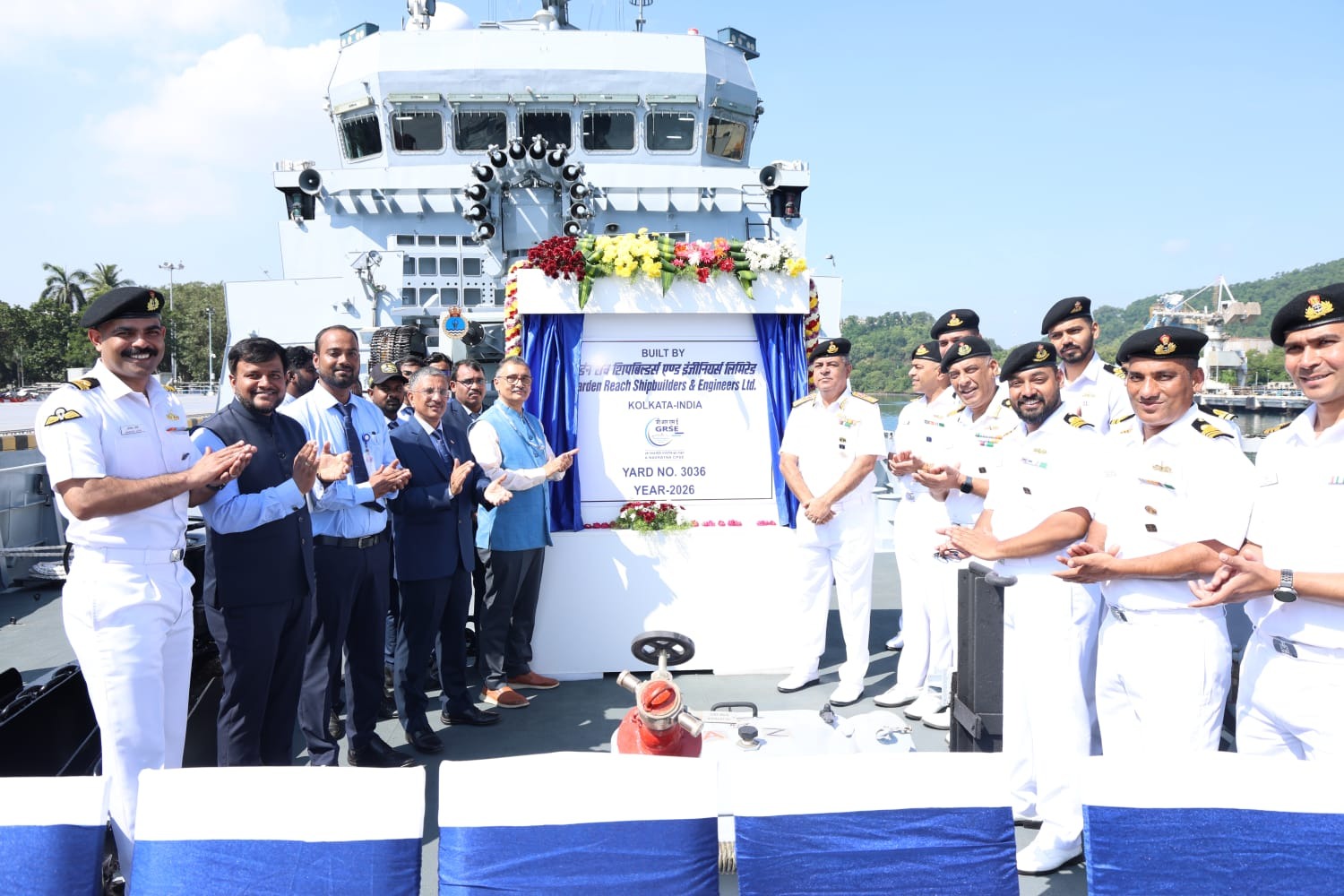
A new submarine hunter has joined the Indian Navy’s coastal shield. On Monday, 23 November 2026, Garden Reach Shipbuilders and Engineers, the Kolkata-based Navratna defence shipyard, delivered Ashank, an anti-submarine warfare shallow water craft, to the Navy at Visakhapatnam. The vessel was formally accepted on behalf of the Navy by Rear Admiral Gautam Marwaha, the Chief Staff Officer (Technical) at Headquarters Eastern Naval Command. The handover came just eighteen days after the shipyard delivered a sister ship, Amini, on 5 November, making it GRSE’s second warship delivery inside a single month.
Ashank, listed as Yard 3036, is the sixth of the eight Arnala-class shallow-water craft that GRSE is building for the Navy. It is a small, specialised warship with a single purpose: to find, track and destroy enemy submarines operating in the shallow waters close to India’s coast, where large frigates and destroyers cannot work effectively. It carries lightweight torpedoes, indigenous rocket launchers and advanced sonar systems, and the Defence Ministry says it has more than 80 per cent indigenous content. Its name means fearlessness, or an undaunted spirit, which the shipyard says reflects the vessel’s role in guarding India’s maritime frontiers.
The delivery matters for three reasons. It adds another hull to the Navy’s littoral anti-submarine force at a time when underwater activity in the Indian Ocean region is growing. It shows that India’s warship building programme can now deliver complex frontline platforms in quick succession rather than one at a time. And it is further evidence of the government’s Aatmanirbhar Bharat policy working in practice, with Indian shipyards, Indian weapons and Indian sensors coming together in a single warship. This article explains what was delivered, what the ship can do, why shallow-water submarine hunting needs its own kind of vessel, and what happens between delivery and the day the ship formally enters service.
INS Ashank delivery: what happened at Visakhapatnam
The announcement from the Defence Ministry was short, and that brevity is itself informative: the delivery was a routine milestone in a programme that is now moving at a steady pace, rather than a one-off event. The ministry said Ashank, indigenously designed and built by GRSE in Kolkata, was delivered to the Indian Navy on 23 November 2026 at Visakhapatnam, the headquarters of the Navy’s Eastern Naval Command. The ship was accepted by Rear Admiral Gautam Marwaha, whose role as Chief Staff Officer (Technical) at the Eastern Naval Command headquarters places him in charge of the technical acceptance of new platforms arriving in the command.
The shipyard’s own announcement added the detail that makes this delivery stand out. Ashank is GRSE’s second delivery in November alone, following Amini on 5 November, just eighteen days earlier. For a shipyard building frontline warships, two deliveries in eighteen days is a demanding tempo, and it suggests that the production line for this class has reached a mature rhythm. With Ashank, GRSE has now built 120 warships, of which 82 have been delivered to the Indian Navy, a figure the shipyard itself highlighted as it announced the handover.
The ceremony itself followed the established pattern for a warship delivery, with naval officers and shipyard officials present on board the vessel, and a plaque recording that the ship was built by Garden Reach Shipbuilders and Engineers in Kolkata, as Yard 3036, in 2026. Photographs released by the government show the ship’s bridge and superstructure behind the ceremony, with officers in white uniform gathered on deck. Delivery, it is worth stressing, is not the same as commissioning. The ship has been handed over to the Navy, but its formal commissioning ceremony, when it will formally enter service under its commanding officer, has not yet been announced.
Inside the submarine hunter: weapons, sensors and waterjets
Ashank’s equipment is chosen for one environment: shallow coastal water. Its principal weapons against submarines are lightweight torpedoes, fired from triple torpedo tubes mounted on either side of the ship, and an RBU-6000 rocket launcher mounted forward, which fires rocket-propelled depth charges against submerged targets. The Defence Ministry’s release describes the rocket launchers as indigenous, and the torpedoes as lightweight, a combination that gives the ship two different ways of attacking a submarine it has detected. The ship also carries rails for laying mines, adding a third role to its work.
Finding the submarine is the harder half of the task, and that is where the ship’s sensors matter most. Ashank is fitted with advanced sonar systems designed to work in shallow water, where sound behaves very differently from the open ocean. In shallow water, sound bounces off the seabed and the surface, creating echoes and confusion that can hide a quiet submarine or produce false contacts. The sonar suite on these craft is designed for exactly those conditions, and it is supported by the ship’s own quiet running. The vessels are propelled by waterjets driven by diesel engines, rather than conventional propellers, which keeps the ship’s own underwater noise down and helps it move in very shallow water.
For self-defence and for dealing with threats on the surface, Ashank carries a 30mm naval surface gun manufactured by GRSE itself, along with two stabilised, remotely controlled 12.7mm machine guns. It also carries torpedo decoy launching systems, which can draw an incoming torpedo away from the ship. Specialist reporting puts the class at about 77.6 metres long, displacing around 900 tonnes, with a crew of 57 officers and sailors. The ships are built to the classification rules of the Indian Register of Shipping, the Indian classification society, and the Defence Ministry notes that they are among the largest Indian naval warships propelled by waterjets.
Why shallow water needs its own submarine hunter
Anti-submarine warfare is often imagined as a deep-ocean contest between large warships and nuclear submarines, but some of the most difficult submarine hunting takes place in water barely deeper than the submarine itself. India’s coastline runs for more than 7,500 kilometres, and its major ports, naval bases, offshore energy installations and shipping lanes all sit in shallow coastal water. A hostile submarine does not need to venture into the deep ocean to threaten those places; it can operate close to shore, where it is hardest to find, and where the consequences of an attack would be most serious.
Large warships are poorly suited to this work. A destroyer or a frigate is built for the open ocean: it draws too much water to operate safely in very shallow areas, it is noisy at the speeds needed for a search, and it is an expensive asset to risk in confined waters. A small, shallow-draught vessel with the right sonar and the right weapons is a better answer, and that is the gap the Arnala class is designed to fill. These craft can work close inshore, around harbours and in the approaches to ports, where a submarine would try to hide among the noise of merchant shipping and fishing traffic.
The role also extends beyond hunting submarines. The Defence Ministry says Ashank will strengthen the Navy’s coastal surveillance and mine-laying capabilities as well as its anti-submarine work. Coastal surveillance means keeping watch over the traffic moving through India’s near waters, identifying vessels that should not be there and building a picture of everything moving along the coast. Mine-laying, the ability to place defensive minefields in chosen waters, is a capability that only a few navies maintain, and it gives the Navy another way to deny an area to an adversary. A single class of ship that can do all three jobs gives the Navy flexibility in how it deploys its smaller vessels.
The Arnala class: six delivered and two still to come
Ashank is the sixth of the eight ships GRSE is building under this programme, which was ordered under contracts signed in April 2019. The first ships of the class have arrived in a steady stream: Amini, the fifth, was delivered on 5 November 2026, and Ashank followed eighteen days later. The pace is significant because it shows the programme has moved past the slow, uncertain phase that usually marks the first ships of a new class, when design problems are still being found and fixed, and into the phase where ships come off the line in a regular rhythm.
Two ships of GRSE’s eight remain to be delivered, and the shipyard has said it intends to complete the project during the first half of calendar year 2027. That timetable, if met, would mean the full class of eight will be in the Navy’s hands a little over a year from now, a notably short period for a warship programme. Each delivery adds to a capability that only works when enough hulls are available: submarine hunting in coastal waters is a numbers game, with ships needed to cover long stretches of coastline at the same time, and a single craft, however capable, can only be in one place.
The class takes its name from its lead ship, Arnala, following the Navy’s practice of naming a class after the first vessel built in it. That ship was commissioned in 2025, and the vessels that have followed it have arrived in a quickening sequence, with two deliveries in November 2026 alone. The result is a class that is approaching completion while the production line is still warm, which matters for the shipyard as much as for the Navy: the skills, suppliers and routines built up over eight ships can be carried straight into the next programme rather than being lost between orders.
Over 80 per cent Indian: the indigenous content story
The figure the Defence Ministry chose to highlight in its announcement was the share of the ship that is Indian. At more than 80 per cent indigenous content, Ashank stands as evidence of how far domestic defence manufacturing has come, and the shipyard’s own figure for the class is higher still, at about 88 per cent. The difference between the two numbers reflects different ways of counting, but the direction is the same: the overwhelming majority of this warship, from its steel and sensors to its guns and rocket launchers, was made in India.
The 30mm naval surface gun is a useful example. It is manufactured by GRSE itself, which means the shipyard is not only assembling a hull but also producing one of the ship’s weapons. The rocket launchers are described by the ministry as indigenous, and the sonar and combat systems draw on Indian suppliers. This matters for reasons beyond pride. A warship built largely from imported equipment depends on foreign suppliers for spares, repairs and upgrades for the whole of its service life, which can last decades. A warship built largely at home can be maintained, modified and upgraded by the same industrial base that built it.
The delivery sits inside a larger government push. Earlier in November, Defence Minister Rajnath Singh said defence production had risen to a record Rs 1.78 lakh crore in the financial year 2025-26, up from Rs 46,429 crore in 2014-15, with defence exports of about Rs 40,000 crore, and set a target of Rs 3 lakh crore of production and Rs 50,000 crore of exports by 2029. The defence budget for 2026-27 was raised to a record Rs 7.85 lakh crore, including Rs 2.19 lakh crore for modernisation and capital procurement. Ashank is one small part of that picture, but it is the kind of delivery those figures are made of: a complex platform, built in India, handed over on schedule.
GRSE’s 120th warship: a shipyard working at full pace
For GRSE, Ashank is a milestone in its own right. The shipyard says it has now built 120 warships, of which 82 have been delivered to the Indian Navy. The yard in Kolkata, a Navratna public sector undertaking under the Ministry of Defence, has been building warships for the Navy for decades, but the current pace of delivery is unusual. Two warships in eighteen days, and a second delivery in a single month, point to a production system that is running at full capacity rather than a shipyard working on one order at a time.
The order book behind that pace is substantial. GRSE says it is currently building twelve frontline naval platforms: one Project 17A advanced stealth frigate, two more anti-submarine warfare shallow water craft, four next-generation offshore patrol vessels and five next-generation corvettes. Earlier in November, on 2 November, the Defence Ministry signed contracts worth Rs 53,866.50 crore for eight next-generation corvettes for the Navy, with GRSE and Goa Shipyard sharing the construction. The corvette order alone is the largest the Goa yard has ever received, and it adds years of work to both shipyards.
That workload carries its own questions. Building twelve warships at once demands a deep bench of skilled workers, reliable suppliers and careful scheduling, and any slip in one programme can ripple into the others. But it also gives the shipyards something they have long asked for: a steady flow of orders that justifies investment in new facilities and in training. The two deliveries in November are the most visible sign that the investment is paying off, and the shipyard will be judged on whether it can sustain the pace through the remaining ships of the Arnala class and into the corvette programme.
What happens next: from delivery to commissioning
Delivery is a handover, not the end of the story. After a warship is delivered, the Navy puts it through its own acceptance process, working up the crew, testing the sensors and weapons, and confirming that the ship performs as contracted. Only then comes commissioning, the formal ceremony at which the ship is accepted into active service and its commanding officer takes command. The ministry has not announced a commissioning date for Ashank, and readers should treat any date circulating online with caution until it comes from the Navy itself.
The two remaining ships of GRSE’s eight will be watched for the same reason Ashank was: each delivery shortens the time until the Navy has the full class available for operations along the coast. The shipyard has said it aims to finish the project in the first half of 2027, and the eighteen-day gap between Amini and Ashank suggests that target is realistic. Once all eight are in service, the Navy will have a dedicated shallow-water force that it has not possessed before at this scale, able to cover ports, patrol coastal waters and hunt submarines in the places where larger warships cannot go.
For now, the fact that matters is simple. On 23 November 2026, at Visakhapatnam, an Indian shipyard handed an Indian-built submarine hunter to the Indian Navy, the sixth of its class, the 120th warship the yard has built, and the second it has delivered in eighteen days. In a year of large defence announcements, it was a quiet milestone rather than a dramatic one. But quiet milestones are how naval capability is actually built: one hull at a time, on schedule, and increasingly made in India.
Sources
USN reviewed reporting from multiple outlets for this story. Read more from Press Information Bureau, The Times of India and Moneycontrol.