

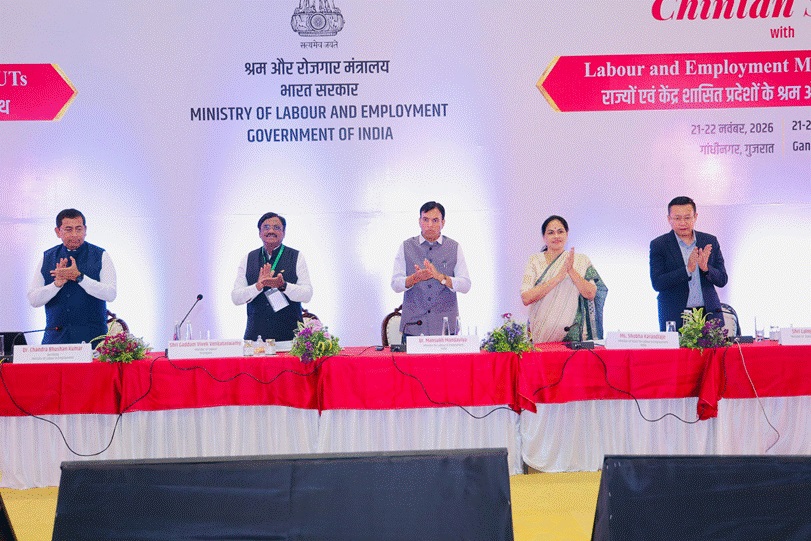
India has launched a new national jobs platform designed to bring job seekers, employers, state employment portals and private recruitment platforms into a single connected network. The National Career Service (NCS) Open Network for Employment, known as the NCS ONE portal, was launched on 22 November 2026 by Union Minister of Labour and Employment Mansukh Mandaviya at Gandhinagar in Gujarat, on the concluding day of a two-day meeting of labour and employment ministers from states and Union Territories.
Alongside the portal, the minister launched an Occupational Shortage Index to measure gaps between the demand for workers and their supply, and an e-Shram Livelihood Profile module that tracks a worker’s livelihood information together with five social security protections. Eight new Career Lounges were also launched virtually in cities across the country, as part of a plan to set up 200 such centres, mainly in smaller cities.
The launch came at a meeting that marked one year since India’s four Labour Codes came into effect on 21 November 2025. The two-day Chintan Shivir, organised by the Ministry of Labour and Employment on 21 and 22 November 2026, brought together state labour ministers and senior officials to review how the codes are working on the ground, and to discuss employment initiatives, social security for unorganised workers, and reforms in the Employees’ Provident Fund Organisation and the Employees’ State Insurance Corporation.
What the NCS ONE Portal Is and Who Launched It
The NCS ONE portal was formally launched by Dr Mansukh Mandaviya, who holds the portfolios of Labour and Employment and Youth Affairs and Sports, on the second day of the Chintan Shivir at Gandhinagar. The conclave was attended by Shobha Karandlaje, Union Minister of State for Labour and Employment and Micro, Small and Medium Enterprises, along with labour and employment ministers and senior officials from states and Union Territories. Gujarat Chief Minister Bhupendra Patel attended the inaugural session on the first day.
The portal is built on the National Career Service, the ministry’s job-matching platform, and turns it into an open network. Instead of job seekers having to visit separate websites and offices, the NCS ONE portal links job seeker applications, employer applications, state employment portals, private job platforms and educational campuses. The idea is that a vacancy posted in one place, and a job seeker registered in another, can find each other through the same network.
The portal adds new features to the existing National Career Service, including a Voice Bot and a Chat Bot, which are meant to make the service easier to use for people who may not be comfortable typing long searches or navigating a website in English. The ministry has presented the voice and chat tools as a way of widening access, so that a young person in a small town, or a worker looking for a change of trade, can ask for help in a more natural way and be guided towards suitable openings.
Officials at the launch described the portal as part of a wider effort to modernise employment services. The ministry said the network would help job seekers make informed career choices, help employers identify shortages and plan recruitment, help education and training institutions align skilling, reskilling and upskilling with industry demand, and help policymakers design targeted employment and skilling interventions. Those are stated aims for the platform, and whether it delivers on them will depend on how many employers and state portals join the network and how regularly its information is updated.
The launch was accompanied by two publications unveiled by the minister: an Addendum to the National Classification of Occupations (NCO-2015) and a Compilation of Existing and Emerging Green Occupations. The classification of occupations is the common language that employment services, training institutions and employers use to describe jobs, and updating it matters because new kinds of work, including green jobs, do not fit neatly into older categories. The green occupations compilation reflects the growth of work linked to renewable energy, energy efficiency, waste management and other environmental fields.
How the NCS ONE Jobs Portal Will Work for Job Seekers
For a job seeker, the most important feature of the NCS ONE portal is that it is designed to work across platforms rather than as a single standalone website. A person looking for work can use a job seeker application, while an employer uses an employer application, and state employment portals and private job platforms connect into the same network. Campuses are also part of the design, so students approaching the end of their courses can be connected with openings while they are still studying.
The Voice Bot and Chat Bot are intended to lower the barrier for first-time users. Many job seekers, particularly those coming from informal work or from families with no experience of formal recruitment, find online job portals difficult to navigate. A voice-based assistant that can answer questions and guide a user through registration and search could make the difference between a person using the service and giving up on it. The ministry has not yet published details of which languages the voice and chat tools will support, or how they will handle the many different ways in which people describe their skills and the work they are looking for.
The portal also has to solve a practical problem that has limited earlier employment exchanges: the gap between the jobs that are listed and the jobs that people actually get. Employment exchanges in India have historically registered large numbers of job seekers but placed relatively few of them, partly because employers did not list their vacancies there and partly because the records were not kept up to date. An open network that pulls in listings from private platforms and state portals could change that, but only if employers see value in it and keep their vacancies current.
For young people, the timing of the launch is significant. Youth unemployment remains far higher than the overall rate, and the latest labour force survey shows that the unemployment rate for people aged 15 to 29 stood at 14.7 per cent in October 2026, even though it had fallen from 15.2 per cent in September. A platform that connects campuses with employers, and that gives students information about which occupations are in demand, speaks directly to that problem. The Career Lounges launched alongside the portal are meant to provide the human support that a website alone cannot, including counselling, mentoring and help with interviews.
There are also questions that the ministry will need to answer as the portal is rolled out. It has not yet said how the network will verify the employers who post jobs, how it will protect job seekers from fraudulent listings, or what will happen to the data of the millions of people who register. These are practical concerns for any employment platform, and they matter more when the platform is run by the government and carries its credibility. For now, the launch establishes the framework, and the details of its operation will become clear as states and private platforms begin to connect to it.
The Occupational Shortage Index: Matching Training to Real Demand
The Occupational Shortage Index, known as the OSI, is a data-driven tool that aims to measure the gap between the demand for workers in different occupations and the supply of people with the right skills. It was launched together with the NCS ONE portal, and the ministry described it as a tool for everyone involved in the labour market rather than only for government.
For job seekers, the index is meant to answer a simple question: which occupations have more openings than available workers, and therefore offer the best chances of finding work. For employers, it is meant to show where shortages exist so that they can plan recruitment in advance instead of discovering too late that they cannot find the people they need. For education and training institutions, it is meant to guide decisions about which courses to offer, so that training matches the jobs that actually exist rather than the courses that have always been taught.
For policymakers, the index is meant to support targeted employment and skilling interventions. If the data show a shortage of, for example, electricians with solar installation skills in one region, or of health care support workers in another, then training funds and programmes can be directed to those occupations and places. That is the theory behind the index, and it is a sensible one, because much of the frustration in India’s labour market comes from a mismatch: employers say they cannot find skilled workers, while job seekers say they cannot find work.
However, an index is only as good as the data that feeds it, and the ministry has not specified the index’s data sources, its methodology or how often it will be updated. That is an important gap, because a shortage index based on incomplete or outdated information could mislead the very people it is meant to help. A job seeker who trains for an occupation that the index wrongly shows as being in demand could waste months of effort, and a training institution that reshapes its courses on the basis of unreliable figures could do lasting damage.
The honest test of the Occupational Shortage Index will therefore come in the months ahead, when its first readings are published and can be compared with what employers and workers are actually experiencing. If the ministry publishes the methodology and updates the index regularly, it could become a genuinely useful public resource. If the figures appear rarely or without explanation, it risks becoming another announcement that is rarely used. For now, the launch of the index is a promise, and its value will be judged by how openly and regularly it is produced.
e-Shram Livelihood Profile and the Five Panch Suraksha Protections
The e-Shram Livelihood Profile module, launched alongside the portal, connects a worker’s livelihood information with the social security protections available to them. The ministry describes five essential protections under the name Panch Suraksha: food security, health protection, life insurance, accident and disability protection, and pension security. The profile is meant to track a worker’s livelihood information alongside these five protections, so that both the worker and the system can see what cover the worker already has and what is missing.
The module builds on the e-Shram portal, which was launched on 26 August 2021 to create India’s first centralised database of unorganised workers, known as the National Database of Unorganised Workers. The portal covers workers such as agricultural labourers, construction workers, domestic workers, street vendors, migrant workers, self-employed workers and gig and platform workers, who have historically been outside formal social security systems. A ministry factsheet released in August 2026 put e-Shram registrations at 31.89 crore workers, with about 11.5 lakh gig and platform workers among them.
The scale of that database is what makes the new Livelihood Profile potentially significant. For the first time, there is a single national record of a very large share of India’s informal workforce, seeded with Aadhaar and carrying information about occupation, skill and address. Adding a profile that links each worker to the five Panch Suraksha protections could help governments identify who is covered and who is not, and could make it easier for workers to claim benefits they are entitled to but may not know about.
It is worth being clear about what the profile does and does not do. It tracks information and protections; it does not by itself create new benefits. A worker whose profile shows no pension cover is not automatically given one, and a worker whose profile shows no health protection is not automatically enrolled in a health scheme. The value of the profile depends on what follows from it: whether it is used to enrol uncovered workers, to simplify claims, and to make benefits portable when a migrant worker moves from one state to another.
Portability is one of the most important issues for India’s migrant workers, who often lose access to benefits when they cross state boundaries. A national profile that travels with the worker could, in principle, help solve that problem, but it requires states to recognise and act on the same record. The Chintan Shivir, as a meeting of Centre and state labour ministers, was the right forum to discuss that kind of coordination, and the ministry’s emphasis on Centre-State partnership suggests that it is aware the profile will only work if states use it.
Eight Career Lounges Open, With 200 Planned in Smaller Cities
The minister also virtually launched eight Career Lounges in Jaipur, Ludhiana, Bhubaneswar, Kanpur, Bengaluru, Varanasi, Hyderabad and Guwahati. The lounges are being set up as a strategic extension of the Model Career Centres under the National Career Service framework, and the ministry plans to establish 200 such centres in employment exchanges, universities and educational institutions, particularly in Tier-II and Tier-III cities, in collaboration with industry partners.
The choice of smaller cities is deliberate. Most career guidance and placement services are concentrated in metropolitan areas, while young people in smaller cities and towns often have little access to counselling, information about careers, or contact with employers. A Career Lounge inside an employment exchange or a university in a Tier-II or Tier-III city brings those services closer to where the job seekers actually live.
The lounges are meant to offer career guidance, skill and aptitude assessments, mentoring, employability training, industry interactions, internships, apprenticeships and placement support. That list covers the full journey from deciding what kind of work to aim for, through acquiring the skills and experience to be employable, to actually securing a job. The inclusion of internships and apprenticeships is important, because employers often say that what they value most is not only a qualification but evidence that a young person has worked in a real workplace.
The lounges will also provide exposure to international employment opportunities, global labour market trends, international skill requirements and occupational standards, including language and cross-cultural preparedness. This reflects a growing reality: a significant number of Indian workers seek jobs overseas, and their chances depend not only on their technical skills but on their ability to meet the standards, language requirements and workplace cultures of other countries. Preparing young people for those opportunities, rather than leaving them to navigate the process alone, could reduce exploitation and improve outcomes.
Eight lounges are only a start, and the plan for 200 will take time and sustained funding. The experience of the Model Career Centres, which the lounges extend, suggests that the quality of the staff and the strength of the links with local employers will matter more than the number of centres. A lounge with well-trained counsellors and active relationships with nearby industries could transform prospects for the young people who use it; a lounge that is simply a room with a signboard will not. The ministry’s decision to build the lounges in collaboration with industry partners is a recognition of that, since employers are the ones who know what skills they need and can offer the internships and placements that make the service real.
One Year of the Labour Codes: What the Chintan Shivir Reviewed
The Chintan Shivir marked one year since the four Labour Codes came into effect on 21 November 2025, and much of the two days was spent reviewing how they are working in practice. The codes consolidated a large number of older labour laws into four codes covering wages, industrial relations, social security, and occupational safety, health and working conditions. Their implementation depends heavily on the states, which have to frame rules and set up the machinery to enforce them, so a meeting of Centre and state labour ministers was the natural place to take stock.
Delivering his closing remarks, Mr Mandaviya said the Shivir had brought forward a wide range of practical insights, field experiences and policy perspectives from states and Union Territories. He said that acting decisively on these deliberations, in alignment with the Prime Minister’s vision, would guide the nation forward along the path to a developed India, while empowering the country’s workforce. He added that the suggestions and learnings exchanged during the conclave would help safeguard and strengthen the interests of workers while supporting more effective ground-level implementation of the Labour Codes.
Minister of State Shobha Karandlaje, summing up the deliberations, stressed strong Centre-State coordination and proactive grievance resolution. She said there was a need to train lawyers and consultants so that disputes could be resolved before cases reached court, and she urged states to compile the takeaways from the discussions so that insights could be acted upon and institutionalised. Her emphasis on resolving grievances early reflects a long-standing problem in India’s labour system, where disputes can take years to move through courts and tribunals, leaving workers without income and employers without certainty.
The thematic sessions across the two days covered implementation of the Labour Codes, employment initiatives, reforms in the Employees’ Provident Fund Organisation and the Employees’ State Insurance Corporation, social security for unorganised workers, and labour statistics. Parallel breakaway sessions for state and Union Territory field officials focused on engagement with micro, small and medium enterprises, field-level initiatives, trust-based electronic compliances, central and state grievance redressal mechanisms, the National Classification of Occupations, and the District Employment Profile framework. States also shared best-practice videos and examples of their own implementation practices.
Day two included sessions on the Labour and Employment Stack and on Career Lounges for International Labour Mobility, with presentations by officials. The V. V. Giri National Labour Institute in Noida and the Gujarat National Law University in Gandhinagar served as knowledge partners for the conclave, providing research and academic support to the discussions.
On social security, Mr Mandaviya told the conclave that coverage had now reached 101 crore people, citing International Labour Organization data showing that India’s social security coverage had risen from 19 per cent in 2015 to 64.3 per cent in 2025. That is a claim about the reach of the system rather than a new announcement, and it was presented as evidence that the expansion of social security, including through the Labour Codes and the e-Shram database, is reaching a far larger share of the population than it did a decade ago. The figure will be debated, as coverage figures always are, but the direction of travel is consistent with the growth of the e-Shram database and the extension of schemes to unorganised workers.
Why the Launch Matters Now: Jobs Data Behind the Push
The launch of the NCS ONE portal and its companion tools comes at a moment when India’s jobs numbers are improving slowly but remain uneven. The latest Periodic Labour Force Survey bulletin, released by the National Statistics Office on 16 November 2026, put the overall unemployment rate for people aged 15 and above at 4.9 per cent in October 2026, down from 5.0 per cent in September and 5.2 per cent in the same month a year earlier. The labour force participation rate rose to 55.7 per cent, and the survey, which covered more than 3.7 lakh people, found that female unemployment had fallen to 5.0 per cent.
Behind the headline figure, however, the picture is more complicated. Rural unemployment stood at 4.2 per cent, while urban unemployment was 6.7 per cent, and the unemployment rate for urban women was 8.7 per cent, compared with 6.0 per cent for urban men. Youth unemployment, at 14.7 per cent for those aged 15 to 29, remains roughly three times the overall rate. Those gaps help explain why the government is investing in tools that connect job seekers with employers and that give young people better information about where the jobs are.
The jobs challenge is not only about the number of openings but about matching. India has a large and growing workforce, a rapidly changing economy in which new occupations appear and old ones disappear, and an education and training system that does not always keep pace. Employers in sectors such as manufacturing, logistics, health care and digital services report difficulty finding workers with the right skills, while graduates and trained workers report difficulty finding jobs that match their qualifications. A platform that links job seekers and employers across the country, and an index that shows where the shortages are, are aimed squarely at that mismatch.
There is also a question of trust. For a government jobs platform to succeed, job seekers must believe that the listings are genuine and that applying through it will lead somewhere, and employers must believe that the candidates they find there are worth hiring. The National Career Service has existed for a decade, and the open network model is an attempt to give it new life by bringing in private platforms and state portals rather than competing with them. If the network achieves the scale the ministry hopes for, it could become the first place both sides look. If it does not, it will join a long list of well-intentioned portals that job seekers visit once and never return to.
For now, the launch at Gandhinagar sets the direction. The portal, the shortage index, the e-Shram profile and the Career Lounges are all in place as announced initiatives. Their success will be measured not by the launch ceremony but by the numbers that follow: how many job seekers register, how many employers post vacancies, how many placements result, and whether the Occupational Shortage Index is published regularly enough to be useful. Those are the figures to watch in the months ahead, and they will determine whether the NCS ONE portal becomes a genuine part of India’s employment system or remains a promising announcement.
Sources
USN reviewed reporting from multiple outlets for this story. Read more from Press Information Bureau, Business Standard and The Economic Times.