

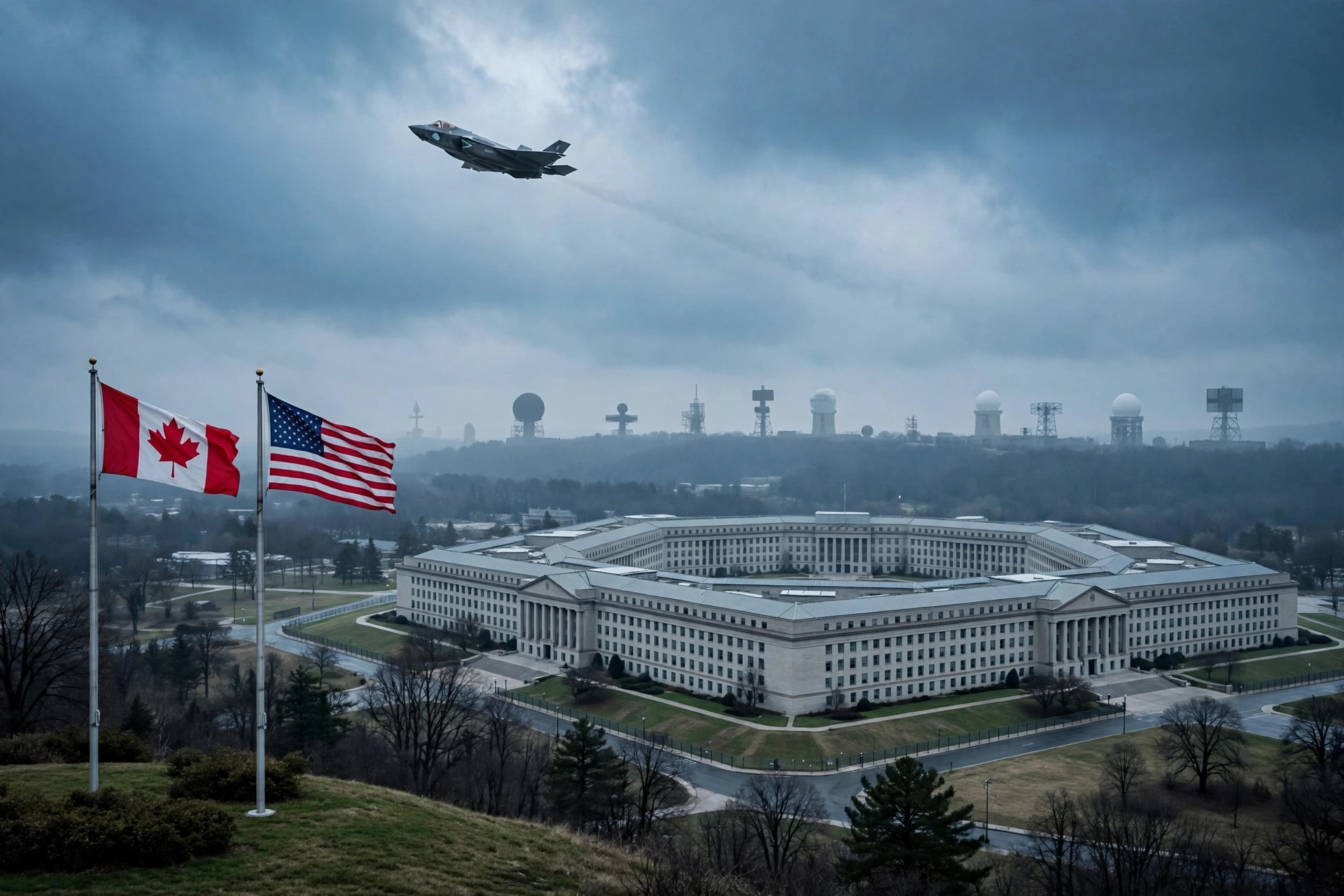
WASHINGTON — United States Defence Secretary Pete Hegseth has imposed new restrictions on military cooperation with Canada in a classified memorandum, according to reporting first published by The Washington Post on Friday evening, November 20, 2026. The Pentagon confirmed on Saturday that it was refocusing the relationship around American defence priorities, but said the guidance would not affect defence intelligence sharing, the binational North American Aerospace Defense Command, known as NORAD, or cooperation through NATO.
The precise scope of the restrictions remains unclear. The Washington Post reported the existence of the memo citing officials familiar with the decision, but said it had not seen the document itself. Canadian Defence Minister David McGuinty said he had not seen it either, and insisted that the armed forces of the two countries continue to work closely together. The result is an unusual situation: a reported shift in one of the world’s closest military partnerships, described in public by spokespeople and senators, but with the underlying document still out of view.
The reported move comes at a moment of strain between the two longtime allies. President Donald Trump has repeatedly suggested that Canada should become the 51st American state, has imposed tariffs on Canadian goods, and has criticised Ottawa’s defence spending. Canadian Prime Minister Mark Carney has firmly rejected any suggestion of annexation. Against that background, even a limited restriction on military contact has been read in both capitals as a signal about the direction of the relationship.
What the Pentagon Canada Memo Reportedly Does
According to The Washington Post’s reporting, Hegseth circulated the directive in a classified memo last week. Officials familiar with the decision told the newspaper that the memo imposes new restrictions on military cooperation with Canada, though they did not disclose its full contents. One official described the restrictions as a “slap in the face” for Canada and expressed concern about how they would affect cooperation between the two countries’ armed forces.
Senators briefed on the document offered a more specific account over the weekend at the Halifax International Security Forum in Canada. They said the memo appeared to restrict informal contact between American and Canadian service members, including attendance at conferences and academic events, and to require approval for social engagements. Republican Senator Mike Rounds of South Dakota told reporters that the memo “basically makes no changes in anything of formal activity, but it is suggesting in a roundabout way that there be less informal activity or social activities without permission.”
Rounds also said the memo limits general flag officer meetings to those that advance the Pentagon’s objectives, and requires permission for attendance at Canadian think tank events or social engagements. He added that he had been told the memo has no operational impact on American defence personnel currently in Canada. The account suggests a directive aimed less at joint operations than at the informal networks — the meetings, conferences and personal contacts — through which two allied militaries build trust over time.
The timeline adds a further wrinkle. Rounds said the memo had been drafted months ago and was signed only recently, which raises questions about why a document prepared earlier was put into effect now. The Washington Post also reported that an official said that while there has been no formal indication of change regarding intelligence sharing, American officials have shared less intelligence with Canada over the past year “across a number of platforms.” That claim, if accurate, would point to a quieter and more gradual cooling than a single memo might suggest.
What the Pentagon Canada Defense Restrictions Leave Untouched
The Pentagon has been careful to draw a line around what the guidance does not cover. Chief Pentagon spokesman Sean Parnell said the Department of War — the name the administration now uses for the Department of Defense — was “taking steps to ensure its engagements with Canada advance tangible US defence objectives and ultimately support a reinvigorated defense relationship.” He added: “This guidance does not impact defence intelligence cooperation, our binational NORAD command, or our cooperation through Nato.”
Parnell elaborated that the department was “prioritizing opportunities for bilateral cooperation that strengthens the defense of our Homelands and shared hemisphere, while supporting Canada’s ability to meet NATO obligations.” The message was consistent across the weekend: the core of the alliance — the systems that defend North American airspace, share intelligence and operate through NATO — is not being dismantled, even as the terms of day-to-day engagement are tightened.
Senator Rounds reinforced that point after speaking to administration officials. He told reporters he had been assured the memo does not affect NORAD, NATO operations or the Five Eyes intelligence-sharing arrangement, and has no operational impact on defence personnel in Canada. The Five Eyes partnership, which links the United States, Canada, Britain, Australia and New Zealand, is one of the most sensitive intelligence relationships in the world, and any suggestion that it was affected would have carried far greater consequences than a limit on social events.
That said, the distinction between formal operations and informal contact may be less clean than the Pentagon’s statements suggest. Military cooperation depends heavily on personal relationships between officers who have trained, exercised and served together. If senior officers need permission to meet their Canadian counterparts, and if attendance at think tank events and conferences is curtailed, the practical effect could be a thinning of the professional ties that make formal cooperation work smoothly, even if no operation is formally cancelled.
What Senators Were Told in Halifax
The Halifax International Security Forum, held over the weekend in Nova Scotia, became the main stage on which the memo was discussed in public. American senators attending the gathering spoke to reporters about what they had been told, while Canadian officials used the same forum to insist that nothing had changed on the ground.
Rounds, speaking at the forum, described the memo’s effect in measured terms: “Nothing changes with official activities. But, to put it delicately, it means reducing unofficial or social activities without approval.” His account framed the directive as a management decision about the terms of engagement rather than a rupture in the alliance, but he did not hide the fact that it represented a deliberate reduction in contact.
According to reporting from the forum, Rounds also said the memo appeared to have been motivated by a push to get Canada to spend more on defence. That explanation fits a pattern in the Trump administration’s approach to allies: pressure on defence spending as a lever, applied publicly through tariffs and rhetoric and privately through measures such as this memo. Canada, like other NATO allies, has faced repeated American demands to raise its military spending, and the question of whether it is doing enough has become a recurring point of friction.
The forum also highlighted how much of the story remains unverified. Neither the senators nor the Canadian minister had seen the memo’s text, and the Pentagon has not released it. Until the document is published or described in full by officials, the public account depends on second-hand descriptions from people who have been briefed on it — a situation that leaves room for misunderstanding about what the restrictions actually require.
Canada’s Response: No Change Seen on the Ground
Canada’s Defence Minister, David McGuinty, responded with a mixture of surprise and reassurance. He told reporters on the sidelines of the Halifax forum that he had not seen the memo and had only learned of it over the weekend. “It’s clear that there’s some sort of document we haven’t seen, not aware of the contents of it,” he said at a press conference. “But I can assure Canadians, and I can assure anybody who’s interested, that Canadian-American cooperation on defense, security, and intelligence continues.”
McGuinty stressed that the two militaries continue to work together in concrete ways. He pointed to ships working in the Caribbean to stop the trafficking of cocaine, fentanyl and other illegal drugs, to integrated missile systems, and to fighter jets being scrambled across North America. “I still see no daylight between what we’re doing, military to military, and otherwise,” he said, adding that despite the president’s repeated threats to annex Canada, he had seen no change in how the two countries’ militaries continue to work together.
He also underlined the depth of the NORAD relationship, describing the 70-year arrangement as “a frankly, extremely effective continental defense system and one that we want to continue to invest in and cooperate with.” NORAD, the joint American-Canadian command responsible for monitoring and defending North American airspace, predates the current tensions by decades, and McGuinty’s emphasis on it was a reminder that the partnership rests on structures that a single memo cannot easily undo.
At the same time, McGuinty did not pretend the broader relationship was untroubled. He acknowledged the trade dispute between the two countries and made clear that Canada intends to reduce its dependence on American defence suppliers — a policy that, if pursued, would itself reshape the military relationship over time, regardless of what Hegseth’s memo says.
The Wider Strain: Tariffs, Spending and the 51st State Remarks
The memo cannot be understood without the wider deterioration in relations between Washington and Ottawa since President Trump returned to office. Trump has repeatedly suggested that Canada should become the 51st American state, a proposal that Canadian leaders across the political spectrum have rejected as unserious and offensive. He has imposed tariffs on Canadian goods, triggering a trade war between two economies that are deeply intertwined. And he has criticised Ottawa’s defence spending, arguing that Canada has relied too heavily on American protection while contributing too little to its own defence.
Canada’s government, led by Prime Minister Mark Carney, has responded by asserting its sovereignty and by seeking to diversify its economic and defence relationships. Carney has firmly rejected any suggestion of annexation, and his government has moved to reduce Canada’s reliance on the United States in areas ranging from trade to military procurement. The result is a relationship that remains close at the working level — soldiers, sailors and aircrews still cooperate daily — but is increasingly strained at the political level.
The memo fits into that pattern. It is not a public break, and the Pentagon has gone out of its way to say that the core alliance is intact. But it is also not nothing: a classified directive from the American defence secretary, restricting contact with the military of a country that is formally America’s closest ally, sends a message even if its practical effects are limited. Officials who described it as a “slap in the face” were capturing that symbolic dimension — the sense that Canada is being treated less as a partner and more as a country that must earn American engagement.
The history of the relationship makes the signal harder to ignore. The United States and Canada have shared the defence of North America since the Second World War, fought together in Afghanistan and other conflicts, and built joint institutions such as NORAD that have no parallel anywhere in the world. A memo that treats contact with Canadian officers as something requiring permission is a departure from that history, even if the Pentagon insists the departure is modest.
Canada’s Push to Buy Less American Hardware
While McGuinty was reassuring reporters in Halifax that military cooperation continues, he was also restating a Canadian policy that points in the opposite direction: buying fewer weapons from the United States. “We’d like to procure less from the United States when it comes to military hardware and produce more of our own here in 10 core areas,” he told reporters. “And, if we can’t produce it here, we will partner with like-minded partners. And if we can’t partner, we will then buy as a third option.”
That hierarchy — produce at home first, partner with like-minded countries second, buy from the United States only as a third option — marks a significant shift for a country that has long been one of the largest buyers of American military equipment. It is part of a new Canadian Defence Industrial Strategy, designed in part to depend less on American defence contractors by growing production capability at home. The strategy was developed as the neighbours remain locked in a trade war, and as Ottawa has concluded that dependence on a single supplier carries political as well as economic risks.
The policy has practical implications for American defence firms, which have counted on Canadian orders for decades, and for interoperability between the two militaries, which depends in part on using compatible equipment. If Canada builds more of its own hardware or buys from European and other partners, the two forces may over time operate with different systems, making joint operations more complicated even if the political will to cooperate remains.
For now, though, the shift is a statement of intent rather than an accomplished fact. Building domestic production capacity in ten core areas will take years and substantial investment, and Canada will continue to rely on American systems for much of its most advanced equipment in the meantime. The announcement matters less for what it changes today than for what it signals about where Ottawa believes the relationship is heading.
Pentagon Fact Sheet Calls Canada ‘Not a Credible Partner’
Two days after the memo was first reported, the Pentagon escalated the dispute in public. Axios first reported on Sunday, 22 November, on a sharply worded Pentagon fact sheet on United States-Canada defence relations, which the Department of War posted online on Monday, 23 November. The document accused Canada of failing to become a “credible partner” in the defence of North America, citing readiness gaps and defence spending shortfalls, and concluded: “Unfortunately, Canada has yet to make the hard decisions and tradeoffs needed to put it on track to fulfill its NATO Defense Investment Pledge and become a credible partner in the defense of our shared continent. Canada’s defense shortfalls speak for themselves.”
The fact sheet put numbers to the complaint. Only 41.9 per cent of the Royal Canadian Air Force fleet was serviceable in the 2025–26 fiscal year, it said, largely because of ageing equipment and personnel shortages, limiting Canada’s ability to contribute to the air defence of North America. Just 53.9 per cent of the naval fleet was serviceable over the same period, with only one of Canada’s four submarines operational at any given time, and the Canadian Army’s operational readiness rate stood at 48 per cent. The document also took aim at Canada’s review of its planned purchase of American-made F-35 fighter jets, and said Ottawa “has yet to articulate a resourced path” to reach NATO’s target of defence-related spending of five per cent of gross domestic product by 2035, deferring the largest increases until after the 2029 federal election.
Canada’s own defence department has reported similar equipment problems, estimating that 61 per cent of its military units were ready for operations — a higher figure than the Pentagon’s, but one that still concedes deep shortfalls. The fact sheet also accused Ottawa of prioritising “parochial economic and commercial interests” in its defence build-up, and advised Canada to commit to “the best military platforms” for homeland defence and its NORAD and NATO obligations. The Globe and Mail reported that senior Canadian military officials had not received formal or informal communication from Washington about the reported restrictions, and that military-to-military relationships were continuing normally — a reminder that the sharpest language so far has come in documents and briefings, while the working relationship on the ground, for now, carries on.
The NATO Innovation Fund Announcement
McGuinty used the Halifax forum to announce a step that underlines Canada’s effort to deepen its ties with other allies even as its relationship with Washington is strained. Canada plans to join the NATO innovation fund, a multi-sovereign venture capital fund backed by a couple of dozen NATO allies. The initial plan, he said, is to contribute 100 million Canadian dollars — about 69.72 million American dollars — to open up new opportunities for investment in Canadian startups and innovation funds.
“For Canadian innovators, that means new investment, new partnerships, and access to international markets,” McGuinty said. “For Canadian workers, it means good jobs in a growing industry, and for our armed forces, it means access to cutting-edge technologies and capabilities faster.” The announcement was framed as an investment in Canada’s own defence innovation base, but it also carries a diplomatic message: Canada is investing in the multilateral alliance, not only in its bilateral relationship with the United States.
The fund is designed to support emerging technologies with military applications, from artificial intelligence to advanced materials, and Canada’s participation gives its startups and researchers access to a wider pool of capital and partners. For a country trying to build domestic capacity in ten core areas, that access could prove valuable — and it offers an alternative channel for defence innovation that does not run through Washington.
The timing of the announcement, at the same forum where the Hegseth memo was being discussed, was unlikely to be accidental. It allowed McGuinty to present Canada as an active and constructive ally, investing in NATO and in its own capabilities, even while responding to an American move that many in Ottawa will have regarded as a snub.
What Happens Next
The immediate question is whether the memo’s restrictions will have any visible effect. McGuinty says he has seen none so far, and Senator Rounds says there is no operational impact on American personnel in Canada. If that remains true, the memo may turn out to be a largely symbolic gesture — a warning shot about defence spending and engagement, rather than a substantive change in how the two militaries work together.
A second question is whether the memo’s text will become public. The Pentagon has not released it, and the Washington Post has said it has not seen it. If the document is eventually disclosed, either through a leak or through congressional oversight, it will be possible to judge whether the restrictions are as limited as the Pentagon and sympathetic senators have described, or whether they go further than the public account suggests.
A third question concerns Canada’s response. Ottawa has so far reacted with calm, insisting that cooperation continues while quietly pursuing policies — domestic production, diversified procurement, NATO innovation investment — that reduce its dependence on Washington. If the restrictions are tightened further, or if intelligence sharing is seen to diminish, Canada’s response may become sharper, and the dispute could move from the margins of the relationship to its centre.
For now, the episode captures the state of the American-Canadian relationship in late 2026: the institutions built over seventy years still function, the aircraft are still scrambled together and the ships still patrol together, but the political trust that sustained those institutions is under visible strain. A classified memo about who may meet whom, and with whose permission, is a small thing in itself. In the context of tariffs, annexation rhetoric and a trade war, it reads as something larger — a sign of how far the two closest of allies have drifted, and how much work would be needed to bring them back.
Sources
USN reviewed reporting from multiple outlets for this story. Read more from Dawn, Breaking Defense and Times Now.