

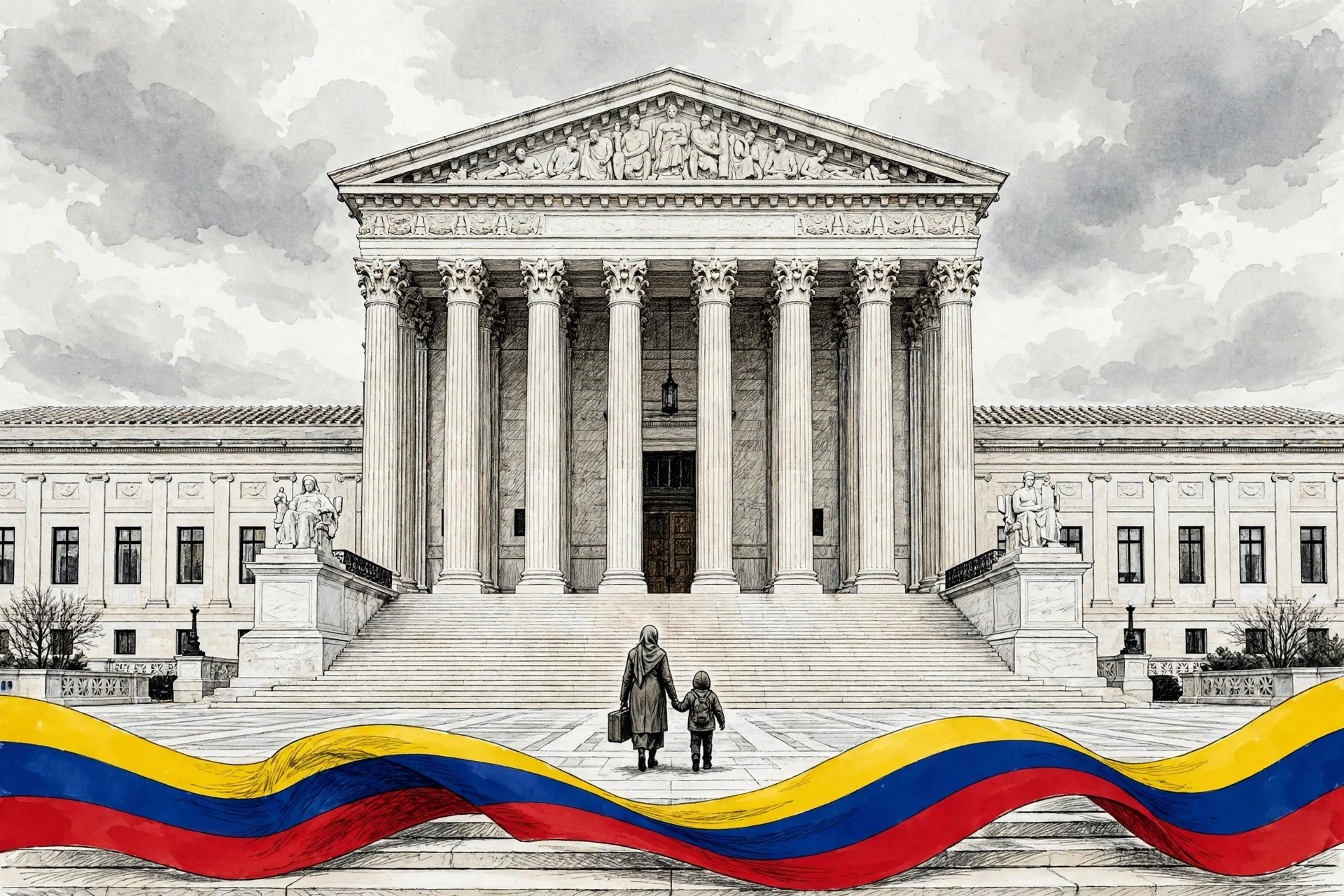
WASHINGTON — The Trump administration asked the Supreme Court on Wednesday, 18 November 2026, to halt a court order that would restore deportation protections for hundreds of thousands of Venezuelan migrants in the United States. The emergency appeal, filed by the Justice Department, is the administration’s third trip to the nation’s highest court in the long-running legal fight over Temporary Protected Status, known as TPS, for Venezuelans.
The filing came after a federal judge in California found that the administration had acted unlawfully when it ended TPS for Venezuelans, and after the United States Court of Appeals for the Ninth Circuit upheld that ruling. The administration warned the justices that, without their intervention before Friday, 20 November 2026, the lower court’s order would take effect, the government would have to restore TPS after a 19-month gap, and it could be required to release about 1,800 Venezuelans from detention. Hours later, however, the Ninth Circuit acted on its own, extending its temporary freeze on the restoration order until seven days after it issues its full ruling — a development that changed the immediate timetable and, on Thursday, 19 November, led the administration to withdraw its emergency request to the Supreme Court.
The case is Mullin v. National TPS Alliance, Supreme Court docket No. 26A714. It concerns the 2023 TPS designation for Venezuela, which was extended by the Biden administration in early 2025 and then terminated by the Trump administration. About 600,000 Venezuelans have received TPS protections since the programme began for Venezuela in 2021, according to Associated Press reporting, although it is not clear how many of those people are still living in the United States.
What the Venezuelan TPS Supreme Court Filing Asked For
The emergency application was filed by Solicitor General D. John Sauer on behalf of Homeland Security Secretary Markwayne Mullin. It asked the Supreme Court to put on hold, once again, a ruling by United States District Judge Edward Chen in San Francisco, who found that officials lacked the authority to end TPS for Venezuelans. The administration asked the justices to act at once, before the ruling took effect on Friday, 20 November.
The government argued that reinstating TPS would cause severe and immediate harm. In its filing, it said that, absent judicial intervention between now and 20 November, the Department of Homeland Security would have to resurrect TPS status for hundreds of thousands of Venezuelans after a 19-month hiatus. It said that reviving the programme would prevent the administration from carrying out up to 332 removal orders against people with final orders of removal, and would require it to provide work authorisation to people whose TPS-based permits had been invalidated.
The administration’s legal argument rested heavily on a Supreme Court decision from June 2026. In Mullin v. Doe, the court held that the TPS statute generally bars judges from reviewing the Homeland Security secretary’s decisions to grant or end a country’s TPS designation. The administration argued that this ruling settles the question in the Venezuelan case, and that Judge Chen’s decision to set aside the termination cannot survive it. It also argued that TPS is, by design, a temporary programme, and that Venezuela no longer meets the requirements for renewal.
The challengers, led by the National TPS Alliance, dispute that reading. Emi MacLean, an attorney for the alliance at the American Civil Liberties Union of Northern California, said the administration has no basis for its request to the Supreme Court. The alliance argues that the termination was unlawful for reasons that survive the June ruling, including that the decision was arbitrary, that it was based on an improper motive, and that it violated the procedures Congress set out for ending a designation. Those arguments have persuaded Judge Chen and, so far, the Ninth Circuit, even as the Supreme Court has repeatedly allowed the termination to remain in force while the case is litigated.
Judge Chen’s Ruling and the Lower Court Fight
The dispute began with two decisions by Homeland Security Secretary Kristi Noem in early 2025. On 29 January 2025, Secretary Noem announced that she was vacating a redesignation of TPS for Venezuela issued by her predecessor, former Secretary Alejandro Mayorkas, on 17 January 2025. She then terminated the designation. The Mayorkas notice had extended the 2023 designation for an additional 18 months, through 2 October 2026, and it affected about 600,000 Venezuelans then in the United States with TPS.
The National TPS Alliance and other plaintiffs sued, arguing that the termination was unlawful. On 31 March 2025, Judge Chen ordered the department to continue TPS for Venezuelans. The Supreme Court granted the government’s request for an emergency stay of that order on 19 May 2025, allowing the administration to end the programme while the appeal continued. Judge Chen then issued a final judgment on 5 September 2025, setting aside Secretary Noem’s decisions and finding that she had exceeded her authority.
The Ninth Circuit upheld Judge Chen’s ruling. The Supreme Court again paused it, in an unsigned order on 3 October 2025, so the termination remained in effect while the appeal proceeded. In June 2026, the Supreme Court decided Mullin v. Doe, limiting judicial review of TPS decisions. In October 2026, the court sent the Venezuelan case back to the Ninth Circuit to be reconsidered in the light of that ruling, and its earlier pause expired on 6 November 2026.
That sequence produced the deadline that prompted the emergency filing. The Ninth Circuit denied the government’s request for a stay on 30 October 2026, then withdrew that order on 3 November and issued a 14-day administrative stay beginning on 6 November, when the Supreme Court’s mandate was due to issue. That stay was due to run out on Friday, 20 November. The government said the Ninth Circuit had refused to issue a new stay, and that Judge Chen’s order would therefore spring into effect. In its filing, Solicitor General Sauer accused the appeals court of forcing the government to return to the Supreme Court for a third time and rehash nearly identical arguments without even a hint of justification.
How Venezuelan TPS Reached This Point
Temporary Protected Status was created by Congress in 1990 to prevent deportations to countries suffering from natural disasters, civil strife or armed conflict. The Homeland Security secretary may designate a country for TPS for periods of up to 18 months, and may extend or redesignate it if conditions in that country have not improved. People granted TPS are protected from deportation and may apply for work authorisation while the designation lasts. The programme was designed to be temporary, but in practice some designations have been renewed for many years.
Venezuela was first designated for TPS in March 2021, under President Joe Biden. The designation was expanded in September 2023 to cover additional people who had arrived more recently. Former Secretary Mayorkas designated the country once on 9 May 2021 and a second time on 3 October 2023, and his January 2025 notice extended the 2023 designation through October 2026. About 600,000 Venezuelans have received TPS protections under the two designations, although the number covered by the 2023 designation alone, which is the subject of this case, is smaller — more than 300,000 people, according to court filings and reporting on the case.
The Trump administration has taken a different approach to TPS across the board. It has terminated TPS for more than one million people from 13 countries, including Venezuela, Haiti, Honduras, Nicaragua, Afghanistan and Syria. In a change of practice in recent months, however, the administration kept protections in place for nearly 200,000 Salvadorans whose TPS was set to expire on 9 September, and for more than 100,000 people from Ukraine and Sudan, in October. The administration has not explained that distinction in the Venezuelan filing, and advocates for Venezuelans have pointed to it as evidence that the termination decisions are selective rather than driven solely by conditions in each country.
The 1,800 Detainees and 332 Removal Orders at Issue
The government’s filing put human numbers at the centre of a legal argument about procedure. Federal attorneys wrote that about 1,800 Venezuelans who previously held TPS are in detention, and that about 330 people are subject to deportation proceedings with final removal orders. Those figures, which the government itself supplied, are the reason the administration said the case could not wait for the ordinary appeals process.
For the people in detention, the difference between TPS and no TPS is immediate and practical. With TPS, a person is protected from deportation and may work lawfully. Without it, that person may be detained and removed, even if he or she has lived in the United States for years, has family here, and has no criminal record. The government argued that restoring TPS would require it to release detained people whose removal it had already ordered, and to issue work permits to people it had decided should no longer hold them.
The 332 removal orders are also a reminder that the case is not only about future policy, but about people already in the immigration system. A final order of removal means that an immigration judge has ordered a person to leave the United States, and that the person has exhausted or waived further appeals. TPS protected people with such orders from being removed while the designation lasted. If TPS is restored, those orders cannot be carried out for the covered group. If it is not, the government may enforce them.
The Supreme Court’s Earlier Interventions in the Case
The Supreme Court has now been asked three times to intervene in the Venezuelan TPS dispute, and each time so far it has allowed the termination to go ahead, at least temporarily. That history is central to the administration’s argument, because it says the court has already decided, in substance, that the termination should remain in force while the case is litigated.
The third chapter came in June 2026, when the court decided Mullin v. Doe, a separate case about TPS for Haitian and Syrian nationals. In that decision, the court held that the TPS statute bars judges from reviewing most challenges to a secretary’s decision to end a designation. The court then sent the Venezuelan case back to the Ninth Circuit to be reconsidered in the light of that ruling. The administration argued in its November filing that Mullin v. Doe settles the Venezuelan dispute, and that the Ninth Circuit should have applied it to uphold the termination.
The challengers argue that Mullin v. Doe does not end the case. They say their challenge raises questions that the June ruling did not decide, including whether the termination was arbitrary, whether it was based on an improper motive, and whether the administration followed the procedures required by law. The Ninth Circuit upheld Judge Chen’s ruling after the June decision, which suggests that the appeals court did not read Mullin v. Doe as dispositive. The Supreme Court has not yet ruled on the merits of that question.
The Ninth Circuit’s Late Move and the Withdrawal
The most important development after the filing came within hours. Late on Wednesday, 18 November, the Ninth Circuit extended its temporary freeze on Judge Chen’s restoration order until seven days after it issues its full ruling. The order means the administration can keep detaining and deporting Venezuelans who once held TPS while the court fight goes on, and it removes the immediate Friday deadline that had prompted the Supreme Court filing.
On Thursday, 19 November, the administration withdrew its emergency application to the Supreme Court. Solicitor General Sauer told the court that, in the light of the Ninth Circuit’s order, the United States was withdrawing its request. He added that if the appeals court rules against the government, it will immediately come back to the Supreme Court. The withdrawal does not mean that TPS has been restored, or that the underlying legal dispute has been resolved. It means only that the government no longer needs the Supreme Court’s help at this moment, because the appeals court has given it the pause it sought.
For Venezuelans who once held TPS, nothing changes for now. The termination remains in force, so they have no protection from detention or removal under TPS, and no work permits based on it, while the Ninth Circuit decides the appeal. If that court lets Judge Chen’s ruling stand, and the Supreme Court does not step in, the protection would come back for the covered group. If the Ninth Circuit reverses Judge Chen, the termination would stand, subject to any further appeal.
Readers should also note a correction that affects one detail in early reporting of the filing. An early version of the Associated Press report listed 30 November as the date for a response to the emergency application. The Associated Press later corrected that report to remove the incorrect response deadline, and the corrected report does not give a response date. The 30 November date should therefore not be treated as confirmed. The Supreme Court has not said when it will decide any future request in the case, and the Ninth Circuit has not said when it will issue its full ruling.
The Friday, 20 November date should also be read with care. It was the date on which Judge Chen’s order would have taken effect under the timetable in place when the government filed its application, because the Ninth Circuit’s short administrative stay was due to expire that day. After the Ninth Circuit’s late order on 18 November, that date no longer marks the restoration of TPS. No automatic reinstatement is scheduled for 20 November 2026, unless another court order changes the situation.
What Happens Next for Venezuelans Without TPS
The next step belongs to the Ninth Circuit. The appeals court must issue its full ruling on whether Judge Chen was right to set aside the termination, applying the Supreme Court’s June 2026 decision in Mullin v. Doe. It has not said when that ruling will come. Its freeze will last until seven days after it publishes its judgment, which gives the losing side time to ask the Supreme Court to intervene before the restoration order, if it is upheld, takes effect.
If the Ninth Circuit rules for the government, the challengers are likely to ask the Supreme Court to review the case. If it rules for the challengers, the government has already said it will immediately return to the Supreme Court. Either way, the dispute is likely to return to the justices, and the court will then have to decide whether to hear the case on its merits, with full briefing and argument, or to resolve it on the emergency docket as it has done before.
For the people affected, the uncertainty is itself a burden. Without TPS, former holders cannot work lawfully on the basis of that status, and they live with the risk of detention and removal. Some may have another basis to remain in the United States, such as a pending asylum claim, a family-based petition, or another form of relief. Others may not. Immigration lawyers and accredited non-profit organisations advise people in this position to seek advice about their individual circumstances, because the outcome of the litigation will not resolve every case in the same way.
Sources
USN reviewed reporting from multiple outlets for this story. Read more from Reuters, Al Jazeera and The Week.