

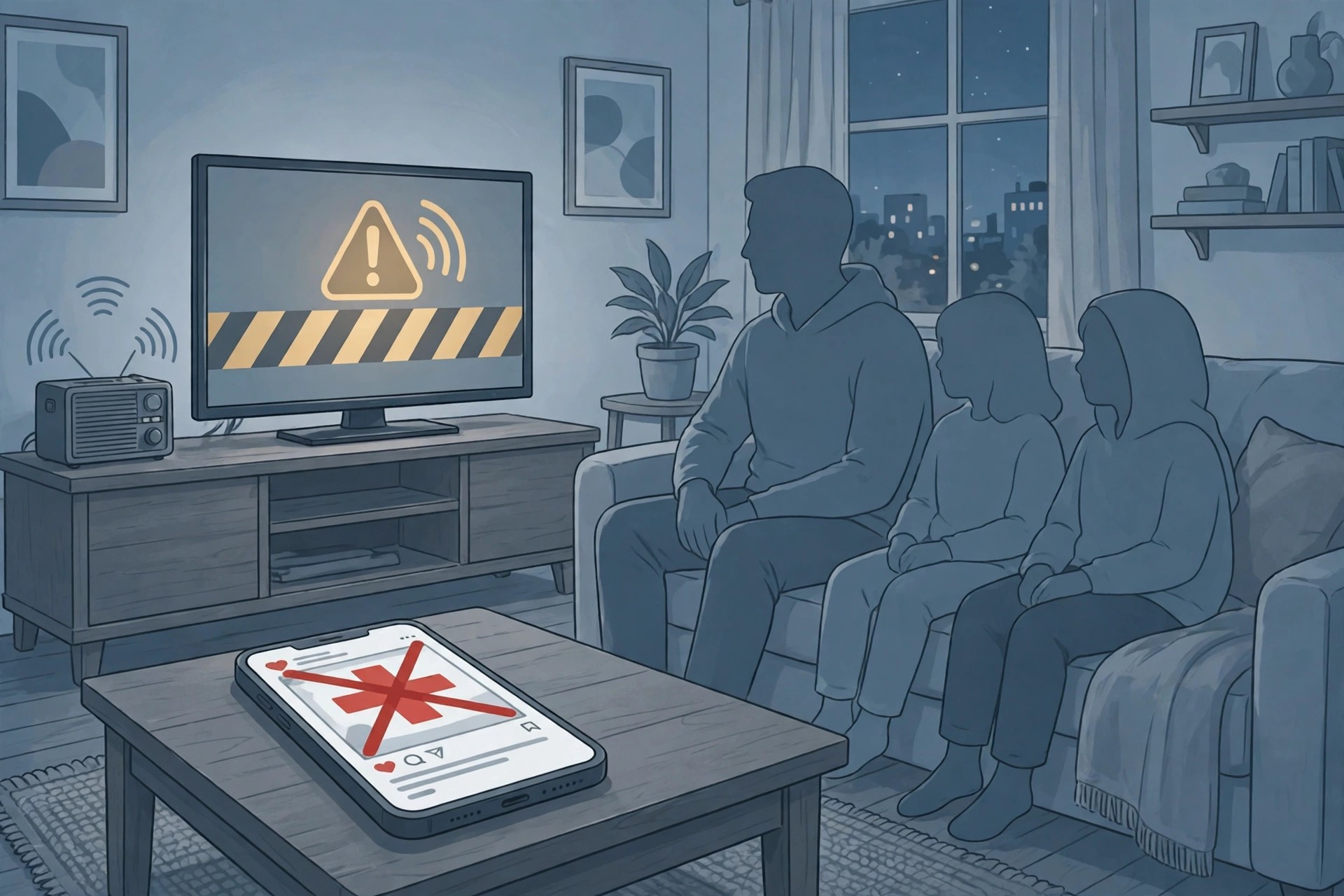
Millions of Americans heard a familiar tone interrupt their television and radio programmes on Tuesday, November 17, 2026, when the Federal Emergency Management Agency carried out a nationwide test of the Emergency Alert System at about 2:20 p.m. Eastern Time. The interruption lasted roughly one minute, carried a message that plainly described itself as a test, and required no action from anyone who heard it. Yet in the days leading up to the broadcast, the scheduled exercise had become the centre of one of the most widely shared false claims of the year: that the test was a prelude to a nationwide power blackout lasting 90 days.
That claim was false. Independent fact-checkers examined the viral posts and the videos attached to them and found no evidence of any planned shutdown of the electricity grid, no announcement from the White House or any federal agency ordering one, and no credible reporting to support the idea that the lights would go out when the test ended. The test went ahead as scheduled, and the blackout that had been predicted across social media did not happen. What did happen was a routine, legally required check of the system the United States uses to warn the public in a genuine emergency, an exercise that has been held in various forms for years and that was announced publicly two months in advance.
What the FEMA Emergency Alert Test Involved
The nationwide test was conducted jointly by FEMA and the Federal Communications Commission, the two agencies responsible for the Emergency Alert System. At approximately 2:20 p.m. Eastern Time on Tuesday, November 17, radio and television broadcasters, cable systems, satellite radio and television providers, and wireline video providers across the country interrupted their normal programming to relay the test message. The exercise was designed to examine how effectively participating broadcasters and communications providers receive a national message and pass it on to the public, and to identify any weaknesses in the chain before a real emergency makes the system necessary.
The message itself left little room for misunderstanding. It said: “This is a nationwide test of the Emergency Alert System, issued by the Federal Emergency Management Agency. This is only a test. No action is required by the public.” The wording was deliberately plain. It identified the agency responsible, described the broadcast as a test, and told listeners in direct terms that they did not need to do anything. The test was expected to last about one minute, a brief interruption rather than a sustained broadcast, and it covered the United States for the duration of the exercise.
The timing of the test was not a secret and was not decided at short notice. FEMA announced on September 17 that the test would take place on November 17, and the Federal Communications Commission issued its formal public notice a day earlier, on September 16. That two-month lead time is part of the point of a public warning test: broadcasters need to prepare, emergency managers need to know when to expect the signal, and the public is meant to recognise the message when it arrives rather than mistake it for a real alert. A backup date of December 3 was also announced in advance, to be used if an actual emergency or severe weather on November 17 made it inappropriate to run the exercise that day.
Why Your Phone Stayed Silent
One detail of the 2026 test caused particular confusion, and it helps to explain why some people who had been warned to expect an alert heard nothing at all. Unlike the nationwide exercise in 2023, this year’s test was not transmitted to mobile phones. The Emergency Alert System, which reaches the public through television and radio, is a different channel from Wireless Emergency Alerts, the separate system that delivers warnings to compatible mobile phones. Only the television and radio system was tested on November 17.
That distinction matters because many Americans have come to associate a national test with a loud alert sounding on every phone at once, as happened in 2023. When their phones stayed silent this time, some took the absence as suspicious, or as evidence that something else was happening. In fact, the silence was planned and announced in advance. FEMA’s own guidance for the test made clear that it would be carried over radio and television only, and news organisations reporting on the exercise before it took place explained that mobile phones would not receive a test alert.
The narrower scope of the test does not make it less important. Television and radio remain central to the national warning system, particularly for people who are driving, working, or otherwise away from their phones, and for communities where broadcast remains the fastest way to reach a large audience at once. Testing that part of the system on its own allows engineers and emergency managers to measure its performance without the added complexity of the mobile network. The two systems were tested together in 2023; this time, the broadcast system was examined by itself.
Where the 90-Day Blackout Claim Came From
The claim that a 90-day nationwide blackout would begin on November 17 spread through social media in the days before the test, carried largely by short video posts urging viewers to prepare for a long period without power. The posts took several forms, but they shared a common structure: a fixed date, a dramatic duration, and an instruction to stock up on food, water, and other supplies before it was too late. Some versions added that the internet would be shut down, that banks would stop working, and that a state of emergency would follow. None of them pointed to an official announcement, a government document, or a credible news report. The date itself was borrowed from the test: because the federal government had publicly scheduled an event for November 17, the rumour had a ready-made day to attach itself to.
Several unrelated events in the days before the test helped the rumour feel plausible to people who encountered it. A Microsoft Outlook outage affected users on November 12, the Federal Aviation Administration ordered a nationwide ground stop for flights on November 13 because of faulty equipment, and software outages were reported at several major banks on November 16. Each of those incidents had its own separate and ordinary cause. Microsoft described its outage as a technical issue rather than a cyberattack, and the aviation regulator allowed flights to resume the same day. But presented together in a short video, the sequence could be made to look like a pattern, and the rumour used that impression to suggest that larger failures were on the way.
Another ingredient was popular culture. An episode of the animated sitcom The Simpsons, titled “It’s a Blunderful Life,” features a fictional blackout beginning on November 17, and clips and references to the episode circulated alongside the rumour. The show has long been the subject of claims that it predicted real events, and fact-checkers have repeatedly examined those claims and found them wanting. In this case, the coincidence of the date was just that: a coincidence. A fictional episode does not constitute evidence about the electricity grid, and no official source connected the programme to the test or to any planned outage.
The Manipulated Video at the Centre of the Rumour
The most persuasive version of the claim, and the one that travelled furthest, was a video that appeared to show President Donald Trump announcing the blackout himself. In the clip, Trump appeared to say from the White House press briefing room that a 90-day blackout was coming before the end of the year. The video was shared widely on TikTok and other platforms, and at least one account that posted it used the clip to promote buying cryptocurrency before the supposed blackout, presenting the digital tokens as a way to protect money during the outage.
That video was manipulated. PolitiFact examined the clip and compared it with the original recording of the November 9 White House news conference from which the footage was taken. In the original recording, Trump said nothing about a nationwide power outage. Among other subjects, he spoke about the former Nvidia chief executive Jensen Huang and the war in Iran. The blackout announcement had been added to footage of a real event, creating the false impression that the president had made a statement he never made. PolitiFact rated the claim that a nationwide 90-day blackout would begin on November 17 as false.
Snopes reached a similar conclusion about a related set of videos. Its fact-checkers found manipulated clips of Trump circulating on Facebook and Instagram, some of which promoted cryptocurrency investments by claiming the tokens would help people financially during the supposed blackout. Snopes traced the footage to real appearances by the president, including remarks at the Lincoln Memorial Reflecting Pool on November 2 and a press discussion on November 7 in which he spoke about Russia, Ukraine, and Iran. In none of the original recordings did he announce a blackout. The organisation concluded that the videos had been altered using artificial intelligence to change the president’s mouth movements and audio, making it appear that he had said things he never said.
The White House made no such announcement. No statement from the president, the White House press office, FEMA, the Federal Communications Commission, the Department of Energy, or any electricity provider announced a nationwide shutdown, and no credible news organisation reported one. A nationwide power cut lasting three months would be the largest domestic emergency in American history, and it would be preceded by statements from multiple agencies, emergency alerts on every phone, and extensive coverage. None of that happened. The only federal event scheduled for November 17 was the one-minute test.
FORTRESS America and the Real 90 Days
The rumour did not invent the figure of 90 days from nothing. It borrowed it from a real Pentagon initiative, and understanding that initiative is the key to understanding why the claim sounded credible to so many people. On September 30, Defense Secretary Pete Hegseth announced a programme called Federal Operations for Resilience, Troop Resources, Energy, Supply and Survivability, known by the acronym FORTRESS America. Its purpose is to ensure that every major United States military installation can generate its own independent power, so that bases remain operational even if the civilian electricity grid is taken down by a cyberattack or sabotage.
On October 25, Fox News reported, citing Pentagon documents it had reviewed, that the project was preparing major military installations to sustain essential operations independently for at least 90 days. That reporting was about military readiness: bases that can keep running on their own supplies if the public grid fails. It did not say that a blackout was coming, it did not give a date, and it did not suggest that civilian power would be switched off. The 90-day figure described how long bases should be able to endure a loss of outside power, not how long the public would be without it.
The distinction was lost as the story travelled. The figure of 90 days, detached from its military context, was attached to the November 17 test date, and the result was a claim that sounded specific and sourced: a Pentagon programme, a number of days, and a date. In reality, the two halves of the claim came from different places and described different things. FORTRESS America is a resilience programme, designed to protect military operations against a grid failure that might happen. The Emergency Alert System test is a communications exercise, designed to check a warning system. Neither one announces a blackout, and neither one provides evidence that a blackout is planned.
That distinction was also the point made by the fact-checkers who examined the claim in detail. PolitiFact noted that the Defense Department had announced a project to prepare military bases to operate for 90 days in case of a blackout of the civilian electric grid, and that this did not mean a blackout was expected on November 17. Snopes examined the FORTRESS initiative separately and reported that the programme itself was real, while noting that the 90-day figure had been reported by Fox News rather than confirmed in an official document. The programme’s existence was never in doubt; what was false was the conclusion that other people drew from it.
What Officials Said Before the Test
Federal officials addressed the rumours directly in the days before the test, and their statements were consistent: the exercise was routine, it was limited to television and radio, and it involved no blackout and no secret emergency. On November 16, FEMA said it was aware of the rumours and speculation surrounding the test and described it as routine and legally required. The agency stated plainly that the test would last one minute, that no action was required, and that there were no blackouts and no secret emergencies connected to it.
Homeland Security Secretary Markwayne Mullin was asked about the claims on November 15, in an interview on Fox News. The interviewer asked whether Americans should start stockpiling food and supplies after the flight ground stop, and whether the warnings circulating online should be taken seriously. Mullin said Americans did not need to stockpile supplies for potential disruptions to power, water, and food, and dismissed the idea that a 90-day disruption was coming. He said the panic that some people were trying to generate was unfounded, and that he was not stockpiling supplies himself. His message was direct: the public should not worry unless they saw him worry, and he was not worried.
Mullin’s comments were notable because they came from the secretary responsible for homeland security, speaking two days before the test, at a moment when the rumour was spreading rapidly. He did not simply deny the claim; he addressed the behaviour it was encouraging, telling people that stockpiling was unnecessary and that the warnings had no basis. That is the kind of statement that carries weight precisely because it is specific and checkable: if a blackout had been planned, the secretary responsible for preparing the country for it would not be telling the public to carry on as normal.
What the Test Means for Emergency Readiness
Once the rumour is set aside, the test itself deserves attention on its own terms, because it is part of a system that most people only notice when it fails. The Emergency Alert System is the national public warning system that operates through radio and television, and it sits within a larger framework called the Integrated Public Alert and Warning System, which FEMA operates. The system is used for severe weather warnings, Amber Alerts, and other urgent public messages, and its reliability depends on regular testing of every link in the chain, from the federal origin of a message to the local broadcaster that carries it into homes.
A nationwide test measures something that local tests cannot. It checks whether a single national message can be received and retransmitted consistently across the country, by broadcasters of different sizes, using different equipment, in different time zones. The results of the 2026 test had not been published at the time of writing, and it will take time for the Federal Communications Commission to collect and analyse the data from participating providers. The 2023 results, showing that the overwhelming majority of providers received and retransmitted the message, set a benchmark against which the new results can be judged, and any gaps that appear will be used to improve the system.
The test ended after about a minute, the programmes it interrupted resumed, and the country carried on as normal. That outcome was not a surprise to anyone who had read the official announcements. It was the result that FEMA and the Federal Communications Commission had described in September, repeated in November, and delivered on the day. The blackout did not happen because it was never planned, and the alert that did happen was exactly what it said it was: only a test.
Sources
USN reviewed reporting from multiple outlets for this story. Read more from The Economic Times, The Sun and FINCHANNEL.