

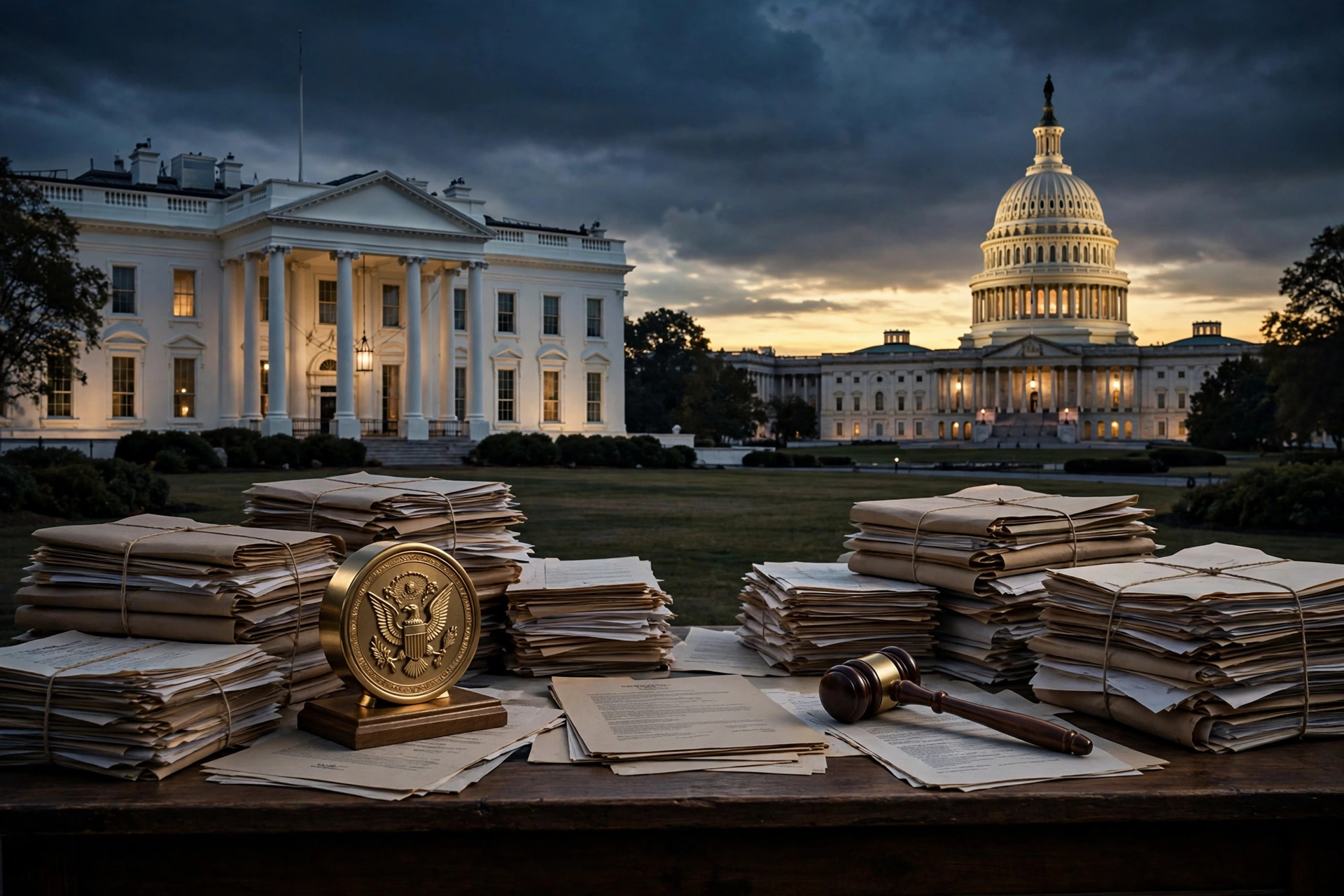
WASHINGTON — President Donald Trump has signed an executive order directing federal contractors and subcontractors to notify the White House before they answer questions from Congress, and to follow White House instructions on withholding material the administration considers protected by executive privilege. The order, signed late on Friday, November 20, 2026, applies to tens of thousands of businesses that do work for the federal government, and it warns that companies which fail to comply could lose their contracts.
The directive arrives as Democrats prepare to take control of Congress in January and launch a wave of investigations into the Trump administration. Democratic leaders have condemned the order as an attack on Congress’s constitutional power of oversight, while the White House has described it as a necessary defence of executive privilege. The dispute sets up a confrontation over who controls information about how taxpayer money is spent — and how far a president can go in shielding that information from the legislature.
The order is titled “Protecting the Executive’s Privileges and Enhancing Efficiencies in Federal Contracting.” Its core instruction is straightforward: when a contractor or subcontractor receives a request from Congress for information about its work with the executive branch, it must tell the White House and its contracting agency at once, coordinate an “appropriate response” with them, and abide by any instructions on withholding communications that the White House or the agency has determined are protected by executive privilege.
What the Executive Order Requires
Under the order, the obligation begins the moment a congressional inquiry arrives. Contractors must immediately notify the White House and the relevant contracting agency about any pending or future congressional requests relating to their communications or work with the executive branch. They must then coordinate their replies with the administration rather than answering Congress directly on their own timetable.
The order also requires contractors to “abide by any instructions received from the White House and contracting agency related to the withholding of communications that the White House or the agency has determined are protected by executive privilege.” In practice, that means the administration, not the company, decides which documents and conversations stay confidential. The White House argues that without that assurance, agencies and the White House would be “chilled from sharing sensitive information with contractors, which will stymie the operation of critical Government programs.”
The scope is broad. It covers every federal contractor and subcontractor, a universe that reporting on the order puts at tens of thousands of businesses across the United States. It covers requests about communications with the executive branch as well as about the work itself. And it applies to requests that are already pending as well as to any that arrive in the future, so companies cannot simply answer an outstanding inquiry before the new rules take hold.
The order also accuses certain congressional leaders of “harassing private companies that contract with the federal government” for information, and it reminds them that their probes must have a “valid legislative purpose.” That language signals that the administration does not intend to treat every congressional request as legitimate, and it foreshadows arguments over whether particular investigations meet the standard the order invokes.
How Federal Contractors Congress Responses Will Work in Practice
For a company holding a federal contract, the new process adds the White House as a gatekeeper between it and Congress. A request that once might have gone to a company’s lawyers and been answered in days could now require notification, consultation and clearance before any substantive reply is sent. Companies will need to decide how quickly to alert the administration, how much detail to share about the request itself, and how to handle a situation in which the White House instructs them to withhold material that a congressional committee is demanding.
The order does not spell out a timetable for the White House to respond to a notification, nor does it explain what happens if the administration does not reply promptly while a committee deadline is approaching. That silence matters, because congressional investigations often run on tight schedules, and a delay in producing documents can itself become a point of conflict between the branches.
Businesses will also have to weigh the risks on both sides. Complying with the order and withholding material could draw a contempt threat or other pressure from Congress. Refusing to follow the administration’s instructions could, under the order, cost the company its federal work. For smaller subcontractors, which may lack large legal teams, the choice could be especially difficult, and the order’s warning about termination and suspension is likely to weigh heavily in their decisions.
The administration’s position is that this coordination is routine and protective rather than obstructive. In the White House’s framing, contractors are extensions of the executive branch’s work, and the confidentiality of executive communications should travel with them. Critics reply that contractors are private companies paid with public money, and that their dealings with the government are exactly the kind of activity Congress is entitled to examine.
The White House Case: Executive Privilege and Confidentiality
The White House has presented the order as a measure to protect executive privilege from congressional overreach. A fact sheet accompanying the directive described the new requirements in those terms, arguing that the confidentiality of communications between the White House, agencies and their contractors is essential to the functioning of government.
The order’s own reasoning is that if the executive branch cannot be assured that its communications will remain confidential, officials will share less sensitive information with the companies that carry out government programmes, and those programmes will suffer. On that view, the directive does not block oversight; it channels it, ensuring that Congress receives what it is entitled to receive while genuinely privileged material stays protected.
Supporters of that approach also point to the scale of modern federal contracting. The government relies on private firms for everything from construction and technology to logistics and advertising, and the line between an agency’s own work and a contractor’s work is often blurred. The administration argues that the same privilege that shields internal White House deliberations should apply to the contractors who help implement them.
That argument, however, depends on a broad reading of executive privilege — one that extends the privilege beyond government officials to private businesses, and that lets the White House itself decide, in the first instance, what counts as privileged. Whether the courts would accept that reading has not been tested, and no court has yet ruled on this particular order.
Democrats Call the Order Unlawful
Democrats reacted swiftly and in strong terms. Representative Jamie Raskin of Maryland, who is poised to chair the House Judiciary Committee when Democrats take control in January, called the executive order “unprecedented and blatantly unlawful.” In a statement on Saturday, he said: “Federal contractors are paid with taxpayer dollars, not Trump’s personal billions. Public contractors have both a duty and a right to speak truthfully when Congress calls, and Congress has a duty to investigate and stamp out all the waste, fraud, kickbacks, shakedowns and corruption choking the government and driving up costs.”
Representative Robert Garcia of California, the incoming chair of the House Oversight Committee, condemned the order on Saturday in a post on social media. “Today’s executive order is the latest in the Trump Administration’s blatant attack on Congress’ constitutional right to conduct oversight,” he wrote. “What is the White House trying to hide? Donald Trump wants to stop us from exposing the rampant waste, fraud, and corruption by his Administration, but we’re just getting started.”
The Democratic case rests on the Constitution’s grant of oversight power to Congress. Lawmakers argue that the power to investigate how public money is spent is inherent in the power to appropriate it, and that a president cannot use an executive order to insert himself between Congress and the private companies it wishes to question. They also note that the order threatens contractors with the loss of their livelihoods, which they say amounts to coercion rather than a good-faith claim of privilege.
Democrats have also pointed to the timing. The order came weeks before a change of control in Congress, after an election in which Democrats won control of both chambers. In their telling, the directive is not a neutral housekeeping measure but a pre-emptive move to blunt investigations that have not yet begun. The White House rejects that characterisation and insists the order protects a legitimate constitutional interest regardless of which party controls Congress.
The Investigations Democrats Are Preparing
The investigations Democrats say they will pursue explain why the order has drawn such a sharp response. They have identified federal contracts as a major target, and they have already sketched out several lines of inquiry that would depend heavily on documents and testimony from contractors.
One focus is the construction of the White House ballroom, a project Democrats have questioned over its cost and the choice of builder. Senator Richard Blumenthal of Connecticut, who will chair a key Senate investigative panel, earlier this month sent letters to a series of companies asking them to cooperate with a planned inquiry into the ballroom. He had previously requested information from the construction firm carrying out the project about the ballroom’s anticipated cost and how it came to be chosen as the builder.
Democrats have also said they will examine the repairs to the Lincoln Memorial Reflecting Pool and the planned renovations of the Kennedy Center, both of which involve substantial federal spending and contracts awarded under the Trump administration. They have said they will look at the influx of contracts the Department of Homeland Security has granted during Trump’s second term, including contracts to support Immigration and Customs Enforcement deportation operations and contracts for the construction of additional border wall in Big Bend National Park.
Representative Henry Cuellar, the ranking Democrat on the House Appropriations Homeland Security subcommittee, has said that once Democrats are in control, “there’s a lot more we can do on guardrails,” referring to bringing the department’s funds under his committee’s oversight. Democrats have also raised the case reported by ProPublica last year in which a firm run by the husband of the department’s chief spokesperson, Tricia McLaughlin, was subcontracted to produce an advertising campaign for the department in a 200 million dollar deal. McLaughlin told ProPublica at the time that the department had no visibility into which subcontractors were selected and that she had recused herself because of the conflict of interest.
A separate potential investigation concerns Elon Musk’s SpaceX. A senior congressional Democrat warned on Friday that lawmakers will withhold government funding for systems developed by SpaceX if the Trump administration and the company refuse to disclose who was responsible for ordering the slowdown of Ukraine’s military-grade Starlink satellite service. That warning shows how wide the planned oversight could reach — from construction and advertising to satellite communications and foreign policy.
The Earlier Scharf Memos and the Wider Pattern
Friday’s executive order did not arrive in isolation. It is the latest in a series of steps the White House has taken to exert greater control over how agencies, officials and private contractors respond to congressional inquiries, in anticipation of a flood of investigations once Democrats take over.
Earlier in the same week, White House counsel Will Scharf told federal agencies that they must seek approval from his office and the White House’s Office of Legislative Affairs before agreeing to allow officials to appear before Congress. That memo covered testimony by government personnel; the executive order extends a similar logic to the private sector, covering the companies that work alongside those personnel.
Scharf also wrote to Representative Garcia, the incoming Oversight chair, saying that the administration “will not be extorted and will not be cowed by unlawful process motivated by animus, pettiness, hatred, or any other unlawful motive to intimidate, penalize or interfere with the lawful functioning of government.” In a separate letter to Democratic committee leaders, Scharf stated that Trump administration officials do not have to comply with demands to preserve or turn over records because of the Democrats’ current status in the congressional minority.
Taken together, the memos and the executive order amount to a coordinated position: the administration will decide which requests it regards as lawful, which officials may testify, which records must be preserved, and which contractor communications may be withheld. Democrats describe that as a blanket refusal to cooperate. The White House describes it as a defence of the executive branch against what it calls unlawful process. The clash is likely to be tested first in the committees themselves, and then, if either side pushes the matter, in court.
What Happens If a Contractor Does Not Comply
The order’s enforcement mechanism is its most direct threat to businesses. It warns that contractors who fail to notify the White House and coordinate with it before responding to congressional requests could face legal action, have their contracts cancelled, or be suspended from future federal work. For companies that depend on government business, that is a serious sanction — and one the administration can impose without going to court first.
The warning raises practical questions that the order does not answer. It does not define how much coordination is enough, or what counts as an “appropriate response” in a given case. It does not say whether a contractor that answers a routine factual question without waiting for White House clearance would be treated the same as one that hands over documents the administration has marked as privileged. And it does not explain how a contractor should respond if Congress issues a subpoena that directly conflicts with a White House instruction to withhold material.
Legal experts are likely to focus on that conflict. A congressional subpoena carries the force of law, and a private company that defies one risks contempt proceedings. An executive order, by contrast, is a presidential directive, and its power over private parties is more limited than its power over executive agencies. Whether the order can lawfully require a private company to defy a congressional demand is a question that may ultimately be decided by a federal court, if a contractor is caught between the two and asks a judge to resolve the dispute.
Until such a case arises, companies are likely to proceed cautiously, notifying the White House as instructed and seeking legal advice before producing anything sensitive. That caution is itself part of the order’s effect: even without a court ruling, the directive may slow the flow of information to Congress while the legal questions remain unresolved.
Legal Experts Warn the Order Stands on Shaky Ground
Within days of the signing, legal specialists began picking apart the order’s foundations. Jessica Tillipman, associate dean for government procurement law at George Washington University Law School, wrote on 23 November that the administration was on weak legal footing when a contractor gives Congress nonprivileged information about potential misconduct in public spending. She pointed to the D.C. Circuit’s ruling in United States v. Navarro, which held that only the president or an authorised representative can invoke the presidential communications privilege — while the executive order lets agencies decide for themselves what counts as privileged. A contractor that withholds subpoenaed information at an agency’s direction without a valid privilege claim risks being held in contempt, she argued.
A client alert from the law firm Crowell & Moring, cited in trade reporting, warned that the order “will likely face court challenges, has little precedent in the government contracting field and will force contractors to grapple with how the EO is to be understood in light of existing laws mandating cooperation with Congress.” A separate alert from the law firm Wiley, published on 23 November, noted that the order directs the Office of Management and Budget to develop guidance on how agencies should ensure contractors comply, but sets no timeline for that guidance, and directs each agency to “promptly inform all contractors and subcontractors” of the new requirements — a step that may prompt contract modifications or formal correspondence from contracting officers.
Trade publication Engineering News-Record added a note of caution about the order’s reach: it does not expressly require contractors to obtain White House permission before appearing before Congress, and it does not declare every record tied to federal contracts privileged. As of 23 November, no court had ruled on the order and no contractor had publicly challenged it — but the legal analysis published in its first days suggests the first confrontation, when it comes, is as likely to be in a courtroom as in a committee room.
What to Watch Next
The first test will come in January, when Democrats take control of Congress and begin issuing the requests they have been previewing for weeks. How quickly the White House responds to contractor notifications, how much material it instructs companies to withhold, and how committees react to delays or refusals will all shape the early months of the new Congress.
A second test may come in the courts. If a committee subpoenas a contractor and the company withholds documents on White House instructions, the committee could seek enforcement in federal court, forcing a judge to weigh Congress’s oversight power against the administration’s claim of executive privilege. Alternatively, a contractor could challenge the order itself, arguing that the president cannot condition federal contracts on surrendering the right to answer Congress.
A third question is whether the order changes the behaviour of contractors before any confrontation occurs. Some companies may decide that the risk of losing federal work outweighs the risk of angering a committee, and may route every congressional contact through the White House as instructed. Others, particularly large firms with their own legal resources, may push back, arguing that their duty to answer Congress truthfully cannot be overridden by an executive order.
What is clear is that the order has turned a procedural question — how contractors answer Congress — into a constitutional one. The White House says it is protecting the confidentiality the executive branch needs to function. Democrats say it is an attempt to hide the administration’s spending from the people elected to oversee it. With control of Congress about to change hands, that argument is only just beginning.
Sources
USN reviewed reporting from multiple outlets for this story. Read more from CNN, NDTV and Washington Technology.