

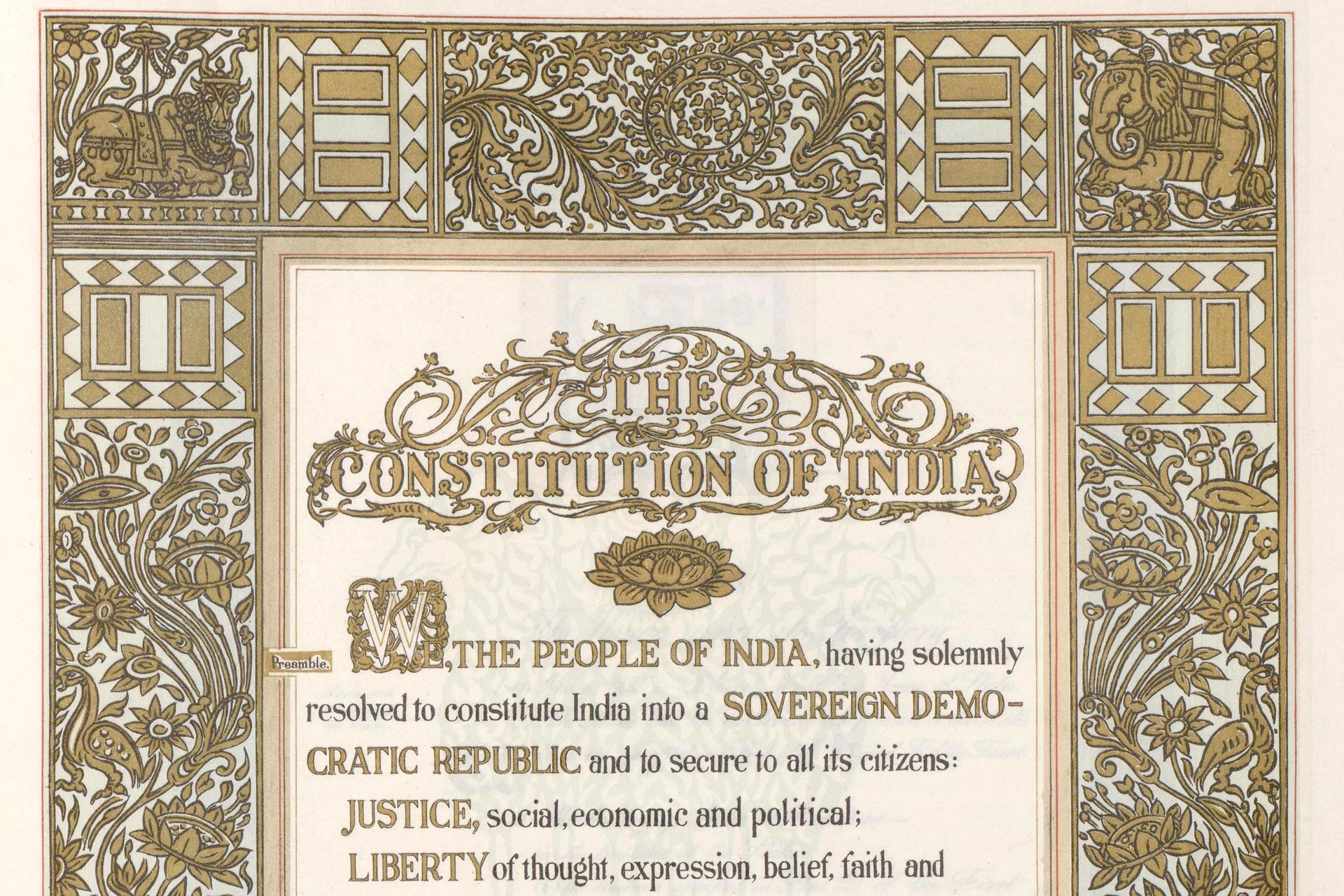
NEW DELHI — The Constitution of India is now available in updated editions in all 22 languages listed in the Eighth Schedule of the Constitution, after Vice-President Shri C. P. Radhakrishnan released the new editions at a ceremony at Vigyan Bhawan in New Delhi on Constitution Day, 26 November 2026. The release means that the country’s founding document, which sets out the rights of citizens and the structure of the Indian state, can now be read in its updated form in every language that the Constitution itself recognises in its Eighth Schedule, from Assamese in the east to Gujarati in the west, and from Kashmiri in the north to Tamil in the south.
The Vice-President described the release as a historic milestone. Addressing the gathering, he said that access to the Constitution in one’s own mother tongue brings governance closer to citizens and deepens democratic participation, a point that goes to the heart of what the day was meant to mark. A Constitution that citizens can read in the language they think and speak in is a Constitution they can understand, claim and use, and the ceremony at Vigyan Bhawan was presented as a step towards making that understanding available to every Indian, in the language of their home.
Union Minister of State (Independent Charge) for Law and Justice Shri Arjun Ram Meghwal was present at the release, along with Dr. Rajiv Mani, Secretary of the Legislative Department, and other dignitaries. The Vice-President praised the Minister and his team for the work that went into preparing the updated editions, a task that involves careful translation and legal checking across 22 languages, each with its own script, vocabulary and traditions of legal expression. The presence of the Law and Justice Ministry’s leadership underlined that this was not only a ceremonial occasion but the outcome of sustained official work behind the scenes.
A Release on Constitution Day
The choice of day was deliberate. Constitution Day, also known as Samvidhan Diwas, is observed every year on 26 November, the date on which the Constituent Assembly adopted the Constitution in 1949. The release of the updated editions in all 22 Scheduled Languages on this day tied the work of translation directly to the anniversary of the document itself, and the Vice-President used the occasion to pay tribute to Dr. B. R. Ambedkar, who chaired the Drafting Committee, and to the members of the Constituent Assembly whose debates and decisions shaped the text that was adopted that day.
In his address, the Vice-President said, “The Constitution is far more than a legal framework. It is the living spirit of our nation.” The words capture the way the Constitution is spoken about in India, not only as a set of rules for government but as a shared statement of the values on which the Republic rests, including justice, liberty, equality and fraternity, the four ideals named in the Preamble. By releasing the updated editions on Constitution Day, the ceremony linked the newest form of the text to the oldest promise of the Republic, that the Constitution belongs to all of its people.
The event was one of several Constitution Day observances held across the country on 26 November 2026. President Droupadi Murmu graced the Constitution Day celebrations at the Supreme Court, and the Ministry of Parliamentary Affairs facilitated an online reading of the Preamble through MyGov in 23 languages, the 22 Scheduled Languages and English, so that citizens could read the opening words of the Constitution in their own language. The Viksit Bharat Yuva Samvad, a youth dialogue, was also held across 786 districts as part of the day’s celebrations, bringing the observance beyond the capital and into districts across the country.
The Constitution in Every Scheduled Language
The 22 languages in which the updated editions have now been released are Assamese, Bengali, Bodo, Dogri, Gujarati, Hindi, Kannada, Kashmiri, Konkani, Maithili, Malayalam, Manipuri, Marathi, Nepali, Odia, Punjabi, Sanskrit, Santali, Sindhi, Tamil, Telugu and Urdu. Together, these are the languages listed in the Eighth Schedule of the Constitution, and together they cover the mother tongues of the overwhelming majority of the people of India, spoken across every state and union territory, in scripts that range from Devanagari to Tamil, from Bengali to Malayalam, and from Perso-Arabic to Ol Chiki.
During the ceremony, the Vice-President referred to official translations in Nepali, Santali, Bodo, Tamil, Gujarati and Sindhi, drawing attention to the range of languages involved and to the work of rendering a legal text faithfully into each of them. Translating a Constitution is not a matter of replacing one word with another. Legal terms carry precise meanings, and a translation must preserve the force of the original while reading naturally in the language into which it is rendered, so that a reader in any of the 22 languages encounters the same rights, the same duties and the same structure of government.
That is why the description of the new volumes as updated editions matters. The Constitution adopted in 1949 has been amended many times in the decades since it came into force, and an edition that is described as updated is one that carries the text as it stands today, with the changes made through amendments reflected in it. For a reader, that means the book in hand is the working text of the Republic as it stands today. Releasing updated editions in all 22 languages at once means readers in every Scheduled Language have access to the same current text.
How the Eighth Schedule Grew to 22 Languages
The Eighth Schedule did not begin with 22 languages. When the Constitution came into force on 26 January 1950, the Schedule originally listed 14 languages: Assamese, Bengali, Gujarati, Hindi, Kannada, Kashmiri, Malayalam, Marathi, Odia, Punjabi, Sanskrit, Tamil, Telugu and Urdu. Those 14 were the languages recognised at the birth of the Republic, and the list has grown in stages since then, as Parliament has added languages through constitutional amendments, each addition reflecting the recognition of a language community’s place in the life of the nation. Article 343 provides that Hindi in the Devanagari script shall be the official language of the Union, while English continues to be used for official purposes.
The first addition came with the 21st Amendment in 1967, which added Sindhi to the Schedule, bringing the total to 15. Sindhi, a language with a long literary tradition, had been spoken in India long before Independence, and its inclusion marked the first expansion of the list. For 25 years after that, the Schedule remained at 15 languages, until the 71st Amendment in 1992 added three more, Konkani, Manipuri and Nepali, taking the total to 18. Konkani is the language of Goa and parts of the western coast, Manipuri is the language of Manipur, and Nepali is spoken in Sikkim, Darjeeling and other parts of the Himalayan region, and each addition recognised a community whose language is central to its identity.
The most recent expansion came with the 92nd Amendment in 2003, which added four languages, Bodo, Dogri, Maithili and Santali, and brought the total to the 22 that stand today. Bodo is spoken in Assam, Dogri in Jammu, Maithili in Bihar and Nepal, and Santali, written in the Ol Chiki script, is spoken by the Santal people across eastern India. The 2003 amendment was the largest single expansion of the Schedule, and it has remained unchanged in number since then, so that the 22 languages of today are the product of more than half a century of gradual recognition.
Understanding this history helps to explain why the release of the Constitution in all 22 Scheduled Languages was described as a milestone. Each language in the Schedule arrived there through its own journey, and the presence of the Constitution in each of them is a recognition of that journey. The Vice-President recalled the Tamil poet Mahakavi Subramania Bharati, who referred to 18 languages in his writing about India, and noted that India now recognises 22 languages under the Eighth Schedule, a contrast that places the growth of the Schedule within a longer story of how India has come to understand its own linguistic richness.
Seventy-Seven Years of the Constitution
The release on 26 November 2026 fell on the 77th Constitution Day, 77 years after the Constituent Assembly adopted the Constitution on 26 November 1949. The Assembly had debated the draft for nearly three years, and the adoption of the text on that November day in 1949 marked the end of that long process of discussion and the beginning of the Republic that would come into force on 26 January 1950, a date now observed as Republic Day. Constitution Day itself has been observed since 2015, as a day for citizens to remember the adoption of the Constitution and to reflect on its meaning.
The 77th anniversary is a reminder of how long the Constitution has served as the framework of Indian democracy. In those 77 years, India has held regular elections, seen peaceful transfers of power, and built institutions that operate within the rules the Constitution sets out. The Constitution has been amended many times, and its interpretation has been shaped by the courts, but the text adopted in 1949 remains the foundation, and the Preamble’s promise of justice, liberty, equality and fraternity remains the measure against which the Republic is judged.
The tributes paid at the ceremony to Dr. B. R. Ambedkar and the members of the Constituent Assembly reflected that history. Ambedkar, as chairman of the Drafting Committee, guided the draft through the Assembly, and the members of the Assembly, drawn from across the country, debated every part of the text, from fundamental rights to the structure of the Union and the states. Their work produced a document that was, at the time of its adoption, among the longest constitutions in the world, and it remains a text that Indians return to whenever the meaning of democracy, rights or federalism is debated.
The observance of Constitution Day has grown in recent years into a nationwide occasion, and the 2026 celebrations reflected that breadth. The online Preamble reading facilitated by the Ministry of Parliamentary Affairs through MyGov, in 23 languages including English, invited citizens to read the Preamble aloud, a simple act that has become a central part of the day. The Viksit Bharat Yuva Samvad, held across 786 districts, brought young people into the conversation about the Constitution and the country’s future, and the celebrations at the Supreme Court, graced by the President, placed the judiciary, the guardian of the Constitution, at the centre of the day.
Why the Constitution in 22 Languages Matters
The Vice-President’s central argument at the ceremony was a simple one, that access to the Constitution in one’s mother tongue brings governance closer to citizens and deepens democratic participation. The argument rests on a fact of everyday life, that people understand their rights best in the language they first learned, the language in which they think, argue and make decisions. A citizen who can read the Constitution in that language does not need an intermediary to explain what it says, and can judge for themselves what the state owes them and what they owe the state.
This matters most for the rights that the Constitution guarantees. The fundamental rights, including the right to equality, the right to freedom of speech and expression, the right to life and personal liberty, and the right against exploitation, are the parts of the Constitution that citizens encounter most directly, whether in a dispute with an official, in a court, or in the exercise of a freedom. When those rights are available to read in a person’s own language, the gap between the promise of the Constitution and the understanding of the citizen narrows, and the rights become something a person can invoke, rather than something they have only heard about.
It matters too for democratic participation. Voting is the most visible act of participation, but democracy also depends on citizens following public debate, understanding the powers of governments, and holding those in power to account. A Constitution in one’s own language makes the rules of that debate accessible, so that a citizen can see what the Union government may do, what a state government may do, and where the limits of each lie. In that sense, the release is not only about books, but about the conditions under which democracy is practised, and the Vice-President’s words at Vigyan Bhawan connected the translation of the text directly to the health of democratic life.
The point is especially important for languages whose speakers have historically had less access to official texts. Speakers of Hindi and English have long been able to find the Constitution in their languages, and translations have existed in several other languages, but the release of updated editions in all 22 Scheduled Languages at once is a statement that access should not depend on which language a citizen speaks. A Santali speaker in Jharkhand, a Bodo speaker in Assam, a Dogri speaker in Jammu, a Manipuri speaker in Imphal and a Konkani speaker in Goa are all, in principle, placed on the same footing as a Hindi or English speaker, with the same text available in their own language.
Languages as Carriers of Culture and Identity
In his address, the Vice-President said that languages are carriers of culture, tradition and identity, a description that frames language not only as a means of communication but as the vessel in which a community’s memory, literature and way of life are carried from one generation to the next. The release of the Constitution in 22 languages can be seen in that light, not only as a legal publication but as an act of cultural recognition, in which the founding document of the Republic is placed within the languages that carry India’s many cultures.
The Vice-President cited two initiatives in this context, Gyan Bharatam and the Kashi Tamil Sangamam, both of which have been promoted under Prime Minister Narendra Modi. Gyan Bharatam is an initiative connected with the preservation and study of India’s knowledge traditions and manuscripts, while the Kashi Tamil Sangamam is a gathering that celebrates the cultural links between Tamil Nadu and Kashi, or Varanasi, bringing together Tamil and northern traditions in a shared celebration. By citing these initiatives, the Vice-President placed the release of the Constitution in 22 languages within a wider effort to preserve and celebrate India’s linguistic and cultural heritage.
The reference to Mahakavi Subramania Bharati carried the same message. Bharati, the Tamil poet whose writing celebrated India’s unity in its many languages, referred to 18 languages in his work, and the Vice-President noted that India now recognises 22 languages under the Eighth Schedule. The comparison is a reminder that the recognition of languages has grown over time, and that the India Bharati wrote about, rich in languages, has become richer still in the languages it formally recognises. The poet’s vision of a land of many tongues, and the Constitution’s list of 22 languages, were presented as part of the same story.
The Vice-President also linked the release to the ideas of Ek Bharat, Shreshtha Bharat, the vision of one India, strong in its unity and in its diversity, and to the journey towards Viksit Bharat by 2047, the goal of a developed India by the centenary of Independence. The argument presented was that a country whose citizens understand their founding document is better placed to build its future, and the Vice-President closed with the call of Nation First, Rashtra Pratham, that the nation comes first.
From Publication to Everyday Use
What “updated editions” means in practice is worth spelling out, because the phrase carries the substance of the release. The Constitution has been amended repeatedly since it came into force in 1950, and each amendment changes the text, whether by adding a right, changing the structure of government, or updating the lists and schedules. An updated edition brings all of those changes together into a single current text. For the 22 languages, that means the translations have been brought up to date with the Constitution as it stands today.
What happens next is the practical question that follows any publication, and it is the question on which the long-term value of the release will depend. The editions have been released, and the next stage is for them to reach the places where they will be used, including libraries, schools, colleges, courts, government offices and the homes of citizens who want them. The release ceremony is the beginning of that process, not its end, and the work of distribution, awareness and use is what will decide whether the books become a living resource or a ceremonial one.
That distinction, between publication and everyday use, is the honest frame in which to view the release. The publication of the Constitution in 22 languages is a real achievement, and the ceremony at Vigyan Bhawan marked it as such, but the existence of a translation does not by itself guarantee that it will be read. Awareness remains the test. The updated editions in 22 languages remove one barrier, the absence of the text in a person’s own language, but the wider challenge of bringing citizens to the Constitution, and the Constitution to citizens, remains.
That challenge is not a criticism of the release, but a description of the work that follows it. Schools and colleges can use the editions in teaching about the Constitution, and libraries can place them where readers can find them. The Preamble reading in 23 languages on Constitution Day showed one way in which the text can be brought to citizens, and the youth dialogue held across 786 districts showed another.
Sources
USN reviewed reporting from multiple outlets for this story. Read more from Press Information Bureau, DD India and Asianet News (ANI).