

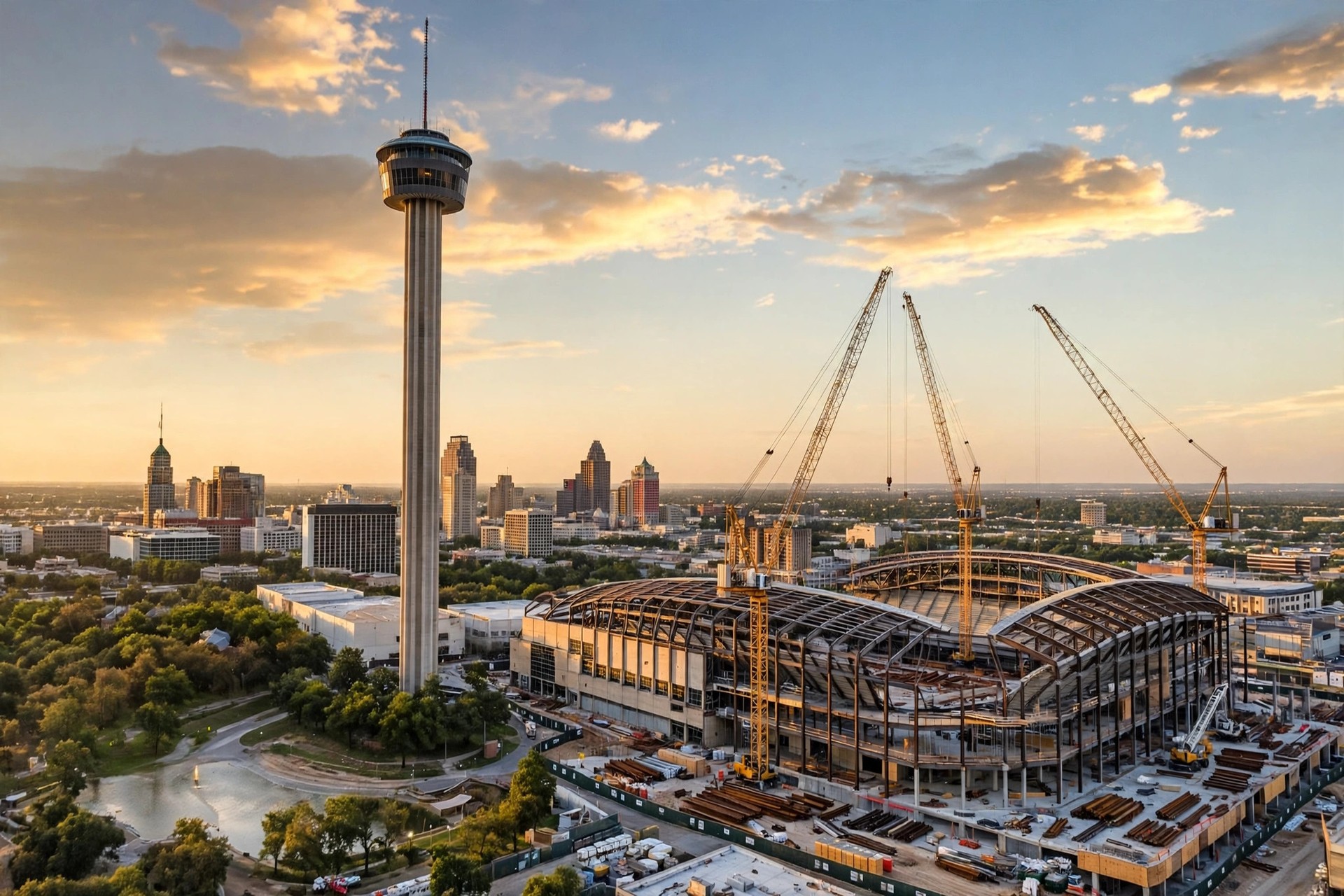
SAN ANTONIO — The plan for a new downtown home for the San Antonio Spurs moved decisively closer this week, as the two land deals at the heart of the project came into focus at the same time. On Thursday 19 November, the University of Texas System Board of Regents voted to authorise the sale of about 13.6 acres at Hemisfair, the former Institute of Texan Cultures site, to the City of San Antonio for the proposed arena. Alongside that vote, the city already holds about 5.7 acres bought from the federal government for the surrounding development, after the United States General Services Administration, known as GSA, completed a 30 million dollar negotiated sale of federal property in the area five years ahead of schedule. Together, the two parcels give the city control of the ground on which the most ambitious downtown redevelopment in San Antonio in a generation is supposed to rise.
The proposed arena would sit at the south-east corner of Hemisfair, in the centre of a wider sports and entertainment district known as Project Marvel. The facility is planned as a roughly 1.3 billion dollar building, with the city contributing 489 million dollars, Bexar County contributing 311 million dollars and Spurs Sports and Entertainment, the company that owns the team, paying the rest, according to reporting on the financing framework. The team hopes to open the building in July 2030, in time for the 2030-31 National Basketball Association season, about two years before its lease at the county-owned Frost Bank Center runs out in 2032. None of that is built yet, and the Hemisfair land sale itself has not closed, but the regents vote removed the largest single obstacle standing between the plan and a signed purchase agreement.
City officials expect that purchase agreement to be finalised in early 2027, with the sale itself expected to close in early 2027 after due diligence and the issuing of debt to fund the purchase, according to KSAT reporting. The city plans to use money from the Midtown Tax Increment Reinvestment Zone, a financing tool that captures growth in property tax revenue inside a defined district, to pay for the land. Reporting on the plan puts the land cost at up to 60 million dollars, with financing costs taking the total to more than 115 million dollars over time. The city has also said the proposed agreement could include a swap of city-owned property with the university system that would reduce the cash price if such an exchange proves feasible. For now, the price is still being negotiated, and the final contracts will need approval from the San Antonio City Council.
The 30 Million Dollar Federal Sale That Cleared the First Hurdle
The federal piece of the puzzle was completed by GSA through a 30 million dollar negotiated sale of federal property to the city of San Antonio, carried out in partnership with the Spurs. GSA said it completed the transaction five years ahead of schedule, using a short-term sale-leaseback agreement that allowed the agency to dispose of the underused property while federal tenants continued to operate without interruption. The sale covered three parcels totalling 5.7 acres, including the San Antonio Federal Building West at 727 East Cesar E. Chavez Boulevard and two parking lots directly across the street. The purchase was funded by the Spurs, according to GSA and the city.
San Antonio City Manager Erik Walsh described the closing as an important step forward for downtown San Antonio, saying the 30 million dollar purchase, funded by the Spurs, gives the city a chance to help guide future growth and redevelopment in the heart of the city as it works towards a downtown sports and entertainment district and a new Spurs arena. Spurs Sports and Entertainment chief executive RC Buford said the milestone supports the ongoing planning for the downtown arena district and reflects a shared commitment to creating a place that will serve San Antonio for generations. GSA Administrator Edward C. Forst said the sale was another example of the agency carrying out the federal directive to strengthen the federal real estate portfolio, and said the accelerated process allowed the government to divest an asset that no longer supported its operational needs.
The federal land sits next to the planned arena site, and city officials see it as part of the surrounding development rather than the arena footprint itself. The distinction matters, because the arena needs the larger Hemisfair parcel, while the federal parcels help assemble the wider district of streets, public space and commercial buildings around it. GSA said the sale removes the property from the federal inventory while creating opportunities for local economic redevelopment. The agency also reported that it has disposed of more than 127 properties since January 2025, generating 614 million dollars in proceeds, as part of a broader effort to reduce the cost of federal real estate.
UT Regents Vote Opens the 13.6-Acre Hemisfair Site
The regents vote on 19 November was the decision the arena plan had been waiting for. The University of Texas System Board of Regents authorised UT San Antonio to sell the 13.59-acre former Institute of Texan Cultures site at Hemisfair to the City of San Antonio, according to the San Antonio Report. The land has been sitting vacant since the museum building was demolished, and it is the planned location for the new arena. The vote does not by itself transfer the land. It authorises the university and the city to proceed with negotiations towards a purchase and sale agreement, which officials expect to be finalised in early 2027.
The site will be owned by a subsidiary controlled by city officials, with participation from Bexar County, according to reporting on the ownership structure, and the arena will be leased to the team. That structure is common for publicly supported sports facilities in Texas, where a public entity owns the building and the team operates it under a long-term lease. The arrangement also reflects the funding split, with both the city and the county putting public money into the project and the team contributing private money and taking responsibility for cost overruns, according to the Spurs chief legal officer, who spoke to KSAT about the next steps.
The regents vote followed months of public debate about the site and its history. The Institute of Texan Cultures building was listed on the National Register of Historic Places in 2024, and demolition began in April 2025 despite lawsuits seeking to stop it, according to reporting on the building. The museum itself had closed in May 2024, after announcing it would move to a temporary location in the Frost Bank Tower downtown. Supporters of the arena plan argued that the vacant site was the only downtown location large enough for a modern arena and its surrounding district. Critics argued that the city was moving too fast, and that the loss of a landmark cultural building deserved more public discussion. The regents vote settles the question of whether the land can be sold, but not the wider argument about what should be built on it.
How the San Antonio Spurs Arena Land Sale Fits Together
Put together, the two land deals give the project a footprint of about 19.3 acres in the south-east corner of Hemisfair, assembled from two different sellers at two different times. The federal government sold 5.7 acres for 30 million dollars, funded by the Spurs, and the university system is now authorised to sell about 13.6 acres, with the city expecting to pay up to 60 million dollars for that parcel before financing costs. The city council approved the purchase of the university land in principle in September, after hearing speakers for and against the move, and the Midtown Tax Increment Reinvestment Zone board has approved funding for the acquisition. The final price, the terms of any property swap and the closing date all remain to be settled in the purchase agreement expected in early 2027.
The timing of the two deals also tells a story about how long the project has been in preparation. The city first revealed plans for a sports and entertainment district anchored by an arena in November 2024, and the informal name Project Marvel had already appeared in city records by September of that year. The city, Bexar County and the Spurs signed a non-binding memorandum of understanding in April 2025, and the city council approved a non-binding term sheet for the arena deal in August 2025. The federal sale and the regents vote are the first steps that turn those paper agreements into land the city actually controls, and that is why local officials have treated them as milestones even though no construction has begun.
There is still a long way to go before a single foundation is poured. The Spurs hope to begin an early works package at the site in about a year, and to begin vertical construction in the first quarter of 2028, according to the team’s chief legal officer. That schedule leaves about two and a half years between the expected land closing in early 2027 and the start of vertical construction, a period that will be filled with design work, permitting, community consultation and the negotiation of the final development, lease and community benefits agreements. The team has not yet revealed a final design for the arena, and has confirmed that it will not look like the original illustrative rendering the city included in its first presentation in November 2024.
Who Pays for the 1.3 Billion Dollar Arena
The financing framework for the arena divides the roughly 1.3 billion dollar cost three ways. The City of San Antonio would contribute 489 million dollars, Bexar County would contribute 311 million dollars, and Spurs Sports and Entertainment would contribute at least 500 million dollars, according to reporting on the proposed funding. The team has also agreed to cover construction cost overruns, a commitment its chief legal officer repeated in the KSAT interview, saying there will be cost increases but that the Spurs, not the public, will be responsible for them. The arena is proposed to seat between 17,000 and 18,500 people, according to reporting on the project, and the city would own the building while the team pays a lease fee and keeps naming and sponsorship rights.
The county share was decided by voters. On 4 November 2025, Bexar County voters approved Proposition B, which authorised an increase in the county hotel occupancy tax to help generate up to 311 million dollars for the proposed arena. About 52 percent of voters supported the measure, a narrow margin that reflected how divided the county was about public funding for a professional sports facility. A companion measure, Proposition A, which funded improvements to the Frost Bank Center and Freeman Coliseum and a year-round rodeo facility, passed with about 56 percent of the vote. The county money comes from a venue tax on hotel stays and car rentals, so visitors to San Antonio pay a large share of it, although local residents who stay in hotels or rent cars also contribute.
The city share is more complicated, and it has been the subject of the fiercest political argument. Unlike the county contribution, the city contribution did not go before voters in a separate referendum, and that distinction became central to the debate in 2026. The city money is expected to come from several sources, including the arena lease and a downtown Project Finance Zone, a state-approved tool that allows the city to capture growth in hotel-related tax revenue within three miles of the arena over 30 years. The non-binding terms for the arena deal state that the city share is subject to voter passage of a city bond programme to support the first phase of transport and pedestrian infrastructure improvements for the sports and entertainment district, and the city manager has warned that if that bond fails, the city would have to re-examine the whole project. Community bond committees have begun meeting to discuss which projects will go before voters in the May 2027 election, with the city council expected to approve the final list in early 2027.
A July 2030 Target, and a Lease That Runs to 2032
The target opening date is July 2030, with an opening event before the first pre-season game and the first regular season game in October for the 2030-31 season, according to the Spurs chief legal officer. That is an ambitious target, and it is not the date in the original term sheet, which called for a finished arena by the start of the 2032-33 season. The team is pushing for the earlier date in part because of inflation, which makes every year of delay more expensive, and in part because the earlier opening would give the team two full seasons in the new building before its current lease expires. The city finance chief has said the Spurs have talked about a July 2030 opening, while the term sheet still points to the later date, so the 2030 target should be treated as the team’s goal rather than a guaranteed completion date.
The current lease gives the project a hard outer limit. The Spurs left the Alamodome for the county-owned Frost Bank Center in 2002, and the lease at the Frost Bank Center expires in 2032. The team has said it will depart the Frost Bank Center when that lease ends, and the new arena is meant to be ready well before then. If the July 2030 target is met, the team would have about two years of overlap, a cushion that matters if construction runs late, as large arena projects often do. If the project slips towards the 2032 date in the term sheet, that cushion disappears, and the team would be moving into a new building just as its old lease expires.
The construction team is already in place, at least on paper. Mortenson and Bartlett Cocke General Contractors have been selected to lead construction management for the planned downtown arena, according to Construction Dive, which reported the 1.3 billion dollar project cost from the Bexar County fiscal 2025-2026 annual budget document. The same reporting confirms the county contribution of 311 million dollars and the city contribution of 489 million dollars, with the Spurs funding the remaining portion, including any cost overruns. No groundbreaking date has been set, and the selection of contractors does not mean construction is imminent. It means the team and the city have chosen the firms that will price, plan and eventually build the arena once the land, the design and the final funding agreements are in place.
From HemisFair 68 to a Vacant Pavilion
The Hemisfair site carries more history than almost any other piece of downtown San Antonio. HemisFair, the six-month world’s fair held from 6 April to 6 October 1968, was the first officially designated international exposition in the south-western United States, and it was timed to coincide with the 250th anniversary of the founding of San Antonio. The fair drew participants from more than 30 countries, and its theme was the confluence of the major civilisations of the Americas. The Texas Pavilion, the building that later became the Institute of Texan Cultures, was built for the fair to showcase Texas history, and it was designed by the architects Caudill, Rowlett and Scott as a three-storey inverted pyramid in unfinished limestone aggregate concrete, in the Brutalist style.
When the fair closed, the Texas Pavilion did not close with it. It reopened in 1969 as the Institute of Texan Cultures, telling the story of the state through the many ethnic groups that make up Texas, and it became a fixture of San Antonio cultural life for more than half a century. The institute was taken over by the University of Texas System in 1969, came under the administrative control of the University of Texas at San Antonio in 1973, and was designated a campus of UT San Antonio in 1986. Its Texas Folklife Festival, first held in 1972, became one of the city’s best-known annual events. The building held 182,000 square feet, including 65,000 square feet of interactive exhibits, and a research library with manuscripts, rare books, personal papers, more than 700 oral histories and historical photographs.
That history is part of why the arena plan has been so contested. The museum closed on 31 May 2024, and demolition of the building began on 8 April 2025, despite lawsuits seeking to stop it and despite the building’s listing on the National Register of Historic Places in 2024. The site has been vacant since then, a cleared parcel in the south-east corner of Hemisfair that the city and the team see as the natural home for a new arena, and that preservationists see as a lost landmark. The regents vote does not resolve that argument, but it does decide the practical question: the land can now be sold to the city, and the arena plan can move from a proposal on paper to a purchase agreement with a price, a closing date and a construction schedule.
Project Marvel: More Than a Basketball Arena
The arena is the centrepiece of Project Marvel, but it is not the whole project. The wider sports and entertainment district is planned to include an expansion of the Henry B. Gonzalez Convention Center, a new convention centre hotel, a land bridge over Interstate 37 to connect the East Side to downtown, improvements to the Alamodome, the renovation of the John H. Wood Junior Federal Courthouse into a live entertainment venue, mixed-use development and enhanced infrastructure. The city first presented conceptual plans for the district in November 2024, and city records show officials were already describing it as a 3 to 4 billion dollar sports and entertainment district in the feasibility phase. The arena, at about 1.3 billion dollars, would be the single most expensive piece, but the convention centre expansion alone is estimated at between 700 million and 900 million dollars, and the hotel at at least 750 million dollars.
The Spurs have promised more than a building. As part of the funding deal, the team is expected to bring in 1.4 billion dollars of private development into the area over 12 years, according to KSAT reporting, including a hotel, office space, retail, apartments and public spaces in the first phase, which the team hopes to open at the same time as the arena. The team’s chief legal officer said the design was shaped by a series of community meetings held over the summer, at which residents were asked for input on the look, the feel and the goals of the project, and that the feedback was incorporated into the concepts for the plaza, the neighbourhood and the arena itself. A public plaza, a hotel, multifamily housing and an office that Spurs Sports and Entertainment would be part of are all planned for the first phase.
The district is also meant to reconnect parts of downtown that the highway system divided. The land bridge over Interstate 37 is one of the most important pieces of that idea, linking the arena district to the Alamodome and to the East Side, where the Frost Bank Center now stands. Bexar County Judge Peter Sakai has said the venue tax will also be critical for delivering on his pledge to redevelop the East Side and to pay for improvements and upgrades to the Frost Bank Center, Freeman Coliseum and the surrounding area. That promise matters politically, because the East Side has hosted the Spurs since 2002, and residents there have asked what the move downtown will mean for the neighbourhood the team is leaving behind.
What Still Has to Happen Before Construction
For all the progress of the past week, the arena is still a proposal, not a construction site. The purchase and sale agreement for the Hemisfair land has to be negotiated and finalised, which officials expect in early 2027, and the sale has to close after due diligence and the issuing of debt. The final development, lease, community benefits and financial guarantee agreements between the city, the county and the Spurs all have to be negotiated, and each will require approval from the San Antonio City Council. The team’s goal is to have the final deal done before the end of 2026, but reporting in October said talks would run into next year instead of wrapping up by the end of 2026, so that timetable is already under pressure.
The 2027 bond vote is the next big public test. The city’s 489 million dollar contribution is tied to voter passage of a bond programme that includes about 34 million dollars of downtown infrastructure projects, leveraged with funding from the Texas Department of Transportation, including improvements to Interstate 37 interchanges, a pedestrian and cyclist bridge over the highway, the reconstruction of Durango Boulevard and the extension of Nueva Street. Those projects are already needed, according to city officials, but their place in the bond programme links the arena to a much wider vote about the city’s infrastructure. If voters reject the bond, the city manager has said the city would have to re-examine the whole project, a warning that gives the May 2027 election real weight for the arena plan.
There is also the question of revenue sharing, which the mayor has repeatedly called for and which the Spurs have repeatedly rejected as a non-starter. The team’s chief legal officer told KSAT that the position on revenue sharing has not changed and will not change, and that it is part of the structure of the transaction. The team argues that the revenue streams are needed to support the 1.4 billion dollars of private development it has promised around the arena. The mayor and other critics argue that a project receiving hundreds of millions of dollars in public money should return a share of its revenue to the city. That disagreement is unlikely to be resolved before the final contracts come before the council, and it will be one of the issues to watch as the deal moves towards a vote. For now, the land is the news: the federal sale is done, the university land can be sold, and the arena has a site at last.
Sources
USN reviewed reporting from multiple outlets for this story. Read more from GSA, San Antonio Report and Construction Dive.