

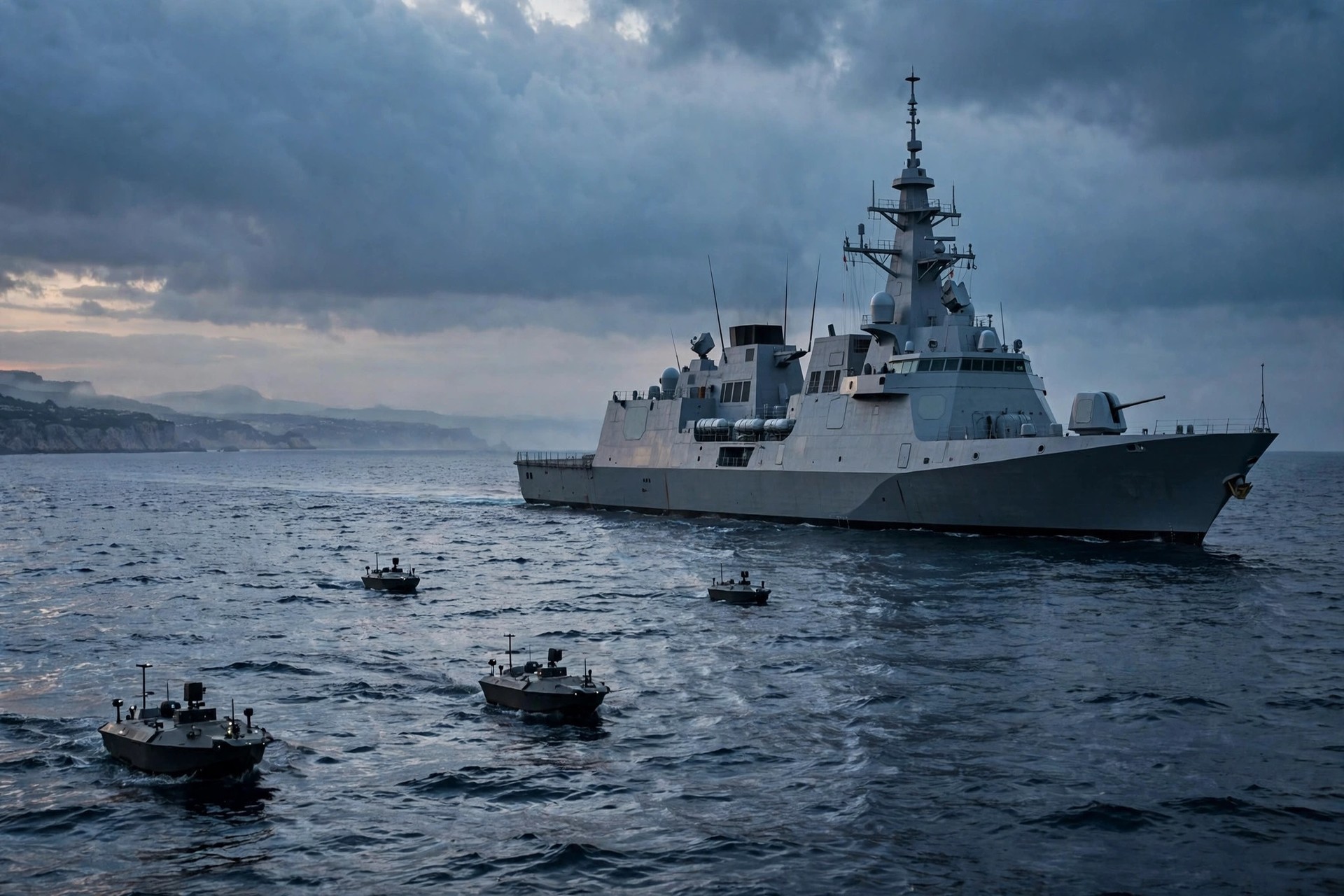
BENGHAZI — Ukraine has confirmed that its forces sank a Russian warship in the Mediterranean Sea off the coast of Libya, in an attack that marks the most dramatic expansion yet of a war that began with Russia’s full-scale invasion of Ukraine in February 2022. President Volodymyr Zelenskyy said on Monday, November 23, 2026, that seven Ukrainian-made naval drones sank the Russian corvette Merkury at the port of Benghazi on Sunday, and that a second target, the Russian dry cargo vessel MV Angara, was also hit. The operation, carried out some 2,400 kilometres from the front lines in Ukraine, came a day after a Russian cargo ship was struck by drones in the Baltic Sea and drifted into Finnish waters, prompting Finland’s prime minister to warn that the war was spilling over into his country’s immediate vicinity.
The two attacks, in two different seas on consecutive days, have transformed a conflict long fought on Ukrainian soil and in the Black Sea into a maritime campaign reaching the southern shore of the Mediterranean and the narrow waters of the Gulf of Finland. For Ukraine, the operations demonstrate a growing ability to strike Russian naval and logistical assets far beyond its own coastline. For Russia, they expose the vulnerability of ships that carry military supplies between its overseas outposts and its home ports. For the countries caught in between — Libya, Finland and the other states around the Mediterranean and the Baltic — they raise difficult questions about neutrality, sovereignty and the risk of being drawn into a war that is no longer confined to one region.
The attacks also came as Russia intensified its own aerial campaign against Ukrainian cities. Overnight on Saturday, Russian drones and missiles struck the Kyiv region, partially destroying an apartment building in the town of Dymer and leaving 14 people missing, according to Zelenskyy, while a separate Russian attack on Kryvyi Rih, the president’s hometown, killed a child and a young woman, according to the city’s administration. The contrast between the two sides’ operations — Ukraine striking Russian ships thousands of kilometres away, Russia striking Ukrainian homes — captures the shape the war has taken in its fifth year: long-range, maritime and civilian in its consequences, with each side seeking to impose costs far from the trenches.
What Happened at Benghazi on Sunday
The attack on the Merkury took place at dawn on Sunday, November 22, at the naval base in Benghazi, the principal city of eastern Libya and the seat of one of the country’s two rival governments. The corvette had docked at the port to refuel and take on supplies under a cooperation agreement between Russia and Libya’s eastern government, according to a statement by the eastern administration, known as the Government of National Stability. The ship was returning to Russia from a mission abroad when it stopped in Benghazi, Libyan officials said.
Video released by Zelenskyy on Monday showed Ukrainian sea drones speeding towards the warship before a huge explosion engulfed the vessel in flames at its berth. Footage circulated on social media showed the ship on fire as a series of ammunition explosions followed, and satellite imagery taken later on Sunday showed that most of the corvette had capsized and sunk, with only its bow still visible above the water. Smoke was visible rising from part of the ship’s superstructure, with significant debris scattered along the pier, according to the satellite imagery provider Vantor, whose images were distributed by news agencies.
The Merkury, also spelled Merkuriy in some reports, was one of the newest ships in the Russian Navy. The 1,800-ton Steregushchiy-class corvette, about 344 feet long, was commissioned in 2023, a year after Russia launched its full-scale invasion of Ukraine, and was officially attached to the Russian Black Sea Fleet, although it had in recent years operated in the Baltic Sea. Zelenskyy said a Russian Ka-27 combat helicopter stationed on board the corvette was also destroyed in the attack. Ukraine’s Security Service, the SBU, said the drones had been transported to the area and launched from a so-called mother ship, although that account has not been independently verified.
The human toll of the Benghazi attack remains disputed. Medical sources told Reuters that 10 people, including Russians and Libyans, were slightly injured in the incident. Local sources quoted by Al Jazeera, however, said late on Sunday that an unknown number of Libyan and Russian nationals had been killed in the attack, adding that the ship was moored inside the civil sea port of Benghazi, close to a naval base. The two accounts could not be reconciled from the reporting available on Monday, and neither the eastern Libyan authorities nor the Russian government had published a confirmed casualty list. On Tuesday, the Libyan National Army General Command said two of its naval personnel had died of wounds sustained in the attack, the first confirmed deaths from the incident. What is established is that an explosion and fire struck a Russian warship at anchor in a Libyan port, and that the vessel sank.
A second attack followed later on Sunday. Zelenskyy said Ukrainian forces also struck the Russian dry cargo vessel MV Angara, which he said Moscow used to transport weapons, and reported the result as a hit. Separately, the Benghazi-based administration’s Health Ministry said all crew members who were injured when a merchant vessel was targeted on Sunday evening by explosives-laden sea drones off the coast of Benghazi had been rescued and were receiving treatment. The eastern administration said its naval and air forces had destroyed at least four other sea drones, while the Almasar satellite television channel reported that at least 12 other sea drones had been destroyed off the Mediterranean city. The precise relationship between the Angara strike and the evening attack on the merchant vessel was not made clear in the available reporting.
How the Ukraine Baltic Sea Drone Attack on the Sparta II Unfolded
The Benghazi attack came a day after a separate drone strike in northern Europe. On Saturday morning, November 21, Finland’s Defence Forces detected a drone attack on the Russian cargo ship Sparta II in international waters in the Gulf of Finland, west of Gogland Island, off the Finnish town of Loviisa. The Finnish Border Guard dispatched units to the scene, and a photograph taken by a Finnish patrol plane showed flames and thick smoke coming from the rear of the ship. The vessel, a 121-metre Russian-flagged roll-on/roll-off cargo ship owned by the Russian shipping company Oboronlogistika, had left St Petersburg on Friday bound for Kaliningrad, the Russian exclave on the Baltic coast, according to shipping data.
The Sparta II caught fire and drifted into Finnish territorial waters, where it was anchored off the southern Finnish town of Loviisa while firefighting efforts continued through the weekend. The Finnish military said the strike was likely carried out by Ukraine. On Tuesday, Zelenskyy confirmed in an interview with Bloomberg that Ukraine had carried out the Sparta II strike, saying the vessel was a legitimate target because it was carrying weapons. Russian officials said two drones had hit the vessel about three nautical miles from the Russian border, an account the Finnish Defence Forces said was corroborated by their own findings about where the damage occurred. The ship’s 16 crew members were evacuated onto a nearby Russian ship, and one crew member was slightly injured, according to Finnish and Russian reports.
Firefighting at sea continued for two days. Finnish Border Guard rescue units and patrol ships, a patrol aircraft and helicopters worked alongside Estonian vessels and, at the request of the Finnish Border Guard, the Russian rescue ship Murman, in a rare instance of cross-border cooperation during an active conflict. By Sunday, visible flames had been put out, but smoke was still coming from the vessel and operations focused on cooling containers stacked on its deck and stabilising the ship. On Sunday, a Russian rescue vessel began towing the Sparta II out of Finnish waters, and on Monday the ship arrived in St Petersburg under tow, according to the governor of the Leningrad Region, Alexander Drozdenko, who said both the ship and its 16-member crew had reached the port.
Finnish authorities said the Sparta II is known to have links to Russia’s armed forces. The vessel is under Ukrainian and United States sanctions, and open-source reporting has linked it to the transport of military equipment, including suspected shipments of weapons from Syria to Russia. Commander Ilja Iljin of the Finnish Border Guard said there was no confirmed information about what cargo was on board, but that it could not be ruled out that there was military materiel on board. Finland’s Defence Ministry said it had immediately informed NATO of the drone strike, and Finnish Defence Minister Antti Hakkanen said the ship would be towed out of Finland’s territorial waters.
Hours after the reported drone attack, a Russian helicopter was suspected of violating Finnish airspace, venturing more than four kilometres into Finnish territory. Hakkanen said the suspected violation was possibly related to rescue or tracking operations for the damaged cargo ship, and that the Defence Forces and the Border Guard were handling the situation in cooperation with other authorities. The Estonian Navy commander, Ivo Vark, warned that the risk of further attacks in the Gulf of Finland, a narrow arm of the Baltic Sea, could not be ruled out.
Zelenskyy’s Confirmation and the Claim of an Exemplary Operation
Zelenskyy’s confirmation on Monday was the first official acknowledgement that Ukraine has carried out an attack in Libya. In a post on social media, he said Ukrainian forces had deployed seven Ukrainian-made naval drones, that the Russian corvette Merkury was sunk despite Russian efforts to counter the attack, and that the Ka-27 helicopter had been destroyed along with the ship. He described the operation as exemplary and said the targets Ukraine had set were achieved. He thanked the warriors of the Security Service of Ukraine and all of Ukraine’s Defence Forces who took part, and added: “We continue our operations in designated waters. We are responding to Russia’s aggression. We are developing Ukrainian weapons.”
The claim fits a pattern of long-range Ukrainian operations that have repeatedly surprised Moscow. In June 2025, Ukraine’s Operation Spiderweb used drones launched from trucks to hit more than 40 aircraft parked at airbases across Russia. Ukrainian forces have also repeatedly used naval drones and missiles to target Russian warships and naval facilities in the Black Sea, sinking or damaging several vessels since the full-scale invasion began. The Libya operation extends that campaign to a new theatre, about 2,400 kilometres from the front line, and demonstrates that Ukrainian maritime drones can be deployed far from Ukrainian-controlled waters.
How the drones reached Benghazi remains a matter of conflicting accounts. The Associated Press quoted two Libyan officials as saying that several Ukrainian sea drones were launched from a base run by Ukrainian forces in western Libya, and that an initial inquiry had reached that conclusion. The SBU, by contrast, said the drones were launched from a mother ship in the region. A Russian military commentary channel claimed the drones had originated in Misrata and Zawiya, in western Libya, where Ukrainian intelligence agents are said to be operating. None of these accounts has been independently confirmed, and the route taken by the drones is likely to be a central question in the investigation that Libya’s eastern government has opened jointly with Russia.
The operation also drew on a history of Ukrainian activity in Libya that predates Sunday’s attack. Russia said in March that Ukrainian naval drones launched from Libya had attacked the Arctic Metagaz, a vessel carrying liquefied natural gas from Murmansk, and Libya’s maritime agency said that vessel had sunk between Libya and Malta after catching fire. Kyiv did not claim responsibility for that attack. Reporting in late 2025 also described an arrangement between Ukrainian intelligence services and the government in Tripoli, in western Libya, which is a rival to the eastern administration in Benghazi that hosts Russian forces. The eastern government has now asked the United Nations to investigate its suspicions that the drones were launched from western Libya and to verify the presence of Ukrainian military experts there.
The Kremlin’s Response: An Accusation of Terrorist Activity
The Kremlin’s response on Monday was sharp but carefully worded. Kremlin spokesman Dmitry Peskov declined to comment directly on the strikes on the Russian vessels off Libya, saying only that Moscow had noted Kyiv’s announcement. But asked about the Baltic Sea attack, Peskov warned of what he called a dangerous trend. “It is indeed a very dangerous trend, the expansion of terrorist activity in the Baltic region,” he told reporters. “This is very dangerous. It is, of course, leading to an escalation of tensions in the region.” The accusation of terrorist activity is one Moscow has used repeatedly to describe Ukrainian attacks on Russian military and logistical targets, and it signals that Russia regards strikes on its shipping as a distinct escalation rather than as ordinary acts of war.
Russia’s Defence Ministry did not immediately comment on the Libya attack. The Russian Transport Ministry and regional officials focused instead on the Sparta II, with the Leningrad Region governor initially saying the situation on board was under control and that no evacuation was necessary, an account that was overtaken by events as the crew was evacuated and the ship was towed back to St Petersburg. The gap between the first official Russian statements and the later outcome illustrates how quickly the situation developed over the weekend, and how little control Moscow had over the narrative once images of the burning ships began to circulate.
For Ukraine, the Kremlin’s language is unlikely to change the calculation. Kyiv has argued throughout the war that Russian military logistics are legitimate targets, and that ships carrying weapons and supplies for the Russian war effort can be struck wherever they are found. Zelenskyy’s statement framed the Libya operation explicitly as a response to Russia’s war, and his promise to continue operations in designated waters suggests that further strikes on Russian shipping outside the Black Sea are possible. The question for both sides is whether the expansion of the maritime campaign will deter Russia, provoke retaliation against Ukrainian ports and shipping, or draw in third countries whose waters and ports are now part of the battlefield.
The legal and diplomatic framing matters as much as the military outcome. Ukraine has not claimed that its operations in Libyan or Finnish waters were conducted with the permission of the states concerned, and Libya’s governments have condemned the Benghazi attack as a violation of sovereignty. Russia, for its part, has accused Ukraine of terrorism while itself conducting nightly drone and missile attacks on Ukrainian cities. The competing accusations show how far the war has moved from the language of conventional battlefield reporting into a contest over legitimacy, in which each side seeks to portray the other’s long-range strikes as unlawful while defending its own as justified.
Libya’s Divided Reaction and the Call for an Investigation
Libya’s reaction to the Benghazi attack reflected the country’s deep division. The eastern-based government, which controls Benghazi and is aligned with the Libyan National Army under Khalifa Haftar, condemned the suspected strike as a violation of Libya’s sovereignty and a threat to maritime safety. It said it had launched a joint investigation with Russia to uncover the circumstances of the attack, its source and the party behind it, and insisted that Libya was not a party to the Russian-Ukrainian war. “The Libyan government will not allow Libyan ports, territory or territorial waters to be turned into an arena for settling scores or exporting international conflicts,” the eastern administration said.
The Tripoli-based Government of National Unity, which controls western Libya and is recognised internationally, said it was following initial reports with grave concern about the danger of exposing the country’s civilian ports to external conflict. It also condemned the operation and said the continuation of the war between Russia and Ukraine gave neither side the right to conduct military operations on Libyan territory or in its territorial waters. The two governments, rivals for more than a decade, found themselves in rare agreement that Libya should not become a battlefield for a foreign war, even as they disagreed about almost everything else.
Ukraine rejected the criticism from Tripoli. Foreign Minister Andrii Sybiha said on Tuesday that the attack on the Russian vessels was a legitimate act of self-defence, citing Article 51 of the United Nations Charter, and said Ukraine was not dragging anyone into the war or transferring the war anywhere. His ministry’s spokesman, Heorhii Tykhyi, said Russian warships, cargo ships carrying military equipment and so-called shadow fleet tankers were legitimate targets. Italy, whose coast lies across the Mediterranean from Libya, said it had no prior knowledge of the operation.
The United Nations mission in Libya expressed serious concern over the attacks and called for an immediate, independent and transparent investigation. The UN’s intervention reflects the fragility of Libya’s ceasefire and the risk that a foreign military operation on Libyan soil could destabilise a country that has only recently emerged from civil war. Eastern Libya has become increasingly important to Russia since the fall of President Bashar al-Assad in Syria in December 2024, which deprived Moscow of its sanctuary there and forced it to move many of its military assets to Libya. The Merkury’s presence in Benghazi, escorting cargo ships that can carry military supplies en route to Russia, was part of that repositioning, according to the Institute for the Study of War.
For Libya’s eastern authorities, the attack is also a security embarrassment. The corvette was docked inside a naval base controlled by Haftar’s forces, in a port that was supposed to be secure, and was struck by drones that apparently travelled a long distance without being intercepted. The eastern administration said its forces had destroyed several of the attacking drones, but the sinking of the warship suggests that its air and naval defences were not sufficient to protect a high-value Russian asset. The investigation that the eastern government has promised will need to answer how the drones reached Benghazi, whether they were launched from inside Libya, and what that means for the country’s ability to control its own territory.
The Human Cost in Ukraine: Dymer and Kryvyi Rih
While the world’s attention focused on the burning ships, the war continued to exact a heavy toll inside Ukraine. Overnight on Saturday, Russian forces launched a large drone and missile barrage across the country, and the Kyiv region bore some of the worst of it. A Russian drone struck a five-storey apartment building in Dymer, a town about 45 kilometres north of Kyiv, partially destroying the building and trapping residents under the rubble. Zelenskyy said nine people had been evacuated and the fire contained, but that 14 people remained unaccounted for. Rescue teams worked through Sunday and into Monday, pulling survivors from the debris, including a seven-year-old boy who spent about 14 hours trapped, and recovering bodies as the search continued.
By Monday, the death toll across the Kyiv region had risen sharply. News agencies reported at least 14 people killed in the region’s overnight attacks, including victims in Dymer, where rescuers recovered the bodies of a teenager and a woman in her forties among others, and in Vyshneve, where a Russian strike on a supermarket killed three people and wounded 15, including three children, according to the town’s mayor. A further person was killed when a strike hit a private home in Bila Tserkva, setting the building ablaze. The figures were still changing on Monday as rescue work continued and as officials updated their counts, but the scale of the loss was already clear: a single night of Russian attacks had killed more than a dozen civilians in one region alone.
In Kryvyi Rih, Zelenskyy’s hometown in central Ukraine, the head of the city administration, Oleksandr Vilkul, said overnight Russian attacks had killed a child and a young woman. Vilkul said the strike had also caused four fires and damaged 25 apartment buildings, a hospital, schools and an industrial facility. The attack on Kryvyi Rih was part of a wider Russian campaign that Zelenskyy described as one of the most intense aerial stretches of the war, with Russian forces firing thousands of drones, guided bombs and missiles across 20 Ukrainian regions in a single week. Ukraine’s air force said it had neutralised 161 of 186 attack drones launched overnight on Saturday, but the drones that got through were enough to destroy homes and kill civilians.
Zelenskyy used the attacks to press Ukraine’s allies for faster delivery of anti-ballistic interceptors, saying on social media that it was particularly difficult to understand the delays from the United States in supporting such systems. The appeal reflects a long-standing Ukrainian complaint: that its air defences, however effective, cannot intercept every drone and missile, and that the gap is paid for in civilian lives. The Dymer apartment building, the Vyshneve supermarket and the Kryvyi Rih homes were not military targets, and their destruction is part of a pattern of Russian strikes on civilian infrastructure that has defined the war since its first weeks.
What the Wider War at Sea Means Next
The events of the weekend point to a war that is becoming more maritime, more geographically dispersed and more dangerous for countries that are not parties to it. Ukraine has shown that it can strike Russian ships in the Mediterranean and the Baltic, using domestically made drones launched from far from its own shores. Russia has shown that it will continue to strike Ukrainian cities in response, and that it regards attacks on its shipping as terrorism and escalation. Finland, which joined NATO in 2023 after decades of neutrality, now finds a burning Russian cargo ship in its territorial waters and a suspected Russian airspace violation on the same day. Libya, still divided and fragile, finds a foreign war fought in its ports.
The immediate questions are practical. Will Ukraine strike again, and where? Will Russia retaliate against Ukrainian ports, grain shipping or the vessels of countries that assist Ukraine? Will Finland and the other Baltic states tighten their maritime security, and will NATO treat attacks in the Gulf of Finland as a matter for the alliance? Will Libya be able to prevent its territory from being used as a launchpad or a target, and will the United Nations investigation establish how the Benghazi drones were launched? Each of these questions will be answered in the coming days, and the answers will shape whether the weekend’s attacks were an isolated demonstration or the start of a new phase of the war.
Finland’s prime minister captured the mood in the north. “War is spilling over into our immediate vicinity,” Petteri Orpo wrote on social media, adding that “Ukraine has the right to fight back against the aggressor.” The statement was both a recognition of the new reality and a defence of Ukraine’s position. It also carried an implicit warning: that the countries around the Baltic and the Mediterranean can no longer assume that a war fought in Ukraine will stay in Ukraine. The ships burning off Benghazi and Loviisa are the visible evidence of that change, and the civilians pulled from the rubble in Dymer and Kryvyi Rih are its human cost.
For now, the war at sea is likely to intensify. Ukraine has invested heavily in naval drones and has every incentive to use them against the Russian logistics chain, which depends on ships to move weapons and supplies between Syria, Libya and Russia. Russia has every incentive to protect that chain and to punish Ukraine for attacking it. The result is a maritime contest that now stretches from the Black Sea to the Baltic and the Mediterranean, with commercial shipping, coastal states and civilian crews caught in the middle. The weekend of November 21 and 22 showed how quickly that contest can escalate — and how far from Ukraine its consequences can now be felt.
Sources
USN reviewed reporting from multiple outlets for this story. Read more from Daily Sabah, Al Jazeera and Reuters.