

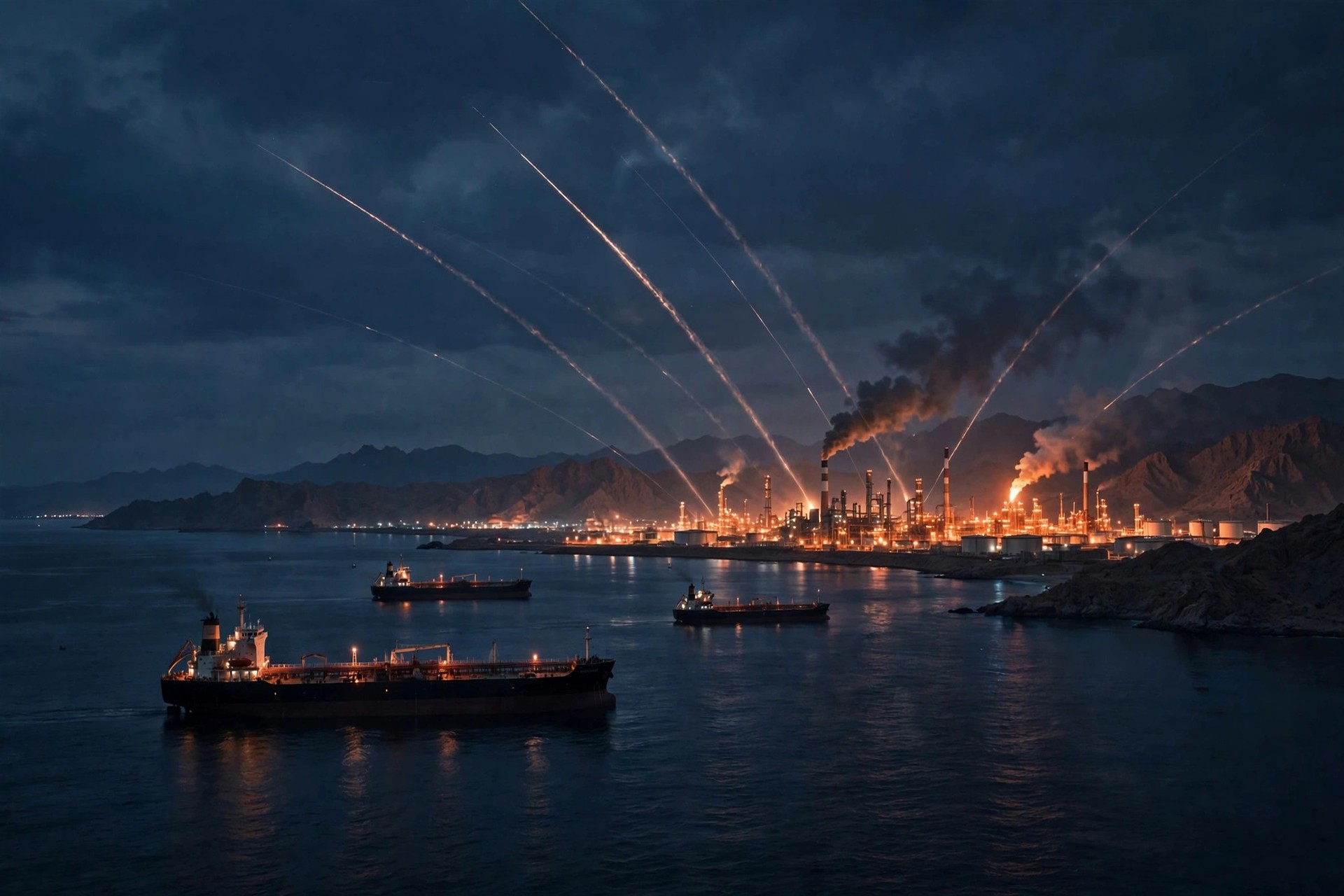
MANAMA — Bahrain said on Sunday, November 22, 2026, that two people were wounded in an Iranian attack the previous day on a civilian industrial facility in the kingdom, as Iran’s Islamic Revolutionary Guard Corps said it had launched a missile and drone assault on United States military positions in Bahrain. The conflicting accounts of what was hit, and what was achieved, capture the fog that now surrounds the widening war between Iran and the United States — a war that has spread from the Strait of Hormuz to the streets of Manama, and that is increasingly fought through competing claims as well as through missiles, drones and naval mines.
The attack on Bahrain came on the same weekend that two more oil tankers caught fire in the Strait of Hormuz, according to Iranian military statements, after striking naval mines in a prohibited zone east of the strait. British maritime authorities separately reported two tankers hit by unknown projectiles near Oman on Saturday, with no casualties reported at the time. Together, the incidents in Bahrain and the strait point to a conflict that is intensifying on two fronts at once: the air war over the Gulf states that host American forces, and the maritime war over the narrow waterway through which about a fifth of the world’s oil normally flows.
What is established is that Bahrain came under attack on Saturday, November 21, that a fire broke out at a civilian industrial facility, and that two people were injured. What is not established — and what the two sides describe in sharply different terms — is whether the Iranian operation struck American military targets, as Tehran claims, or a civilian site, as Manama says. The distinction matters, because it determines whether the attack is understood as a military strike on a belligerent’s forces or as an attack on civilians in a country that is not itself a party to the war. This article reports each side’s claims as claims, attributes every casualty and damage figure to its source, and separates what has been independently verified from what has only been asserted.
The Iran Bahrain Attack on a Civilian Industrial Site
According to Bahrain’s Interior Ministry, the attack took place on Saturday, November 21, when Iranian forces struck a civilian industrial facility in the kingdom. The ministry said on Sunday that two people had been wounded in the attack: a Bahraini national with a disability, who was in a stable condition, and a Pakistani resident, who remained in a critical condition. Both were receiving treatment, the ministry said. The ministry did not name the facility or say where it was, but residents told the Agence France-Presse news agency that they had seen smoke rising above Sitra Island, east of Manama, which hosts several industrial facilities, including a refinery operated by the state-owned oil company Bapco.
The ministry’s first statement on Saturday evening had reported material damage but no injuries, and said civil defence teams were working to bring the fire under control. The update on Sunday, which reported the two injuries, reflected the changing picture as the damage was assessed. Bahrain’s Foreign Ministry condemned the attack, saying it threatened civilian lives and violated the kingdom’s sovereignty. Saudi Arabia’s Foreign Ministry also condemned the attack, expressing what it called the strongest condemnation and denunciation of the criminal Iranian attacks against a civilian industrial facility in the brotherly Kingdom of Bahrain.
Bahrain’s Defence Force said its air defences had intercepted a number of Iranian aerial attacks on Saturday. Shrapnel from the interceptions caused material damage but no casualties, the Defence Force said, adding that Tehran was continuing what it called a systematic hostile approach towards the kingdom. The distinction between the two Bahraini statements is important: the Defence Force’s account of no casualties referred to the intercepted attacks and the falling shrapnel, while the Interior Ministry’s later report of two injured people concerned the fire at the industrial facility itself. Read together, they describe an attack in which most incoming weapons were intercepted, but at least one got through to a civilian site with human consequences.
Before the attack, Bahrain’s Interior Ministry had issued two security warnings on Saturday, advising residents to move to the nearest safe location during the threat. The warnings, and the fire that followed, brought the war home to a population that has lived with the threat of Iranian retaliation for months. Bahrain is a small island kingdom of about 1.5 million people, and its industrial facilities, refineries and residential areas sit close together. An attack on a civilian industrial site, even one that injures only two people, carries a weight in Bahrain that a similar attack on a remote military base would not.
What Iran’s Revolutionary Guards Claim They Hit
Iran’s account of Saturday’s operation is very different from Bahrain’s. In a statement carried by Iranian state media on Saturday evening, the Islamic Revolutionary Guard Corps said its aerospace force had launched a combined missile and drone attack on United States military positions at the Al-Riffa and Awali bases in Bahrain. The Guards said two radars belonging to the US Army’s Patriot air defence systems were struck, and warned that any violation of Iranian airspace would be met with what it called a harsh and decisive response. The claim has not been independently verified, and Bahrain has denied that Iran struck US military positions, pointing instead to the damage at the civilian site.
Tehran described the operation as retaliation for what it called continued violations of Iranian airspace, including by US MQ-1 and MQ-9 reconnaissance and combat drones, and for an attack on a radar installation on Hengam Island, in the Strait of Hormuz. Iran’s Fars news agency reported separately that the Revolutionary Guards had attacked two US bases, Sheikh Isa and Juffair, on the island of Bahrain, in response to what it called the illegal actions of the United States. The differing lists of bases in Iranian reports — Al-Riffa and Awali in the Guards’ statement, Sheikh Isa and Juffair in the Fars report — have not been explained, and neither list has been confirmed by any independent source.
The United States has not confirmed the Iranian claims about the Patriot radars. In previous rounds of Iranian attacks on Bahrain, American officials have disputed Tehran’s accounts. After Iranian attacks on November 13 and 15, the US military said Iranian one-way attack drones launched towards Bahrain had been shot down by US forces, without any damage to US equipment or injury to American personnel. The pattern of Iranian claims followed by American denials has become a regular feature of the war, and Saturday’s claims should be read in that light: as an assertion by one side in an active conflict, not as an established fact.
Bahrain’s strategic importance explains why it has become a target. The kingdom hosts Naval Support Activity Bahrain in the Juffair district of Manama, the headquarters of the US Navy’s Fifth Fleet, which is responsible for American naval operations across the Middle East. It also hosts US air defence batteries, including Patriot systems, and other American military facilities. From Tehran’s perspective, striking Bahrain is a way of striking at the United States without attacking American territory directly. From Manama’s perspective, it is an attack on a sovereign state that has not declared war on Iran, and whose civilian population bears the risk.
The cost of that exposure became clearer on Friday, November 27, when The Washington Post reported that Naval Support Activity Bahrain, the headquarters of the Fifth Fleet, remains low-staffed months after the strikes, with only a small fraction of the more than 8,000 personnel, dependents and contractors based there before the war still on site. A Congressional Research Service estimate put the damage to the base at more than 400 million dollars, and Navy officials told the Post it was unclear when, or whether, the base would return to its pre-war operations. Neighbourhoods around the base that once housed American families have largely emptied, according to the report.
Two Injured, and a Pattern of Escalating Attacks
Saturday’s attack was not an isolated incident. Iranian strikes on Bahrain resumed on November 13, after a lull since early September, and have continued for more than a week. On November 13, Bahrain intercepted two drones, according to the kingdom’s Foreign Ministry, which said the Revolutionary Guards had explicitly claimed responsibility for that attack and for a later attack on November 15. The Guards said they had destroyed a US early warning radar in Bahrain, a claim the US military countered by saying the drones had been shot down without damage or injury. On November 15, Bahrain’s air defences intercepted and destroyed further Iranian drones, and the kingdom said it held Iran fully responsible for both attacks.
On November 18, Iran attacked both Bahrain and Kuwait. Iran’s army said it had struck US Patriot air defence systems along with drone and missile launch platforms at Ali Al Salem base in Kuwait, according to Iranian state media. The attacks on November 18 showed that Tehran was willing to widen its targeting beyond Bahrain to other Gulf states that host American forces, and they raised fears in Kuwait and elsewhere that the war could spread further across the region. Saturday’s attack on Bahrain, three days later, confirmed that the escalation was continuing rather than subsiding.
The two people injured on Saturday are the human face of that escalation. The Bahraini national with a disability and the Pakistani resident were not soldiers, and they were not at a military base. They were at or near a civilian industrial facility when it was hit, and their injuries — one stable, one critical — are the direct consequence of an attack that Bahrain says was aimed at a civilian site and that Iran says was aimed at American radars. The gap between those two descriptions is not a detail. It is the central dispute of the incident, and it will not be resolved by further statements from either side. Only an independent investigation, or the release of verifiable evidence about what was hit and where, could settle it.
The regional response has been one of condemnation and anxiety. Saudi Arabia’s denunciation of the attack as criminal reflects the solidarity of the Gulf states, but it also reflects a shared fear: that Iran’s campaign against American bases in the Gulf will increasingly hit civilian infrastructure in the countries that host them. The Gulf states have tried to distance themselves from the US-Iran war, insisting that they are not parties to it, but the presence of American forces on their territory makes them targets in Tehran’s eyes. Bahrain, the smallest and most exposed of the Gulf monarchies, is bearing the heaviest burden of that contradiction.
On Sunday, November 22, Bahrain’s Foreign Ministry went further than condemnation. It called on the United Nations Security Council to enforce Resolution 2817, which demands an end to attacks on Gulf states, and demanded that Iran be held internationally accountable and pay full compensation for the damage its attacks have caused. The ministry also reserved Bahrain’s right to individual and collective self-defence under Article 51 of the United Nations Charter and the Gulf Cooperation Council’s Joint Defence Agreement, in coordination with its allies and partners. Saudi Arabia, in a separate statement, held Iran responsible for the consequences of its continued attacks. The legal language marked a shift from protest to a formal record: Manama has now filed a series of letters with the Security Council documenting the attacks, building a case it could cite later if it chooses to respond.
The Iran Hormuz Tanker Mines and Two More Tankers on Fire
While Bahrain was counting its injured, the war at sea was also intensifying. Iran’s army navy said on Saturday that two more oil tankers had caught fire after hitting naval mines in a prohibited zone east of the Strait of Hormuz. The statement, carried by Iranian state television, said the tankers had entered a restricted area and had been travelling with their identification and navigation equipment switched off. The Iranian account could not be independently verified, and the names and origins of the vessels were not provided. It was also unclear whether the burning tankers described by Iran were the same vessels reported by British maritime authorities on the same day.
The British agency, the United Kingdom Maritime Trade Operations centre, known as UKMTO, reported two separate incidents on Saturday near Oman. One tanker was hit at its rear about 20 kilometres north of Khasab, a port town on Oman’s northern Musandam coast, and another was struck in its engine room about 31 kilometres east of Khasab. UKMTO said the first tanker had been hit by an unknown projectile and that there were no reported casualties at the time, and that the second tanker had also been struck. The agency did not attribute either incident to Iran, and it did not say whether the vessels had hit mines or been struck by missiles or drones. The distinction matters, because a mine strike and a projectile strike imply different weapons, different tactics and different risks for shipping.
Al Jazeera’s correspondent in Tehran reported that incidents involving tankers had increased sharply over the past week, citing statements issued by Iran’s armed forces that about 25 incidents had been reported since the previous Saturday, averaging roughly three a day, a trend he called quite dramatic. The Iranian military has made multiple announcements in recent weeks saying ships have caught fire in the strait, often claiming they struck mines. On November 5, Iranian media reported that five oil tankers and a tugboat had caught fire after hitting mines, and on November 6 the Revolutionary Guards said two more tankers were on fire. On November 10, the Guards said three more tankers had caught fire, and on November 14 they reported three further incidents. The cumulative picture is one of a sustained campaign against shipping, but the individual claims remain largely unverified by independent sources.
The United States military has said it cleared all mines from the main routes through the waterway, a claim that sits uneasily with the Iranian reports of repeated mine strikes. The Joint Maritime Information Center, a maritime security body, has said Iranian military claims of mine strikes on tankers have not been confirmed by official or national authorities. The centre has also warned that further attacks on tankers using the Omani side of the strait were highly likely, and has kept the threat level for the Strait of Hormuz at severe. For shipowners and crews, the uncertainty is itself a danger: whether the threat comes from mines, missiles or drones, the strait has become one of the most dangerous waterways in the world.
A Wartime Peak: More Than 30 Attacks in October
The incidents of the past week are part of a broader surge in attacks on shipping that reached a wartime peak in October. According to an analysis of UKMTO data, the number of attacks reported to the Royal Navy-affiliated centre in October exceeded 30 for the first time since the US-Iran war began in late February 2026. The reporting area covers the Strait of Hormuz, the Persian Gulf and the Gulf of Oman. As of Sunday, November 22, at least 22 attacks had been reported in November, the second-highest monthly figure since the war began. Before October, the number of reported attacks in the region had averaged around 10 per month. Data from the International Maritime Organization also points to October as having the highest number of confirmed incidents so far this year.
The UKMTO figures are likely an undercount. The organisation only reports incidents verified through primary sources, and in its weekly overview published on Friday it said additional incidents are known but cannot be independently verified. Vessels have also become increasingly reluctant to report attacks or to keep their commercial tracking systems active, and in a report released in mid-October UKMTO said it was struggling to accurately report the true number of attacks, with the majority of vessels attacked refusing to report to the centre. The real number of attacks in October and November is therefore probably higher than the published figures, and the trend is unambiguously upward.
Three tankers were struck by unidentified projectiles off Oman in less than 15 hours on November 20 and 21, according to Marisks, a maritime risk management company, bringing the number of tankers struck in the Strait of Hormuz to seven since November 16, according to the Joint Maritime Information Center. The centre did not attribute the latest attacks to a specific actor, although Marisks assessed Iranian involvement as likely, an assessment that has not been independently established. The concentration of attacks in a single week, in a narrow stretch of water off Oman’s Musandam peninsula, suggests a deliberate and sustained effort to disrupt shipping through the strait, rather than a series of isolated incidents.
The economic stakes are enormous. The Strait of Hormuz normally carries about a fifth of global oil consumption, and it is the only sea route for oil exports from several Gulf producers. Tehran has sought to tighten its control over the strait since the war began, restricting navigation and warning shipowners that vessels using routes it has not authorised will be attacked or will hit mines laid by the Revolutionary Guards. The US military has said it helped Gulf countries export 1.5 billion barrels of oil via Hormuz since the summer, but the rising number of attacks, and the rising insurance and shipping costs that follow them, are putting that trade under strain. Falling oil prices have added to the pressure, as Tehran seeks to reassert control over a waterway whose revenues matter to both sides.
The Wider US-Iran War Behind the Escalation
The attacks on Bahrain and in the Strait of Hormuz cannot be understood in isolation. They are part of a war that began in late February 2026, when the United States and Israel attacked Iran, and that has since drawn in the Gulf states, the shipping industry and the wider region. Tehran has responded to the American and Israeli campaign by striking at US bases in the Gulf, by seeking to control the Strait of Hormuz, and by warning that any violation of Iranian airspace will be met with a harsh and decisive response. Washington has responded with a naval blockade and with strikes of its own, and has insisted that the mines in the strait have been cleared and that shipping can proceed safely.
Diplomacy has continued alongside the fighting, but without a breakthrough. President Donald Trump said on Friday that Iran wants a deal to end hostilities, but not one that is acceptable to him. “We want to make a real deal, not a fake deal,” Trump said, adding that the Iranian government has been “bullshitting people for 51 years.” Tehran, for its part, announced a visit from the mediator Qatar, and said it had intercepted a US drone targeting Qeshm Island in the Strait of Hormuz, a claim that has not been independently verified. The gap between the two sides’ positions — on the terms of any deal, on the future of Iran’s nuclear programme, and on the control of the strait — remains wide, and the fighting has continued while the talking goes on.
The war has already claimed civilian lives at sea. On November 6, a seafarer on the Greek-owned, Marshall Islands-flagged oil tanker Velos Sapphire was killed in an apparent missile attack in the Gulf, according to the vessel’s owner, after Tehran said ships were on fire after hitting mines in the strait. The tanker was sailing to Bahrain empty of cargo when the attack happened, and the explosion was likely caused by an unidentified projectile that struck the vessel’s port quarter, sparking a fire. The death was a reminder that the maritime war is not only about oil and insurance rates. It is about the crews who sail through a war zone, and who bear the risk when a missile or a mine finds its target.
The war has also exposed the limits of the region’s defences. Bahrain’s air defences intercepted a number of Iranian attacks on Saturday, but they could not intercept them all. The US military has shot down Iranian drones headed for Bahrain on several occasions, but it has not prevented the attacks from continuing. The mines in the Strait of Hormuz, whether they have been cleared from the main routes or not, continue to be reported as a threat, and the shipping industry continues to sail through a waterway that its own monitors describe as severe in threat level. The result is a war of attrition, in which each side tests the other’s defences and resolve, and in which the costs fall increasingly on civilians and on commerce.
What to Watch Next: Shipping, Diplomacy and the Risk of Miscalculation
The coming days will show whether the escalation of the past week continues or pauses. The immediate indicators will be the UKMTO reports from the Strait of Hormuz, which will show whether the pace of attacks on shipping remains at its current level, and the statements from Bahrain, which will show whether further Iranian attacks follow Saturday’s strike. The Joint Maritime Information Center’s assessment that further attacks on tankers using the Omani side of the strait are highly likely suggests that the maritime campaign will continue, at least in the short term. The question is whether it will remain confined to shipping, or whether it will spread further to the Gulf states that host American forces.
Diplomacy will also be watched closely. The visit from Qatar’s mediator, announced by Tehran on Saturday, is the latest attempt to find a path to a deal, but President Trump’s comments on Friday suggest that Washington is not prepared to accept the terms Iran is offering. The gap between the two sides is not only about the terms of a ceasefire. It is about the future of the Strait of Hormuz, the future of Iran’s nuclear programme, and the future of the American military presence in the Gulf. Until those questions are addressed, the fighting is likely to continue, and the risk of a miscalculation — a strike that kills many civilians, a tanker sinking that blocks the strait, or an attack on a Gulf state that draws in its allies — will remain high.
For Bahrain, the priority is the protection of its people and its infrastructure. The kingdom has lived with the threat of Iranian attack for months, and Saturday’s strike showed that its air defences, however capable, cannot guarantee that every missile and drone will be stopped. The two people injured at the industrial facility are a reminder of that vulnerability, and the kingdom’s condemnation of the attack as a violation of its sovereignty is a reminder that Bahrain does not regard itself as a party to the war. Whether Tehran accepts that distinction, or continues to treat Bahrain as a legitimate target because it hosts American forces, will determine whether Saturday’s attack was an isolated incident or the start of a sustained campaign against the kingdom.
For the shipping industry, the priority is survival. The Strait of Hormuz remains open, and oil continues to flow through it, but the cost of sailing through a war zone is rising, and the risk to crews is growing. The more than 30 attacks reported in October, and the at least 22 reported in November, are not abstract figures. They represent ships hit, crews endangered, and a waterway that is becoming harder to use. If the trend continues, shipowners may reroute, insurers may raise their premiums further, and the global oil market may feel the consequences. The war in the Gulf is no longer a distant conflict. It is a war that is fought in the strait, in the skies over Bahrain, and in the lives of the people who live and work there.
Sources
USN reviewed reporting from multiple outlets for this story. Read more from Just Security, Al Jazeera and CNN.