

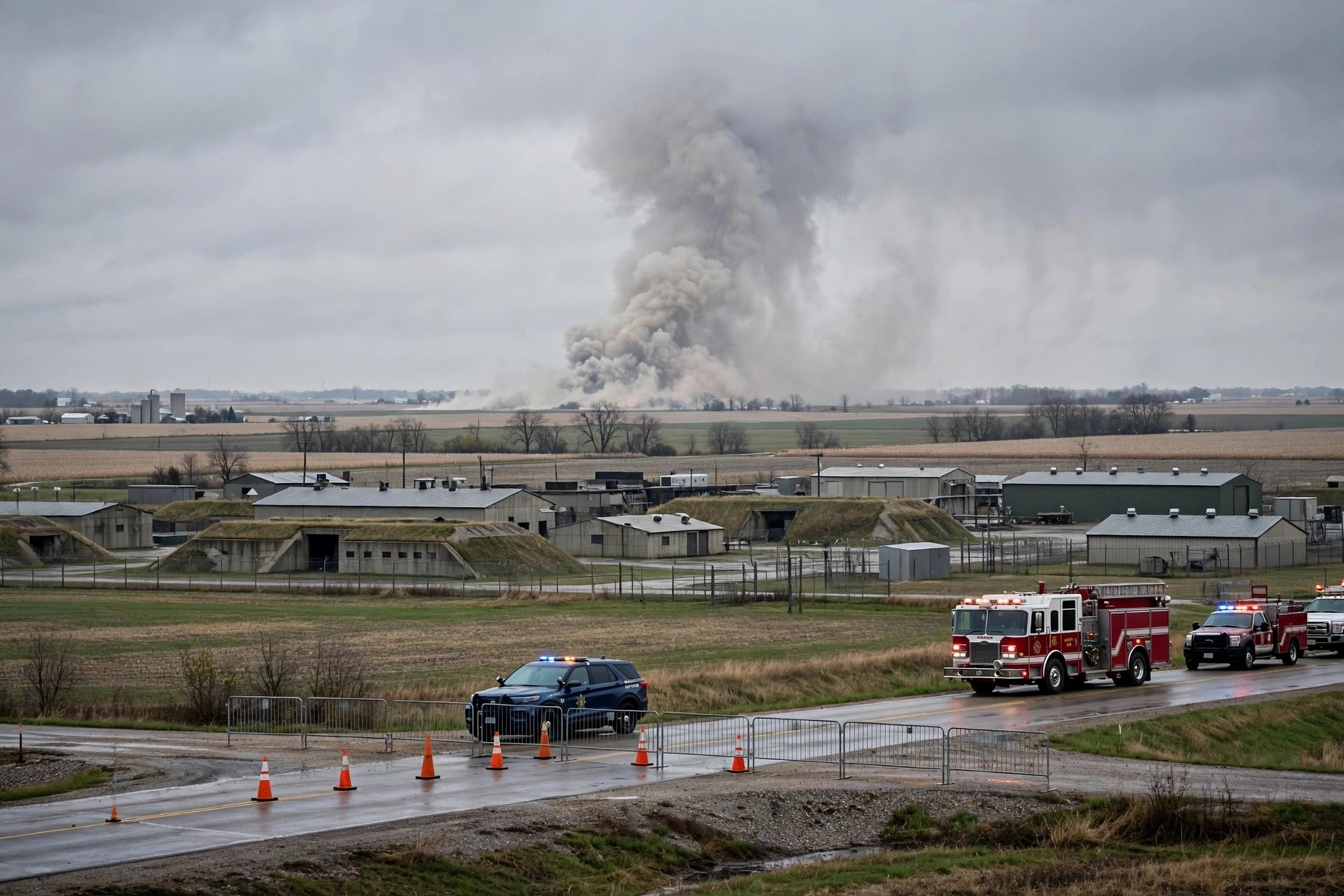
MIDDLETOWN, Iowa — The United States Army detonated nearly five tons of deteriorating lead azide at the Iowa Army Ammunition Plant on Wednesday, November 25, 2026, ending a tense standoff over a stockpile of unstable explosives that had worried residents of southeastern Iowa for days. The controlled blast, carried out at about 9 a.m. Central time, destroyed 68 barrels containing roughly 10,000 pounds of the sensitive compound, and the Army said afterwards that the threat of an uncontrolled spontaneous detonation had been eliminated.
The detonation was the culmination of days of delay and a last-minute court battle, and it unfolded under extraordinary precautions. Residents living within five miles of the plant, in and around the small city of Middletown, were urged to leave their homes before the blast, while people living within 20 miles were told to shelter in place, staying indoors with their windows and doors closed until they were told it was safe. Federal emergency officials offered lodging to displaced residents through Friday, a measure of how seriously the authorities treated a blast involving a substance that can detonate with little warning once it has begun to break down.
By early evening, the immediate danger appeared to have passed. An all-clear was issued at about 6:30 p.m. Eastern time, and monitors operated by the Environmental Protection Agency showed zero airborne lead in the hours after the detonation. The Army presented that reading as a reassuring early result, not as a final verdict on safety, because post-detonation soil and surface sampling still lay ahead, and the full picture of what the blast left behind on the ground will only emerge once that testing is complete.
What Happened at the Iowa Army Ammunition Plant
The Iowa Army Ammunition Plant is a large military industrial site near Middletown, in Des Moines County in southeastern Iowa, where munitions have been manufactured and stored for decades. The lead azide at the centre of this week’s events had been stored at the plant since 2009, a period of 17 years during which the compound, already known as one of the most sensitive primary explosives in military use, had been deteriorating. Lead azide is used to set off larger explosive charges, and it is valued precisely because it detonates easily. That same quality makes it dangerous to handle, move or store once it has aged, because a shock, a spark, friction or even a change in its chemical condition can set it off without warning.
The Army’s solution was to destroy the material where it sat, in a single controlled detonation, rather than to attempt to move 68 barrels of unstable explosive over public roads or to handle the barrels one by one. The blast, at about 9 a.m. Central time on Wednesday, was heard and felt across the surrounding area, and a plume rose over the plant as the compound was consumed. Officials had planned the timing of the detonation to give residents the morning to leave the evacuation zone and to give emergency crews the whole day to monitor conditions afterwards.
The scale of the operation was unusual for a domestic military site in peacetime. Ten thousand pounds of explosive is a very large quantity to destroy in one event, and the precautions around it reflected that scale. Roads were closed, emergency services were placed on standby, air monitoring equipment was positioned around the site, and the evacuation and shelter-in-place orders were drawn far more widely than they would have been for a routine demolition. The Army’s message to the public, repeated through the day, was that a controlled detonation, for all its drama, was far safer than leaving the stockpile in place to deteriorate further.
Why the Army Decided to Detonate the Lead Azide
The central problem was time. Lead azide does not become safer as it ages. As the compound deteriorates, it can become more sensitive and less predictable, and the risk is not simply that it might one day explode on its own, but that nobody can say with confidence when that day might come. The Army’s assessment was that the stockpile stored since 2009 had reached a point where the danger of leaving it alone outweighed the danger of destroying it under controlled conditions, and that the risk of an uncontrolled spontaneous detonation had to be removed rather than managed indefinitely.
That judgment shaped every part of the operation. Moving deteriorating lead azide is itself one of the most hazardous things that can be done with it, because vibration, jolting and handling can supply the shock that sets it off. Destroying it in place avoided the need to load the barrels onto trucks and carry them through populated areas, and it allowed the Army to choose the moment, the weather and the precautions. A single large detonation, carried out with the surrounding population warned and moved, was presented as the least dangerous of a set of bad options.
There was also a wider lesson in the decision. Military explosives are stored all over the United States, and many stockpiles date back years or decades. The Iowa case was a reminder that storage is not a permanent solution, and that compounds designed to explode on command do not stop being dangerous simply because they have sat quietly in a warehouse. The Army said after Wednesday’s blast that the threat of an uncontrolled detonation at the plant had been eliminated, a statement that was carefully limited to the stockpile that had been destroyed, rather than a claim about every explosive stored at the site.
The Evacuation Zone Around Middletown
The evacuation order covered everyone living within five miles of the Iowa Army Ammunition Plant, an area that includes Middletown itself and the homes and farms closest to the site. Residents were urged to leave before the detonation, and local officials worked to make sure that people who needed help getting out, including older residents and those without transport, were not left behind. For a small community, an evacuation of that size is a major disruption, and many families spent the day away from home, waiting for word that it was safe to return.
The five-mile radius was chosen to keep people clear of the blast itself and of the immediate debris and dust that a detonation of this size would throw into the air. Lead is a toxic metal, and lead azide contains lead, so the dust and residue from the blast were a particular concern. Keeping people out of the area during the detonation and in the hours afterwards was the simplest and most reliable way to protect them from whatever the blast put into the air at close range.
For residents, the evacuation was the most visible and personal part of the operation. People locked up their homes, took pets and essential belongings, and drove out of the zone to stay with relatives or in lodging arranged by the authorities. The fact that federal lodging was offered through Friday, well beyond the day of the blast itself, told residents that the authorities were not expecting everyone to rush home the moment the explosion was over, and that monitoring and checking would continue after the all-clear.
Shelter in Place: Life Within 20 Miles
Beyond the five-mile evacuation zone, a much larger area was placed under a shelter-in-place order. People living within 20 miles of the plant were told to stay indoors, to close their windows and doors, and to wait for further instructions. That radius covered a substantial part of southeastern Iowa, including communities that were never in danger from the blast itself but that could have been affected by a plume of dust and smoke drifting on the wind.
Shelter-in-place orders are designed for exactly this kind of hazard: a cloud of material in the air that is dangerous to breathe but that will disperse and settle over time. Staying inside, with a house closed up, greatly reduces exposure, and the order gave the authorities time to check air monitoring readings before telling people it was safe to go back outside. Schools, workplaces and public buildings in the zone followed the same guidance, and residents were asked to avoid unnecessary travel while the order was in force.
The breadth of the shelter-in-place zone also reflected the uncertainty that surrounds any large detonation. Wind direction and speed, temperature and humidity all affect where a plume goes and how quickly it disperses, and the authorities could not be sure in advance exactly where the dust from the blast would travel. A 20-mile zone was a cautious answer to that uncertainty, and it meant that tens of thousands of people spent part of Wednesday indoors, listening for updates, even though most of them were far from the plant itself.
FEMA Lodging and Support for Displaced Residents
The Federal Emergency Management Agency offered lodging to residents displaced by the evacuation, with accommodation available through Friday. That support mattered because the evacuation was not a matter of leaving home for an hour or two. Residents were told to leave before a morning detonation, and many of them did not know when they would be allowed back, or whether follow-up testing would extend their time away from home.
Federal involvement in a local evacuation is a sign of how seriously the operation was treated. FEMA’s role was to make sure that nobody was left without a place to stay because they could not afford a hotel or had nowhere else to go, and that the burden of a government-ordered evacuation did not fall hardest on the people least able to bear it. Lodging through Friday gave displaced families a buffer, so that they were not forced to decide on Wednesday evening, in the dark, whether to return to homes that officials were still checking.
The offer of lodging also reflected the human cost of the operation. An evacuation, even a well-run one, is frightening and disruptive, particularly for families with children, for older people and for anyone with medical needs. The authorities’ willingness to support residents for several days, rather than only for the hours of the blast itself, was an acknowledgement that the disruption would not end the moment the explosion was over, and that people needed time and certainty before they could go home.
The All-Clear and Zero Airborne Lead Reading
The all-clear came at about 6:30 p.m. Eastern time on Wednesday, roughly nine and a half hours after the detonation. By then, monitors operated by the Environmental Protection Agency had recorded zero airborne lead in the air around the plant, an early result that the Army and environmental officials presented as reassuring. Lead in the air is the most immediate health concern after a blast involving a lead compound, because fine particles can be breathed in, and a zero reading suggested that the plume had not carried dangerous levels of lead into the communities around the plant.
That reading needs to be understood for what it was: a measurement of the air at the time it was taken, at the places where the monitors were positioned. It was not a guarantee about every location, and it was not a final judgment on the safety of the site or the surrounding land. Airborne lead disperses and settles, and the monitors could only report on what was in the air while they were running. The authorities were careful to present the zero reading as an early and encouraging result, and to pair it with a clear statement that further testing was still to come.
For residents waiting to go home, the all-clear was nevertheless the news they had been waiting for all day. It meant that the evacuation and shelter-in-place orders could be lifted, that roads could reopen, and that people could return to their houses and their normal routines. The relief was real, but it was also qualified, because the people of Middletown and the surrounding area knew that the questions about what the blast had left on the ground had not yet been answered.
What Testing Comes Next After the Detonation
The work after the detonation is less dramatic than the blast itself, but it is the part that will determine whether Wednesday’s operation can be called a complete success. Post-detonation soil and surface sampling still lies ahead, and those tests will look for lead and other residues deposited on the ground, on buildings, on vegetation and on surfaces around the plant. Soil testing is slow, methodical work: samples are collected from many locations, sent to laboratories, and analysed before any conclusions are drawn.
The first update on that testing came on Thursday, November 26, when the Environmental Protection Agency said its real-time air monitors continued to report zero detection of airborne lead across the region. The agency said it had collected 1,591 air, water, soil and dust samples before the detonation and more than 1,000 samples since, including from homes, public parks with playgrounds and every drinking-water intake in the pre-detonation plume model, with more than 130 structures sampled before the blast sampled again afterwards. Sampling on Thursday focused on schools, playgrounds, daycares and churches, and the agency said laboratory results could be released as early as Friday. The Army, meanwhile, confirmed that all 68 barrels had been destroyed, with no secondary explosions and no infrastructure damage in or around the installation, and the operation’s commander, Major General Eric Shirley, said the detonation had wildly exceeded his expectations. None of that changes the central caveat: the laboratory results, not the air monitors, will decide whether the ground around the plant is safe.
That testing matters because lead does not disappear when it settles out of the air. It can remain in soil for a long time, and it can pose a risk if it is disturbed, tracked into homes, or taken up in ways that bring people into contact with it. The results of the sampling will guide any cleanup that is needed, and they will tell residents whether the land around the plant is safe to use as before. Until those results are in, the zero airborne lead reading should be treated as one piece of evidence, not as the whole story.
The Army and the Environmental Protection Agency will also need to account for the site itself. A detonation of 10,000 pounds of explosive leaves a crater and a damaged area, and the plant will need to be inspected and made safe before normal operations can resume in the affected part of the site. The longer-term question is what happens to the remaining explosives and materials stored at the plant, and whether the events of this week will lead to a review of how ageing stockpiles are monitored and disposed of across the country.
The Court Battle and Days of Delay Before the Blast
Wednesday’s detonation did not happen on the first date planned. Days of delay preceded it, and a last-minute court battle added to the uncertainty, as the Army’s plan to destroy the stockpile was challenged and argued over in the days before the blast. The delay was frustrating for residents, who had been warned about the operation, told to prepare to leave or to shelter, and then left waiting while the legal arguments played out. It was also a sign of how difficult it is to carry out an operation of this kind in a populated area, where the interests of public safety, private property and legal process all have to be weighed.
Court challenges to a detonation of this size are not surprising. A blast involving five tons of explosive, an evacuation of homes and a shelter-in-place order covering a 20-mile radius affects a large number of people, and those affected have a right to ask a court whether the plan is lawful, whether the precautions are adequate, and whether their interests have been properly considered. The fact that the challenge came at the last minute, and that it delayed the operation for days, shows how finely balanced the decision was, and how much was at stake for everyone involved.
In the end, the Army’s plan went ahead, and the blast took place as scheduled on Wednesday morning. The delay may have added to the anxiety of the week, but it also gave residents more time to prepare, and it gave the authorities more time to arrange the evacuation, the monitoring and the lodging that supported it. The question now is whether the legal arguments that delayed the detonation will continue, or whether the successful completion of the blast, and the reassuring early air monitoring results, will bring the dispute to an end.
The detonation at the Iowa Army Ammunition Plant was a reminder that some of the most dangerous problems in the United States are not new threats but old ones, stored away and left to deteriorate. A stockpile that had sat since 2009 became, over 17 years, a hazard that could no longer be left alone, and the only way to remove it was a blast that emptied a town and closed the doors of a region for a day. The Army says the threat of an uncontrolled spontaneous detonation has now been eliminated. The air monitoring so far supports that cautious optimism, but the final judgment will come from the soil and surface sampling that is still to be done, and from the answers it gives to the people of Middletown about the ground they live on.
Sources
USN reviewed reporting from multiple outlets for this story. Read more from CNN, USA Today and Des Moines Register.