

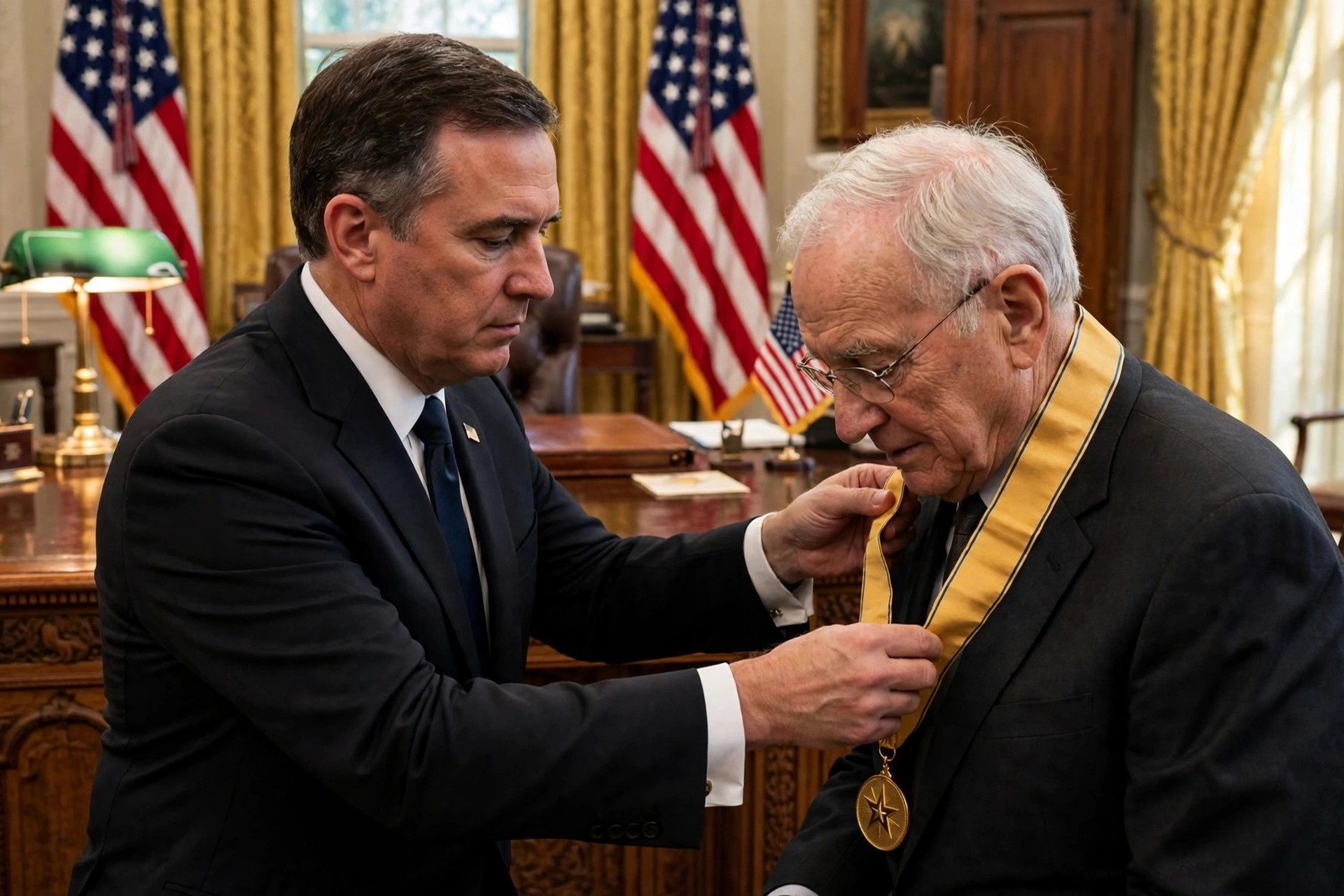
WASHINGTON — President Donald Trump on Tuesday, November 24, 2026, awarded the Presidential Medal of Freedom to Rudy Giuliani, his former personal lawyer and the former mayor of New York City, in a private ceremony in the Oval Office. Trump personally placed the medal around Giuliani’s neck in front of a small gathering of relatives, friends and supporters, more than a year after first announcing that he would give his longtime ally the nation’s highest civilian honor. Giuliani, 82, who became known around the world as “America’s Mayor” for his leadership after the September 11, 2001, attacks, is only the third person Trump has given the honor to so far in his second term.
The ceremony was closed to reporters, and the White House did not explain why the press was kept out. The public learned of the event largely through photographs the White House posted on social media, showing Trump shaking Giuliani’s hand and placing the medal around his neck beneath a portrait of former President Ronald Reagan. “America’s Mayor receives America’s highest civilian honor,” the White House wrote on X. “President Donald J. Trump awards Rudy Giuliani the Presidential Medal of Freedom for true American leadership and a lifetime of public service.” Giuliani said in a statement that he was honored and humbled to receive the medal from his nation and from his commander in chief, and his son Andrew Giuliani spoke to reporters outside the White House after the ceremony ended.
A Private Ceremony in the Oval Office
The White House schedule had listed the ceremony for 11 a.m., but reporters were not allowed to attend, and no cameras were permitted inside the Oval Office while the medal was presented. Andrew Giuliani, who served as executive director of the president’s task force on the 2026 FIFA World Cup, told reporters afterward that both Trump and his father spoke at the small gathering. The photographs released by the White House showed the two men at the Resolute Desk, surrounded by family members, in a scene that looked more like a family occasion than a formal state ceremony.
The private character of the event stood out because Medal of Freedom ceremonies are usually public occasions, staged for the cameras with citations read aloud and an audience of past recipients, officials and family members. Presidents have often used the ceremony to tell a story about the country and its values, and the choice of recipient is itself a statement. Holding this one behind closed doors meant that the public saw the award mainly through a handful of official photographs and a short social media message, rather than through a televised ceremony. The White House offered no reason for the closed format, and the decision drew attention in coverage of the day, with some commentators reading it as a sign that the administration expected a divided reaction.
How the Trump Giuliani Medal of Freedom Was Announced
Trump first announced that he would give Giuliani the medal on September 1, 2025, in a post on Truth Social, two days after the former mayor was seriously injured in a car crash in New Hampshire. “As President of the United States of America, I am pleased to announce that Rudy Giuliani, the greatest Mayor in the history of New York City, and an equally great American Patriot, will receive THE PRESIDENTIAL MEDAL OF FREEDOM, our Country’s highest civilian honor,” Trump wrote at the time. He added that details of the time and place would follow.
The crash had taken place on the night of Saturday, August 30, 2025, on a New Hampshire highway. Giuliani was a passenger in a rented Ford Bronco when the vehicle was struck from behind at high speed. According to his spokesperson and his head of security, he was taken to a nearby trauma center, where doctors diagnosed a fractured thoracic vertebra, along with multiple lacerations and contusions and injuries to his left arm and lower leg. Before the crash, Giuliani had stopped to help a woman who had flagged him down as a victim of domestic violence, staying with her until police arrived. His aides said he was in good spirits and was expected to recover fully, and the crash was not treated as a targeted attack. More than 14 months passed between that announcement and Tuesday’s ceremony, and the White House has not said why the presentation took so long to arrange.
From Federal Prosecutor to America’s Mayor
Long before he became a national figure after September 11, Giuliani built his reputation as a federal prosecutor. He served as associate attorney general under President Ronald Reagan and then as United States Attorney for the Southern District of New York, where he led high-profile prosecutions of organized crime figures and Wall Street defendants. Those cases made him a household name in New York and established the tough-on-crime image that would define his political career.
Giuliani was elected mayor of New York City in 1993 and served from 1994 to 2001, winning re-election in 1997. His time in office was marked by a sharp fall in crime, an aggressive approach to quality-of-life offenses, and a transformation of Times Square from a district known for crime and decay into a center of tourism and business. Supporters credit his policies with making the city safer and more livable, while critics argue that his policing tactics, including the expanded use of stop-and-frisk, fell disproportionately on Black and Hispanic New Yorkers and damaged relations between the police and minority communities. That argument about his mayoralty has never fully gone away, and it remains part of any honest account of his record.
It was the attacks of September 11, 2001, that turned Giuliani into a figure of national and international standing. As the World Trade Center towers fell and the city reeled, he appeared before the cameras again and again, calm, direct and visibly present at the scene, giving New Yorkers information and a sense that someone was in charge. He was widely praised for his steadiness in the days that followed, was named Time magazine’s Person of the Year for 2001, and received an honorary knighthood from Queen Elizabeth II. The nickname “America’s Mayor,” first used in those weeks, has stayed with him ever since, and it was the title the White House reached for again on Tuesday.
What the White House Said About the Honor
The White House presented the award as recognition of a lifetime of public service, pointing to Giuliani’s work as a prosecutor, his two terms as mayor, and his leadership after September 11. “Mayor Rudy Giuliani is a dedicated public servant whose decisive leadership has left a lasting impact on New York City and our nation,” White House spokeswoman Olivia Wales said in a statement. The citation for the medal, as described by the White House, covered the same ground: public service at the federal level, the fight against crime in New York, and the response to the worst terrorist attack on American soil.
Giuliani, in his own statement, shared the credit with the people who had worked with him and with those who had died in the causes they undertook together. “I am honored and humbled to receive the Presidential Medal of Freedom from my nation and from our Commander-in-Chief, President Donald J. Trump,” he said. He credited the advice of Reagan, his former boss, for guiding his career in public service, quoting the former president’s line that there is no limit to what a man can do or where he can go if he does not mind who gets the credit. In a separate post on X, he wrote that doing the right thing for others had been his guiding light.
Giuliani’s Role as Trump’s Personal Lawyer
Giuliani’s path to the Oval Office on Tuesday ran through his second act in public life, as Trump’s personal lawyer and most visible defender. He joined Trump’s legal team in 2018, during the investigation into Russian interference in the 2016 election, and became a constant presence on television and at rallies, defending the president in blunt and often combative terms. After the 2020 presidential election, he became the public face of Trump’s effort to challenge the result, appearing at press conferences and in court filings to argue that the election had been marred by fraud.
Those claims were repeatedly tested in the courts, and they were rejected. Dozens of lawsuits challenging the 2020 result failed, judges found no evidence of widespread fraud that could have changed the outcome, and election officials in both parties certified the result. Giuliani has maintained that he believed the claims he was making, and his defenders say he was acting as an advocate for a client. His critics say he used his standing as a former prosecutor and mayor to lend credibility to allegations that had no basis, and that the damage to public trust in elections was lasting. That dispute is now inseparable from his public image, and it was the reason Tuesday’s award was received so differently by different audiences.
The two men have known each other for decades, going back to Giuliani’s years as a prosecutor and mayor in New York, where Trump was a prominent developer. Trump has stood by Giuliani through years of legal and financial trouble, and Giuliani has remained one of his most loyal allies. To supporters of the award, that loyalty is part of the story: a president honoring a friend who stood with him. To critics, it is the whole story: a medal given not for public service in the abstract, but for personal allegiance to the president who awarded it.
The Disbarment and the Georgia Defamation Case
The strongest criticism of the award centers on what happened to Giuliani after the 2020 election. He was disbarred in New York in 2024, after an interim suspension in 2021, and disbarred in Washington, DC, the same year, with disciplinary authorities citing false statements he made about the 2020 election. The panels that reviewed his conduct concluded that he had made claims about election fraud that he knew, or should have known, were unsubstantiated, and that he had undermined the administration of justice. Giuliani denied wrongdoing and argued that he was being punished for representing a client and for raising questions about an election.
Separately, a federal jury in Washington awarded nearly 148 million dollars in damages in December 2023 to Ruby Freeman and her daughter Shaye Moss, two Georgia election workers whom Giuliani had falsely accused of manipulating ballots. The jury found that he had defamed them and intentionally inflicted emotional distress, and the women testified about the threats and harassment they faced after his claims spread online. The case was later settled, but the verdict remains one of the largest defamation awards in American political history, and the two women have become symbols, for critics of election denial, of the human cost of false claims.
Giuliani also faced criminal charges arising from the 2020 election. He was indicted in Georgia in 2023 alongside Trump and others in a case alleging a conspiracy to overturn the result in that state, and he was charged in Arizona in 2024 in a case involving so-called fake electors. He pleaded not guilty in both cases. He filed for bankruptcy in December 2023, days after the defamation verdict, and the bankruptcy case was dismissed in July 2024. Taken together, these legal troubles transformed the public image of a man once celebrated as America’s Mayor into that of a cautionary tale, and they are the reason many observers reacted to Tuesday’s ceremony with disbelief.
Why the Award Divides Opinion
Supporters of the award argue that a lifetime of service should not be erased by its final chapter. They point to the mafia prosecutions, the fall in crime in New York, and the leadership shown on September 11 and in the weeks that followed, and they say those achievements are what the medal recognizes. In this view, the Medal of Freedom honors a record of service to the country, not a person’s later controversies, and presidents have always used it to honor allies and figures they admire. They also note that the medal has gone before to recipients whose politics were divisive, and that disagreement about a recipient is nothing new.
Critics argue the opposite: that the nation’s highest civilian honor should be reserved for people whose service is beyond reproach, and that giving it to a man disbarred over false election claims cheapens the award for everyone who holds it. They argue that the medal is being used as a political favor, rewarding loyalty to the president rather than service to the country, and that the private nature of the ceremony suggests the White House knew the choice would be controversial. Some also point to the timing, more than a year after the announcement, and ask why an honor supposedly earned long ago needed to be conferred now, in private, in the closing weeks of a turbulent year.
Both arguments were on display in the reaction to the ceremony, and the divide fell largely along partisan lines. Conservative commentators celebrated the recognition of a man they see as a hero of September 11 who was later persecuted for his politics. Liberal commentators called it a disgrace and said it showed how far the honor had fallen. That split is itself a measure of how polarized the country has become about its own recent history, and about whether the events of 2020 should define the people who took part in them.
What Comes Next for the Medal of Freedom
The medal is the highest civilian honor the United States can bestow, established by President John F. Kennedy in 1963 for people who have made an especially meritorious contribution to the security or national interests of the United States, to world peace, or to cultural or other significant public or private endeavors. Recipients have ranged from presidents and generals to scientists, artists and civil rights leaders, and the list of names is, in effect, a record of who each president believes deserves to be remembered.
Giuliani is the third person to receive the medal in Trump’s second term, and the choice will shape how that record is read. For Trump, the award is a statement about loyalty and about which version of Giuliani’s career matters most: the prosecutor, the mayor, and the leader of September 11, rather than the lawyer of the 2020 election challenges. For Giuliani, now 82 and largely out of public life, it is the highest honor of a career that has swung from national celebration to professional ruin and back to presidential recognition. Whether history remembers the medal or the disbarment as the truer measure of that career is a question Tuesday’s ceremony did not settle, and it is unlikely to be settled soon.
Sources
USN reviewed reporting from multiple outlets for this story. Read more from USA Today, The Hindu and NY Post.