

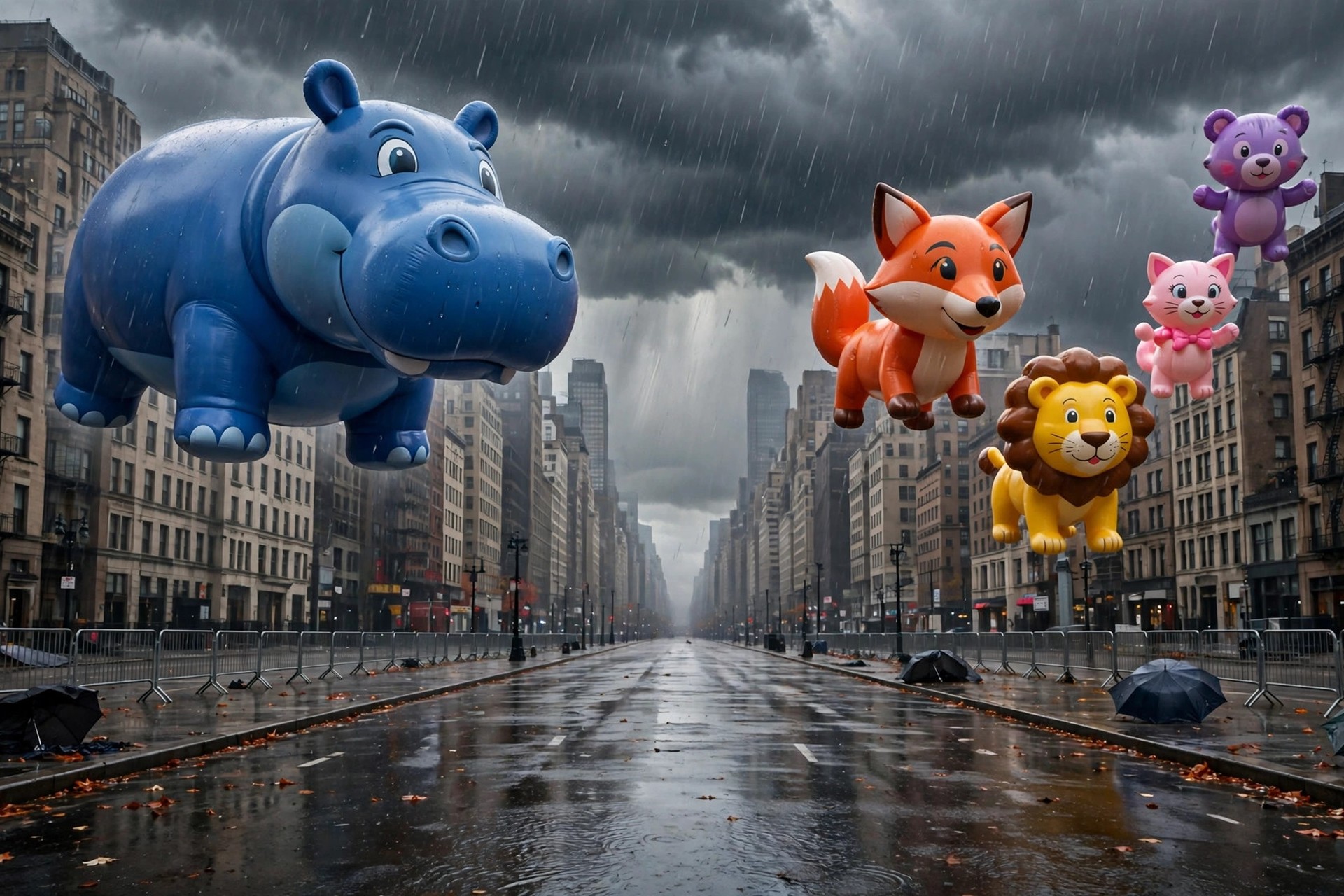
NEW YORK — For the first time in its 100-year history, the Macy’s Thanksgiving Day Parade was postponed — and then, on Saturday, November 28, 2026, it went ahead anyway. Organisers announced on Wednesday, November 25, that the 100th edition of the parade, which was due to step off through Manhattan on Thanksgiving morning, would be moved to Saturday because a powerful storm bearing down on the East Coast would have made it unsafe to fly the parade’s giant balloons through the city. On Saturday morning, under crisp, dry skies, the parade stepped off at 8:30 a.m. Eastern time with the same balloons and floats, 1,000 clowns and most of the original celebrities, travelling its usual route from Manhattan’s Upper West Side to Herald Square.
The decision, taken after consultation between Macy’s, the city of New York and the parade’s broadcast partner NBC, was described as unprecedented. The parade was suspended from 1942 to 1944 during the Second World War, but it had never before been moved to another day because of the weather. This year, the forecast left the organisers with little choice: strong to damaging winds, heavy rain and coastal flooding were expected across the region on Thanksgiving Day, with gusts in New York City forecast to reach 50 to 60 miles per hour, and the giant helium balloons that are the parade’s signature could not safely be flown in those conditions.
The postponement was a blow to a milestone celebration that had been planned for months. The 100th parade was to feature 100 inflatables, including a lovingly recreated Blue Hippo, a 30-foot balloon rebuilt from old photographs after the original disappeared in 1931, and a balloon of Bluey, the cartoon dog who has become one of the most popular characters in the parade in recent years. All of that happened on Saturday instead, two days after Thanksgiving, in a parade that was still the 100th, but one that will be remembered as much for the storm that moved it as for the anniversary it was meant to celebrate. The Saturday line-up even gained two additions: LL Cool J and Gloria Gaynor, who joined the bill after the postponement.
The Postponement Announced on Wednesday
The announcement came on Wednesday afternoon, as the parade’s balloons were already being inflated on the Upper West Side of Manhattan and as millions of Americans were beginning their Thanksgiving journeys. Macy’s said in a statement that the safety of participants and spectators was its top priority, and that after close consultation with the city and agency partners, it had made the decision to move this year’s celebration to Saturday. Will Coss, Macy’s executive producer, told a news conference that the organisers were heartbroken that the parade had been postponed, but that safety had to come first.
NBC, the network scheduled to broadcast the parade, issued a joint statement with the city and Macy’s, saying that due to the extreme weather conditions, the three parties had decided, in the interest of safety for both participants and spectators, to move the parade to Saturday, November 28. The network had been due to televise the parade from 8:30 a.m. Eastern time on Thursday, November 26. Instead, it televised the 2025 parade on Thursday morning, and broadcast the 2026 parade live on Saturday at 8:30 a.m. in the Eastern, Central and Mountain time zones, and at 7:30 a.m. in the Pacific time zone, with the parade also airing on Peacock and Telemundo.
New York City Mayor Zohran Mamdani, speaking at a news conference on Wednesday, said the decision had been made in coordination with Macy’s, the New York Police Department and many agency partners, and that safety would always remain the priority. He described the coming storm as a heavy one, and said the city was preparing for damaging winds, heavy rain and coastal flooding. Mamdani, who is due to undergo foot surgery, said he would not attend Saturday’s parade, and he assured New Yorkers that the parade route would be safe once the storm had passed, thanks to a surge of law enforcement. He also said there were no known specific or credible threats to the parade.
Why the Storm Forced the Macy’s Parade to Move
The storm that forced the postponement is a powerful coastal system, a nor’easter that formed in the Southeast earlier in the week and has been racing north along the Eastern Seaboard, drawing in warm, moisture-rich air from the Atlantic and colliding with cooler continental air. The National Weather Service issued a high wind warning and a coastal flood warning for New York City for Thursday into Friday, with the high wind warning in effect from 10 a.m. local time on Thursday through 1 a.m. on Friday.
The numbers explain why the balloons could not fly. Winds in the New York area were expected to begin picking up steadily on Wednesday, with gusts nearing 40 miles per hour by 8 a.m. Eastern time on Thursday, and widespread steady rain moving in by noon, when gusts would approach 50 miles per hour. The city’s emergency management office said the city could face wind gusts of 50 to 60 miles per hour on Thursday, with sustained winds of 30 to 38 miles per hour, and rainfall of one to three inches was expected along the Interstate 95 corridor from Washington through Philadelphia, New York and Boston. On the New Jersey coast, gusts were forecast to reach up to 70 miles per hour.
Those conditions are dangerous for giant balloons. A balloon is, in effect, a large sail, and a gust of 50 miles per hour can push it sideways with enormous force, dragging its handlers with it and driving it into buildings, lampposts and the crowds lining the street. The parade route runs through the canyons between Manhattan’s skyscrapers, where the wind is funnelled and strengthened, and the balloons pass over throngs of spectators standing below. The parade’s balloons have been grounded only once because of the weather, in 1971, but the forecast for this Thanksgiving was worse than anything the parade had faced in decades, and the organisers were not prepared to gamble with the safety of the thousands of handlers, performers and spectators involved.
A First in 100 Years of Thanksgiving Parades
The postponement is the first of its kind in the parade’s history, and it breaks a record of continuity that stretches back to 1924, when the parade began as a way of creating buzz for the holiday windows at Macy’s Herald Square flagship store. That first parade featured 27 fairy tales acted out with marionettes, and live animals borrowed from the Central Park Zoo. The character balloons that now define the event came later, and the parade grew over the decades into one of the most watched events in American television, a fixture of Thanksgiving morning for millions of families.
The parade has been interrupted before, but never in this way. It was suspended for three years during the Second World War, from 1942 to 1944, when the rubber used to make the balloons was needed for the war effort and the balloons themselves were donated to the cause. That was a cancellation, not a postponement, and the parade returned in 1945 when the war was over. In 1971, high winds grounded the balloons, but the parade itself went ahead on the ground. This year is different: the parade itself, the whole three-hour procession, has been moved to another day.
That distinction matters to the people who run the parade, and to the millions who watch it. A Thanksgiving parade on a Saturday is still a parade, and it was still the 100th, but it was not a Thanksgiving parade in the sense that generations of Americans have known it. It took place after Black Friday, on a day when retailers traditionally offer holiday shopping and discount prices, and it was watched by people who had planned to be somewhere else, doing something else, on a Saturday morning. Bringing the parade to life on Saturday took a scramble: the organisers had to deflate the entire balloon complement, pack it up, bring it back to the studio and prepare it all again. Two marching bands could not make the new date — Macy’s own Great American Marching Band, whose 400 members could not reschedule their flights from across the country, and the University of Alabama’s Million Dollar Band, which had to return home in time for Saturday’s Iron Bowl football game against Auburn. The eight remaining bands made it after raising more than 1 million dollars between them to stay the extra two days in New York.
Blue Hippo Returns After Nearly a Century
One of the stars of this year’s parade should be very easy to spot. Just look in the sky for a gigantic blue hippo with a goofy smile. Blue Hippo is one of 100 inflatables included in the 100th parade, and it is a loving reconstruction of one of the parade’s earliest character balloons, a 30-foot inflatable recreated by hand from old photographs and video because the original balloon disappeared in 1931. Blue Hippo was among the balloons set loose 95 years ago that never returned, a mystery that prompted Macy’s parade designers to go digging into newspaper archives to look for clues about what it had looked like.
The recreation is a piece of detective work as much as a piece of craftsmanship. The team had no surviving balloon to copy, only photographs and film footage from the 1920s and 1930s, and they rebuilt the hippo from those images, adding age spots for the 2026 version, as if the balloon had spent the intervening decades out in the world. Blue Hippo is also part of the store’s holiday window displays this year, and it took its rightful place in the show on Saturday, 95 years after the original vanished.
The balloon also carries a tribute to a real animal. Blue Hippo honoured Fiona, the beloved hippopotamus from the Cincinnati Zoo, who died this month after ingesting a knit hat. Handlers walking Blue Hippo wore purple patches with Fiona’s face inside a heart and the words Celebrating Fiona, a small and touching detail in a parade that is usually defined by its scale. The combination of history and tribute made Blue Hippo the most talked-about balloon in this year’s parade, and its first appearance in nearly a century happened on a Saturday, under clear, cool skies with only a light wind. Blue Hippo sailed in the parade for the first time since 1931, while Felix the Cat, who made his debut in 1927, returned after a decade away, and the Joe Cool balloon made its parade debut.
Bluey and the 100 Balloons of the 100th Parade
Blue Hippo is not the only balloon making headlines. Will Coss, the vice president and executive producer of Macy’s Studios, wanted each decade of the parade’s history represented in this year’s event, and the 100 inflatables include new characters alongside old favourites. Joining Blue Hippo were balloons of Bluey, Petula Pig, Hello Kitty, Snoopy’s alter ego Joe Cool, Mickey Mouse, a Minion riding a banana, and Underdog. There was also a 101-foot-long Doodlebug caterpillar snaking along the streets, and 1,000 clowns marching in the parade.
The parade’s musical line-up is equally starry. Scheduled performers include Megan Moroney, Teddy Swims, Queen Latifah, Keke Palmer, JoJo, and Jimmy Fallon and The Roots, and the parade included a tribute to Dolly Parton led by Megan Hilty, with special appearances by Melissa Joan Hart, Jack McBrayer, Janet McTeer and Holly Robinson Peete, all leading the way for Santa Claus, who traditionally brings the parade to a close. For the 100th parade, one long-time observer was not watching from the sidelines: he had been asked to be a handler for a recreation of one of the first-ever character balloons, Felix the Cat.
The scale of the 100th parade is a measure of how far the event has come since 1924. A hundred inflatables, a thousand clowns, a 101-foot caterpillar and a line-up of performers that would fill a concert hall are a long way from the marionettes and zoo animals of the first parade. The organisers have described the parade as a snapshot, a time capsule of a specific year, and this year’s parade, they say, is a representation of the parade’s larger history. The storm has delayed that snapshot by two days, but it has not changed what is in it.
The Thanksgiving Storm Threatening the East Coast
The storm that moved the parade is not only a New York story. It is a major East Coast storm, and it threatens damaging winds, power outages and coastal flooding from the Southeast to New England. The system is expected to bring soaking rain, gale-force coastal winds and pockets of embedded thunderstorms from Florida to New England, with the most serious immediate impacts forecast for the Mid-Atlantic coast, from New Jersey south through coastal Delaware, Maryland and into parts of eastern Virginia and North Carolina.
Coastal flooding is the most dangerous part of the storm for many communities. National Weather Service coastal flood warnings in effect early on Thursday called for water levels several feet above normally dry ground in some areas during one or more high-tide cycles, driven by persistent onshore winds, low atmospheric pressure and already elevated astronomical tides. Forecast guidance for locations such as Ocean City Inlet in Maryland and the back bays of Atlantic County in New Jersey indicated peak inundation of roughly three to four and a half feet above ground level in the most vulnerable spots, and some causeways and barrier-island access routes were expected to be closed or restricted during peak water levels.
New Jersey declared a state of emergency on Wednesday as the nor’easter moved up the coast, with Governor Mikie Sherrill warning that damaging winds, heavy rain and severe tidal flooding were expected through Friday, with the most dangerous conditions on Thanksgiving Day. The state of emergency took effect at 6 p.m. Eastern time on Wednesday. New Jersey was the only East Coast state to have declared a state of emergency as of Wednesday afternoon, but the impacts were expected to be felt across the region, with major coastal flooding possible near Cape May, Avalon, Ocean City and Atlantic City, and high winds affecting the entire state.
Thanksgiving Travel Disruption Across the Country
The storm arrived at the worst possible moment for travellers. Thanksgiving is one of the busiest travel periods of the year, and the Federal Aviation Administration forecast that United States skies would be busier over the 2026 Thanksgiving period than at any time in the past 16 years, with nearly 418,000 flights scheduled between November 23 and December 1. AAA projected that 81.5 million people would travel at least 50 miles from home between Tuesday, November 24, and Monday, November 30, a figure close to last year’s record, and the Transportation Security Administration said it expected to screen about 17.6 million passengers at airports over the same period.
By Wednesday afternoon, the disruption was already visible. More than 4,200 flights within, into or out of the United States had been delayed, though only 62 had been cancelled, according to flight tracking service FlightAware, and Newark Liberty International Airport had the second most delays of any airport in the country. Travellers at several major airports reported unusually long security queues, particularly at Miami International Airport, Newark Liberty and Portland International Airport in Oregon, with peak wait times reaching roughly 80 minutes in Miami and around 40 minutes in Newark and Portland during the morning rush. Transportation Secretary Sean Duffy said on Wednesday that a majority of Tuesday’s flight delays were weather-related, but warned that delays could increase as the storms moved up the East Coast and hit some of the nation’s busiest airports.
The problems were not confined to the East Coast. A separate storm moved from the Deep South to the Midwest, with the potential for several inches of snow near St Louis, and airlines issued widespread fee waivers as the Thanksgiving storm targeted the East Coast. On Sunday, November 22, more than 1,000 Delta Air Lines flights had already been delayed after an automated system used to calculate aircraft weight and balance malfunctioned during one of the first major outbound days for Thanksgiving travellers. For millions of people trying to get home for Thanksgiving, the week became a test of patience, and the postponement of the parade was only the most visible sign of a holiday disrupted by the weather.
Saturday Morning: The Parade Goes Ahead
On Saturday, November 28, the parade finally took place. It stepped off at 8:30 a.m. Eastern time, travelling the three-hour route through Manhattan from 77th Street and Central Park West to Macy’s flagship store at Herald Square, and it was broadcast live on NBC from 8:30 a.m. to noon Eastern time, as well as on Peacock and Telemundo, followed by a rebroadcast of the National Dog Show. The weather was perfect for balloon flying: wind gusts hovered around 17 miles per hour at the start of the parade and died down to about 12 miles per hour by the time Santa Claus reached Herald Square — a far cry from the 54-mile-per-hour peak gusts recorded on Thanksgiving that had forced the postponement.
Tom Turkey opened the 100th parade, and thick crowds braved chilly weather and cloudy skies to watch the balloons float down the route, including replicas from the earliest days of the 100-year-old tradition. Will Coss, vice president and executive producer of Macy’s Studios, told The Associated Press that the crisp, dry fall day was worth waiting for, and that having experienced the storm in the city on Thanksgiving Day, he believed the decision to postpone had been a wise one. “Safety,” he said, came first.
For the people who had planned to watch the parade on Thanksgiving morning, Saturday was a second chance, and for the organisers, it was proof that a parade can be moved by two days and still feel like the same event. The balloons were ready, the performers were ready, and the route was ready, and the only thing that had changed was the date. The 100th Macy’s Thanksgiving Day Parade was still the 100th, it still featured Blue Hippo and Bluey and a hundred inflatables, and it still ended with Santa Claus. It simply happened on a Saturday, two days late, because the weather on Thanksgiving Day was too dangerous to risk.
The postponement will be remembered as the year the weather finally beat the parade, after a century in which it had survived war, economic depression and every kind of November weather New York could throw at it. It will also be remembered as a decision that put safety first, and that recognised that a balloon in a 60-mile-per-hour gust is not a celebration but a hazard. The parade went on, on Saturday morning, under clearer skies, and the crowds that lined the route watched a piece of history that almost did not happen at all.
Sources
USN reviewed reporting from multiple outlets for this story. Read more from CNN, Reuters and USA Today.