

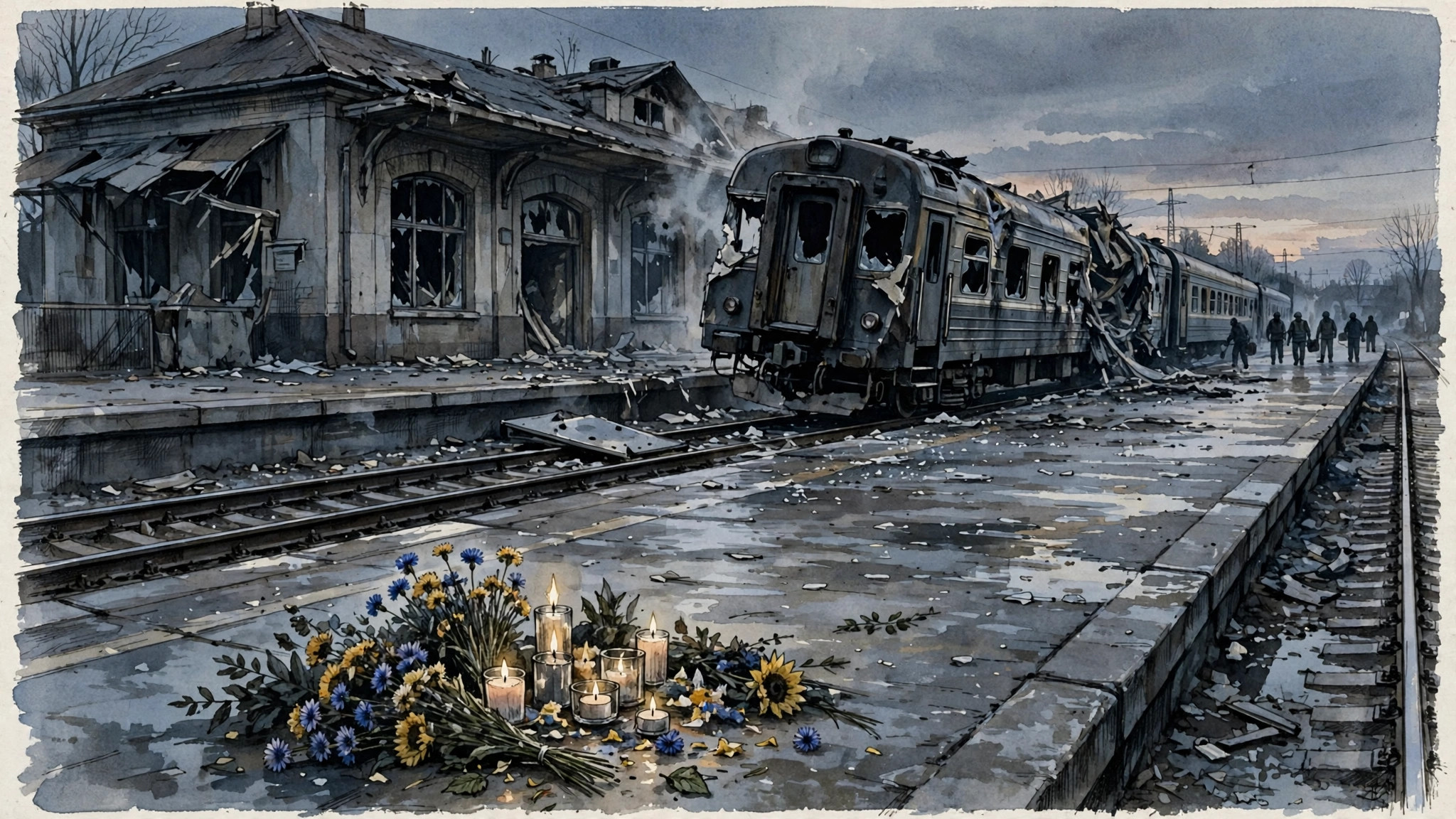
Ukraine woke on Friday to the aftermath of one of the deadliest days of Russian strikes in recent weeks, a day in which a railway platform full of ordinary passengers became the center of a national tragedy. On Thursday, October 29, a Russian drone struck the main station in Dnipro while trains were standing at the platform and people were waiting to travel. By the time rescuers had worked through the wreckage, at least 14 people were confirmed dead there alone, according to Ukrainian officials. Other attacks the same day killed civilians in the northern city of Chernihiv and in Kremenchuk, in central Ukraine, pushing the nationwide toll still higher and leaving hospitals treating dozens of wounded, among them children.
The figures from Thursday changed as the day went on, and they still differ slightly depending on the source and the hour at which they were reported. President Volodymyr Zelenskyy said late on Thursday that the strikes across the country had claimed the lives of 19 people, with another 71 people injured, including 11 children. Other reporting, based on local officials, put the nationwide total at at least 20 people killed and more than 70 injured. USN is presenting the lower, presidential figure as the confirmed minimum while noting the higher local count, because casualty numbers in the first day after attacks of this scale are often revised as families are notified, the wounded are counted, and rescue teams finish their work. What is not in dispute is the scale of the loss, or where most of it occurred.
A Platform Full of Passengers in Dnipro
The attack in Dnipro, a major city in central-eastern Ukraine, was the deadliest single incident of the day. Ukrainian officials said a jet-powered Russian drone struck a platform at the city’s main railway station where, in Zelenskyy’s words, a regular commuter train and a regular passenger train were standing. The state railway operator said one of the trains affected was preparing to travel toward Zaporizhzhia, in the south of the country. It was, by every account, an ordinary working-day scene: people carrying bags, waiting to board, expecting a routine journey.
Ukraine’s air force said it had intercepted three jet-powered drones during the daytime attack, but a fourth got through the defenses and hit the station. Photographs released by the Ukrainian Emergency Service showed rescuers carrying an injured person away on a stretcher, damaged and burned-out passenger cars, and windows blown out along the platform. Those images, shared widely on Thursday, conveyed what words struggle to capture: a place built for departures and reunions turned, in seconds, into a scene of grief.
Dnipropetrovsk regional governor Oleksandr Ganzha said the toll in Dnipro had risen to 14 dead by Thursday afternoon, with 14 more people wounded. Six of the injured were described as being in severe condition, suffering from multiple shrapnel wounds. Among the wounded was an 11-year-old boy. The governor also described one man whose injuries were so severe that both of his legs had to be amputated. Early reports from the scene had put the Dnipro toll at 13, which helps explain why some initial accounts carried that number before officials updated it.
Railway stations and trains have been struck repeatedly since Russia launched its full-scale invasion in 2022. Reporting on Thursday noted that Russian forces have targeted trains across Ukraine since the first days of that invasion, destroying hundreds of locomotives and killing railway workers over the course of the war. For many Ukrainians, the railway is far more than transport. It is a lifeline that has carried evacuees away from danger, brought families back together, and kept cities connected when other routes were closed. An attack on a crowded platform therefore lands with a particular weight, and the response from Kyiv reflected that.
Attacks in Chernihiv and Kremenchuk
Dnipro was not the only city mourning on Thursday. In Chernihiv, north of Kyiv, an attack on the city center killed two 15-year-old girls, according to Zelenskyy and to the head of the city’s military administration, Dmytro Bryzhynsky. Nearly two dozen other people were wounded there, including four children, Bryzhynsky said. The deaths of the two teenagers were mentioned by name and age in Ukrainian statements throughout the day, a reminder that behind every national total are individual young lives, classmates, and families whose loss cannot be measured in statistics.
Further south, in Kremenchuk, a Russian Shahed drone struck a multi-storey apartment building, killing three people, according to the local governor and to Zelenskyy’s account. Several other residents were wounded, including a six-year-old child. A home, like a railway platform, is a place where people are entitled to feel safe. When a drone hits an apartment block, the victims are not found near a front line or a military position as described in the reports reviewed for this story. They are found in their own building, in the middle of daily life.
Taken together, the three cities explain how the national figures were reached. Fourteen people in Dnipro, two teenagers in Chernihiv, and three people in Kremenchuk account for the 19 deaths cited by Zelenskyy. Reports based on local officials that put the total at 20 or described at least six additional deaths beyond Dnipro in separate attacks may reflect a later count or an additional victim recorded elsewhere during the day. USN has not treated either figure as final. In mass-casualty events, the most responsible approach is to attribute each number clearly, explain when it was given, and update readers when officials provide a settled total.
No specific Russian comment on the Dnipro station strike, the Chernihiv attack, or the Kremenchuk apartment strike was included in the reports reviewed for this article. More broadly, the Kremlin has said this week that it would not reduce the overall pace of the war, even as preparations continue for renewed talks under United States mediation. Russia has also intensified drone and missile attacks in recent weeks, including strikes on energy sites that Kyiv says are intended to leave the country facing cold and darkness through the winter. Those are claims and characterizations from the respective sides, and USN labels them as such: Ukraine’s description of Moscow’s intent is Kyiv’s assessment, and Moscow’s statements about the tempo of its operations are its own stated position, not an independently verified account of its plans.
Zelenskyy Appeals for Air Defences and Tougher Sanctions
Zelenskyy condemned the Dnipro attack in stark terms, calling it horrific and describing the day’s strikes as cynical attacks on civilians. He offered condolences to the families of those killed, said medical teams were doing everything they could to save the wounded in hospitals across the affected regions, and argued that the attacks showed Moscow’s true attitude toward efforts to de-escalate the war and end the killing. For Kyiv, Thursday was not presented as an isolated tragedy. It was presented as evidence in an argument Ukraine has been making to its partners for months: that without stronger air defenses, more Ukrainian cities will face the same exposure that Dnipro, Chernihiv, and Kremenchuk faced this week.
That argument was directed most clearly at Europe. In a message posted on X, Zelenskyy thanked European Council President Antonio Costa for his solidarity and used the exchange to press for greater support from the European Union and from every member state. Support from Europe, he said, was extremely important at this moment, and joint efforts needed to be mobilized further ahead of winter so that Ukraine would have the capabilities it needs to defend itself against Russian missiles and drones. The timing matters. As temperatures fall, attacks on power and heating infrastructure carry consequences far beyond the immediate blast, affecting hospitals, schools, water systems, and elderly residents who depend on warmth to survive the season.
Costa responded with a clear condemnation. He described the attacks as yet another cruel and devastating series of Russian strikes against civilians, extended condolences to Zelenskyy and to the Ukrainian people, and said the European Union would continue to increase pressure on Russia and to support Ukraine until what he called a just and lasting peace is achieved. He also called on other international partners to do the same. French President Emmanuel Macron likewise reacted with outrage and argued that far more than a localized ceasefire would be needed to protect Ukrainians.
Sanctions were the other half of Zelenskyy’s appeal. He insisted that sanctions against Moscow and its war machine must not be eased for as long as the war continues, and he renewed his criticism of a recent arrangement between President Donald Trump and Russian President Vladimir Putin that eased some American sanctions to allow Moscow to release diesel onto global markets. How many such strikes, he asked, had Russia carried out since some of those restrictions were lifted, instead of tensions being reduced? He also appealed directly to Washington not to stay silent about the killings, saying that American attention to the deaths mattered greatly. Ukraine is therefore asking for two things at once: practical help in the sky, in the form of air-defense capability, and sustained economic pressure on Moscow from the United States, the European Union, and the wider Group of Seven.
A Quiet Corner in Kherson, and Talks Ahead in Abu Dhabi
Against the grief of Thursday, one small part of southern Ukraine offered a contrasting picture. A fragile local ceasefire around Oleshky, in the Russian-occupied part of the Kherson region, held into a third day. The truce, brokered by the United States and associated in reporting with First Lady Melania Trump, is intended to allow humanitarian relief and possible evacuations for residents who have endured months of shortages of food, water, and medicine. Zelenskyy had said a day earlier that it would be a huge success if the arrangement allowed stranded citizens to be evacuated. Former residents in contact with people still in the city have described desperate conditions in recent months. The fact that the guns stayed quiet there while strikes hit other cities underlines both the value of even a limited pause and how narrow its protection remains. A local truce can save lives in one place. It does not, on its own, protect a platform in Dnipro or an apartment block in Kremenchuk.
The diplomatic calendar ahead is also uncertain. Russia and Ukraine are expected to meet next month with American envoys for another round of trilateral discussions aimed at ending a war now described as Europe’s worst conflict since the Second World War, though no firm date has been confirmed. Zelenskyy has pointed to a possible window in Abu Dhabi in mid-November, and Ukrainian officials have suggested the agenda for technical talks could include an energy and maritime ceasefire, prisoner exchanges, and the return of Ukrainian children. Several previous rounds have failed to bring the two sides meaningfully closer to a settlement.
One dispute is already visible before the delegations sit down. Russia has said European countries will not be invited to the next round of trilateral talks. Kremlin foreign policy aide Yuri Ushakov was quoted as saying that European participation had not been discussed and that the agreement in place was for three-sided consultations among Russia, Ukraine, and the United States alone. That is Moscow’s stated position, presented here as its claim about the format of the talks. Zelenskyy, by contrast, has said Kyiv wants Europe involved, arguing that security guarantees cannot properly be discussed without Europeans at the table, and other European voices have suggested Europe would play a role. The disagreement is not a minor matter of seating. Europe is Ukraine’s closest group of allies and among its biggest military backers, and whether its representatives are inside the room will shape both the content of any proposal and the trust Kyiv places in it.
For now, the immediate work in Ukraine is not diplomatic. It is medical, practical, and human. Doctors are treating the wounded, including children in serious condition. Rescue services are clearing damaged buildings and a damaged station. Families are receiving the worst news a family can receive, and communities in Dnipro, Chernihiv, and Kremenchuk are beginning to bury their dead. However the arguments over sanctions, air defenses, and negotiating tables develop in the coming weeks, Thursday’s toll will be remembered first in those three cities, by the people who were simply waiting for a train, walking through a city center, or at home when the strikes came.
Sources
USN reviewed reporting from multiple outlets for this story. Read more from Gulf News, The Tribune and Firstpost.
[…] halls. A recent Russian drone strike on a crowded station platform in Dnipro, reported in detail in USN’s coverage of the Dnipro station attack, underlined for European delegations why they regard accountability and continued support as urgent […]
[…] It is also worth noting what the reporting does not claim. It does not say the United States threatened to withdraw troops if allies kept speaking out, nor that any ally agreed to change its language. The sources describe advice delivered cordially, not an ultimatum. And the Pentagon’s refusal to comment on private allied conversations is standard practice, not an admission. What can be said is that four people familiar with the matter, including European officials on the receiving end, understood the message the same way: Washington would prefer that its European allies speak about Russia in more measured terms while it pursues a settlement in Ukraine and rethinks its force posture in Europe. For the latest on how Russian strikes continue to hit Ukrainian cities, see USN’s report on the deadly drone attack on a crowded station platform in Dnipro. […]
[…] not lessened. Russian strikes continue to kill civilians far from the front lines, including in a deadly Russian drone strike on a crowded station platform in Dnipro that left at least 19 people dead across Ukraine. For European ministers, that toll is the reason […]
[…] even as they welcome the decision. Readers following Ukraine’s air defence can also read our earlier coverage of Russian strikes on Ukrainian infrastructure, which explains how the nightly campaign against energy targets has shaped the war’s civilian […]