

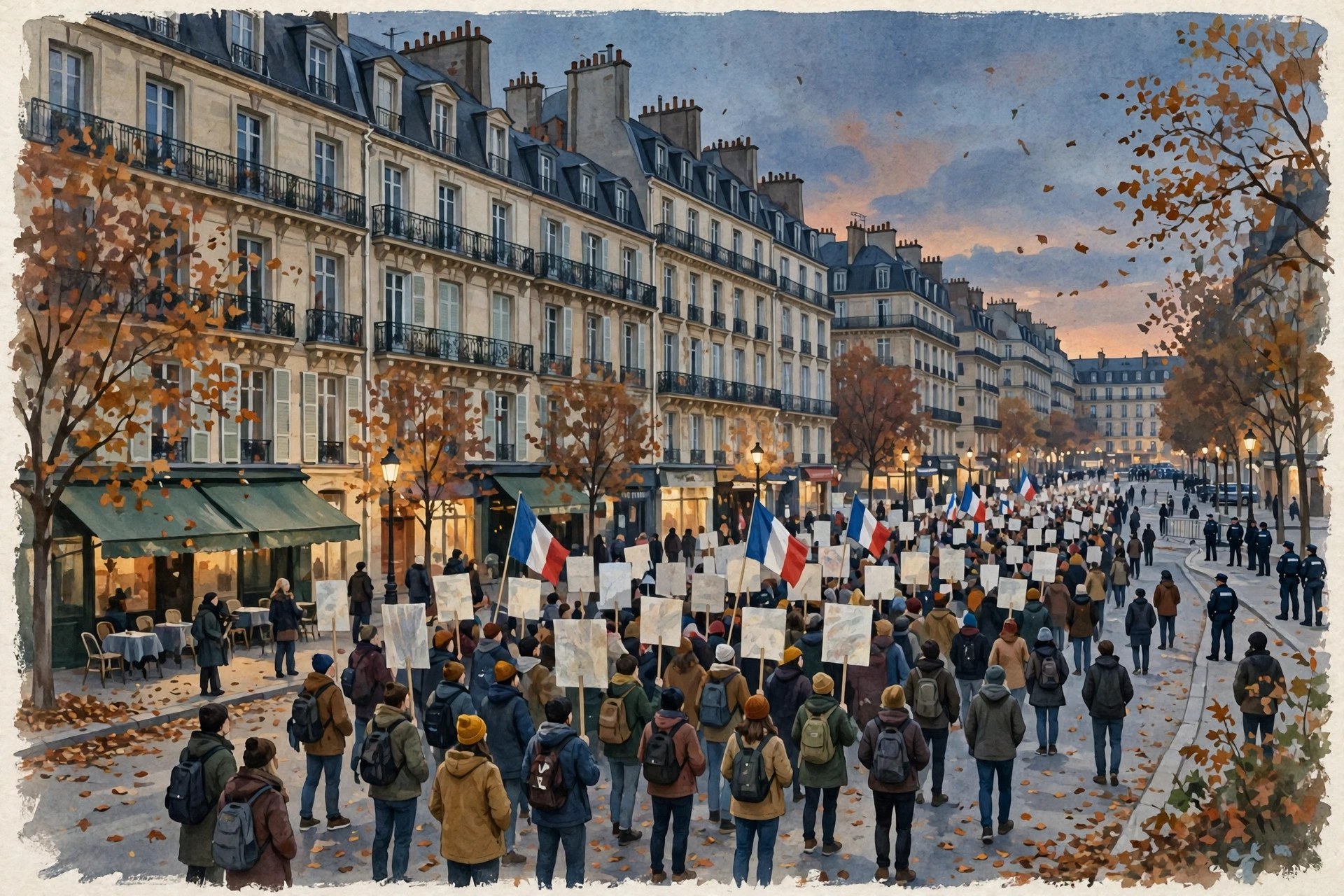
France’s protest movement now faces its next test on November 5, when trade unions have called a nationwide demonstration that student groups plan to join, after a third consecutive weekend of marches drew about 320,000 people across the country on Saturday. The coming week will show whether a movement that began in schools a month ago can hold its breadth as it moves from weekend street marches into weekday blockades and a joint day of action with organised labour. Student leaders have already promised high school and university blockades on Tuesday and Thursday, setting up a sequence of pressure that runs straight into the November 5 demonstration and will be watched closely by a government that insists it has heard the protesters but has not yet persuaded them to stop.
The interior ministry said about 320,000 people demonstrated across France on Saturday, including 70,000 in Paris, at roughly 150 demonstrations nationwide. That official figure was lower than the previous two weekends, when the government counted about 410,000 people on October 24 and more than 500,000 on October 17. Youth unions and student organisers put Saturday’s turnout far higher, at nearly half a million nationwide, including about 200,000 in Paris according to a coalition of youth organisations and unions cited in reporting of the day. The gap between the two counts is itself part of the story of this movement: the authorities and the organisers have disagreed about crowd sizes at every stage, and each side reads the same streets differently.
In Paris, protesters set off from Porte de Bagnolet and headed towards Porte de Charenton, largely avoiding the city centre after police moved the main demonstration following a last-minute court dispute over the route. Many marchers wore Halloween costumes, and much of the day passed peacefully, according to both the authorities and protest organisers. Interior Minister Laurent Nuñez said the marches had been largely orderly, a judgement that sat alongside his sharp condemnation of the disorder that broke out on the sidelines as the demonstrations ended. The contrast between those two descriptions captures Saturday in miniature: a mass mobilisation that was, for most participants, a march, and a fringe of confrontation that dominated the evening’s headlines.
Arrests and injuries, and two accounts of the violence
By late Saturday, the interior ministry said police had arrested 565 people across the country. Four police officers and one gendarme were injured in Paris, three of them burned by Molotov cocktails, according to the ministry’s account reported by several outlets. Nuñez described an attack in which a police officer was struck by a Molotov cocktail as attempted murder and denounced what he called an extraordinary level of violence by some groups as the rallies ended. Protest organisers, for their part, have consistently argued that the overwhelming majority of demonstrators marched peacefully and that the violence came from small groups on the margins, a distinction the authorities themselves partly echoed when Nuñez said about 150 planned demonstrations had passed off peacefully. The arrests figure was lower than at the same point the previous weekend, when reports put the number at about 800, though the ministry’s late-Saturday total was still far above the roughly 290 arrests reported earlier in the day, a reminder that arrest counts during a moving protest are provisional and rise as the evening goes on.
About 70,000 police officers and gendarmes were deployed across France for Saturday’s protests, including elite units, after Nuñez warned of a very high risk of disorder, especially after dark on Halloween. The minister had argued that masked participants and Halloween gatherings could add to the security risk, and the scale of the deployment reflected the experience of the previous two weekends, when demonstrations degenerated into some of the worst rioting in years, with shops looted and public buildings damaged. Supporters of the heavy deployment say it prevented a repeat of that scale of destruction; critics of heavy-handed policing argue that such a large security presence can itself raise tensions on the street. Both claims were in circulation on Saturday, and neither side’s account of the policing should be taken as the whole picture: the day contained both a largely peaceful mass march and serious, documented injuries to officers.
How a school protest became a cost-of-living movement
The protests began a month ago at a high school on the outskirts of Paris, over the state of schools, and widened from there into a broader movement over the cost of living. High school students launched the movement to protest neglected buildings, teacher shortages and a university admissions system they see as unfair to disadvantaged students. What started as a dispute about classrooms and places at university has since drawn in university students, trade unions and Yellow Vest activists, united by anger over rising living costs, widening inequality and deteriorating public services. That broadening is the movement’s strength and its complication: it now speaks for many grievances at once, from school funding to household budgets, which makes it harder for the government to answer with a single concession and harder for the movement to agree on what would count as victory.
The government response so far
The government’s response so far has combined dialogue with a firm security line. Prime Minister Sébastien Lecornu held several meetings with student representatives in the week before Saturday’s marches, and the government has said it is examining measures to ease pressure on household budgets. President Emmanuel Macron has promised concrete measures in response to what he has described as legitimate demands at the root of the movement, while also acknowledging that the authorities did not anticipate the scale of the demonstrations. In the run-up to Saturday, two high school student groups welcomed some of the government’s concessions while still calling for protests to continue, according to reporting of their positions, and other student representatives dismissed the announcements as insufficient, describing them as crumbs against demands that include far more higher-education places and billions of euros in school funding. The disagreement among student groups themselves matters: the government has been accused by some representatives of meeting people who do not speak for the movement, a charge that, if widely believed, would undercut the value of any negotiated concession.
What the November 5 France protest will test
The calendar now gives both sides a series of dates to aim at. Student groups have vowed new high school and university blockades on Tuesday and Thursday, with Sabrine Kharbach of the student group Union Étudiante telling reporters that students would then join the November 5 demonstration called by workers and unions. Classes resume after the school holidays on November 2, which gives the blockade calls a practical stage: school gates, rather than weekend streets, become the next front line. The November 5 demonstration is the more consequential test, because it will show whether students and trade unions can mobilise together at scale, and whether the movement’s weekend energy survives the working week. A large, peaceful turnout on November 5 would strengthen the organisers’ claim that this is a broad social movement rather than a student moment; a smaller or more disorderly day would strengthen the government’s argument that the movement is fading and that its remaining energy sits with a violent fringe.
The turnout trend invites competing readings, and both deserve a hearing. The government can point to a clear decline in its own figures, from more than 500,000 to 410,000 to 320,000, and argue that its combination of dialogue and policing is working. Organisers dispute the official counts, note that their own estimates remain far higher, and argue that sustaining hundreds of thousands of people on a third consecutive weekend, on Halloween, in itself demonstrates durability. Neither reading can be settled by crowd estimates alone, which are notoriously uncertain and politically contested in France as elsewhere. What can be said with more confidence is that the movement has lasted a month, has spread beyond its original school base, and has forced the government into repeated rounds of meetings and promises, which is more than most protest waves achieve. Whether it can convert that persistence into concrete policy change is the question November 5 will help answer.
What households feel behind the numbers
For households, the stakes are not abstract. The cost-of-living grievance at the heart of the widened movement is about the everyday arithmetic of rent, food, transport and energy, and about public services that many protesters say have visibly deteriorated. Readers interested in how government policy reaches household budgets can find a related USN examination of how policies can change profit and loss for households, which looks at the same question from the American side: the distance between a policy announcement and what a family actually feels. In France, that distance is precisely what protesters say they are marching about, and it is why promises of future reforms, however detailed, have so far not been enough to end the demonstrations.
Elsewhere in Europe, Germany also saw cost-of-living demonstrations the same weekend, a sign that the pressures driving the French marches are not confined to one country.
What to watch in the fourth week
What happens next will be determined by three things: the size and conduct of the Tuesday and Thursday blockades, the scale of the November 5 demonstration, and whether the government follows its meetings with student representatives with measures that the movement’s own spokespeople recognise as answers to their demands. If the blockades are large and the November 5 march is peaceful and broad, the government will face renewed pressure to move from examining measures to announcing them. If the week brings further clashes and arrests, the argument about violence, rather than the argument about living costs, will again dominate the coverage, and the movement’s organisers will face the difficult task of keeping a mass peaceful protest distinct from the confrontations on its edges. Either way, the third weekend did not end this movement. It set up its fourth week.
Sources
Sources: USN reviewed reporting from multiple outlets for this story. Read more from Channel News Asia, MercoPress and Al Jazeera.