

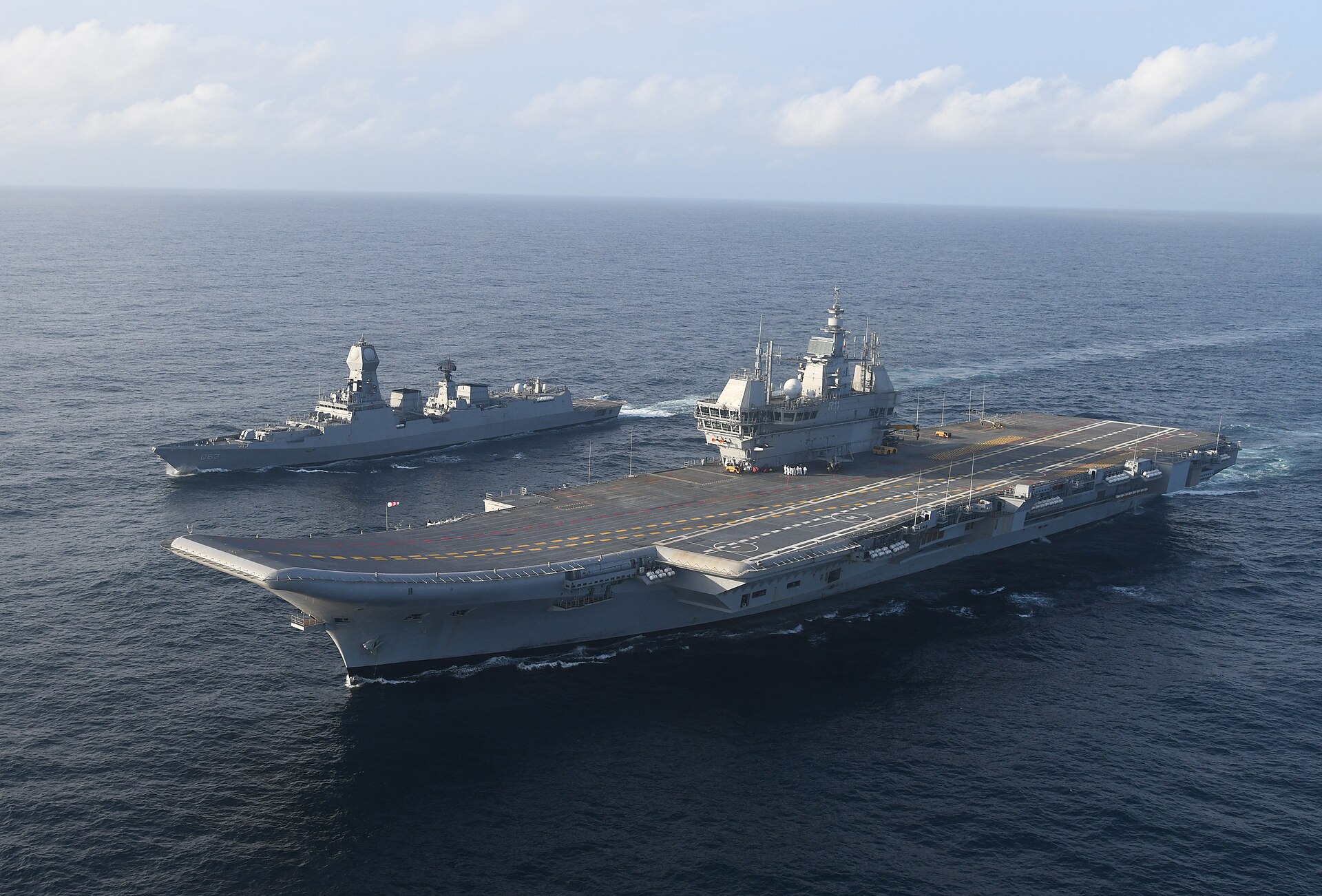
India’s Ministry of Defence has signed a contract worth Rs 1,976.40 crore with Israel Aerospace Industries for the upgradation and obsolescence management of the Barak Point Defence Missile System fitted on Indian Navy ships. The agreement, signed in New Delhi on 18 November 2026 in the presence of Defence Secretary Rajesh Kumar Singh, is one of the most significant naval air-defence deals of the year, and it underlines a practical reality of modern sea power: keeping the weapons a fleet already owns effective for longer can matter as much as buying new ones.
The contract does not buy India a new missile system. It buys the continued life and improved performance of a system the Navy has relied on for more than two decades. Under the agreement, the Barak point defence system will receive a comprehensive upgrade of both its hardware and its software, and the long-running problem of ageing parts and outdated electronics will be managed so that the system stays serviceable for the rest of its working life. The ministry said the upgradation would ensure enhanced features and potent range anti-air defence capability for Indian naval platforms, a formulation that points to both better sensors and computing and a sharper ability to engage incoming threats.
The deal was concluded under the Other Capital Procurement Procedure, a route within the Defence Acquisition Procedure that is used for capital purchases which do not fit the standard acquisition categories. That choice of procedure is itself informative. It signals that the ministry treated this as a capital investment in an existing capability rather than as a fresh acquisition, and it reflects the way the procurement framework has evolved to handle upgrades, life extension and obsolescence work as distinct categories of spending. For the Navy, the practical consequence is straightforward: ships that sail today with the Barak system will, over the course of the programme, sail with a more capable version of it.
The announcement also fits into a wider pattern of naval procurement in November 2026. It is the third major agreement signed for the Indian Navy in the month, and it arrives at a time when the fleet is being asked to operate across a wider geography, in waters where the threat from aircraft, drones and anti-ship missiles is no longer theoretical. The value of the contract, just under Rs 2,000 crore, is modest beside the cost of a new warship or a new missile programme, but its effect is spread across a large part of the surface fleet, because the Barak point defence system is fitted on many of the Navy’s most important ships.
The Barak Missile System Upgrade: What the Contract Covers
The heart of the agreement is a comprehensive upgrade of the Barak Point Defence Missile System’s hardware and software. The Press Information Bureau release issued by the ministry on 18 November 2026 describes the scope in those terms, and reporting of the release confirms that the work will cover the system’s launchers, its fire-control radars and its command systems. The Hindu BusinessLine, reporting the signing, said the ministry intends to upgrade seven complete shipborne Barak-1 anti-missile defence systems under the deal, each broadly comprising vertical launch units, fire-control radars and command systems. That detail, attributed to the newspaper’s reporting of the ministry’s statement, gives the clearest picture yet of the scale of the programme.
What the upgrade is expected to deliver, in the ministry’s own words, is enhanced features and potent range anti-air defence capability for Indian naval platforms. The phrasing is deliberately general, and neither the ministry nor the reporting of the announcement has disclosed the specific range improvements or the precise technical changes involved. That restraint is normal for a contract of this kind, where the details of radar performance, software changes and interceptor behaviour are not published. What can be said with confidence is that the work is aimed at the two halves of any missile system that age fastest: the electronics that detect and track targets, and the software that decides how to engage them.
The second half of the contract, obsolescence management, is less visible but just as important. A missile system that has been in service for more than twenty years depends on components, circuit boards, processors and test equipment that were designed in an earlier era of electronics. Manufacturers stop making some of those parts. Suppliers close product lines. Software written for older computing hardware becomes harder to maintain. Obsolescence management is the structured process of assessing those risks and resolving them before they leave a ship unable to fire its own defensive missiles. The Times of India, reporting the deal, described it in exactly those terms: a structured process of assessing and resolving risks when missile hardware, electronics, software or test equipment become outdated during the system’s service life.
It is worth being precise about what has actually happened. The contract has been signed, and the work it describes has been agreed and funded. The upgraded systems have not yet been delivered, and no completion date has been announced. The ministry has not said which ships will be upgraded first, nor has it published a timetable for the programme. Those details may emerge as the work proceeds, but for now the public record establishes the signature, the value, the contractor, the system and the scope, and nothing beyond that should be treated as settled.
Why Point Defence Matters at Sea
To understand why this contract matters, it helps to understand what a point defence missile system does. A warship at sea faces threats from several directions and at several ranges. Long-range air defence systems engage aircraft and missiles far from the ship. Medium-range systems cover the middle distance. Point defence is the last layer. It protects the ship carrying it, engaging threats that have got past the outer layers, at short range and with very little time to react. When it works, the ship survives an attack that has already penetrated its outer defences. When it does not, there may be no second chance.
The Barak-1 is a ship-borne surface-to-air missile system built for precisely that role. It is designed to intercept aircraft, unmanned aerial vehicles and anti-ship missiles, including sea-skimming missiles that fly just above the waves and are among the hardest targets for a ship’s radar to detect in time. The Times of India, reporting the contract, noted that the system uses a compact and low-maintenance eight-cell vertical launching module weighing about 1,700 kilograms, and that it complements or replaces gun-based close-in weapon systems with longer-range vertical-launch interception. That compactness matters on a warship, where space and weight are always rationed and every system competes for room with every other.
The threats the system is built to defeat have changed considerably since it was first bought. Drones have become a routine part of naval warfare, and the inventory of anti-ship missiles in the region has grown more capable. A point defence system that was adequate against the threats of the early 2000s needs better sensors, faster processing and more capable software to deal with the threats of the late 2020s. That is the gap the upgrade is intended to close, and it is why the ministry framed the deal in terms of enhanced features and a more potent anti-air capability rather than simply in terms of keeping old equipment running.
There is also a simple arithmetic to fleet air defence. The Times of India reported that roughly eleven to fifteen Indian warships have been deployed with Barak missile systems. The Hindu BusinessLine reported that the systems are installed on an aircraft carrier and frontline destroyers and frigates. The New Indian Express, reporting the same announcement, said the system is fitted on several major platforms, including the aircraft carrier INS Vikramaditya, Delhi-class destroyers, and Shivalik- and Brahmaputra-class frigates. A single upgrade programme that touches that many ships therefore lifts the defensive capability of a large part of the fleet at once, which is a far more efficient way of adding capability than buying a small number of new systems for a small number of hulls.
From Approval to Signature: A Fifteen-Month Path
The contract signed on 18 November 2026 did not appear from nowhere. It followed a formal approval process that began more than a year earlier. The Hindu BusinessLine reported that the Defence Acquisition Council, chaired by Defence Minister Rajnath Singh, granted administrative approval for the upgradation of the Barak-1 missile system at its meeting on 5 August 2025. The New Indian Express reported that the approval came as part of proposals worth about Rs 67,000 crore cleared at that meeting, which also approved BrahMos fire control systems and launchers, and compact autonomous surface craft, for the Navy.
The gap of about fifteen months between that approval and the signature of the contract is normal for a deal of this kind. Administrative approval, known as Acceptance of Necessity, is an in-principle decision that the armed forces need a capability. It is not a contract, and no money is spent at that stage. What follows is the detailed work of costing, negotiation, technical discussion and contract drafting, all of which takes time, particularly when the work involves a foreign original equipment manufacturer and a system whose design data sits with that manufacturer. The fact that the contract was concluded under the Other Capital Procurement Procedure also shaped the path it took, since that route has its own rules and stages within the Defence Acquisition Procedure.
The signing itself took place in New Delhi in the presence of Defence Secretary Rajesh Kumar Singh, a detail confirmed by the Press Information Bureau release and by every major report of the announcement. The presence of the Defence Secretary at the signing is a mark of the deal’s importance within the ministry, and it is consistent with the way significant defence contracts are concluded in India, with the senior civilian leadership of the ministry present to mark the agreement.
The timeline also matters for a different reason. Each month between approval and signature is a month in which the ships sail with the older version of the system, and in which the risk of parts running out grows a little larger. The completion of the contract removes that uncertainty, at least for the systems covered by it, and gives the Navy and the shipyards a firm basis for planning the refit and upgrade work that will follow. Whether the work is carried out during scheduled refits or as a separate programme has not been announced, and it would be wrong to speculate about the sequence of individual ships.
Seven Systems, Two Decades of Service
The Barak-1 system has been in Indian service for more than two decades. The Hindu BusinessLine reported that India originally bought the system in October 2000, in an emergency procurement valued at approximately Rs 1,160 crore at the time. The New Indian Express reported that the Navy bought the system in 2000 after the Kargil conflict exposed gaps in the anti-missile defences of its frontline ships. That history explains both why the system is so widely fitted across the fleet and why it now needs an upgrade: it was bought quickly, in large numbers, to fill an urgent gap, and it has been in continuous service ever since.
The original purchase was not without controversy. The Hindu BusinessLine reported that the 2000 deal courted controversy because of a Central Bureau of Investigation inquiry into alleged middleman commissions following the Tehelka sting operation of 2001. The agency closed the case in December 2013, citing a lack of evidence to prosecute the suspects. After that, the ministry approved a follow-on order of 262 additional Barak-1 missiles worth Rs 880 crore. That sequence, from emergency purchase through investigation to closure and a follow-on order, is part of the system’s history in Indian service, and it helps explain why the upgrade contract has been reported with attention to the procurement route and the approvals behind it.
The seven complete shipborne systems that The Hindu BusinessLine reported as covered by the new deal represent the core of the Navy’s Barak-1 fit. Each complete system, broadly comprising vertical launch units, fire-control radars and command systems, is a substantial piece of a warship’s combat capability, and upgrading seven of them is a significant engineering undertaking. It involves not only the missiles themselves but the sensors that find targets, the radars that guide the interceptors and the command systems that tie the whole arrangement together. A failure in any one of those elements would leave the system unable to perform, which is why the upgrade is described as comprehensive rather than limited to a single component.
The age of the system is also the reason the obsolescence management component of the contract is so prominent. Twenty-six years after the original purchase, many of the electronic components in the system will no longer be manufactured, and the test equipment used to maintain it will itself be ageing. An upgrade that replaced only the visible hardware while leaving the support chain untouched would leave the Navy with a more capable system that it could not keep running. The contract’s pairing of upgradation with obsolescence management is designed to avoid exactly that outcome.
Obsolescence Management: The Quiet Half of the Deal
Obsolescence management rarely makes headlines, but for a navy it is one of the most persistent and expensive problems in keeping a fleet combat-ready. A warship is expected to serve for thirty years or more, while the electronics inside its weapons typically become obsolete within a decade. Processors are superseded, memory chips go out of production, and the companies that made specialised components move on to other products. The result is a slow erosion of supportability: the system still works, but the parts needed to repair it become harder and more expensive to find, and the people who know how to maintain it become fewer.
The contract signed with Israel Aerospace Industries addresses that problem directly. By pairing the hardware and software upgrade with obsolescence management, the ministry has bought not only improved performance but a renewed support base for the system. The new hardware will use components that are currently in production, the new software will run on modern computing hardware, and the test and maintenance equipment will be brought up to date alongside them. That combination is what allows a system bought in 2000 to remain viable into the 2030s, and it is the reason the ministry described the work as ensuring enhanced features and potent range anti-air defence capability rather than simply as a repair job.
This is also where the economics of the deal become clear. Buying a new point defence system for eleven to fifteen warships would cost far more than Rs 1,976.40 crore, and it would require structural work on every ship to remove the old system and fit the new one. A previous Comptroller and Auditor General report on warship construction recorded how costly such structural rework had been when the Barak system itself was fitted to frigates under construction. Upgrading the existing system avoids that cost and that disruption, and it preserves the investment already made in the ships, their crews’ training and the Navy’s logistics chain for the system.
There is a trade-off, and it should be stated plainly. The upgrade keeps India dependent on the original foreign manufacturer for the system, because only Israel Aerospace Industries holds the design data and software needed to upgrade it. That dependence is a recognised feature of buying a finished foreign weapon system, and it is the price of the speed with which the system was originally acquired. The contract does not, on the public record, include a transfer of technology that would allow India to carry out future upgrades itself, and that means the next upgrade of this system, if one is needed, is likely to involve the same manufacturer again.
The Indian Industry Angle: Bharat Electronics and Bharat Dynamics
One of the more consequential details reported about the contract concerns the role of Indian industry in carrying it out. The Hindu BusinessLine reported that defence public sector undertakings Bharat Electronics Limited and Bharat Dynamics Limited will act as a primary industry partner for Israel Aerospace Industries in the upgrades of the Barak systems. That arrangement matters for two reasons. First, it means that a significant part of the work will be carried out in India, by Indian companies, with Indian workers and facilities. Second, it means that the knowledge and experience gained from the upgrade programme will sit, at least in part, within the Indian defence industrial base.
Bharat Electronics and Bharat Dynamics are both central to India’s missile and electronics industry. Bharat Electronics builds radars, fire-control systems and electronic warfare equipment, and Bharat Dynamics manufactures missiles. Their involvement in the Barak upgrade is consistent with the way India has handled major foreign defence programmes in recent years, in which an Indian public sector company acts as the domestic partner for the foreign original equipment manufacturer. The precise division of work between Israel Aerospace Industries and the two Indian companies has not been published, and it would be wrong to guess at the shares involved, but the principle is clear: the upgrade is not a purely imported service.
The Indian industry angle also connects to the wider debate about self-reliance in defence, known as Atmanirbharta. In recent years the ministry has placed increasing emphasis on buying from Indian industry, and a large share of new capital contracts now goes to domestic companies. A contract with a foreign vendor for the upgrade of a foreign-designed system sits uneasily with that direction of travel, and it is fair to note the tension. The counter-argument, which the ministry’s own framing of the deal supports, is that point defence is a capability the fleet cannot do without while a replacement is being developed, and that upgrading a proven system is the fastest way to keep the fleet protected. The two positions are not easily reconciled, and the debate they represent is likely to continue as the programme proceeds.
What is not in doubt is that the involvement of Bharat Electronics and Bharat Dynamics gives the programme a domestic anchor. If the upgrade work is carried out well, it will deepen the two companies’ familiarity with the Barak system and with the technologies involved in modernising it, and that familiarity may be useful when the Navy eventually moves to an Indian-designed replacement. That is a longer-term benefit, and it should not be overstated, but it is a real one, and it is one of the reasons the partnership arrangement was reported as a significant element of the deal.
Barak-1, Barak-8 and the Road to an Indian Replacement
The Barak name covers more than one system, and the distinction matters. The system being upgraded under the new contract is the Barak-1, the short-range point defence missile that protects an individual ship. Alongside it, the Indian Navy operates the Barak-8, a longer-range surface-to-air missile system jointly developed by Israel Aerospace Industries and India’s Defence Research and Development Organisation. The Times of India, reporting the contract, noted that the Barak-8 long-range surface-to-air missile system is deployed on major surface combatants such as destroyers, frigates and aircraft carriers, and that India has pursued expanded deployments and extended-range variants of it.
The two systems do different jobs. The Barak-8 provides area air defence at longer range, engaging threats before they come close to the fleet. The Barak-1 provides the last layer of protection for the ship carrying it. They are complementary rather than interchangeable, and the upgrade of one does not remove the need for the other. The co-development model behind the Barak-8, in which Indian and Israeli organisations designed the system together, is also different from the model behind the Barak-1, which India bought as a finished product. That difference is at the root of the vendor dependence discussed above, and it is the reason the Barak-8 programme is often held up as a better template for future cooperation.
Looking further ahead, the Barak-1 is expected eventually to give way to an Indian-designed system. The New Indian Express reported that the Barak-1 is slated eventually to be replaced by the Vertical Launch Short Range Surface-to-Air Missile, known as VL-SRSAM, which is being developed indigenously by the Defence Research and Development Organisation. Until that system is ready and in service, the upgrade is meant to keep a proven system combat-ready. That framing is important: the contract is a bridge, not a destination. It buys time for the indigenous replacement to mature, and it does so by keeping the existing capability effective in the meantime.
The timeline for that replacement has not been announced in connection with this contract, and it would be wrong to suggest a date. What can be said is that the development of an indigenous short-range ship-borne air defence missile is a complex undertaking, involving the missile itself, its launcher, its radar and its integration with the ship’s combat management system, and that such programmes take years to move from development to service. The upgrade contract ensures that the Navy is not left without an effective point defence capability while that work proceeds.
A Busy Month for Naval Procurement
The Barak contract is the third major agreement signed for the Indian Navy in November 2026, and the other two give a sense of the scale and pace of the Navy’s current modernisation. The Times of India reported that on 11 November the defence ministry signed an agreement worth Rs 498 crore with Cochin Shipyard Limited for the refit and re-powering of the Brahmaputra-class guided missile frigate INS Betwa, which had faced two accidents in the past. On 2 November, the ministry signed contracts worth Rs 53,866 crore with two defence public sector undertakings for the construction of eight indigenously designed next-generation corvettes for the Indian Navy.
Taken together, the three deals illustrate the breadth of the Navy’s current programme. The corvette contract is about new construction and the expansion of the fleet. The INS Betwa agreement is about repairing and returning a damaged ship to service. The Barak contract is about keeping the weapons on the ships the Navy already has effective against modern threats. Each addresses a different part of the same problem, which is how to maintain a fleet that can operate across the Indian Ocean and beyond, and each involves a different mix of Indian and foreign industry.
The scale of the corvette deal, at Rs 53,866 crore, puts the Barak contract in perspective. At Rs 1,976.40 crore, the missile upgrade is a fraction of the cost of eight new warships, yet its effect is felt across many of the ships the Navy already operates. That ratio of cost to effect is one of the strongest arguments for upgrade programmes in general, and it is a point that defence planners return to often when they are asked why money is spent on old systems rather than new ones. A navy that can only afford new ships and new weapons, and cannot afford to maintain what it has, will find its fleet shrinking in capability even as it grows in numbers.
The month’s three contracts also show the ministry working through different procurement routes for different purposes. The corvettes were ordered from Indian public sector undertakings, the frigate refit went to an Indian shipyard, and the missile upgrade went to the foreign original equipment manufacturer under the Other Capital Procurement Procedure. That variety reflects the reality that no single procurement route fits every need, and that the ministry’s task is to match the route to the requirement rather than to force every requirement through the same channel.
For now, the public record of the Barak contract is complete in its essentials. A contract worth Rs 1,976.40 crore has been signed with Israel Aerospace Industries for the upgradation and obsolescence management of the Barak Point Defence Missile System on Indian Navy ships. It was signed in New Delhi on 18 November 2026, in the presence of the Defence Secretary, under the Other Capital Procurement Procedure, following approval by the Defence Acquisition Council in August 2025. The work it covers, a comprehensive upgrade of hardware and software together with obsolescence management, is intended to give Indian naval platforms enhanced features and a more potent anti-air defence capability. What happens next, the order in which ships are upgraded and the pace at which the work is completed, will become clear as the programme moves from signature to execution, and it will be worth following closely, because the ships that carry this system are among the most important in the fleet.
Sources
USN reviewed reporting from multiple outlets for this story. Read more from PIB, The Hindu BusinessLine and The Times of India.