

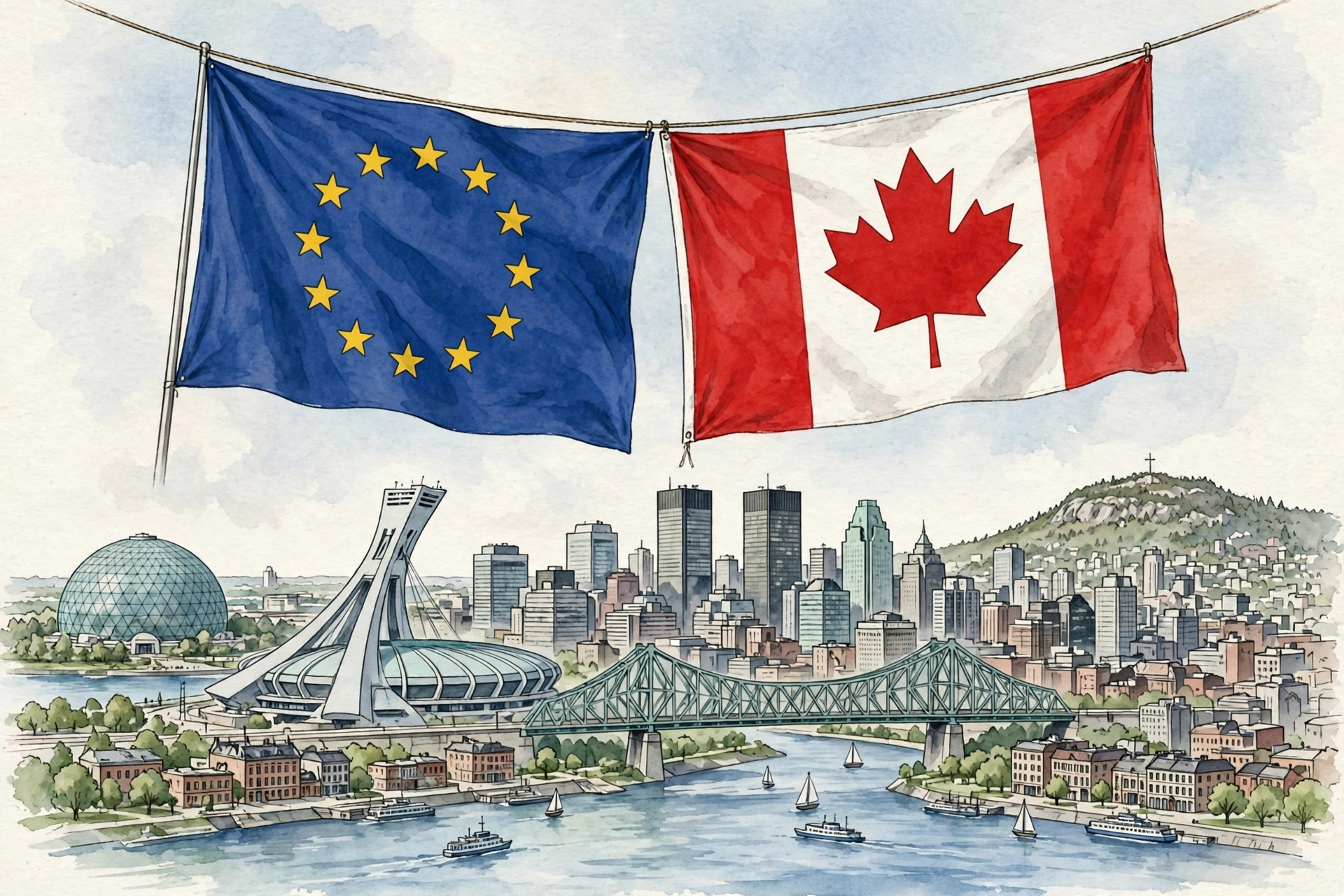
Canada and the European Union announced a new partnership on Friday, 30 October 2026, after two days of talks in Montreal, presenting it as a deeper alliance for a period of growing global uncertainty. Canadian Prime Minister Mark Carney hosted European Commission President Ursula von der Leyen and European Council President António Costa for the 21st Canada-EU summit, and the three leaders closed the meeting with a joint statement, a digital trade agreement and a series of cooperation pledges spanning trade, technology, energy and security.
The leaders called the new framework the Alliance for the Future. In their joint statement, they described it as an effort to build what they called a common space of prosperity and economic security, with more than 20 measures intended to make life more affordable, create opportunities and protect sovereignty on both sides of the Atlantic. Carney told reporters in Montreal that the summit marked a major step forward, while von der Leyen framed sovereignty in the current era not as the freedom to act alone, but as the capacity to act together.
The announcement matters because it goes beyond a routine summit communique. Canada and the EU already trade heavily under the Comprehensive Economic and Trade Agreement, known as CETA, which entered into force in 2017 and removed duties on most goods traded between them. The Montreal package is designed to deepen that relationship further, into areas that were not at the centre of the earlier trade deal, including critical minerals, artificial intelligence, satellite systems, defence-related industrial cooperation and student and research exchanges.
At the same time, the summit took place against a difficult backdrop in relations with the United States. Both Canada and the EU have faced steep American tariffs and repeated trade threats under President Donald Trump, and both have spoken publicly about reducing their vulnerability to sudden shifts in Washington. The leaders did not present the Montreal agreement as a break with the United States, and Brussels has previously said the closer Canada partnership is not aimed against any other country. But the timing, the language about economic security and the emphasis on diversifying supply chains left little doubt that strain with Washington was part of the context.
What Was Announced at the Montreal Summit
The centrepiece of the summit was the Alliance for the Future itself, a political framework rather than a single treaty. The seven-page joint statement set out six broad areas of work: trade and regulatory cooperation, digital technology and research, critical resources and energy, financial services, security and preparedness, and people-to-people ties. Officials said the two sides would spend the coming months working out the details, with further talks leading toward the next summit in 2027.
One concrete outcome was the conclusion of negotiations on a digital trade agreement. The deal is intended to make cross-border business easier by setting clearer rules for digital services, electronic transactions and data transfers. Supporters say such rules matter more as services, software and online commerce make up a larger share of trade, and as companies on both sides seek predictable standards rather than a patchwork of national requirements.
A second agreement allows the European Investment Bank to finance critical raw materials projects in Canada. Canada holds large deposits of rare earths and other critical minerals that Europe needs for batteries, clean-energy equipment, electronics and defence manufacturing, but many of those resources are in remote areas and require major infrastructure investment before they can be developed at scale. The bank’s involvement is intended to help unlock that investment and give European buyers more secure, diversified sources beyond China, which currently dominates much of the global supply chain for several critical minerals.
The joint statement also pointed to wider cooperation on artificial intelligence safety and security, satellite connectivity and navigation, and Arctic and border security. Canadian artificial intelligence researchers are to gain greater access to European supercomputing capacity, according to summit reporting, while the two sides also agreed to discuss Canada’s participation in the EU’s Erasmus student exchange programme and its Galileo satellite navigation system. Those steps, if completed, would bring Canada closer to parts of the EU’s research, education and space infrastructure that have traditionally been reserved mainly for member states and close partners.
Just before the summit, Ottawa also announced a 1.6 billion Canadian dollar investment in Cohere, a Canadian artificial intelligence company. The timing underlined how central AI has become to the partnership: both sides are trying to build competitive AI industries without depending entirely on the United States or China for models, computing power and talent.
Canada’s €500 Million Contribution to the €90 Billion Ukraine Support Loan
Ukraine was a major item on the summit agenda, and the most closely watched financial announcement concerned support for Kyiv. Carney announced that Canada would contribute to the EU’s €90 billion support loan for Ukraine, with an announced initial Canadian contribution of €500 million (about $558 million). Canada does not fund the whole €90 billion loan: that total is the EU-led loan package, to which Canada is adding its initial share. The overall loan is valued at about $103 billion, according to reporting of the announcement.
It is important to be precise about the status of that money. The loan and Canada’s participation were announced in Montreal, but they have not yet been disbursed in full. The EU loan mechanism is intended to cover 2026 and 2027, and further decisions, parliamentary steps and technical arrangements will determine how and when funds actually reach Ukraine. Canada’s €500 million was described by Carney as an initial contribution, which leaves open the possibility of further Canadian support later, but no larger final Canadian total had been confirmed at the time of the announcement.
Ukrainian officials and analysts have stressed the scale of Kyiv’s financing needs. Ukraine is reported to face a budget shortfall of at least €70 billion next year, even after accounting for about €45 billion the EU is already set to disburse. The €90 billion loan is therefore presented by its backers as a bridge to keep the Ukrainian state functioning, pay for essential services and sustain the war effort while longer-term funding arrangements are negotiated.
Carney described the loan mechanism as an effective way of using frozen assets to provide much-needed financing to Ukraine. A Canadian government backgrounder cited in reporting also indicated that Canada’s participation would allow Ukraine to use EU funds to purchase military equipment from Canadian defence companies. That detail matters politically in Canada, where supporters of the aid argue that it supports both Ukraine and Canadian industry, while critics of foreign aid spending often ask what domestic benefit such commitments bring.
The announcement also fits a wider pattern of recent pledges to Ukraine. Norway pledged $9 billion for 2027 earlier in October, and the United Kingdom announced a $13 billion pledge on 28 October, described as its largest ever. The Montreal decision therefore places Canada alongside other partners that have moved in recent weeks to fill gaps in Ukraine’s expected 2027 budget, rather than acting alone.
In the joint statement, Canada and the EU reaffirmed what they called continued firm and unwavering support for Ukraine’s independence, sovereignty and territorial integrity within its internationally recognised borders. They pledged to continue political, financial, economic, energy, humanitarian, military and diplomatic support, and to press for a comprehensive, just and lasting peace based on international law, including the United Nations Charter. They also said they would continue to step up pressure on Russia, although the statement did not announce new sanctions measures at the summit itself.
Why the Alliance Is Happening Now: Strain With Washington
The Montreal summit cannot be understood without the deterioration in transatlantic trade relations over the past two years. Before the current tariff disputes, Canada sent nearly 80 percent of its exports to the United States, making it deeply exposed to any change in American trade policy. That exposure became a central political issue after Trump returned to office and imposed sweeping tariffs on allies as well as rivals.
In August 2026, trade talks between Ottawa and Washington broke down, and Trump imposed a 50 percent levy on about $20 billion worth of Canadian goods, covering a small but symbolically important share of Canadian exports. Canada responded with equivalent tariffs on American steel, dairy products, appliances, farm equipment, pulp and paper and electronics. The tit-for-tat measures did not resolve the dispute, and they pushed Ottawa to look more urgently for alternative markets and partners.
The EU has faced its own version of the same pressure. After Trump announced broad so-called Liberation Day tariffs in April 2025, including a 20 percent rate for EU member states, Brussels and Washington reached a looser arrangement in July 2025 under which most EU imports faced a 15 percent tariff. That deal did not end the uncertainty, and Trump has since threatened further tariffs, including in response to the proposed closer EU-Canada relationship itself.
When von der Leyen first floated the idea of Canada becoming the EU’s first so-called associate member in a speech to the European Parliament in September 2026, a label with no legal basis in EU treaties, Trump dismissed the proposal as laughable and warned that Washington could impose very serious tariffs, or even stop trading with Europe, if it viewed the move as hostile. Brussels responded that the proposal was intended to strengthen ties with Ottawa, not to challenge the United States. That exchange captures the delicate balancing act at the heart of the Montreal summit: deepening ties with each other without presenting the move as an open break with Washington.
Carney has spoken in similar terms, arguing that economic integration is now being weaponised and that tariffs are being used as a means of pressure. In a parliamentary address in Europe last month, he argued that Canada needed greater security and prosperity through diversification. His government has also unveiled a domestic plan for a stronger Canada, aimed at building infrastructure, supporting industry and reducing dependence on a single export market.
Supporters’ Case and the Sceptics’ Questions
Supporters of the Alliance for the Future argue that it is a logical next step for two partners that already share democratic values, a free trade agreement and close security cooperation through NATO and other forums. From this perspective, the summit formalises cooperation that was already growing: Canada joined the EU’s SAFE defence instrument earlier this year, participates in the European Space Agency’s work, takes part in the EU’s Horizon Europe research programme and has long cooperated on election monitoring and international diplomacy.
Supporters also point to the practical benefits. A digital trade deal could cut costs for small businesses selling online across the Atlantic. European Investment Bank backing could help turn Canada’s mineral wealth into operating mines, processing plants and jobs, while giving Europe more reliable supplies. Cooperation on AI, supercomputing and satellites could help both sides compete with larger American and Chinese technology ecosystems. And joint support for Ukraine, supporters say, shows that the partnership is about shared security, not only commerce.
Sceptics, however, have raised several questions, and the summit’s own wording reflects some of that caution. The most debated phrase is associate member. A post by Carney on X described Canada as working toward becoming the EU’s first associate member, but that wording is contested and is context, not a settled official status: the term has no legal basis in EU treaties and is not part of the bloc’s standard enlargement framework, according to analysts cited in summit coverage, and the partnership described in Montreal is far from full membership. Reports also indicate that some EU member states, including Germany, pushed back on the language, and the written joint declaration did not itself use the words associate membership.
Instead, the leaders agreed to define what they called an ever-closer association of Canada with the EU by the 2027 summit, with talks over the next eight months intended to settle the terms. That leaves the most headline-grabbing idea still undefined. Critics in Canada have also questioned whether closer institutional ties to Brussels could compromise Canadian sovereignty, even as supporters argue the opposite: that diversification strengthens sovereignty by reducing dependence on Washington.
Other questions are practical rather than constitutional. Critical mineral projects take years to permit, build and bring into production, and financing alone does not solve infrastructure, labour, environmental review or Indigenous consultation challenges in remote Canadian regions. Digital trade rules will need to be implemented in domestic law and tested by businesses. The Ukraine loan, as noted, is announced rather than disbursed, and its final structure, repayment terms and use of frozen Russian assets remain subject to further negotiation within the EU and with partners.
There is also the question of how Washington will respond. If the United States views deeper EU-Canada integration as a hostile act, as Trump has threatened in the past, both sides could face new tariffs that offset some of the benefits of diversification. If, on the other hand, Washington treats the alliance as normal cooperation between allies, the Montreal package could become a model for how middle powers and regional blocs hedge against great-power unpredictability without severing old alliances.
What Happens Next
The next test will be implementation. Over the coming eight months, Canadian and EU officials are expected to negotiate the meaning of ever-closer association, the scope of the digital trade deal, the pipeline of critical mineral projects eligible for European Investment Bank support, and the details of AI, satellite and research cooperation. A target of June 2027 has been mentioned in reporting for settling some of those terms, ahead of the 2027 summit.
On Ukraine, observers will watch for the disbursement timetable for the €90 billion loan, any additional Canadian contribution beyond the initial €500 million, and whether EU member states agree on further support on top of the €45 billion already expected. The loan’s success will be judged not by the Montreal announcement, but by whether money reaches Kyiv in time to close its 2027 budget gap.
For Canada, the alliance also raises a domestic political question. Carney has staked significant political capital on diversification away from the United States, and voters will judge the strategy by results: new export markets, new investment, lower costs and more secure jobs. For the EU, the question is whether associate-style partnerships with like-minded countries outside Europe can become a durable feature of its foreign policy, or whether the Montreal language will fade once the immediate trade tensions ease.
What is clear from Montreal is that two long-standing partners have chosen to formalise a closer relationship at a moment when the old certainties of transatlantic trade and security can no longer be taken for granted. Whether the Alliance for the Future becomes a lasting institutional bond or remains a useful diplomatic label will depend on the hard, detailed work that follows the summit photographs.
Sources
USN reviewed reporting from multiple outlets for this story. Read more from Al Jazeera, Dawn and Kyiv Independent.
[…] Canada and the European Union launching a new alliance of their own. USN previously reported on Canada and the EU launching a new alliance with a major Ukraine loan pledge, a reminder that partnership-building is not confined to the Indo-Pacific. The Quad is part of a […]