

The announcement came as Trump wrapped up a final weekend of campaign travel. He spent Sunday at rallies in Iowa and Kansas, states where Republicans are defending competitive seats, and he told reporters as he left Air Force One in Iowa that speaking at the Reflecting Pool would, in his words, show how beautiful it is. In a social media post before landing, he had described his Sunday evening rally in Kansas as his last campaign stop, a signal that the Washington event would be a different kind of finale: not another stop on a tour of competitive states, but a single, highly symbolic appearance in the capital itself. Senior White House officials, speaking about the plan, said the remarks would focus on the agenda advanced by Trump and Republicans in Congress since the start of his second term, rather than on any single race or state.
That choice of venue is unusual for a closing campaign event, and it is what makes Monday’s speech worth watching beyond the words themselves. For more than a month, Trump has crisscrossed the country holding more than two dozen rallies, largely in conservative-leaning areas, urging supporters to turn out and warning that Democratic victories would undo his agenda. Ending that tour in Washington, at a monument he has personally championed, shifts the emphasis from persuading voters in a particular state to presenting a finished picture of his presidency: a capital he has worked to remake in his own image. Whether voters read that picture as a record of achievement or as a distraction from the cost-of-living concerns that polls have shown dominating the campaign will depend heavily on what he actually says on Monday, and on how much of the speech is about the future rather than the monument behind him.
What the Trump Reflecting Pool speech is expected to cover
According to a senior White House official cited in reporting on the plan, Trump’s remarks will centre on the agenda his administration and congressional Republicans have advanced since January 2025. That is a broad brief, and it leaves room for the speech to touch on the themes that have dominated his campaign appearances: tax cuts, tariffs, immigration enforcement, and the claim that the economy is stronger than his critics acknowledge. It also leaves room for a direct appeal to turnout, which has been the practical purpose of every stop on the tour. What the official’s description does not suggest is a major new policy announcement. The event is being presented as a closing argument, not as the launch of a new initiative, and its power is expected to come from the setting as much as from any single line.
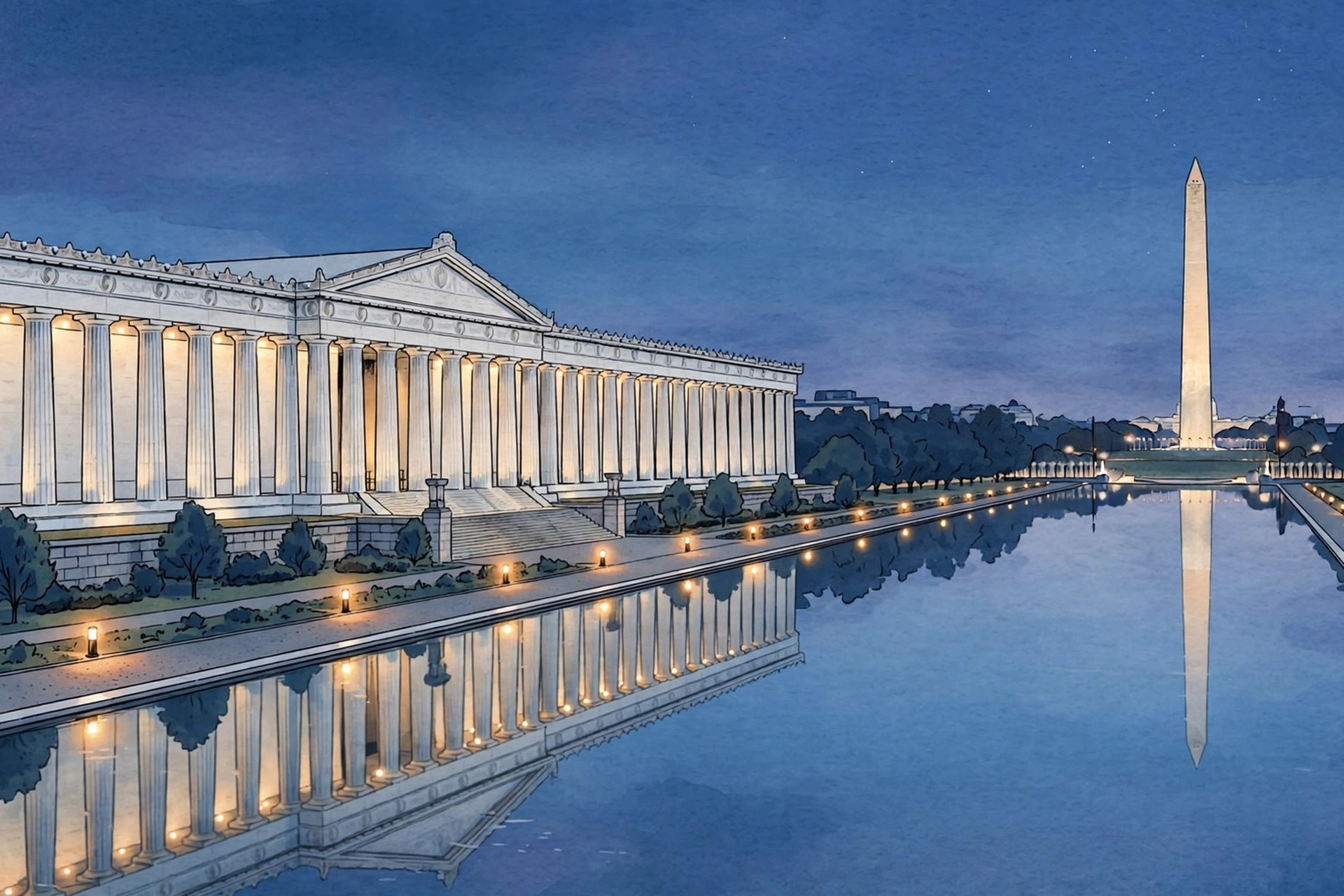
The timing reinforces that reading. Monday is the last full day before Election Day, and it is traditionally a day when candidates make their final case in the places where they think it will matter most. Trump has instead chosen a place where no votes are cast, but where television cameras can frame him against one of America’s most recognisable backdrops: the Lincoln Memorial at one end of a pool and the Washington Monument at the other. That framing has a long history. The Reflecting Pool and the steps of the Lincoln Memorial have hosted some of the most consequential speeches in American public life, above all the civil rights demonstrations of the 1960s, and any president who speaks there invites comparison, favourable or otherwise, with that history. Supporters are likely to see the choice as a claim to that legacy of national purpose. Critics are likely to see it as an attempt to borrow grandeur for a partisan closing pitch.
There is also a practical question that Monday’s event will answer by its staging alone: how finished is the pool itself? That question has dogged the project since the spring, and it is the reason the venue carries political risk as well as visual reward. If the water is clear and the setting looks as the president has described it, the event will serve as a visual rebuttal to months of criticism. If the setting shows the problems that have plagued the work, the cameras will capture that too, and the speech will be remembered as much for its backdrop as for its message.
Why the Reflecting Pool restoration became a political story
The Reflecting Pool saga began in April 2026, when Trump said he wanted to change the colour of the pool and have contractors he knew carry out the work in a matter of days, at a cost he put at about 1.5 million dollars, in time for Independence Day. The pool, built in the 1920s as part of the Lincoln Memorial landscape, is a shallow basin roughly 2,000 feet long, and its still water is designed to mirror the memorial and the Washington Monument. Changing its appearance was presented by the president as a straightforward improvement, the kind of common-sense fix he has often promised for Washington’s public spaces. In June, he declared the work complete, and the pool was unveiled with a new liner in a shade his administration called American Flag Blue.
What followed, according to reporting on the project, was a series of embarrassments that turned a beautification effort into a running news story. Algae blooms soon clouded the water, and sections of the new blue liner began peeling away, undermining the very effect the work was supposed to create. By mid-July, the pool had been drained again so that repairs could be made, a reversal that critics seized on as evidence that the project had been rushed and poorly executed. The administration has continued to defend the work, and Trump has repeatedly returned to the subject in public remarks, treating it as a personal project rather than a routine maintenance job. That personal investment is part of why Monday’s speech matters: the president is not merely borrowing a famous location, he is showcasing a site he has claimed as his own handiwork.
The pool is only one piece of a much larger remodelling of the White House and its surroundings that Trump has pursued during his second term, and Monday’s event should be understood in that wider context. Inside the White House, the Oval Office has been filled with gold flourishes. The East Wing has been demolished to make way for a large new ballroom. The Rose Garden has been converted into a patio area reminiscent of his Mar-a-Lago estate in Florida, and a large helipad has been built on the South Lawn. Each of those projects has drawn its own criticism, from preservationists, from opponents who see extravagance, and from supporters who see a president finally taking pride in the symbols of the office. Together, they form a consistent theme of Trump’s second term: that the physical spaces of American power should reflect his taste and his sense of national grandeur, and that restoring them is itself a form of governing.
How the closing event fits a month of campaigning
The Washington appearance caps a campaign blitz in which Trump has stumped for Republicans facing competitive races across the country, including Senate nominees in Texas and Michigan, according to reporting on the tour. The rallies have followed a familiar pattern: large crowds, lengthy speeches mixing policy claims with personal attacks on opponents, and repeated warnings that Democratic control of Congress would block his agenda for the remaining two years of his term. Polls cited in campaign coverage have pointed to a difficult environment for Republicans, with Democrats favoured to win the House while the Senate remains closely contested, and the president’s own approval ratings have been a persistent concern for his party’s candidates. Against that backdrop, the closing event is less about winning over undecided voters in a single state than about energising the base that has turned out for the rallies and giving the campaign a final, nationally televised moment.
That strategy carries an obvious trade-off, and it is one that commentators noted as soon as the Reflecting Pool plan emerged. A final day spent travelling to two or three battleground states might have reached more persuadable voters in the places where House and Senate control will actually be decided. A single speech in Washington reaches a national television audience, but it does so from a city that votes overwhelmingly Democratic and from a monument whose restoration has already attracted mockery as well as praise. The administration’s calculation appears to be that the visual power of the setting, and the president’s ability to command a news cycle on the eve of the election, outweigh the value of one more rally in a competitive state. Whether that calculation is right will only become clear when the results arrive on Tuesday night and in the days that follow, as slower-counting states finish their tallies.
USN will update this story with the text and reaction to Trump’s remarks on Monday, and with the results of the midterm elections on Tuesday. Readers can follow live coverage from the White House and from election officials for the latest developments.
Sources
USN reviewed reporting from multiple outlets for this story. Read more from USA Today, CBS News and AP News.