

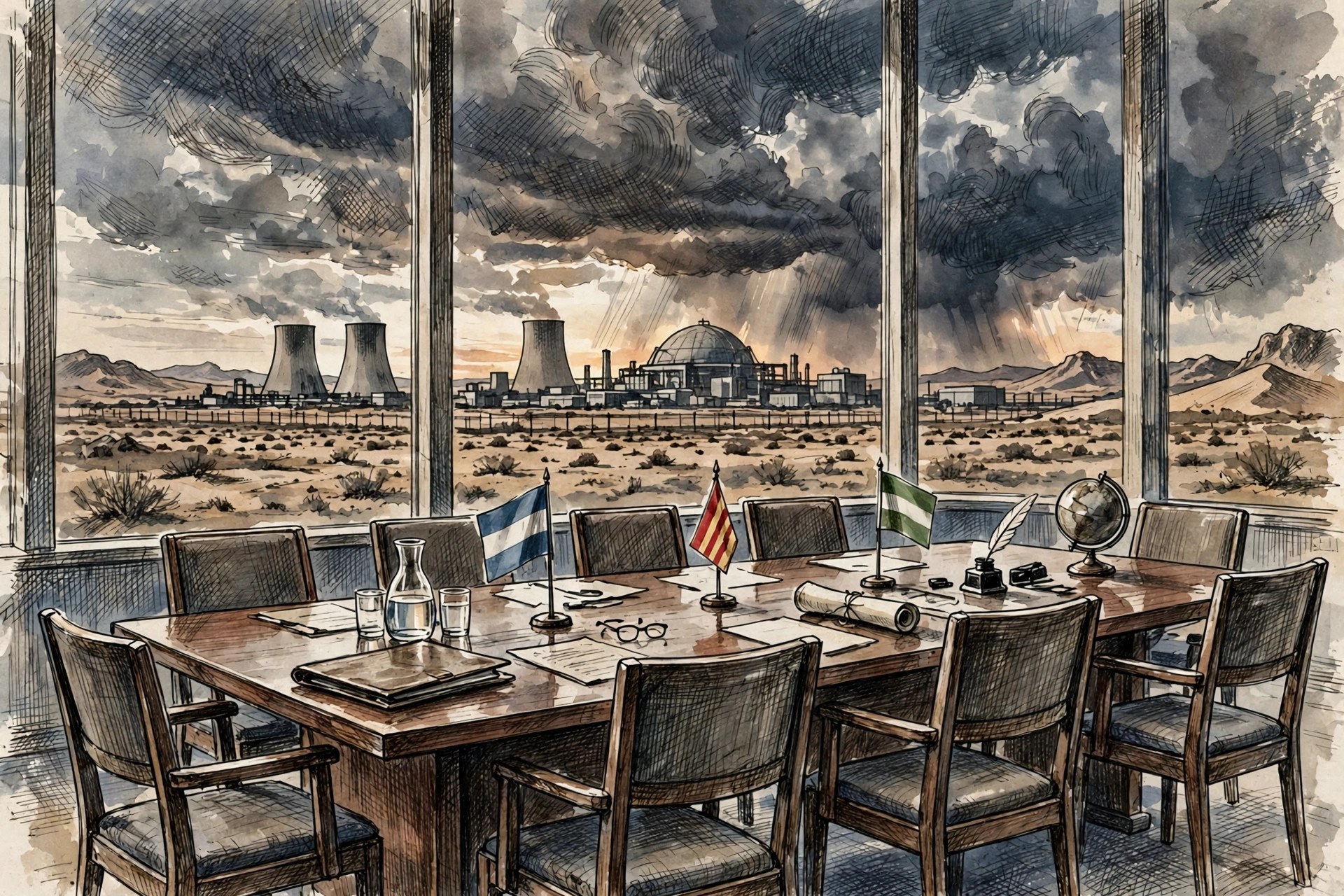
Trump made the remark at a Halloween party at his Mar-a-Lago club in Florida, in an informal exchange with reporters that was quickly reported around the world. He said the United States had already knocked out Iran’s nuclear programme and its military capacity in the war that began on February 28, when the United States attacked alongside Israel, but that one or two sites remained to be dealt with. We have knocked out their nuclear. We still have to take care of, I would say, one or two sites, but we can do that in 10 minutes, he said. He named Pickaxe Mountain, the underground site where American officials say Iran has moved thousands of centrifuges, as an example of what remained. He also said he was in no hurry, a qualification that matters because it separates a capability claim, that the United States could act quickly, from a decision to act, which he has not announced.
Iran’s response came from several senior figures on Sunday, and it was deliberately broad. Defence Minister Mehrdad Akhlaghi Ketabchi said Iran was rapidly increasing its armed forces’ combat capabilities to be able to respond without geographical limits, and that any attack would receive an appropriate, decisive and effective response. The spokesman for the Islamic Revolutionary Guard Corps, Hossein Mohebbi, echoed remarks attributed to Iran’s new Supreme Leader, Ayatollah Mojtaba Khamenei, saying that in a conflict with America there are no geographical limitations and that a vast theatre has been defined for inflicting damage on the enemy. An army spokesman, Mohammad Akraminia, added that a potential future war could last longer than the previous conflict and that Trump would not be in a position to dictate the timing or the conditions of its conclusion. Taken together, those statements are a warning that Iran does not intend to confine any retaliation to the immediate theatre of a strike, and that it believes it can impose costs beyond it.
What Trump Iran nuclear sites 10 minutes remark does and does not mean
It is important to be precise about what Trump said, because the phrase in 10 minutes has been read in different ways. He did not say that strikes would begin in 10 minutes, or that he had ordered them, or that they would take only 10 minutes to complete in any literal military sense. He said the United States retains the capacity to target the remaining sites in a matter of minutes, in the context of a longer argument that American operations have already degraded Iran’s navy, air force, anti-aircraft networks and defence manufacturing infrastructure. In other words, the remark was about readiness and deterrence, not about an imminent operation, and it was paired with his own statement that the United States is not in an urgent rush to resume strikes.
That distinction does not make the remark harmless, because in a confrontation this tense, capability claims are heard as threats by the other side, and threats can narrow the space for diplomacy even when no decision has been made. Trump has repeatedly suggested in recent weeks that further military action could take place after the November 3 midterm elections, and he has said the United States will not launch new attacks before the vote. That timeline, if taken at face value, gives mediation a window of a few days, but it also creates a deadline after which Iran must assume that the threat could become action. Mediators are therefore working not just to reach an agreement, but to reach one before the political calendar changes the incentives for both sides.
Secretary of State Marco Rubio struck a softer note than the president’s remark, saying that if there is a diplomatic solution, the United States would be open to it. That statement, reported alongside Trump’s comments, suggests that within the administration there is still an active diplomatic track, even as the military option is kept visible. The tension between those two messages, openness to diplomacy and readiness to strike, is not accidental. It is a classic coercive-diplomacy posture, in which the threat of force is used to push the other side toward concessions, while the offer of talks gives it a way to concede without appearing to surrender. Whether that posture produces a deal or a new round of fighting depends on whether Iran reads the threat as a bargaining tactic or as a prelude to an attack it must pre-empt or deter.
Iran’s no geographical limits warning, and what lies behind it
Iran’s warning about no geographical limits should also be read carefully, because it is both a military claim and a political signal. On the military level, it suggests that Iran’s retaliatory planning is not limited to striking American bases in the immediate region, but could include targets across a wider theatre, potentially including American assets, allies’ facilities, shipping lanes, and other interests that Iran considers legitimate targets in a war. Iranian officials have not published a target list, and the supreme leader’s reported instruction to commanders to prepare an updated list of targets and to demand maximum deterrence through preparedness for an immediate response without geographical restriction is, by its nature, a statement of intent rather than a detailed plan.
On the political level, the warning is addressed to several audiences at once. It is addressed to Washington, to warn that a strike would not be cost-free and would not be contained. It is addressed to regional states, to warn that hosting American forces or cooperating with a strike could carry risks. And it is addressed to Iran’s domestic audience, to show that the leadership, under a new supreme leader who has not been seen in public since the war began, is prepared and is not intimidated by American threats. The fact that the warning was delivered by multiple figures, the defence minister, the Revolutionary Guard spokesman, and the army spokesman, on the same day suggests a coordinated messaging effort rather than a single offhand remark, which is why it has been treated as a significant escalation in rhetoric even though it does not, by itself, announce a new military operation.
Iran’s foreign minister, Abbas Araghchi, provided the diplomatic counterpart to that rhetoric on Sunday, saying Tehran was prepared for both defence and diplomacy, and that the purpose of the ongoing consultations was to continue consultations with Qatari mediators. That dual formulation, ready to fight and ready to talk, mirrors the American posture, and it is the space in which mediation is trying to operate. Araghchi said the success of the Doha consultations would depend on the United States’ response, and that a meeting with an American delegation was not currently on the cards, which suggests that the talks remain indirect, conducted through Qatari intermediaries, rather than direct negotiations between American and Iranian officials.
Qatar-led mediation and the Strait of Hormuz proposal
The mediation itself has been moving, according to officials briefed on the discussions and to Araghchi’s own account, even as the threats have intensified. Iranian negotiators were in Doha on Sunday for a third consecutive day of talks with Qatari mediators, aimed at pushing for a deal to end the United States-Iranian war on Iran, after earlier talks in Tehran on Friday that lasted more than 12 hours. Qatar and Pakistan are leading the mediation effort, according to reports, and China and Russia could act as guarantors of a potential agreement, a structure that reflects the difficulty of reaching a deal that both Washington and Tehran can trust without direct contact.
The most concrete proposal to emerge from the talks concerns the Strait of Hormuz, the narrow waterway through which a large share of the world’s oil and liquefied natural gas passes, and whose closure or disruption would have global economic consequences. Araghchi told Al Jazeera on Saturday that Iranian and Qatari negotiators had developed a proposal to reopen the strait within two days of a potential agreement with Washington, if the United States implements Tehran’s conditions. That two-day figure represents a shortening of the timeline: Tehran had previously offered seven days, Qatar had suggested five days, and the parties have now reached a proposal at the two-day stage, according to Araghchi. The proposal is not a deal, and Araghchi stressed that a result has not yet been reached, but the movement on timing is one of the few tangible signs of progress in the mediation, and it is why mediators describe the talks as ongoing and progressing rather than stalled.
The broader understandings reportedly under discussion involve Iran’s nuclear programme, sanctions relief, and the security of navigation through the strait, according to a Qatari newspaper report citing sources familiar with the mediation. That report described a breakthrough in preliminary steps, but it should be treated with caution, because neither Washington nor Tehran has confirmed a final agreement, and because preliminary understandings in this conflict have collapsed before. The sequencing is the hardest part: Iran is seeking tangible implementation of its demands, including sanctions relief and recognition of its right to a civilian nuclear programme, while the United States is seeking verifiable limits on Iran’s nuclear activities, including on enrichment and on the centrifuges that American officials say have been moved to Pickaxe Mountain. Bridging that gap requires not only agreement on principles but on verification, on timelines, and on what happens if either side is judged to have broken the deal, questions that have derailed previous rounds of talks.
What could go wrong in the next few days
The risks in the next few days are not only that a deal is not reached, but that the rhetoric itself creates a dynamic that makes a deal harder to reach or a conflict harder to avoid. If Iran believes that a strike is coming after the midterms, it may take steps to protect its assets, to disperse centrifuges, or to prepare retaliatory capabilities in ways that the United States reads as preparations for an attack, creating a cycle of escalation in which each side’s defensive measures are read as offensive preparations by the other. If the United States believes that Iran is using the mediation period to rebuild its nuclear programme, it may conclude that diplomacy is a delaying tactic and that a strike is necessary before Iran can restore its capabilities. And if regional states believe that a conflict is imminent, they may take steps to protect themselves, including by distancing themselves from the United States or by seeking assurances from Iran, that change the strategic landscape in ways that make a negotiated settlement more difficult.
There is also a domestic political dimension that cannot be ignored. Trump made his 10 minutes remark on the weekend before midterm elections in which foreign policy, and in particular the question of whether the United States should be involved in another war in the Middle East, is a significant issue for voters. A president who presents himself as able to strike quickly and decisively may be appealing to voters who want a strong stance against Iran, but he also risks being seen as reckless by voters who fear another costly war. Similarly, Iran’s warning about no geographical limits may be aimed in part at American voters, to suggest that a strike on Iran would have consequences for American interests far beyond the immediate region, and that the costs of a new war would not be contained. In that sense, both statements are not only messages to each other but messages to the American electorate, and their timing, just before an election, is not coincidental.
What to watch next in US-Iran talks and threats
In the days ahead, the most important things to watch are not the rhetoric but the concrete indicators of whether diplomacy is progressing or stalling. Those indicators include whether the Doha talks continue beyond Sunday, whether a meeting with an American delegation is scheduled, whether the Strait of Hormuz proposal moves from a reported understanding to a formal agreement, and whether either side takes military steps that suggest preparations for a strike or for retaliation. They also include whether the United States and Iran make public statements that are more specific than the general warnings of the weekend, such as statements about timelines, about verification arrangements, or about the specific nuclear activities that would be limited under a deal. Vague statements about readiness and resolve are less informative than specific statements about what a deal would contain, and readers should pay more attention to the latter than to the former.
It is also important to watch what regional states do, because they will bear the immediate consequences of any conflict and because their positions can influence both Washington and Tehran. Qatar, as the leading mediator, has a particular interest in preventing a war that would threaten its own security and its role as a regional diplomatic hub. Pakistan, as the other leading mediator, has its own interests in regional stability and in its relationship with both Iran and the United States. Saudi Arabia, the United Arab Emirates, and other Gulf states, which host American military facilities and which would be affected by any disruption to shipping through the Strait of Hormuz, have a strong interest in a diplomatic solution, even if they share American concerns about Iran’s nuclear programme. Their quiet diplomacy, and their public statements, may be as important as the public statements from Washington and Tehran in determining whether the current confrontation ends in a deal or in a new war.
USN will update this story as new statements, mediation developments, and military developments become available. Readers should follow the White House, the State Department, the Qatari Foreign Ministry, and Iranian official sources for the latest information, and should treat claims about secret negotiations, about target lists, and about military preparations with caution, because such claims are often based on anonymous sources and are difficult to verify independently. The situation between the United States and Iran remains fluid, and the information in this story reflects the best available reporting as of Sunday, November 1.
Sources
USN reviewed reporting from multiple outlets for this story. Read more from AP News, Fox News and Al Jazeera.