

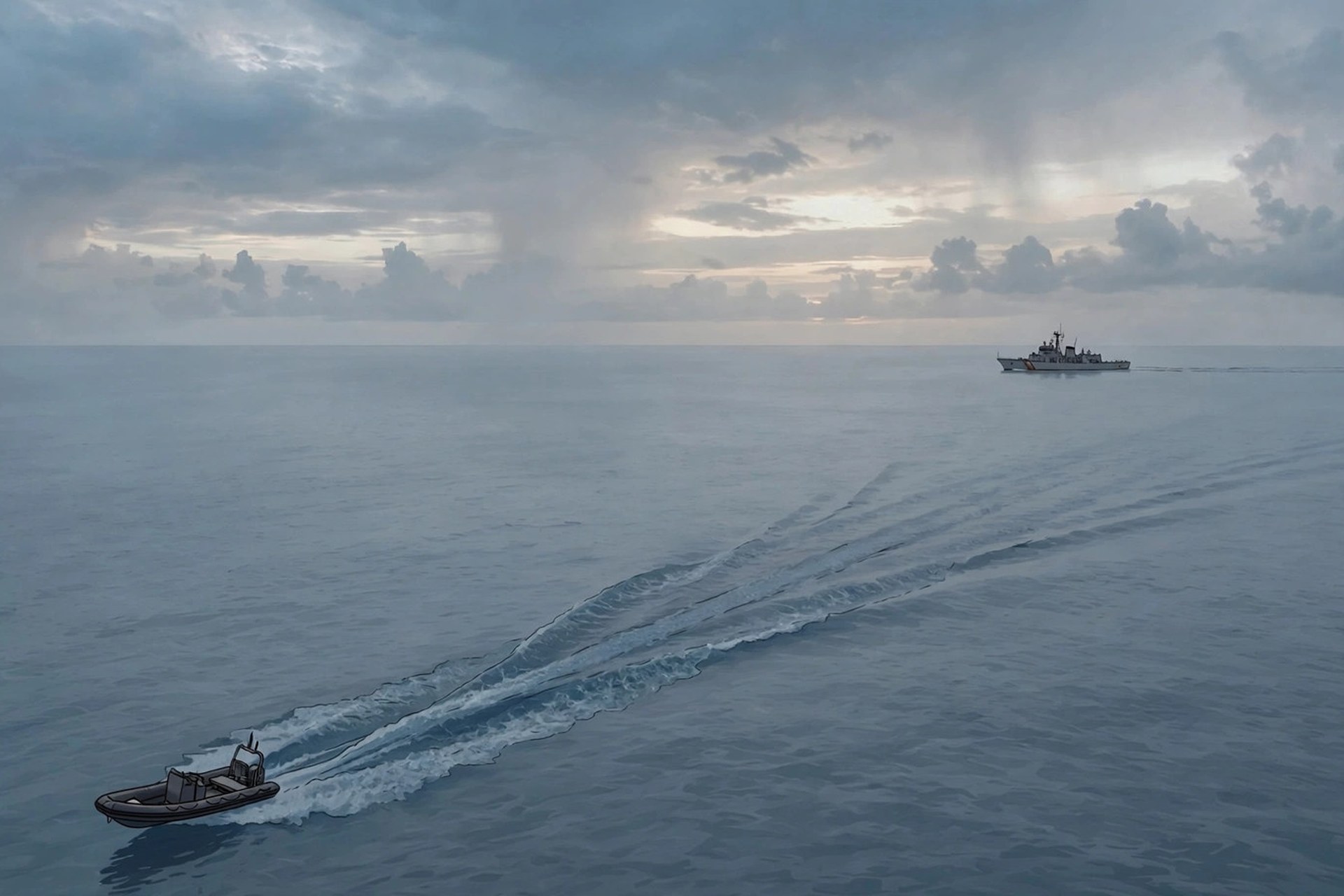
WASHINGTON — The latest American strike on an alleged drug boat did not settle the argument about the campaign. It sharpened it. On October 27, United States Southern Command said a Joint Task Force Western Hemisphere strike on a go-fast vessel in the Eastern Pacific killed five people it described as narco-terrorists. The command said confirmed intelligence showed the vessel was actively involved in drug trafficking along established routes. It did not name the dead, identify an alleged organization, give a precise location, or publish the intelligence behind the decision. That pattern — a short announcement, a video, and little verifiable detail — is now central to the legal and congressional scrutiny facing a campaign that began in September 2025.
Three weeks earlier, on October 4, Southern Command announced a similar strike in the Caribbean Sea that killed four people aboard a go-fast vessel. Again it cited confirmed intelligence and established routes, released thermal video, and disclosed no names, cargo, flag or nationality. The Associated Press reported the military did not provide evidence the vessel was carrying drugs. The result is a gap between what the government asserts and what the public, Congress and courts can independently test.
What is known about the Caribbean drug boat strikes
The campaign, known as Operation Southern Spear, breaks from the traditional model of maritime drug enforcement, in which Coast Guard crews pursue, board, seize contraband and detain suspects for prosecution. Instead, the military has used lethal strikes against vessels it alleges are trafficking drugs in the Caribbean and the Eastern Pacific. Southern Command has often released short videos showing a small craft before an explosion. No American service members have been reported harmed in the strikes, according to military statements summarised in recent coverage.
The death toll is above 240 by most independent counts, but the exact number depends on the tracker. The Washington Office on Latin America had counted at least 238 killed in 68 strikes before October 27, implying 243 after five more deaths. Just Security put the total at 238, including 23 missing or presumed dead, as of October 4, after 71 strikes. The Associated Press reported at least 240 killed in more than 70 strikes. Trackers differ because they define strikes and missing people differently, and the government has not published a single vessel-by-vessel list.
In most recent announcements, the government has not said what drugs, if any, were aboard, how much, where the vessel was registered, or who was aboard. Supporters argue operational security justifies that restraint. Critics argue that without names, cargo or location, the public cannot verify whether the right vessel was hit or whether a less lethal interdiction was possible.
The administration’s legal justification
The administration argues the United States is in an armed conflict with drug cartels it has designated as terrorist organizations. President Donald Trump has described that conflict in those terms, and officials have used the label narco-terrorists for people they say are associated with designated groups. Under that framework, the administration treats those killed as unlawful combatants who may be targeted with lethal military force without the arrest, evidence and trial that govern ordinary law enforcement. Officials have also pointed to a classified Justice Department finding, reported in coverage, said to support the legal basis for the strikes.
Supporters add that cartels are not ordinary smugglers but heavily armed organizations responsible for large numbers of American drug deaths, and that conventional interdiction has not stopped the flow. The administration has also signed a defence declaration with Guyana on October 21, 2026, committing to deeper training and cooperation on maritime interdiction — a step supporters present as evidence the campaign is not unilateral in spirit.
What the administration has not done, according to lawmakers and journalists, is publish the full legal reasoning. The Office of Legal Counsel memorandum said to underpin the campaign remains classified. On September 30, 2026, a federal judge in the Southern District of New York ordered the administration to provide it for in camera review — for the judge’s eyes only — and to identify everyone who had access to it. Congress has pressed for the same document, and for the Pentagon’s execute order, with only partial success.
Lawmakers’ objections cross party lines
Congressional scrutiny has not come only from the opposition. Lawmakers in both parties have questioned the legal basis, the secrecy, and one early operation: the September 2, 2025, strike that killed 11 alleged traffickers, including two people who survived an initial strike and were then killed in a follow-on strike. Reporting said Defence Secretary Pete Hegseth authorised the second strike, carried out by Admiral Frank Bradley. Hegseth has said he did not personally witness it, while the White House said he authorised Bradley to carry it out.
That second strike is legally distinct from the broader debate about cartels as combatants. The Pentagon’s own manual, as cited by lawmakers and analysts, says orders to fire upon the shipwrecked would be clearly illegal. Former military lawyers quoted in coverage have said that if a second strike was ordered against people who could no longer fight back, it would amount in essence to an order to show no quarter, which they describe as a war crime. Those are allegations, not court findings, and the administration has defended the operation as consistent with standing guidance.
Lawmakers have reviewed a two-page summary of the Pentagon execute order, according to sources cited by Reuters, broadly laying out the chain of command and strike authority. Lawmakers have asked for the full document, and it was unclear whether the Pentagon would hand it over. The Pentagon also provided Congress with the full, unedited video of the September 2 strike, after only a brief clip was initially released. A War Powers resolution introduced in the House would require congressional authorization for such hostilities; two similar Senate resolutions had already failed, according to coverage.
The international-law debate
Independent experts cited in recent coverage are largely against the administration’s framework. Their argument is straightforward: drug trafficking, however violent, is a law-enforcement matter unless it rises to an armed conflict under international humanitarian law, which requires an organized armed group engaged in sustained hostilities of sufficient intensity. Critics, including Human Rights Watch and Amnesty International, say no such conflict exists in the Caribbean or Eastern Pacific that would displace human-rights law, which permits intentional lethal force only when strictly necessary to protect life.
Ben Saul, the United Nations special rapporteur on human rights and counterterrorism, has said there are reasonable grounds to believe the attacks constituted crimes against humanity of murder under customary international law, an allegation the administration rejects. United Nations experts have likewise said cartels are not conducting armed attacks that trigger self-defence under Article 51 of the United Nations Charter. Defenders counter that designated terrorist organizations and the scale of drug deaths justify a military framework, but that argument has not persuaded most independent lawyers cited in coverage.
Families’ claims, and the fishermen question
The most human part of the scrutiny comes from families who say the government’s labels do not match the people who died. Relatives of some of those killed in earlier strikes have said they were fishermen or workers not involved in the drug trade. In one case reported in Caribbean coverage, Chad Joseph, 26, and Rishi Samaroo of Las Cuevas, Trinidad, were among six killed in a strike off Venezuela in October 2025. Their families say the men had been fishing and working on farms there and were simply coming home, and Joseph’s mother and Samaroo’s sister are now suing the American government in federal court in Boston. Those claims are allegations, not adjudicated findings.
In February 2026, the St Vincent and the Grenadines Coast Guard said a strike took place about 32 miles east of Canouan, inside that country’s exclusive economic zone, according to Caribbean reporting. Prime Minister Godwin Friday said two Saint Lucian nationals died and his government had received no official information on the circumstances. Fishermen in Trinidad and St Vincent have reported staying ashore, and Trinidad charter bookings have fallen, according to Caribbean coverage. The government has not publicly identified most of the dead, which families say prevents accountability; officials say it protects intelligence.
Effectiveness, and what remains undisclosed
A Washington Post investigation based on Drug Enforcement Administration analysis and congressional briefings, as summarised in recent coverage, found the strikes had not reduced cocaine supply or prices in the United States. That finding, if confirmed, would undercut a practical justification for lethal strikes. It also strengthens the argument that interdiction — which preserves evidence and allows prosecution — is more useful. On October 23, Southern Command itself announced the Coast Guard had interdicted a suspected vessel and apprehended the people aboard, showing capture remains possible in some cases.
What remains undisclosed is the heart of the story. The full legal memorandum has not been published. The full execute order has not been handed to Congress, only a summary. The intelligence for individual strikes has not been published, nor have the identities of most of the dead, nor evidence that specific vessels carried drugs. Until those gaps close, the campaign will be described in two vocabularies: by the administration as a war against narco-terrorists, and by critics as lethal force without trial, evidence or a published legal basis. The next test is whether Congress or a court forces the orders into the open.
Sources
USN reviewed reporting from multiple outlets for this story. Read more from Al Jazeera, Just Security and Reuters.