

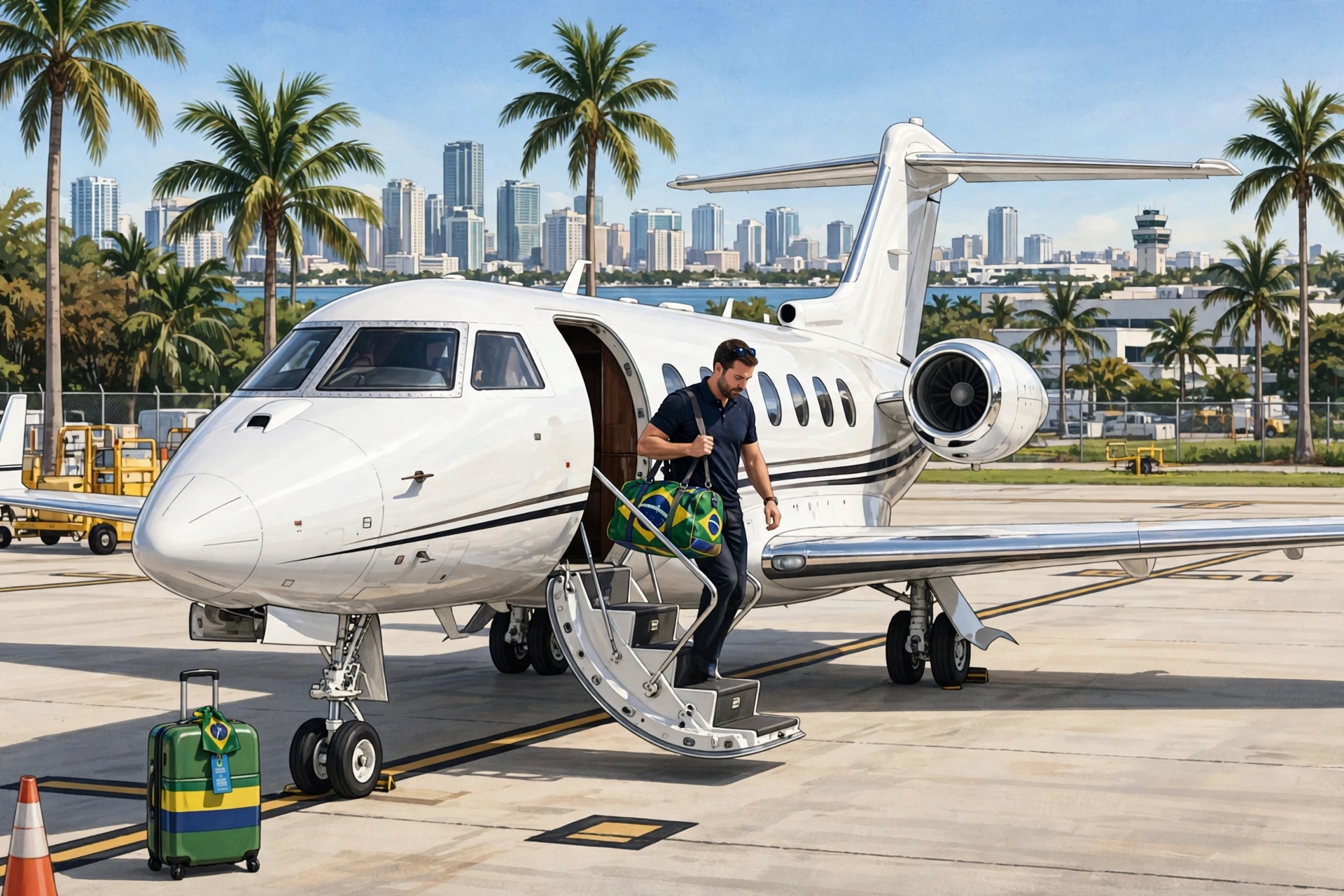
Three days after losing Brazil’s presidential election, Senator Flávio Bolsonaro stepped off a private jet in Miami on Wednesday and declared himself the rightful leader of his country. The 45-year-old son of former president Jair Bolsonaro had crossed into Argentina by road late on Tuesday with his wife and two daughters, boarded a charter flight that stopped in Ecuador, and landed in South Florida on visas granted this week by the Trump administration — defying an order from Brazil’s Supreme Court to surrender his passports and remain in the country.
Bolsonaro, who lost Sunday’s runoff to leftist incumbent Luiz Inácio Lula da Silva by more than 4.4 million votes, has refused to concede. In an open letter posted on X after his arrival, he initially described himself as “the elected president” and accused the Supreme Court and Lula of stealing the election — claims he made without providing evidence — before deleting that version and replacing it with one calling himself Brazil’s “leader” and vowing to direct the opposition from the United States. Brazil’s electoral court, international observers, world leaders and Bolsonaro’s own Liberal Party have all recognised Lula’s victory.
A Journey Timed Against a Court Order
The escape unfolded against a legal deadline. Bolsonaro is under investigation by the Supreme Court in cases involving alleged corruption, money laundering and tax evasion — allegations he denies. On Monday, the day after the election, Justice Alexandre de Moraes ordered him to hand over his regular and diplomatic passports by noon on Tuesday, citing a concrete risk that he would flee; the order also barred him from leaving Brazil. In a video posted Monday, Bolsonaro said federal police had relayed the request and that he would comply, dismissing speculation about flight. By Tuesday night he was gone.
Argentina’s migration authority said Bolsonaro, his wife Fernanda and their daughters entered Argentina at 10:50 p.m. on Tuesday over the Tancredo Neves International Bridge, which links Brazil to the Argentine province of Misiones, travelling on valid documents and facing no legal bar to entry. The family then boarded a Gulfstream G400 operated by Baires Fly. Flight-tracking data recorded by FlightAware showed the jet leaving Puerto Iguazú at 12:22 a.m., landing in Guayaquil, Ecuador, at 3:46 a.m., departing again at 6:22 a.m. and touching down at Miami’s Opa-locka Executive Airport at 10:31 a.m. local time. Dressed casually in a dark polo shirt, Bolsonaro disembarked with his family shortly after landing, Reuters television images showed. It remained unclear whether he had surrendered any passport before leaving; allies said late Tuesday that he also holds an Italian passport. The Supreme Court, for its part, pushed back on a separate report on Wednesday, stating that no search-and-seizure warrant had been issued or executed against the senator, after the news outlet G1 reported that federal police had served such a warrant at his Brasília home.
Washington and Buenos Aires Open the Door
The journey was possible because two foreign governments helped it happen. The Trump administration approved entry visas for Bolsonaro and his family this week, and President Donald Trump — whom Bolsonaro visited at the White House in May, and who has described Brazil’s election in remarks to reporters as “very strange” — indicated in the early hours of Wednesday that he would have approved the senator’s arrival. Asked at Joint Base Andrews about Bolsonaro’s claim to leadership, Trump declined to comment. Bolsonaro publicly thanked both Trump and Argentine President Javier Milei for their assistance. On Monday, Trump had alleged, again without presenting evidence, that the Brazilian election looked rigged — even as Bolsonaro’s own party acknowledged the result.
Florida is familiar ground for the family, and for its predicament. After Jair Bolsonaro lost the 2022 election to Lula, he too travelled to Florida, remaining there for three months before returning to Brazil. The state hosts the largest Brazilian population in the United States, and Miami has become a gathering point for prominent figures of Brazil’s right who are facing legal pressure at home. On Friday, before the runoff, Flávio’s brother Eduardo Bolsonaro had suggested on an American conservative podcast that Flávio should leave Brazil if he lost, pointing to the investigations he could face when his Senate term ends on January 31, 2027 — leaving him out of elected office for the first time in 24 years.
The Election He Lost
The bitterness of the departure reflects how the race was lost. Bolsonaro had won the first round of voting and entered Sunday’s runoff as the favourite, only to lose to Lula by more than 4.4 million votes — a margin the senator’s letter does not dispute even as it contests the result itself. His stated grievance centres on a Supreme Court decision extending voting hours by two hours, which he argues affected the outcome; on that basis he said he would seek annulment of the election. But the institutions around him moved the other way: world leaders quickly recognised Lula’s victory, and on Monday Bolsonaro’s own Liberal Party formally acknowledged the runoff result, even as Trump alleged without evidence that the vote looked rigged and Bolsonaro himself refused to concede. His letter claimed the support of “60 million voters,” a reference to his losing total — a substantial constituency, but a minority that Brazil’s electoral authorities, courts and his own party all agree did not win the election.
What He Claims, and What Is Established
The distinction between the senator’s claims and the verified record is central to this story. Bolsonaro says he is the victim of electoral fraud and political persecution, that the election was stolen by a criminal organisation, and that he left to escape the politicisation of Brazil’s justice system. None of those claims has been substantiated: no evidence of fraud affecting the outcome has been produced, the runoff was recognised by Brazil’s federal electoral court — whose chief, Kassio Nunes Marques, said the election took place in full compliance with legal and constitutional requirements — and by international observers and governments worldwide. What is established is that he lost by a wide margin, that a Supreme Court justice ordered him to surrender his passports and stay in Brazil because of a flight risk in an ongoing financial-crimes investigation, and that he left the country anyway, within roughly a day of that order.
A Court That Saw the Flight Coming
The legal backdrop makes the departure more pointed still. Justice de Moraes’s passport order was issued precisely because the court judged there to be a concrete risk that Bolsonaro would flee — a judgment he delivered one day before the senator did exactly that, after publicly promising to comply. The underlying investigation concerns alleged money laundering, with related cases touching corruption and tax evasion; Bolsonaro denies wrongdoing in them, and no conviction exists. Nor is he the first in his circle to test Washington’s hospitality: he joins other prominent allies of the Bolsonaro movement who have moved to the United States while facing legal trouble at home, turning South Florida into something of an offshore capital for Brazil’s embattled right.
What Happens Next
Bolsonaro says he did not intend to leave and promises to lead the opposition from American soil, a posture that sets up a prolonged political confrontation conducted from exile. Brazil’s courts must decide how to treat a senator and defeated presidential candidate who departed in defiance of a surrender order in an investigation he calls persecution, and Washington must decide how long to host a foreign politician who claims — against the recognised result — to lead his country. For now, the man who would be president is in Miami, and the president Brazil actually elected is in Brasília.
Sources
USN reviewed reporting from multiple outlets for this story. Read more from Reuters, Associated Press via The Business Standard and CNN.
[…] change continues elsewhere in the world, including in Latin America, where USN has reported on Flavio Bolsonaro flies to Miami and declares himself Brazil’s leader. That story is not connected to the Dakar Games, but it is a reminder that the young athletes […]
[…] is also why this article does not repeat, in full, the story of Bolsonaro’s flight itself. Earlier USN coverage of Bolsonaro flying to Miami and declaring himself Brazil’s leader set out the departure and the immediate claim that followed it; the new development on November 1 […]