

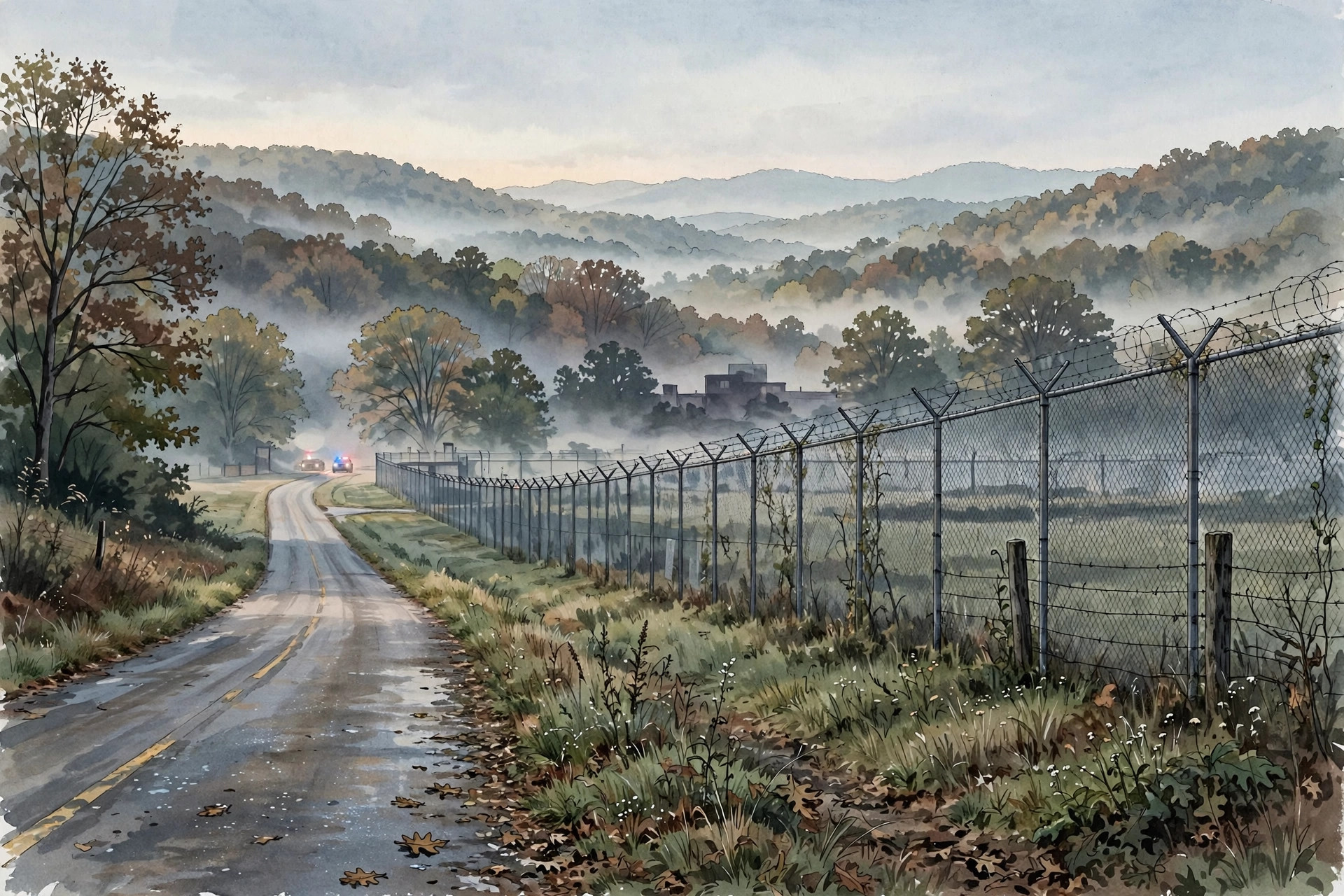
A manhunt across state lines is under way for Jacob Allen Morley, 28, a convicted murderer serving a life sentence who escaped from the Northwest Correctional Complex in Lake County, Tennessee, late on October 25, 2026, and then stole a pickup truck in the early hours of the following morning. Prison staff found him missing at about 11:30 p.m. on Sunday, October 25, launched an emergency count and a search of the facility, and later learned from security camera footage that Morley had breached the perimeter fence and left the prison wearing his Tennessee Department of Correction uniform. By the time the wider search was fully under way, he had already travelled a short distance from the prison, taken a truck, and begun a journey that would carry the investigation into southern Illinois, where the truck was eventually found abandoned without him.
The Northwest Correctional Complex is in Tiptonville, in the far northwestern corner of Tennessee, a rural area where a prison, farmland and small towns sit close together. That geography shaped the first hours of the escape in a very practical way: the farm from which the truck was taken was only about two miles from the prison through fields, according to reporting of the surveillance evidence, and a fire department building in Hornbeak, roughly twelve to fifteen miles away, later captured the truck passing in the early morning. Morley was therefore not immediately far from the prison, but he was moving, and in a rural landscape at night a single vehicle can cover a considerable distance before anyone realises a particular truck is missing. The truck’s owner, in fact, did not realise it had gone until midday on Monday, because the vehicle was not in service at the time, which gave the search a delayed start on that part of the trail.
The Night of the Escape
According to the Tennessee Department of Correction, staff at the Northwest Correctional Complex reported Morley unaccounted for at about 11:30 p.m. on October 25, and an emergency count and facility search began at that time. Security camera footage later showed that Morley had breached the perimeter fence and left the facility in his prison uniform. Officials have not, in their public statements so far, explained exactly how the fence was breached, and the method remains unclear. That gap is important, because the difference between cutting, climbing, exploiting a weak point or using some other means would matter a great deal to any review of security at the complex, but investigators have not released that detail, and this article does not fill it with speculation.
What is clear is that Morley left the secure perimeter on foot and in uniform, and that he then made his way to a nearby farming operation. The Tennessee Bureau of Investigation, which joined the search on October 26 and added Morley to its Most Wanted list, released surveillance video that authorities say showed him taking a white 2008 Ford F-350 at about 1 a.m. on October 26. The truck was taken from the 400 block of Keystone Drive in Lake County, was marked with Lindamood Planting Company on its side, had a Tennessee licence plate, and had an air compressor in its bed. The vehicle belonged to Lindamood Planting Company and was carrying tools, according to its co-owner John Lindamood. Surveillance video from the farm, described in reporting, showed Morley opening the truck’s unlocked driver’s side door and driving away, a detail that, if confirmed, would help explain how quickly he was able to leave the area without forcing entry.
The Truck Trail to Illinois
The trail after the theft was pieced together from cameras rather than from a single sighting. Firefighters in Hornbeak, about twelve miles east of the farm according to some reports and about fifteen miles away according to others, said investigators confirmed their cameras captured the truck driving past their station at about 1:15 to 1:18 a.m. on Monday, only minutes after the theft. That short interval shows how fast the truck moved from a quiet farm track to a road where it could be recorded, and it also shows the value of cameras far beyond the prison itself in a rural manhunt, where a fire station, a shop or a farm building may hold the only record of a vehicle passing in the night.
The next major development came on Tuesday, October 27, when the Tennessee Bureau of Investigation announced, just after 1 p.m., that the truck had been found abandoned in Marion, Illinois. Marion is about 120 miles north of the prison, or between 117 and 141 miles depending on the route, and roughly ninety miles southeast of St. Louis. Later reporting added a striking detail: surveillance video suggested the truck had appeared to have been left in Marion at about 4:40 a.m. on Monday, nearly thirty hours before police found it at about 10 a.m. on Tuesday. In other words, the truck may have sat in southern Illinois for more than a day before it was recognised, which means Morley’s movements after abandoning it are even harder to reconstruct. Marion police investigators reviewed grainy surveillance videos that matched Morley’s description but could not confirm whether he was still in Marion, according to a Marion police lieutenant quoted in reporting, and police said they would continue to operate on the assumption that he might be, while also accepting that he might have moved on.
That uncertainty is the central difficulty of the search at this stage. Finding a stolen vehicle is a breakthrough, because it confirms a route, a direction and a stopping point, but it is not the same as finding the person. Once a vehicle is abandoned, a fugitive may travel on foot, by another vehicle, or with help that investigators have not yet identified, and each possibility opens a different line of inquiry. Officials have not said whether they believe anyone helped Morley, and they have not released additional detail about how he may have travelled after Marion. The Illinois State Police offered assistance to the Tennessee Bureau of Investigation and the Marion Police Department but was not leading the investigation, according to a spokesperson, which reflects the normal pattern in a multi-state search: the home state agency and the local police where evidence is found work together, with federal partners supporting where needed.
The Reward and the Public Appeal
Morley was added to the Tennessee Bureau of Investigation’s Most Wanted list after the agency joined the search on October 26. At first, the bureau offered a reward of 2,500 dollars for information leading to his arrest. That figure then rose sharply. Reporting put the total reward on offer at 17,500 dollars, after Governor Bill Lee increased the state reward to 10,000 dollars and the United States Marshals Service contributed an additional 5,000 dollars. Readers should treat the reported total as the figure given in updated reporting, rather than trying to reconstruct it from the individual components alone, because the updates describe both an increase to an earlier figure and an additional federal contribution. What is not in doubt is the direction of travel: the reward grew substantially within days, which is a signal of how seriously authorities regard the search and how keen they are for public help.
The public appeal that accompanies the reward is straightforward. The Tennessee Department of Correction and the Tennessee Bureau of Investigation advised anyone with knowledge of Morley’s whereabouts to call 911, to contact the department, or to contact the bureau on its tip line. Authorities have not, in public statements, encouraged members of the public to approach Morley themselves, and the normal advice in such cases is to report a sighting promptly and leave any confrontation to law enforcement, particularly where the person sought is serving a life sentence for murder. The surveillance images released by the authorities, including images taken during the escape, are intended to help the public recognise him, and the description of the truck, its markings and its plate were published for the same reason while the vehicle was still missing. Now that the truck has been found, the most useful public information is likely to be a sighting of Morley himself, a vehicle he may since have used, or a person who may have given him shelter or transport, and investigators will want even small details, such as a time, a place and a direction of travel.
The Conviction Behind the Life Sentence
Morley is serving a life sentence for first-degree murder, together with convictions for aggravated burglary, tampering with evidence, evading arrest and vandalism, according to the Tennessee Department of Correction and reporting of his sentence. The murder victim was Cody Birchfield, a co-worker, who was initially reported missing in February 2022, according to the Carter County Sheriff’s Office. That February 2022 date relates to when Birchfield was reported missing, and it is a firmly reported fact in the coverage of the case. The conviction itself, however, is the subject of a reporting conflict that readers should be aware of, and this article deliberately does not state a single disputed conviction year as settled.
Some reporting describes Morley as having been convicted in connection with a killing that took place four years before the escape, while other accounts and records present the timeline in ways that do not line up neatly on a single year, and the difference has been noted across outlets covering the manhunt. Because the brief for this story flags that conflict, and because a conviction year is a matter of court record rather than a detail to be guessed at, USN is not adopting one year as the settled date here. What is settled, and what matters most to the public safety story, is the sentence itself: a life sentence for first-degree murder, with the additional convictions listed above, imposed for the killing of Birchfield. Anyone seeking the precise court chronology should consult the Tennessee court records and the Department of Correction’s own account, rather than relying on a single news summary written in the urgency of a manhunt.
A Second Escape in a Week, and a Wider Context
Morley is the second inmate to escape from Tennessee Department of Correction custody in less than a week, according to reporting, after Gregory Redden escaped on October 21 from a Nashville hospital. That sequence is part of the context in which Morley’s escape is being discussed, because two escapes in such a short period naturally raise questions about security, supervision and transport procedures, even though the two cases involve different facilities and different circumstances. Officials have not, in the material reviewed for this story, stated that the two escapes are linked, and this article does not suggest that they are. The point of noting Redden’s escape is to show why Morley’s case has drawn attention beyond a single prison: it arrived in the middle of a week when the department’s custody arrangements were already under scrutiny.
In the same month, Tennessee Department of Correction Commissioner Frank Strada resigned. That resignation is context only. Reporting links Strada’s departure to a separate and difficult episode in the department’s recent history, involving a botched execution and hospitalisation, rather than to Morley’s escape itself, and no source reviewed for this story states that Strada resigned because of Morley or because of Redden. It would therefore be wrong to present the resignation as a consequence of this escape, or to use it as evidence about the cause of this escape. Its relevance is narrower: it means the department has faced leadership change at a moment when its custody operations are in the spotlight, and any review of the Northwest Correctional Complex escape will take place against that background. The department’s own priority, as stated, remains the practical one of locating Morley, and the security review that follows an escape of this kind will normally examine fence integrity, counts, staffing, camera coverage and the procedures for responding when a prisoner is found missing, without prejudging which, if any, of those factors failed.
What Happens Next
As of the latest updates reviewed for this story, Morley’s whereabouts remained unknown, and locating him continued to be described by the Tennessee Bureau of Investigation as an urgent priority. The search involves local, state and federal partners, and the bureau said its agents continue to assist those partners. That multi-agency character is likely to continue until Morley is found, because an escape that crosses a state line, involves a stolen vehicle found in another state, and generates tips from a wide area cannot be handled by a single local force alone. Investigators will continue to work through surveillance video, to interview people connected to the farm, the truck and the Marion area, and to follow up tips generated by the increased reward and the Most Wanted listing.
For residents of Lake County, of the Hornbeak area, and of Marion, Illinois, the practical message is unchanged: remain alert, report anything unusual promptly, and do not attempt to intervene. For the wider public, the story is a reminder of how quickly a prison escape can become a multi-state operation, and how much of that operation depends on ordinary cameras and ordinary observations: a farm camera, a fire station camera, a truck recognised in a town more than a hundred miles away. Until Morley is located, the confirmed facts are the escape itself, the fence breach as described by the department, the theft of the truck, its discovery in Marion, the reward as updated, and the life sentence he was serving. The method of the fence breach, his movements after Marion, and whether anyone assisted him remain unconfirmed, and USN will update this story when authorities release further verified information.
Sources
USN reviewed reporting from multiple outlets for this story. Read more from CNN, The Tennessean and Times Now.