

France’s October 31 Protest in Numbers
Hundreds of thousands of people took to the streets across France on Saturday, October 31, 2026, for a third consecutive weekend of demonstrations against the rising cost of living, inequality and conditions in schools and universities. The French Interior Ministry put the nationwide turnout at about 320,000 people, including about 70,000 in Paris. Youth organisations and unions involved in the mobilisation gave a much higher estimate, saying nearly half a million people demonstrated nationwide, including about 200,000 in the capital. The gap between official and organiser counts is common in French protest reporting, and neither figure should be treated as an exact headcount. What is not in dispute is the scale: this was a national mobilisation, spread across major cities and smaller towns, and it was large enough for the government to deploy about 70,000 police officers and gendarmes across the country.
The turnout was smaller than in the two previous weekends, according to the government’s own figures. Officials counted about 550,000 people on October 17, when some demonstrations deteriorated into looting and rioting described as among the worst in France in years, and about 410,000 on October 24. The decline on October 31 does not, on its own, show that the movement is fading. Organisers argued that the turnout remained strong despite route restrictions, bans on city-centre marches in several places, heavy policing and a Halloween weekend that complicated both protest planning and policing. The government, by contrast, pointed to the falling official numbers as evidence that its security approach was working and that the most disruptive phase had passed. Both readings are political interpretations of the same numbers, and the next test will come quickly, with student blockades planned for Tuesday, November 3, and a nationwide strike and mobilisation called by unions for Thursday, November 5.
The movement that filled the streets on October 31 is not a single organisation. It brings together Yellow Vest activists, trade unions including the CGT, high school and university students, and a wider set of citizens angry about prices, fuel costs, wages that have not kept pace with inflation, and what protesters describe as deteriorating public services. It began in mid-September with student protests over school conditions in the Paris suburb of Créteil and broadened into a wider protest over living costs. That breadth is both a strength and a source of tension inside the movement. Students emphasise classrooms, staffing and the cost of studying. Unions emphasise wages, pensions and working conditions. Yellow Vest activists emphasise purchasing power and a sense of being ignored by political elites. The shared slogan, in various forms, is that ordinary life has become unaffordable, and that the government has not done enough to change that.
How the Paris March Unfolded
In Paris, the main march was routed along the eastern edge of the capital, from Porte de Bagnolet to Porte de Charenton, rather than through the city centre. Police had banned marches through central Paris, and a court challenge by unions and student groups against the restrictions failed. President Emmanuel Macron had said earlier in the week that marches would stay out of city centres to protect shops, a position the government linked directly to the looting seen on October 17. Protesters and civil-liberties advocates described the rerouting as a restriction on the right to demonstrate, arguing that a march pushed to the edge of the city is less visible and less effective. That disagreement over routes and bans has become a central part of the story, arguably as important as the turnout itself, because it shapes how the public experiences the protest and how the police manage it.
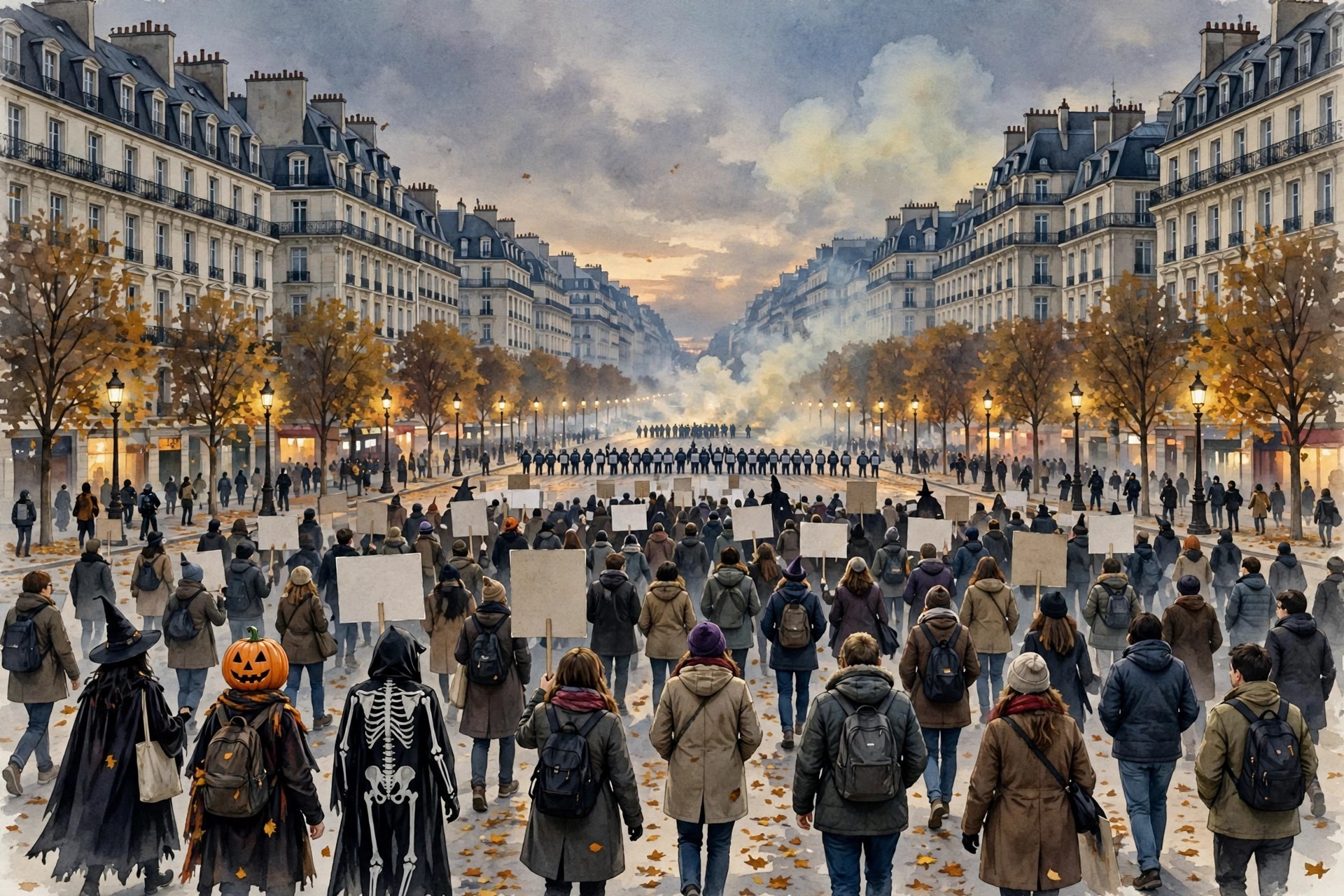
For much of the afternoon, the Paris march was largely peaceful. Thousands of people walked behind students who led the procession hand in hand, according to reporting from the scene. Some marchers wore Halloween costumes, from superheroes to witches and clowns, and carried placards about the cost of living and the future. A helicopter circled overhead, and police were massed on side streets along the route. Jean-Luc Mélenchon, leader of the far-left France Unbowed party, joined the march and praised the turnout. The atmosphere described by many participants was festive and determined rather than confrontational, at least until the procession reached its endpoint.
Clashes broke out as the march reached Porte de Charenton, the authorised endpoint. The Paris police prefecture said a hard core of several hundred rioters at the rear of the march attacked officers with projectiles, including a Molotov cocktail. Journalists at the scene reported that dozens of masked people dressed in black used hammers to pry up paving stones and throw them at police, and that officers responded with tear gas and baton charges. Interior Minister Laurent Nuñez described the throwing of a Molotov cocktail at a riot police officer as an attempted murder, saying the officer escaped with minor injuries, and he blamed what he called far-left extremist groups for attacks on security forces. He pointed to what he called an extraordinary level of violence from some protesters. Those characterisations are the government’s account of who was responsible. They have not been tested in court for the individual incidents on October 31, and protesters’ groups have argued that heavy-handed policing and route restrictions contributed to the confrontations at the end of marches.
Clashes Beyond Paris
Paris was not the only city where the day ended in tension. In Lyon, France’s third-largest city, people threw projectiles at police, prompting officers to fire tear gas. In Toulouse, in the southwest, police used water cannon against an unauthorised protest that drew several thousand people. In Marseille, tension broke out at the end of the march, and the Interior Ministry said radical elements in cities including Bordeaux, Toulouse, Rennes, Lille, Nantes, Marseille and Lyon had attempted to enter city centres with the aim, in the ministry’s words, of carrying out vandalism and looting. That is an allegation about intent, made by the ministry in the hours after the protests, not a court finding about any individual protester. In Rennes, clashes broke out on Avenue Janvier, where bins were set on fire and 26 people were arrested, according to local prefecture figures reported in French media.
The arrest figures also evolved through the day, which is worth noting because early reports and later reports can appear to contradict each other. By 2 p.m. local time, police had made 27 arrests nationwide, compared with 217 at the same point a week earlier, according to figures cited by the Agence France-Presse news agency. By the evening, the picture had changed sharply. Interior Minister Nuñez said police had arrested 520 people across the country as of 9 p.m. Some later summaries cited a lower figure of around 296 arrests, reflecting different reporting times and counting methods. The safest reading is that hundreds of people were arrested on October 31, that the number rose steeply in the evening as clashes spread, and that the final official tally should be read with its time stamp attached. What the arrest total does not, by itself, establish is how many of those arrested were accused of violence, how many were released without charge, or how many cases will reach court.
Security preparations had been extensive before a single marcher set out. In Paris, police barred entry to Place de la République and Les Halles, both hit by rioting and looting on October 17, from 11 p.m. to 6 a.m. on Saturday and Sunday nights. More than 40 metro stations in Paris were closed, face-covering masks were not allowed at the demonstrations, and shops in Paris and other cities boarded up windows. The Interior Minister had warned of a very high risk of disorder, especially after dark on Halloween, and had said rioters could use Halloween masks to conceal their identities. Shopkeepers told French media they were anxious, with the president of France’s Chamber of Commerce saying shopkeepers could not wait for Saturday to be over and that Halloween was not helping matters because people would be wearing masks. Those preparations explain why the day felt, to many residents, like a city braced for trouble even before the marches began.
Why Living Costs Became the Spark
The substance behind the slogans is familiar to households across Europe: prices, especially for food, energy and housing, have risen faster than many wages, while public services feel thinner. In France, the protest movement’s demands have widened as it has grown. The initial focus on school conditions and living costs has expanded to include inequality, fuel prices, and, after the security crackdown and injuries to some protesters in earlier weekends, greater protection for civil liberties and the right to protest. Student protesters complained that police had not authorised a march through the centre of Paris, and they vowed to stage new blockades of high schools and universities in the coming week. Sabrine Kharbach, spokeswoman for the Union Étudiante student union, said students would blockade universities and high schools starting Tuesday and again on Thursday before joining the November 5 demonstration called by workers and trade unions.
The economic backdrop limits what the government can easily offer. France is the eurozone’s second-largest economy, but reporting on the protests has noted that it is on the brink of recession and under pressure to rein in its debt, leaving limited scope to appease protesters through additional spending. That constraint is central to the political argument. Protesters say the government is choosing to protect other priorities, including military spending and budget discipline, over households. The government says it must balance support for households with fiscal responsibility and public order, and that it cannot simply spend its way out of the pressures protesters describe. Neither side has, so far, proposed a package that the other accepts as a basis for negotiation, and the November 5 strike will test whether the movement can convert street mobilisation into broader workplace action.
The political calendar adds pressure. France’s presidential election is less than six months away, and far-right leader Marine Le Pen has topped opinion polls in recent reporting. Le Pen condemned the firebomb attack on the police officer in Paris, saying on X that those responsible must be punished with the utmost severity and describing images of the officer in flames as unbearable. Her intervention illustrates how the protests are already being fought over in electoral terms. For the government, the challenge is to restore order without being seen to crush legitimate protest. For the opposition, left and right, the challenge is to channel anger over living costs without being blamed for violence at the margins of marches. For protesters, the challenge is to keep a broad coalition together when its members disagree about tactics, targets and what a victory would look like.
A European Wave, Not Just a French Weekend
France’s third weekend of protests did not happen in isolation. On the same Saturday, youth-led demonstrations spread to Germany, where organisers said more than 160,000 people were expected across 34 cities, and where the group Gen Z regelt, meaning Gen Z has got this, protested against the high cost of living, underfunded schools and universities, government spending cuts and a potential return of mandatory military service. In Berlin, Frankfurt, Cologne, Munich and dozens of other cities, thousands turned out. German authorities expected the demonstrations to remain largely peaceful but warned that extremist groups could try to exploit them. In Spain, police in Barcelona planned their highest-level alert after calls for new gatherings, and police in Italy were on alert after clashes in Milan, Turin and Bologna. Calls to protest also circulated on social media in Belgium, the Netherlands, Austria, Switzerland and Portugal.
The European dimension matters because the grievances rhyme even when the national politics differ. Young protesters in several countries describe a similar experience: rising prices, schools and universities that feel underfunded, public services under strain, and political decisions that seem to prioritise other spending over their futures. In Serbia earlier this year, student-led activism helped unseat a long-time leader at the ballot box, a precedent that organisers elsewhere have noted. In France, the movement’s history is different, drawing on the Yellow Vest tradition of 2018 and 2019 as well as on union and student organisation. But the shared language of affordability, education and prospects helps explain why a French protest can inspire a German one within days, and why governments across Europe watched October 31 closely.
It would be a mistake, however, to treat the European protests as a single movement with a single leadership. The German protests were organised separately, with their own demands about conscription and education funding. The French protests have their own history, organisations and internal debates. The Spanish and Italian mobilisations have their own triggers. What connects them is a mood and a set of shared pressures, not a coordinated campaign. That distinction matters for forecasting: a wave can fade in one country while continuing in another, and a concession in Paris would not automatically calm Berlin or Barcelona.
What Happens Next
The immediate calendar is now set. Students have promised blockades of high schools and universities on Tuesday, November 3, and again on Thursday, November 5, when unions including the CFDT, CGT, FO, UNSA and FSU have called a nationwide strike and mobilisation. A fourth round of protests is scheduled for Saturday, November 7. The government, for its part, has promised firmness against vandals, looters and those calling for insurrection, in the Interior Minister’s words, while insisting that peaceful protest remains protected. The tension between those two promises, firmness and protection, will be tested again on each of those days.
Three questions will shape the next phase. First, can the movement sustain turnout after three weekends, or will fatigue, colder weather and the competing demands of school and work thin the crowds? Second, can the government offer anything on living costs, wages or school funding that protesters recognise as a real response, rather than a security measure dressed up as a concession? Third, can both sides keep the distinction between peaceful protest and violence clear in public debate, when images of clashes travel faster than explanations of what happened at the end of a long march? The answers will not come from a single Saturday. They will come from the sequence of November 3, November 5 and November 7, and from whether any negotiation, formal or informal, begins between the government and the unions and student groups that have become the movement’s most organised voices.
For now, October 31 stands as a revealing snapshot: a large but smaller-than-before national mobilisation, a largely peaceful march in Paris that ended in clashes, hundreds of arrests, a government warning of a very high risk of disorder that proved partly right and partly, in the sense that most marchers demonstrated peacefully, overstated, and a movement that has already announced its next dates. France has seen protest waves before, and many have faded without changing policy. This one has lasted three weekends, spread across Europe, and forced a national argument about prices, schools, policing and the right to march. Whether it becomes a turning point or another episode in a long French tradition of street protest will depend less on the images from one Halloween Saturday than on what happens when the crowds return, and whether anyone in power is prepared to negotiate with them.
Sources
Al Jazeera [LINK: https://www.aljazeera.com/news/2026/10/31/germany-and-france-brace-for-protests-on-halloween-weekend]
The Hindu [LINK: https://www.thehindu.com/news/international/france-heads-into-third-weekend-of-protests-as-youth-led-rallies-sweep-europe/article71649225.ece]
Free Malaysia Today [LINK: https://www.freemalaysiatoday.com/category/highlight/2026/11/01/clashes-break-out-as-hundreds-of-thousands-protest-in-france]