

By Farhan Khan, November 9, 2026
A federal judge has twice refused to stop the planned sinking of the SS United States, clearing the way for the historic ocean liner to be sunk on Thursday 12 November and to become the world’s largest artificial reef off the coast of Florida.
Judge M. Casey Rodgers of the US District Court for the Northern District of Florida, Pensacola Division, denied the SS United States Preservation Foundation’s emergency motion for a temporary restraining order on Friday 6 November. She denied a second, amended motion on Saturday 7 November.
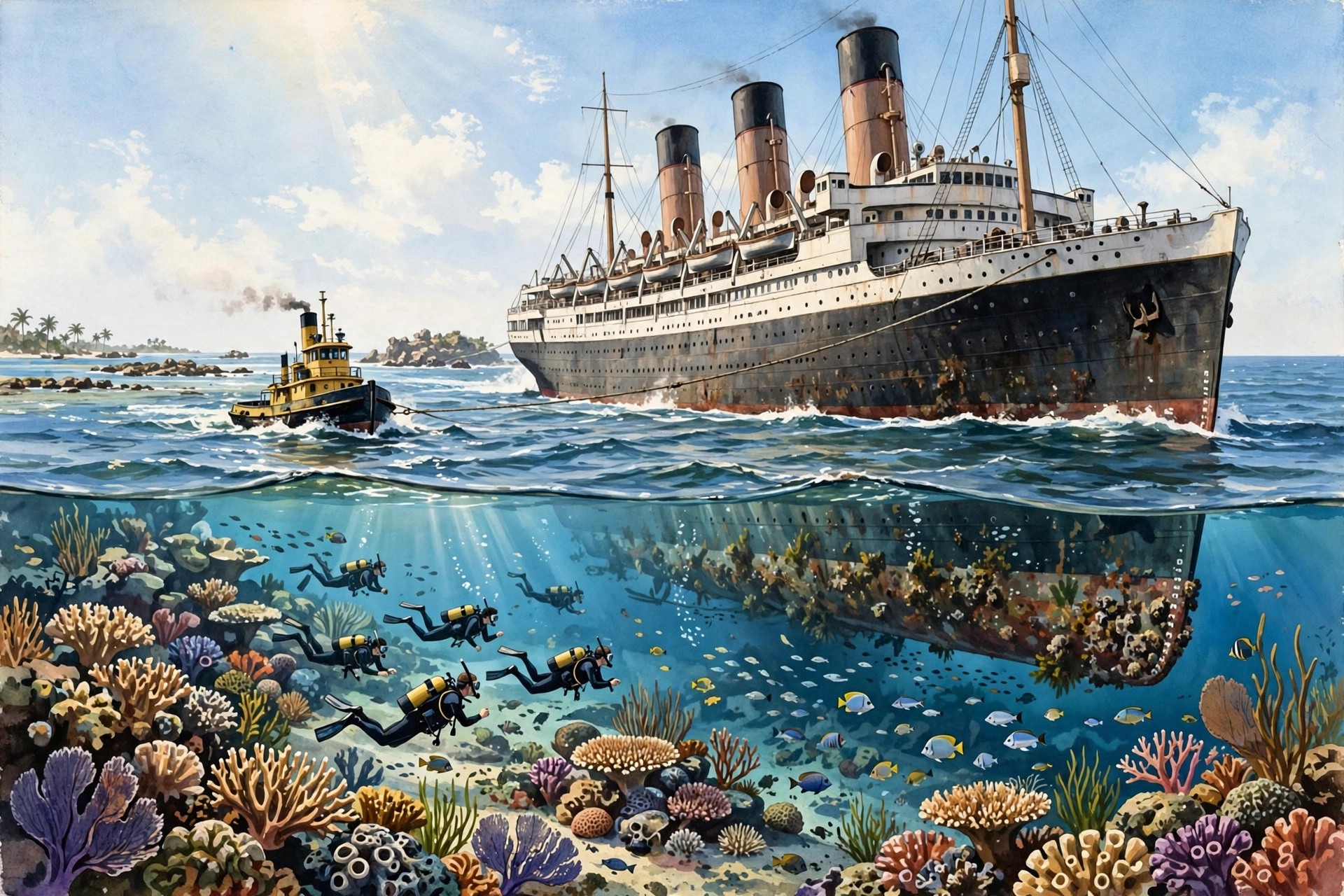
The ship will be towed from Mobile, Alabama, on Monday 9 November. The sinking is scheduled for 12 November at about 10 a.m., weather permitting, about 22 nautical miles southwest of Destin–Fort Walton Beach, Florida, in about 180 feet of water. The upper deck will sit about 55 feet below the surface.
Two rulings, both without prejudice
Both denials were made without prejudice. The Foundation can refile with sworn statements and a costed bond, and the underlying lawsuit remains active. A renewed motion was already filed after the first denial.
The case is SS United States Preservation Foundation, Inc. v. U.S. Army Corps of Engineers, No. 3:26-cv-05339, in the Northern District of Florida. The Foundation filed the case on 3 November and its emergency motion on 4 November, seeking to stop the sinking while the court considered its claims.
The first denial, on Friday 6 November, was set out in a three-page order that gave two reasons. The first was that “no affidavits accompany the motion, and the corresponding complaint is unverified”. The second was the bond: the plaintiffs had sought no, or only nominal, bond despite the “obvious substantial expense” of berthing, mooring, docking, and storing a 990-foot vessel. The judge said any new motion “must propose a bond amount sufficient to cover these expenses.”
The second denial, on Saturday 7 November, addressed the amended motion. Judge Rodgers said the Foundation “did not account for the cost to taxpayers for continuing to berth the ship”, that it was “rank speculation” to say there was no risk of monetary loss to the county, and that it was “naïve to think that this process would impose only a brief delay”.
Any future motion would need sworn statements, a bond covering berthing costs, and a showing that the delay would not impose an open-ended expense on the county. The denials decided only that the sinking should not be stopped immediately on the motions as filed.
Tow on 9 November, sinking on 12 November
The dates reflect the county’s schedule as of 7 November and could slip if conditions are not suitable. The sinking will be deliberate and controlled, the ship flooded and allowed to settle on the seabed, accessible to divers and providing a large structure for marine life to colonise.
Okaloosa County, Florida, acquired the vessel in October 2024 for about $1 million from the SS United States Conservancy, which had owned it since February 2011. County spending on buying and preparing the ship is put at more than $13 million. The county plans to create the world’s largest man-made reef — the ship is 990 feet and 53,300 gross tons — to attract marine life, support fishing and diving, and bring visitors to the area.
The fastest liner ever to cross the Atlantic
Built by Newport News Shipbuilding, the SS United States entered service in July 1952 and remains the fastest passenger liner to cross the Atlantic, having reached about 35 knots on her maiden voyage. She is 990 feet long and 53,300 gross tons, designed as both a luxury liner and, if needed, a troop transport. Her record has never been broken by another passenger liner. She has been out of service since 1969 and was listed on the National Register of Historic Places in 1999.
Her funnels, radar mast, last propeller, and many portholes and windows have already been removed during remediation work preparing her for sinking, a process the lawsuit describes as “anticipatory demolition”. The Foundation cites the removal as evidence that the ship’s historic character has already been damaged, so the ship sunk on 12 November will be a stripped hull, not the ship as she appeared in service.
The SS United States artificial reef and the chromium dispute
The Foundation’s environmental case is at the heart of the lawsuit. It argues that the US Army Corps of Engineers approved the project without an environmental impact statement and without a completed historic-preservation review under Section 106 of the National Historic Preservation Act. It alleges that about 59,000 pounds of zinc chromate primer, which contains hexavalent chromium, remains on the hull, citing laboratory findings of 4,520 milligrams per kilogram of chromium in one sample, and argues sinking the ship would release it into the marine environment.
The Corps and the county dispute that account. They say the release effects would be “negligible” and that the coating is not federally regulated for reefing. They also put the real chromium figure at less than a third of the Foundation’s estimate. The 59,000-pound figure is therefore not an established fact: it is the Foundation’s claim, based on one lab sample and a modelled estimate.
If the weather cooperates and no further legal order intervenes, the ship will be sunk on schedule. The county plans to monitor the reef as marine life colonises it and promote it for divers and fishing.
Sources: The Maritime Executive, Cruise Chaos, CruiseSnooze