

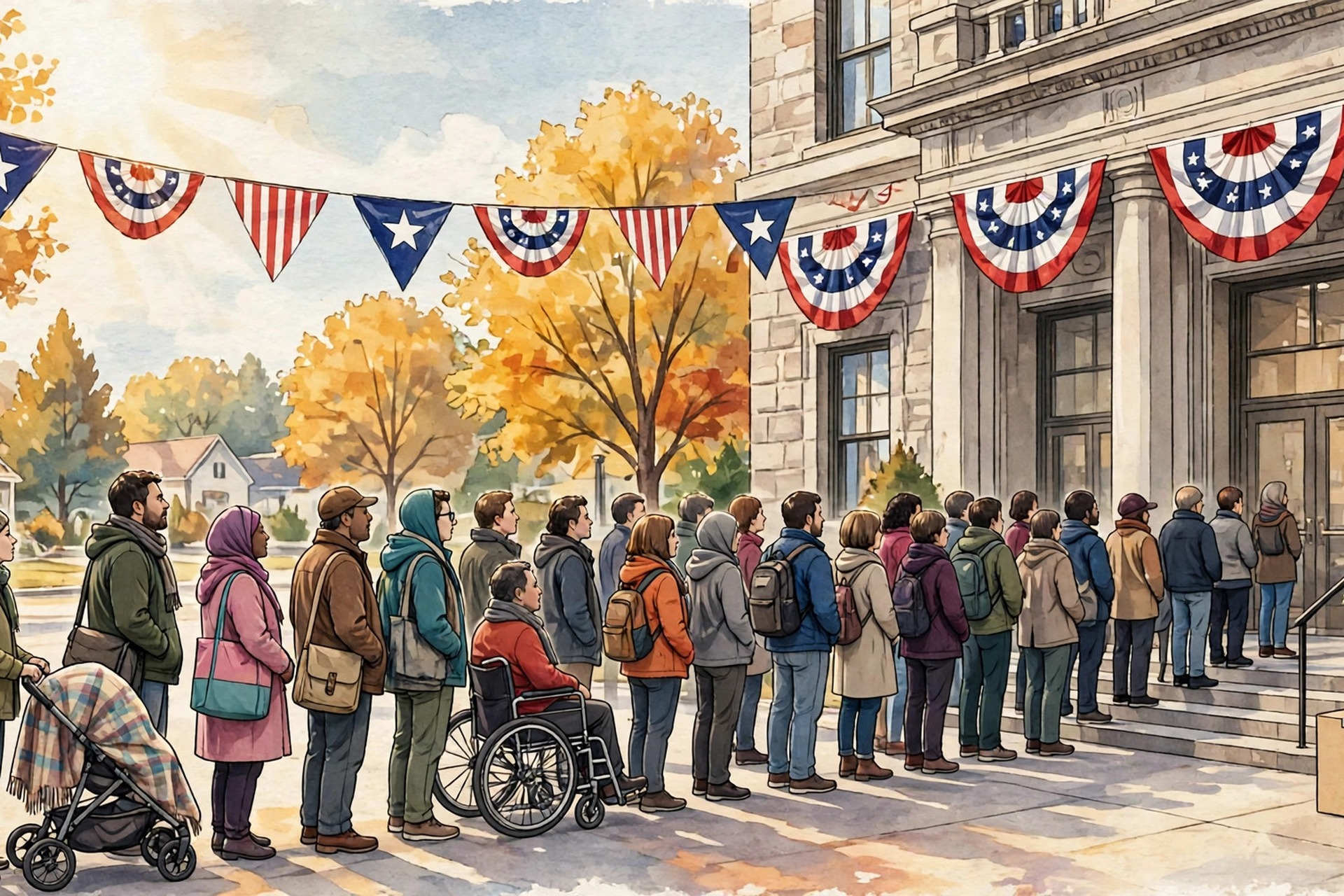
More than 53 million Americans had already cast a ballot in the 2026 midterm elections by Sunday afternoon, setting a new record for early voting in a midterm cycle and leaving only the final Election Day electorate still to be counted. The figure, compiled by the University of Florida Election Lab from state reports, passed the previous midterm early-voting mark of 45.9 million set in 2022, and it was still rising as additional states updated their totals through Sunday and into Monday.
The scale of the advance vote is striking because it was reached before a single Election Day ballot had been cast. Out of roughly 210 million registered voters nationwide, about one in four had already voted by Sunday morning, according to the Election Lab snapshot that put the total at 53.14 million. By Sunday afternoon, reporting outlets put the running total above 53 million, and later updates pushed it higher still. That movement matters for how the number should be read: it is a snapshot of a moving count, not a final total, and different reports captured it at different moments.
Earlier in the weekend, a lower figure of more than 51 million was widely reported, reflecting an end-of-October cutoff in some state tallies. The later Sunday-afternoon total of more than 53 million does not contradict that earlier figure; it reflects additional ballots reported as states continued to process early in-person votes and mail ballots. Readers should therefore treat the headline number as an as-of figure that will keep changing until Election Day voting closes on Tuesday, November 3.
What the record does show, clearly, is that early voting is no longer a side channel in American elections. It is now a central part of how millions of people vote, and in 2026 it has arrived earlier, in larger numbers, and across more states than in any previous midterm.
How the 2026 midterm early voting record was built
About 30 million of the early ballots counted by Sunday afternoon were cast in person, with the remainder arriving by mail, according to the Election Lab figures cited in Sunday reporting. That balance is important. In-person early voting accounted for most of the growth over 2022, when about 20.5 million people voted early in person across the whole early-voting period. By Saturday of this cycle, that in-person figure had already passed 28 million, and it continued to climb on Sunday.
Mail ballots, at roughly 23 million in the Sunday snapshot, also formed a large share of the total. Every state allows mail voting in some form, although rules on who can vote by mail, when ballots must be requested, and when they must arrive differ sharply. Those differences help explain why national totals arrive unevenly: some states report daily, others report in batches, and some counts lag behind the ballots actually cast.
The Election Lab tracker, which aggregates state-level reports, is therefore best understood as a continuously updated running total rather than a single official count. No single federal body certifies a national early-voting total in real time. The record claim rests on comparing the Lab’s running total with the comparable 2022 early-voting total of 45.9 million, a comparison that holds even allowing for reporting lags, because the 2026 total had already passed the 2022 mark with voting still open in many states.
Party registration data, where states publish it, adds a partial picture but not a result. In the states that disclose registration for early voters, Democrats accounted for roughly 43 to 44 percent of early ballots in weekend snapshots, Republicans for about 31 to 32 percent, and voters registered as independent or unaffiliated for about a quarter. Those shares describe registration, not vote choice, and they cover only reporting states. They also say nothing about how Election Day voters, who have not yet voted, will break.
Texas, California and Florida lead the state totals
Three large states accounted for a substantial share of the national early vote. Texas led with 7,630,789 early ballots in the Election Lab figures, followed by California with 5,504,307 and Florida with 5,148,276. Georgia and North Carolina followed, with 2,823,265 and 2,612,250 ballots respectively.
Texas illustrates the scale of the change. More than 7.7 million Texans voted early in person or by mail before the state’s early-voting period ended on October 30, according to preliminary figures from the Texas secretary of state’s office cited in weekend reporting. That surpassed the state’s full early-voting total from 2022 and set a new Texas midterm record. The state’s size and its large number of competitive races, including a closely watched Senate contest, helped drive turnout, but the pattern was not confined to Texas.
Georgia also set a new midterm early-voting record, with more than 2.8 million ballots cast before its early-voting period ended on October 30, above the roughly 2.5 million recorded in 2022. North Carolina likewise passed its previous midterm early-voting levels. In South Carolina, the State Election Commission announced on October 26 that early voting had already set a new record for a gubernatorial election cycle, with nearly 564,000 ballots cast by mid-afternoon that day, above the 561,563 cast early in 2022.
These state records matter because control of Congress will be decided state by state and district by district, not by a national popular vote. National early-voting totals can signal enthusiasm and organisation, but they cannot by themselves show who is winning individual House or Senate races. A surge in one state does not offset a shortfall in another, and turnout in safe states does not change the balance in competitive ones.
Where early voting was ending, and where it was still open
Early in-person voting closed on Sunday in several major states, including New York, New Jersey, Michigan and Connecticut. For voters in those states, the remaining options on Monday and Tuesday are mail ballots, where deadlines allow, and in-person voting on Election Day itself. Voters who still hold a mail ballot should check their local election office’s deadline for return, because rules on postmarks and receipt dates vary.
Other states kept early in-person voting open on Monday, including California, Illinois and Arkansas. Colorado and Hawaii continued early voting through Election Day on November 3. That patchwork is normal in American elections: there is no single national early-voting calendar. Each state sets its own window, and within states, counties may offer different hours and locations.
The staggered endings also explain why the national total kept moving after Sunday. Ballots cast on Monday in California and other states still offering early voting, plus late-reported mail ballots, will be added to the running total before Election Day. Final turnout, including Election Day votes, will not be known until states count and certify their results, a process that in some states extends well beyond Tuesday night.
For voters who have not yet cast a ballot, the practical point is simple: check the local election office, not the national headline. Polling places, hours, identification requirements and mail-ballot deadlines are set locally, and a national record does not change any individual voter’s deadline.
What a record early vote does and does not predict
A record early vote is often read as a sign of high final turnout, and that reading has some support: when more people vote early, total turnout often rises as well. But the relationship is not one-to-one. An early ballot can replace a ballot that would otherwise have been cast on Election Day, rather than adding a new voter to the electorate. In that case, the early total rises without final turnout rising by the same amount.
Researchers who study turnout also caution that early voters are not a random sample of the electorate. They tend to be more engaged, more likely to have voted before, and more responsive to campaign mobilisation. Election Day voters, by contrast, include a larger share of people who decide late, who face work or transport constraints during the early period, or who simply prefer to vote in person on the day itself. The final result will therefore depend on both groups.
Nor do early totals reveal vote choice. In most states, ballots are not counted by candidate before Election Day, and party registration is an imperfect proxy for how a person votes. Independent and unaffiliated voters, who made up about a quarter of early voters in reporting states, are particularly hard to read from registration data alone, because they are not registered with either major party.
That uncertainty cuts both ways. Campaigns on both sides have pointed to the early numbers as encouraging, but neither side can claim a lead from turnout alone. The only count that decides control of the House and Senate is the count of votes for candidates, and that count will not be complete until Election Day ballots are added and, in close races, until mail ballots that arrive by state deadlines are processed.
Why turnout is so high in this midterm
Analysts and campaign officials have offered several overlapping explanations for the surge. One is practical: early voting is now available in far more places than it was a generation ago. In 2000, 24 states offered early in-person voting; in 2026, 47 states plus Washington, D.C., do so, according to the National Conference of State Legislatures data cited in weekend coverage. Convenience alone does not create enthusiasm, but it lowers the cost of voting for people with inflexible work schedules, caregiving duties or long commutes.
A second explanation is mobilisation. Both parties, along with civic groups, have invested heavily in encouraging supporters to vote early, in part because an early vote banked in October cannot be lost to bad weather, illness or a long Election Day queue in November. Campaigns also use early-voting data to focus their final efforts on supporters who have not yet voted, rather than spending resources on people who already have.
A third explanation is political intensity. This midterm is widely seen as a referendum on the second term of President Donald Trump, with control of both chambers of Congress at stake, along with governorships and state offices. National polling in the final days put Democrats ahead in the generic congressional ballot, but individual races remain competitive, and the stakes for both parties — investigations and legislative blocking power for Democrats if they win, continued unified control for Republicans if they hold — have given voters on both sides a clear reason to turn out.
Cost-of-living pressures, including grocery, housing, health-care and energy prices, have dominated campaign messaging, alongside tariffs and the war with Iran. Those issues affect different voters in different ways, but they have contributed to an election in which many voters say they feel the outcome will touch their daily lives directly.
Security and confidence questions around the early vote
High early voting has also renewed debate about election administration and public confidence. Election officials stress that early ballots are subject to the same verification steps as Election Day ballots, including signature checks where required, secure storage, and counting under observation. Mail ballots are typically processed, but not tabulated for candidates, before Election Day in most states, and results are not released until polls close.
At the same time, the final days of the campaign have seen heightened attention to the role of federal personnel around polling places. USN has previously reported on concerns raised inside the FBI about election-related orders, and on the Justice Department’s statement that FBI and Immigration and Customs Enforcement staff will not serve as midterm poll monitors. Readers following those questions can find that background in USN’s earlier coverage: Inside the FBI agents’ worry they could be ordered to seize ballots on Election Day and Justice Department says FBI and ICE staff will not serve as midterm poll monitors.
Those stories do not change the early-voting totals, but they form part of the context in which voters are casting ballots: an election in which process questions, as well as policy questions, are on voters’ minds. Election officials in both parties have urged voters to rely on their local election office for authoritative information about where and how to vote, and to be wary of unverified claims about results before counting is complete.
What happens next
On Tuesday, November 3, voters who have not yet cast a ballot will vote in person, and states will begin counting Election Day ballots alongside early and mail ballots already received. Some states will report results quickly on election night; others, particularly those that allow mail ballots to arrive after Election Day if postmarked by then, will take days to finalise counts. Close races may therefore remain uncalled well beyond Tuesday night.
The early-voting record will then be judged against final turnout. If Election Day voting is also strong, total midterm turnout could approach or exceed recent highs. If Election Day voting is soft, the early surge will have shifted when people voted more than how many voted in total. Either way, the 2026 early vote has already changed the shape of the election: by the time polls open on Tuesday, more than 53 million ballots will already be in, and the outcome will be decided by the voters who join them on the final day.
For now, the as-of figure stands as a record, with the caveat that it is still moving. The final number will be higher, because Monday early voting and late mail ballots will add to it, and because Election Day itself is still to come. The record is real, but it is not yet final — and neither, until the votes are counted, is the election it belongs to.
Sources
USN reviewed reporting from multiple outlets for this story. Read more from Dawn, USA Today and Al Jazeera.