

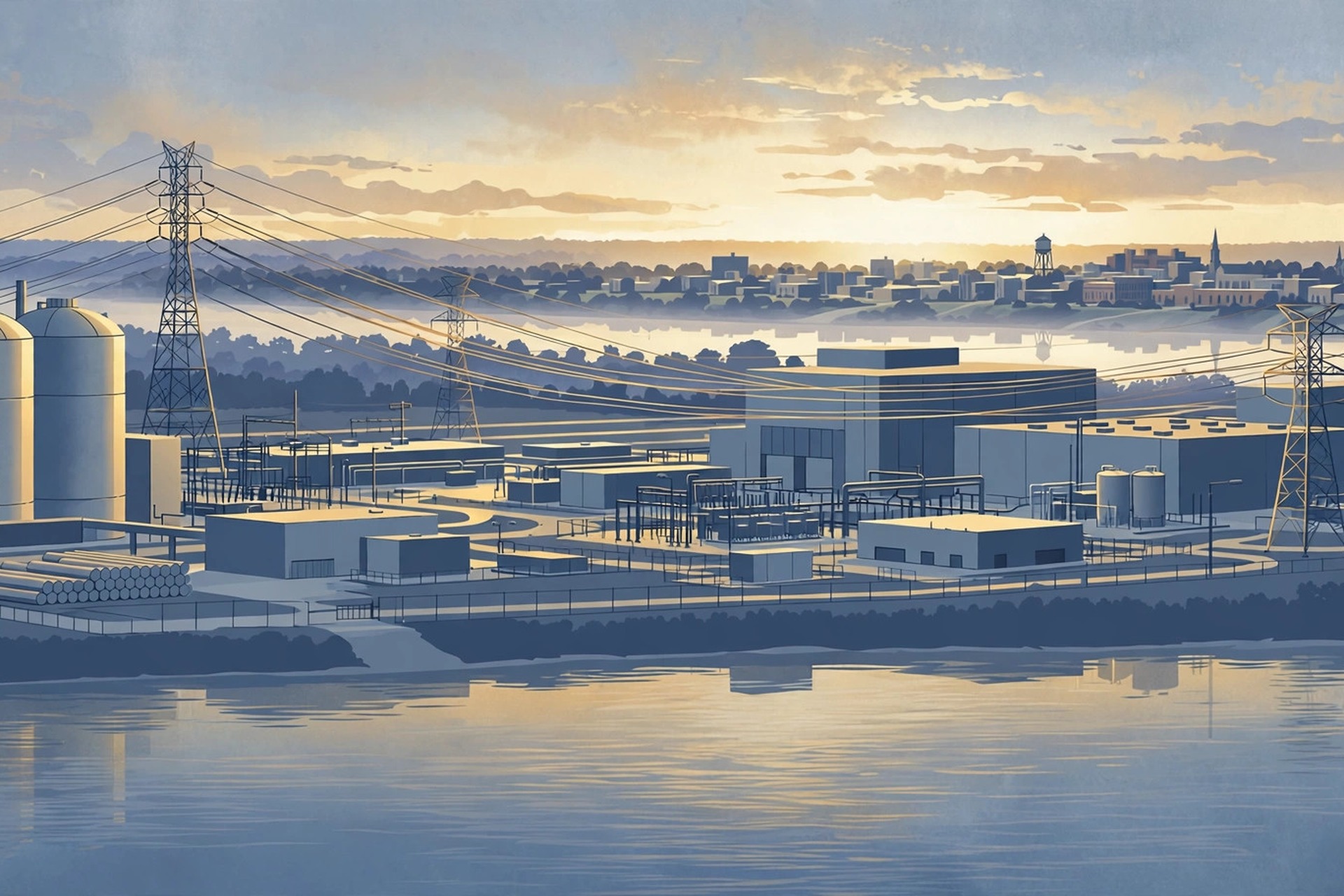
The United States Nuclear Regulatory Commission has accepted a licence application from General Matter, a nuclear fuel start-up, to build and operate a uranium enrichment facility in Paducah, Kentucky, moving the project from months of closed-door preparation into a formal public review. The acceptance, announced on October 29, 2026, does not approve the plant. It means only that the commission’s staff found the application complete enough to examine in detail, and it starts a review the agency now estimates will run until April 2028.
That distinction is the most important fact in the story, and it is also the easiest to lose. Acceptance is a doorway, not a decision. The commission has not judged whether the plant is safe, secure or environmentally acceptable. Those questions are the review itself, and they will be tested over the next eighteen months through technical analysis, environmental study, security checks and opportunities for public comment. What acceptance does settle is narrower but still significant: after more than a hundred pre-application meetings with regulators, General Matter has produced a filing the commission is willing to work through, and the clock on that work has now formally started.
General Matter filed the application on September 28, 2026. It runs to more than 1,000 pages, including a 457-page environmental report that has begun to appear in public, and it followed what the commission described as unusually constructive early engagement between the company and its staff. The commission said the quality and completeness of the filing allowed it to finish the acceptance review in roughly half the time usually allotted to that stage. For a first-time applicant in an industry where licensing timelines are measured in years, that is a notable compliment, even if it guarantees nothing about the outcome.
The company has described its goal as building what it calls America’s first United States-owned commercial enrichment facility, and enriching uranium in Paducah at commercial scale by the end of the decade. That goal is the company’s ambition, not a regulatory promise. Whether it is met will depend on the licence review, on financing, on construction, and on a second application the company has not yet filed. Readers should hold those two things apart: the ambition, which is large, and the decision taken on October 29, which is procedural and limited.
What the General Matter uranium enrichment application covers
The application now under review covers conventional low-enriched uranium, the fuel used in today’s large commercial reactors, enriched to roughly 5 percent uranium-235. It does not yet cover the more potent fuel that has drawn much of the industry’s recent attention. High-assay low-enriched uranium, known as HALEU, is enriched to between 5 and 20 percent and is needed by many of the smaller, advanced reactors now being designed by companies such as Oklo, TerraPower and X-energy. General Matter says it will seek that authority through a licence amendment in 2027, and it has signed an enrichment agreement with X-energy, whose chief executive discussed the arrangement with investors in August.
The two-step approach matters because it shapes what the current review can and cannot deliver. If the commission grants a licence on the present application, General Matter would be authorised to produce conventional fuel, not HALEU. The HALEU question would return for a separate decision, with its own technical review. That sequencing was deliberate: the company says it reflects months of open communication with regulators, and it allows the first review to proceed on a narrower, better-understood set of questions while the more demanding fuel is prepared separately.
General Matter has not publicly disclosed the enrichment technology it plans to use. Its chief executive, Scott Nolan, an early engineer at SpaceX, has said the company is developing novel technology but not novel physics or novel engineering, a formulation that tells the public something about the company’s confidence and very little about the hardware. The commission’s review will examine the technology in detail behind the closed doors of the licensing process, through safety and security analysis, but the public case for the plant, at this stage, rests less on a disclosed design than on the completeness of the filing and the credibility of the team behind it. The company was incubated at Founders Fund, the venture firm associated with Peter Thiel, a background that has drawn attention in coverage of the project but that has no bearing on the commission’s safety judgement.
The site itself is part of the story. General Matter plans to build on the Department of Energy-owned site at Paducah, a place with a long nuclear history. The Paducah gaseous diffusion plant enriched uranium for decades before closing, and the site carries a legacy of contamination and cleanup that is still being addressed. The company has framed its plan as converting part of that industrial landscape into a new fuel plant. For regulators, that history cuts both ways: the site is already industrial, already connected to the nuclear complex, and already familiar to federal overseers, but it also carries environmental obligations that any new project must respect and that local residents will rightly want examined in the environmental review.
Why April 2028, and why the fast track was refused
General Matter asked the commission for an accelerated review, hoping for a licence decision within twelve months rather than the standard eighteen. The commission declined to commit to that faster schedule. In its acceptance letter, the staff cited an anticipated increase in workload and associated resource constraints, and said it could not promise a timetable shorter than the estimated April 2028 completion date. It left a door open: parts of the review could be accelerated if the company continues to file complete and timely submissions and if agency resources allow. That is a conditional possibility, not a commitment, and it should not be reported as a new deadline.
The refusal is revealing about the state of the regulator itself. The commission is being asked to review more new nuclear projects than it has handled in a generation, at the same time as it oversees the existing fleet of reactors. An acceptance review completed in half the usual time suggests the staff can move quickly when an application is well prepared. A refusal to promise a twelve-month licence decision suggests the same staff knows its limits, and is unwilling to trade thoroughness for speed on a facility that handles enriched uranium. Both facts can be true at once, and together they describe a regulator trying to be responsive without being rushed.
The April 2028 estimate also sets up a collision with another date that matters to the industry. The United States is moving toward a ban on Russian nuclear fuel imports starting in 2028, a step intended to end reliance on a foreign supplier for a material central to the country’s reactor fleet. Reporting on the General Matter application has framed the project as a step toward reducing that reliance. The framing is reasonable as a statement of purpose, but the timing deserves care. Even if the commission completes its review in April 2028 and grants a licence, a plant must still be built, tested and brought into operation before it produces fuel at commercial scale. The company aims for production by 2030. The import ban and the plant’s output are therefore on different clocks, and the plant alone will not close the gap in 2028.
The federal government has already put money behind closing that gap. In January 2026, the Department of Energy awarded 900 million dollars each to General Matter, Orano Federal Services and American Centrifuge Operating, as part of a 2.7 billion dollar milestone-based programme to expand domestic enrichment. Milestone-based matters: the money is tied to progress, not handed over unconditionally, and it reflects a judgement in Washington that domestic enrichment capacity is a matter of energy security as well as industrial policy. The commission’s licensing decision, however, is independent of that funding. A Department of Energy award does not oblige the regulator to grant a licence, and the regulator’s acceptance of an application does not guarantee that milestones will be met.
Paducah, Kentucky: the local stake in a Washington decision
For Paducah and McCracken County, the commission’s decision is not an abstraction about fuel cycles. It is a question about jobs, land, water, roads and the future of a community that has lived with the nuclear industry for generations. A new enrichment plant, if licensed and built, would bring construction work, skilled operating jobs and a long-term industrial presence to a city on the Ohio River. It would also bring heavy construction, increased traffic, security requirements and environmental scrutiny to a community that knows, from the diffusion plant era, that nuclear promises and nuclear legacies are not the same thing.
Local leaders have welcomed the project in public statements, and the company has said its chief executive was in Paducah when the acceptance was announced, a small detail that signals how much the company wants to be seen as a local presence rather than a distant applicant. But the most consequential local judgement has not yet been made. That judgement belongs to the environmental review, which will examine the plant’s effects on air, water, land and public health, and to the public comment process, in which residents, local officials and community organisations can raise concerns and ask questions that the commission must answer on the record. A plant that is welcomed in principle can still be shaped, conditioned or delayed by what that review finds, and local residents who lived through the cleanup era will understand that better than most.
The local angle also runs through Kentucky’s wider energy debate. Kentucky communities are already weighing large energy projects closely, as the debate over a proposed data centre near Louisville has shown, and the same questions recur: who benefits, who bears the disruption, and what guarantees are written down rather than merely promised. General Matter’s project will be judged locally on similar terms, even though its federal licence is decided in Washington. The commission’s process gives the community a formal place to ask those questions. Whether the answers satisfy Paducah will depend on how seriously the company and the regulator treat that process over the next eighteen months.
The other Paducah project, and the Oak Ridge contrast
Paducah is, unusually, host to two separate uranium enrichment proposals, and confusing them would mislead readers. Alongside General Matter’s application, the commission issued a final environmental impact statement on October 23, 2026, for a different project: Global Laser Enrichment’s proposed Paducah Laser Enrichment Facility, on a 322-acre greenfield site in McCracken County about five miles west of the city. That project would use laser-based isotope separation, would re-enrich depleted uranium tails and enrich natural uranium up to 8 percent, and could operate for up to 40 years. Commission staff recommended issuing its licence unless safety issues require otherwise, drawing on the company’s environmental report, consultations with federal, state, local and tribal officials, public comments and independent review.
The two projects are different companies, different technologies and different sites, and they are at different stages. General Matter’s application has been accepted for review. Global Laser Enrichment’s environmental review is complete, with a licensing decision still to follow. Treating them as one project, or adding their capacities together, would be a mistake. What they share is a place and a moment: Paducah, in the autumn of 2026, became the centre of America’s effort to rebuild domestic enrichment capacity, with two different technical bets being tested in the same county.
The contrast with the third federally backed project is sharper still. Orano’s Project IKE, a planned enrichment plant near Oak Ridge, Tennessee, is on a separate timeline and has run into the kind of delays General Matter has so far avoided. In the same week that General Matter’s application was accepted, the commission published a long account of shortcomings in Orano’s submissions, and Orano sought more time to respond to information requests, proposing to file final responses in two batches, by October 16 and November 20. Earlier, in May, the commission had said it intended to complete the technical review of the Orano project within twelve months, assuming high-quality and timely inputs. The gap between that intention and the autumn’s delays is a reminder that licensing schedules are estimates built on assumptions about the quality of what applicants file, and that those assumptions can fail.
None of this means Orano’s project will fail, or that General Matter’s will succeed. It means the three federally backed enrichment efforts are now on visibly different tracks: one accepted quickly, one delayed by information requests, and one, American Centrifuge Operating, proceeding on its own course. For policymakers watching from Washington, the lesson is not that one company has won but that the system’s capacity to review complex applications promptly depends heavily on the completeness of what is submitted, and on a regulator with enough staff to test it.
What enrichment is, and why Washington cares now
Uranium enrichment is the process of increasing the proportion of uranium-235, the isotope that can sustain a nuclear chain reaction, in uranium feedstock. Natural uranium contains less than 1 percent uranium-235. Commercial reactors generally use fuel enriched to around 5 percent. Advanced reactors designed for HALEU need fuel enriched to between 5 and 20 percent. The process is technically demanding, heavily safeguarded and politically sensitive, because the same underlying technology, taken further, can produce weapons-grade material. That dual-use character is why enrichment plants are licensed by a dedicated regulator, inspected, and subject to international safeguards, and why a decision to license a new plant is never treated as an ordinary industrial approval.
Washington’s interest in new enrichment capacity has grown for two linked reasons. The first is the impending end of Russian fuel imports, which has exposed how dependent the American reactor fleet, and the advanced reactor developers waiting behind it, have been on foreign enrichment. The second is demand: rising power demand from data centres and electrification, alongside renewed interest in nuclear power as a low-carbon source, has made fuel supply a strategic question rather than a procurement detail. Federal energy planning has increasingly treated reactor construction and fuel supply as a single problem, since a reactor without assured fuel is an expensive asset with an uncertain future.
That demand story also explains why the enrichment debate is no longer confined to energy specialists. The same power-demand pressures driving data centre construction and grid investment are now driving fuel policy, and the companies building advanced reactors need fuel contracts years before their plants operate. X-energy’s agreement with General Matter is an early example of that forward contracting: a reactor developer securing a future fuel source before either the fuel plant or, in some cases, the reactor itself is licensed. These arrangements are commercial bets on a licensing process that has not yet concluded, and they should be reported as bets, not as guarantees.
What acceptance does not decide
It is worth stating plainly what the commission has not done. It has not found the Paducah plant safe. It has not approved its security arrangements, its waste handling, its emergency planning or its environmental impact. It has not decided whether the plant’s design, whatever technology it ultimately uses, meets regulatory requirements. It has not granted permission to build, let alone to operate. Each of those judgements comes later, and each can produce conditions, delays or, in the extreme, refusal.
The review will also test arguments that supporters and critics of enrichment expansion make in general terms. Supporters argue that domestic enrichment strengthens energy security, reduces dependence on foreign suppliers, supports American reactor exports and provides skilled jobs in communities like Paducah. Critics of enrichment expansion argue, in general, that more enrichment capacity raises proliferation and security questions, creates long-lived waste and decommissioning liabilities, and deserves the closest possible scrutiny of its economics and safety case. Neither set of arguments is decided by the acceptance decision. Both will be tested, in specific form, against this plant’s actual design and site, in the review that now follows. This article attributes those positions to their respective sides in general terms because no specific critic or supporter of this particular application has been quoted in the reporting relied on here, and inventing one would be misleading.
There is also a question the acceptance letter answers only indirectly: whether the commission has the resources to review this plant, and others like it, on the timetable the industry wants. The staff’s refusal to promise a twelve-month review, citing workload and resource constraints, is a candid admission that the regulator’s capacity is a binding constraint on nuclear expansion. Congress and the administration can change that capacity through funding and staffing, but until they do, applicants and investors should expect licensing timelines to reflect the regulator’s workload, not only the quality of their filings. General Matter’s unusually fast acceptance review shows what good preparation can achieve. Its April 2028 estimate shows the limits of that achievement.
What to watch next
The next milestones are procedural but consequential. The commission will publish notices opening the formal review to public participation, and local residents, officials and organisations will have opportunities to comment and, where the rules allow, to seek a hearing on specific contentions. The environmental review will proceed alongside the safety review, and its findings will shape the conditions, if any, attached to a licence. General Matter’s promised HALEU amendment, expected in 2027, will be a second decision point, and its timing relative to the main licence review will matter: if the amendment arrives while the first review is still running, the two tracks could interact in ways that help or complicate the schedule.
Orano’s responses, due in batches through November 20, will also be watched as a gauge of whether the Oak Ridge project can recover its timetable. And the January 2028 horizon for the Russian fuel import ban will focus attention on whether any domestic plant can produce meaningful quantities of fuel in time, or whether the transition will rely on stockpiles, existing suppliers and the American Centrifuge project. General Matter’s own goal of commercial-scale production by the end of the decade sits beyond that horizon, which is a further reason to treat the October acceptance as the start of a long process rather than the resolution of a short one.
For now, the accurate summary is modest and, for that reason, credible. A well-prepared application has been accepted. A regulator with limited resources has set an eighteen-month review. A Kentucky community with a long nuclear history waits to see what that review finds. And a Washington debate about energy security, fuel supply and the pace of nuclear expansion has a concrete test case, in Paducah, on which to judge whether the system can move both quickly and carefully at the same time. The answer will not be known in November 2026. It will be written, document by document, between now and April 2028.
USN reviewed reporting from multiple outlets for this story. Read more from Heatmap News, Energy Intelligence and TokenPost.