

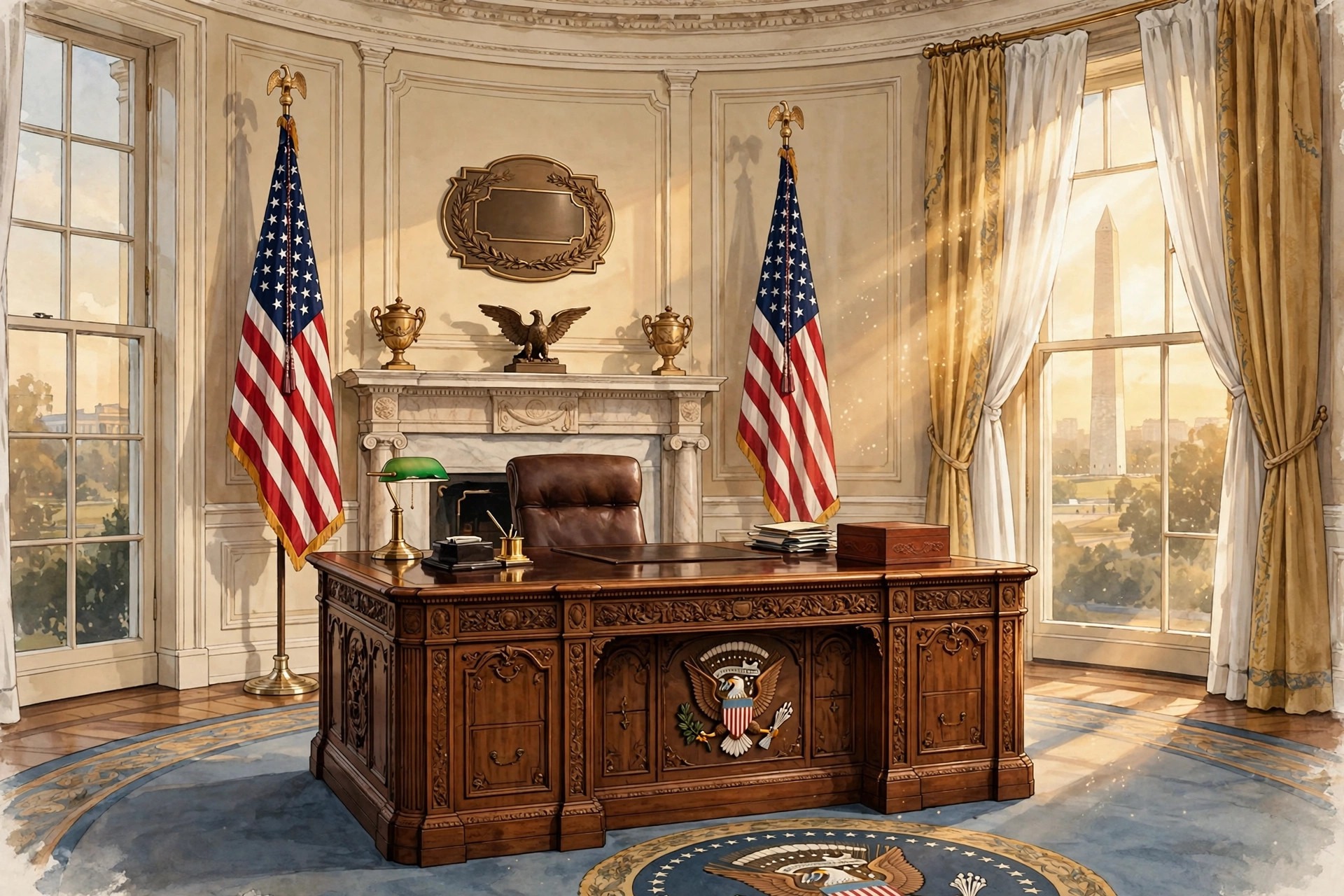
President Trump signed a proclamation on Thursday 5 November 2026 designating the Oval Office and the adjacent Cabinet Room as a national monument, in his first official action since his party’s sweeping losses in the midterm elections two days earlier. The move, announced in the Oval Office itself, placed two of the most famous rooms in American government under a designation more commonly associated with canyons, deserts and historic battlefields, and it immediately raised questions about what the designation actually does, what it does not do, and why the president chose this moment to make it.
The monument also includes the Outer Oval Office, the ante-room through which visitors pass on their way to the president’s desk, and the proclamation orders the interior secretary to manage the new monument through the National Park Service. That is the formal machinery of the designation: a presidential proclamation, an instruction to a cabinet secretary, and a role for the agency that looks after the country’s national parks and monuments. The symbolism, however, was larger than the machinery, and it was the symbolism that dominated the reaction on the day.
Mr Trump told reporters at the signing: “We’re making it a national monument, and it will not be allowed to be touched by anybody, destroyed, ripped down by stupid people, in order to build something in a slightly different shape.” He called the rooms “a landmark for the ages”. The language was characteristic of the president, direct and personal, and it framed the designation as an act of protection: a safeguard against future change, imposed by a president who had just lost control of Congress and who was looking for ways to leave a lasting mark on the building he occupies.
The signing was also a visual event. A red baseball cap with the word “VETO” in bold lettering sat prominently on the Resolute Desk during the ceremony. Mr Trump had earlier shared an image of the cap on Truth Social, and he had told Fox News that the veto was among the strongest powers available to a president. The cap, placed where the cameras could not miss it, was a message in itself: that the president, having lost Congress, intended to use the veto to block the legislation that the new Democratic majorities would send him, and that he wanted the country to know it.
Oval Office national monument: what the proclamation does and does not do
Despite the sweeping language used at the signing, the proclamation does not permanently protect the rooms in the way that Mr Trump’s words might have suggested. It does not prevent future presidents from restyling the office, and it does not prevent a successor from rolling back the proclamation itself. Mr Trump himself has reversed national monument designations made by his predecessors, a fact that was noted in reporting on the day and that underlines the limits of the action he had just taken.
The text of the proclamation makes the limits explicit. It says that nothing in it will “restrict the President’s authority to redecorate the monument, select furnishings, or make ordinary operational and security modifications that do not substantially impair the monument’s historic structure or architectural character.” That is a broad reservation. A future president would remain free to change the furniture, the decoration and the fittings, and to make the operational and security changes that the running of the White House requires, provided those changes did not substantially impair the historic structure or the architectural character of the rooms.
The reservation matters because the Oval Office is, by its nature, a working room that every president makes his own. Each occupant changes the carpet, the curtains, the pictures on the walls, and the objects on the desk. The proclamation does not stop that. It preserves the structure and the character of the rooms, but it leaves the president’s authority over their contents and their day-to-day use largely intact. A successor who wanted to redecorate would be able to do so, and a successor who wanted to revoke the designation altogether would be able to try, just as Mr Trump has done with designations made by others.
That does not make the proclamation meaningless. A national monument designation carries legal weight, and it creates a formal status that a future administration would have to address if it wanted to change the rooms in a fundamental way. It also creates a record: a presidential act, entered into the formal history of the building, that declares these rooms to be of national significance. But it is not the permanent shield that the language at the signing might have implied, and it should not be reported as one.
The legal basis for the designation is the same authority that presidents have used for more than a century to protect land and historic sites: the power to proclaim national monuments. Its application to the working rooms of a sitting president, inside a building that is itself the seat of government, is unusual, and it is that unusualness that made the announcement newsworthy. A monument in the middle of the White House, managed by the National Park Service, is a novel arrangement, and it raised immediate questions about how the Park Service would manage rooms that are also the daily workplace of the president and his staff.
Trump VETO cap on the Resolute Desk signals a new posture toward Congress
The red cap on the Resolute Desk was not a prop that happened to be there. It had been shared by Mr Trump on Truth Social before the signing, and it was placed where it would be seen by every camera in the room. The word on it, in bold capital letters, was the message: VETO. The president had told Fox News that the veto was among the strongest powers available to a president, and on the day after his party had lost both chambers of Congress, he was making clear that he intended to use it.
The timing gave the gesture its force. The day before the signing, Mr Trump had toured the ballroom project with reporters and told them: “I have the power of the veto” and “I’ll get along probably with the Democrats, unless they want to be destructive.” The cap, appearing the next day on the desk where the proclamation was signed, was a continuation of that argument, in visual form. It said, without the need for a speech, that the president saw the veto as his principal weapon in the new political landscape, and that he was not going to be shy about using it.
The veto is, in constitutional terms, a formidable power. A bill passed by Congress does not become law if the president vetoes it, unless Congress can muster a two-thirds majority in both chambers to override the veto. With Democrats in control of the House and the Senate, but without two-thirds majorities, the veto gives Mr Trump the ability to block legislation that he opposes, even if it has the support of a majority in both chambers. The cap was a reminder of that arithmetic, placed in the most photographed spot in the White House.
It was also a statement about the president’s mood. The midterm losses had been severe, and the days since the election had been filled with speculation about the future of his administration. The cap, and the proclamation it accompanied, were an assertion of continued authority: a president who had lost Congress, but who still held the White House, still held the veto, and still intended to use the powers of his office to shape what happened next. The visual language was blunt, but it was effective, and it ensured that the signing would be remembered as much for the cap as for the proclamation itself.
A week centred on building projects, from the Reflecting Pool to the ballroom
The monument proclamation was the third day that week in which Mr Trump had centred his public activity on his building projects. On Monday, he had spoken at the Lincoln Memorial Reflecting Pool about its renovation. On Wednesday, the day after the election defeats, he had gathered reporters to sign the final beam being raised for his ballroom project. On Thursday, he signed the monument proclamation in the Oval Office. The sequence was deliberate, and it showed a president turning, in the immediate aftermath of a political defeat, to the physical legacy he is building in Washington.
The ballroom project is the largest of those undertakings. The White House released plans for it on 31 July 2025, describing a 90,000-square-foot addition on the east side of the building. The project is reported to cost about 200 million dollars. It is a substantial addition to the White House complex, and it has been the subject of debate since it was first announced, both for its scale and for the changes it will make to one of the most familiar buildings in the country.
The ballroom was also the subject of the president’s remarks on Wednesday, when he toured the project with reporters and signed the final beam. That event, held the day after the election, was itself a statement: that the president’s building programme would continue, regardless of the political outcome, and that he intended to see it through. The monument proclamation on Thursday continued that theme, extending it from the new ballroom to the oldest and most famous rooms in the building.
The third building project in the news that week was the proposed triumphal arch. On 5 November, the National Capital Planning Commission, described by USA Today as stacked with Trump loyalists, was expected to vote on whether to approve Mr Trump’s plan for a 250-foot triumphal arch in Washington, topped with a 60-foot-tall gilded, winged figure of Lady Liberty. The vote was expected on that day, but its outcome had not been confirmed at the time of reporting, and it should not be presented as decided. The arch, if built, would be a major addition to the capital’s landscape, and the expectation of a vote on the same day as the monument signing added to the sense that the president was pursuing a broad programme of physical change in Washington.
Democratic Representative Don Beyer of Virginia, whose district includes Arlington County, said hours before the arch vote that he had never seen such widespread opposition to a project from his community. His comment captured the local reaction to the arch proposal, and it suggested that the building projects, like the monument designation, were becoming a focus of political argument in their own right. The arch was not the subject of Thursday’s proclamation, but it was part of the same story: a president using the built environment of the capital to make a statement about his presidency, at a moment when his political position had weakened.
Democratic criticism and the limits of a monument made by proclamation
The monument move drew criticism from Democrats, among them Senator Richard Blumenthal of Connecticut, the senior Democrat on the Homeland Security Committee’s Permanent Subcommittee on Investigations, who criticised the action in comments reported on the day. The criticism reflected a broader Democratic view that the proclamation was a distraction from the election result, and an attempt to use the powers of the presidency to entrench a personal legacy at a moment when the voters had just delivered a verdict against the president’s party.
The criticism also reflected a legal point: that a proclamation is, by its nature, reversible. A future president can revoke it, just as Mr Trump has revoked designations made by his predecessors. The rooms themselves, moreover, remain a working office, and the proclamation’s own text preserves the president’s authority to redecorate and to make operational changes. A monument that can be redecorated by its occupant, and revoked by its successor, is a different thing from a monument that is permanently protected, and the distinction was central to the reaction on the day.
The signing also came a day after Mr Trump’s post-election ballroom tour, at which he had spoken about the veto and about his willingness to work with Democrats unless they chose to be destructive. That remark, reported by USA Today, framed the proclamation in a particular light: as part of a negotiating posture, in which the president was signalling both his readiness to cooperate and his readiness to block. The monument, the cap, and the remarks about the veto were all part of the same message, delivered over two days, about how the president intended to govern with a Congress controlled by the opposition.
For historians, the proclamation will be a curious footnote: a national monument declared inside the White House, by a president who had just lost an election, in rooms that he himself had redecorated and that his successors will redecorate again. For the politics of the moment, it was a clearer signal: that Mr Trump, having lost Congress, was looking for other ways to assert his authority, and that the building he lives in, and the legacy he leaves in it, would be one of them. Whether the designation endures will depend on his successors, and on whether they choose to keep it, revoke it, or simply ignore it as they make the rooms their own.
Sources
USN reviewed reporting from multiple outlets for this story. Read more from Al Jazeera, New Indian Express and USA Today.