

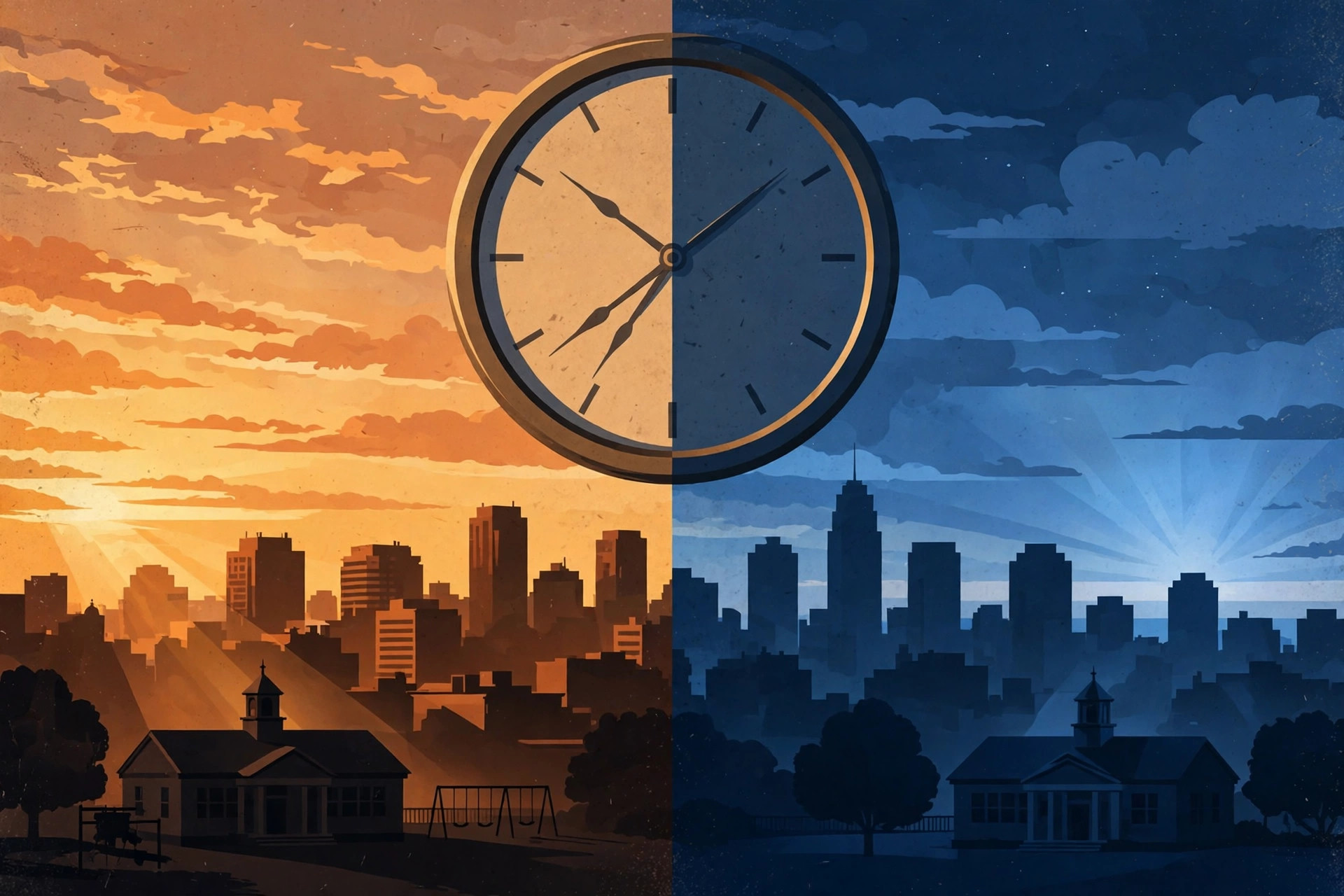
WASHINGTON — Americans will turn their clocks back an hour this Sunday, 1 November 2026, just as they have every autumn for decades, because the Senate has not taken up a House-passed bill that would have made daylight saving time permanent. The bill, the Sunshine Protection Act, passed the House in July and was referred to the Senate Commerce, Science, and Transportation Committee, where it has sat without a vote. As daylight saving time ends at 2 a.m. local time on Sunday, when clocks move back to 1 a.m., the twice-yearly ritual that most Americans say they dislike will continue for at least another cycle — despite repeated pressure from President Donald Trump, who has demanded that the Senate pass the bill and send it to his desk.
The Associated Press reported on 29 October that the Senate is unlikely to act before the end of the year on the measure, dashing the hopes of supporters who had seen the House vote as a breakthrough. Several senators, including members of the Republican leadership, are holding up the legislation, and several Republicans have predicted in recent weeks that it will not come up for a vote in the short time remaining when the Senate returns to Washington after the 3 November midterm election. The result is a familiar Washington pattern: a proposal with broad public support and a strong House majority stalls in the Senate, where a smaller number of determined opponents, procedural hurdles and a crowded calendar can stop a bill that most voters say they want.
What the Bill Would Actually Do
Clarity about the bill matters, because its name invites misunderstanding. The Sunshine Protection Act would not abolish daylight saving time. It would make daylight saving time permanent, so that the “summer” clock setting — the one Americans live under from March to November, with later sunsets — would apply all year round, and the November “fall back” to standard time would no longer happen. Supporters argue that ending the time change would provide more daylight in the afternoon, when Americans are most active, for work, shopping, exercise and outdoor leisure. Opponents argue that the trade-off is darker winter mornings, with the sun not rising until after 9 a.m. in some northern states.
That distinction also explains why the debate is not simply between people who like changing clocks and people who do not. Almost nobody likes the change itself: an AP-NORC poll last year found that only 12 percent of American adults favoured the current system, while almost half opposed it. The disagreement is about which permanent time to choose. Permanent daylight saving time means lighter evenings and darker mornings. Permanent standard time — the winter setting — would mean lighter mornings and earlier winter sunsets, with darkness falling as early as 4 p.m. in some places. Congress has, in effect, been asked to choose between two imperfect options, and its inability to choose is why the twice-yearly switch survives.
Federal law currently constrains the states as well. Under current law, daylight saving time begins on the second Sunday in March and ends on the first Sunday in November. States may exempt themselves from observing daylight saving time through state legislation — as Hawaii and most of Arizona do, along with several territories — but they cannot adopt permanent daylight saving time without federal approval. The Department of Transportation, which oversees daylight saving time and American time zones, administers that framework. A state that wants year-round daylight saving time, as Florida sought to do, must therefore wait for Congress, which is precisely why the Senate’s inaction has national consequences.
Trump’s Pressure Campaign Has Not Worked
President Trump has pushed the change aggressively, putting pressure on Senate Republicans to pass the House bill. Earlier in October, he publicly targeted Senator Tom Cotton of Arkansas, posting the senator’s personal cellphone number on social media and ordering him to “GET IT DONE!” He argued that sunshine is better in the afternoon than in the morning and that “CRIMINALS DON’T LIKE WORKING IN THE LIGHT.” This week, he renewed his call on Truth Social, writing that the “United States Senate is letting the Daylight Saving Bill die, when a vast Majority of the Country want it.”
Trump has also made the case in more personal terms. An avid golfer, he has said that adding daylight hours would mean more time on the course. He has argued that changing the time can be dangerous, especially when, in his words, “you have high and dangerous steeples to reach, like on churches and municipal buildings,” and that “nobody wants to spend their precious time running all over the place, turning Clocks back twice a year.” The arguments are characteristically Trumpian — a mix of public safety, convenience and personal preference — but they have not, according to the Associated Press, changed many votes in the Senate. Cotton has doubled down in response to the pressure, and other opponents have held their ground.
The episode also reveals a limit of presidential influence over his own party’s Senate caucus. A president can dominate a news cycle, endorse candidates and set the party’s public agenda, but senators answer to their own state electorates and their own judgments, and on a question with no clear partisan line, that independence is visible. Daylight saving time divides both parties internally: supporters and opponents can be found among Republicans and Democrats alike, which means the president cannot simply order his party to fall in line in the way he might on a tax bill or a nomination.
The Senators Blocking the Bill
Cotton, a member of the Republican leadership, is the most vocal opponent. “No one likes changing the clock, me included, but Congress has enacted permanent Daylight Saving Time multiple times before and repealed it each time once Americans experienced absurdly late sunrises in the winter,” he said. His argument rests on history, and it is the argument opponents return to most often: America has tried permanent daylight saving time before, and Americans did not like living with it once winter arrived.
Cotton is not the only senator blocking the legislation. Several other Republicans, particularly those from northern states that would see much later sunrises, say they also oppose it. “You’d be sending kids to school in the dark,” said Senator Mike Rounds of South Dakota. Senator Todd Young of Indiana said it is his understanding that the House bill is a “non-starter” for Senate Republican leaders. Senator Bernie Moreno of Ohio was even more blunt when asked this month whether he thinks the bill will pass the Senate anytime soon. “No way,” Moreno said. Senate Majority Leader John Thune of South Dakota has not weighed in publicly on the House bill, but he has voted against similar versions in the past — a record that supporters read as a further obstacle.
The geography of the opposition is not accidental. In southern states, winter sunrises under permanent daylight saving time would still arrive at a tolerable hour. In northern states, and in the western edges of time zones, where the sun already rises late in winter, the same policy would mean children waiting for school buses and commuters driving to work in darkness well into the morning. That regional split cuts across party lines and explains why a bill that passed the House by a wide margin can stall in a Senate designed to give smaller and more rural states outsized influence.
The Supporters’ Case
Supporters have their own history, and their own champions. Senator Rick Scott of Florida signed legislation when he was governor in 2018 that would allow his state to remain on daylight saving time year-round, pending federal approval. Now in the Senate, the Republican has led efforts to make that happen nationally. “I hear from Americans constantly that they are sick and tired of changing their clocks twice a year — it’s an unnecessary, decades-old practice that’s more of an annoyance to families than benefit to them,” Scott said.
Several Democrats are on board as well. “The head-spinning ritual of falling back and springing forward has a very real impact on our economy, our health, and our happiness,” said Democratic Senator Ed Markey of Massachusetts, when Scott introduced his own bill last year. “Let’s say goodbye to 4 p.m. winter sunsets.” Proponents of a single time also include the American Medical Association and the American Academy of Sleep Medicine, which have argued that the abrupt clock changes disrupt sleep and circadian rhythms, with measurable effects on health, safety and productivity in the days after each switch. That medical argument gives supporters a claim beyond convenience: the time change, they say, is not merely annoying, but harmful.
The economic argument runs alongside the health argument. Retailers, restaurants, sports leagues and outdoor recreation businesses have long favoured later evening daylight, arguing that consumers spend more when it is light after work. Supporters point to that coalition as evidence that permanent daylight saving time would benefit the economy as well as public well-being. Opponents counter that the economic gains are overstated, that morning darkness carries its own safety costs for schoolchildren and early workers, and that the energy savings once claimed for daylight saving time have diminished as lighting has become more efficient and as heating, cooling and screen use have changed how Americans consume energy.
The 1973 Experiment Americans Still Remember
Both sides invoke the winter of 1973, when, amid an energy crisis, Congress passed a law instituting permanent daylight saving time for what was supposed to be a trial period. The experiment was repealed by the following October, as public support dropped sharply, partly because of concern for children walking to school in the dark. Opponents treat that episode as a decisive warning. Supporters treat it as a product of its time — an emergency measure imposed suddenly, in the depths of winter, without the public preparation and debate that a permanent change today would receive.
The truth, as with most historical analogies, is less tidy than either side admits. The 1973 experiment did face genuine public backlash, and school safety was a real concern. But America in 1973 also differed in important ways: school start times, commuting patterns, lighting technology and the structure of the working day have all changed, and the trial was implemented in January, the darkest month, rather than phased in with time for adjustment. What the episode does establish is narrower and more useful: a policy that sounds popular in the abstract can become unpopular in practice when its costs fall unevenly, on children and morning workers in particular. That is the risk any new attempt must address, and it is the reason opponents keep returning to 1973.
There is also a more recent precedent that supporters cite and opponents prefer to forget. The Senate itself passed a version of permanent daylight saving time in 2022, by unanimous consent, before the House failed to take it up and the bill expired. That episode showed that the Senate can move quickly on this issue — sometimes too quickly, with senators later admitting they had not fully appreciated what they had passed. It also showed that speed is not the same as durability: a bill that passes one chamber without sustained debate can die quietly in the other, which is essentially what has happened again, in reverse, with the House passing the bill and the Senate letting it sit.
What Happens on Sunday, and What Happens Next
On Sunday, then, the practical advice is simple. At 2 a.m. local time, clocks move back one hour to 1 a.m., giving most Americans an extra hour of sleep and an earlier sunset on Sunday evening. Digital clocks and phones will change automatically; analogue clocks, watches, car dashboards and appliance timers will need to be changed by hand. The change applies everywhere except the places that do not observe daylight saving time, including Hawaii, most of Arizona and the territories that remain on standard time year-round.
What happens next in Congress is less certain. Supporters could try to attach the measure to a larger bill, seek a floor vote after the election, or reintroduce it in the next Congress, when the membership will have changed. Opponents could continue to block it, or could push for the opposite permanent solution — year-round standard time — which has its own supporters among sleep scientists who argue that morning light matters more for health than evening light. The president could renew his pressure campaign, or move on to other priorities. None of those paths is assured, and the history of this issue suggests that the most likely short-term outcome is the one Americans have already experienced for decades: another March, another November, and another round of arguments about the clocks.
For now, the Senate’s decision — or, more precisely, its decision not to decide — is the story. A House majority, a president, medical groups and a clear majority of the public all favour ending the twice-yearly change, yet the bill remains in committee, and the clocks will fall back on Sunday anyway. That gap between public preference and legislative action frustrates supporters, but it also reflects something real about the American system: on a question where the costs and benefits fall unevenly across regions, ages and working hours, a determined minority in the Senate can hold the line, even against a president of its own party. On Sunday morning, Americans will gain an hour of sleep — and lose, for another season, the argument about what time it should be.
Sources
USN reviewed reporting from multiple outlets for this story. Read more from The Week, USA Today and Daily Pioneer.