

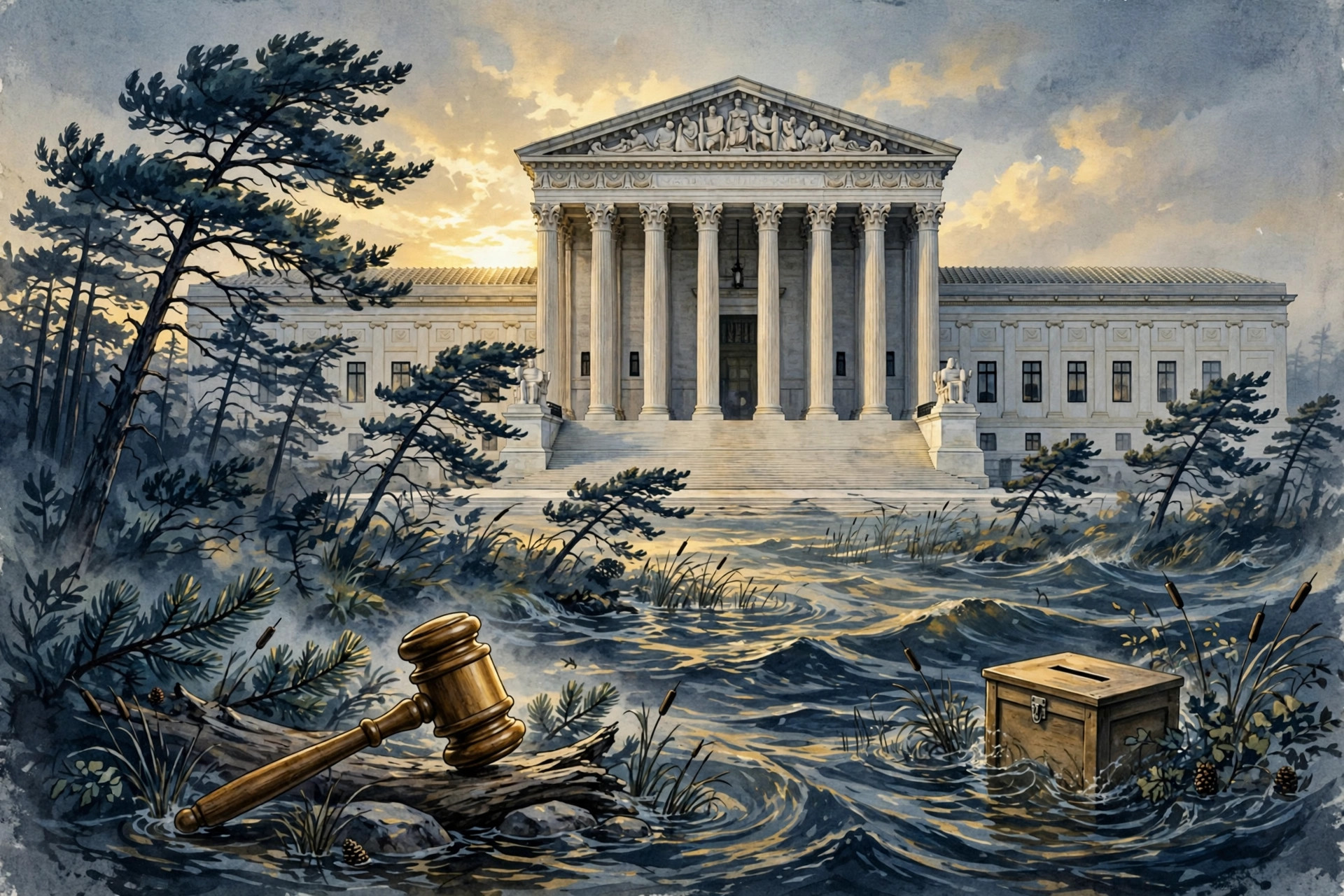
WASHINGTON — The Supreme Court opened a new term on 5 October 2026 with a docket that reads like a map of the country’s unresolved arguments. In the months ahead, the nine justices will decide whether local governments can sue energy companies over the harms of climate change, whether states may ban rifles styled like the AR-15, how far the federal government can go in deporting people to countries other than their own and detaining them without a bond hearing, and how much proof of citizenship Arizona may demand from people who register to vote. Decisions in most of these cases are expected by the end of June, but their political consequences will arrive much sooner, because several of the arguments fall in December, weeks after voters cast ballots in the 3 November midterm elections.
The term began, as it often does, with a case that could reshape far more than its own facts. The first argument concerned a lawsuit by Boulder, Colorado, against energy companies over the local costs of climate change, and it set the tone for a term in which the court, with its 6-3 conservative majority, will repeatedly be asked to draw lines between state authority and national policy. Supporters of the lawsuits say states and cities are simply using ordinary state law to recover money they have spent coping with floods, wildfires and extreme heat. Opponents, including the companies and the Trump administration, say climate change is a global problem that cannot be divided into dozens of local lawsuits without producing chaos and contradicting federal policy. Neither side disputes that the stakes are enormous: dozens of similar lawsuits around the country are waiting on what the court decides in the Boulder case, and billions of dollars in claimed damages could turn on the answer.
That opening also carried an unusual wrinkle. Justice Samuel Alito announced that he would no longer participate in the climate case, leaving eight justices to decide it. The court gave no public explanation for his decision, and a 4-4 split among the remaining justices would leave the lower court’s ruling in place without setting a national precedent. Court watchers noted the possibility with care rather than alarm: an evenly divided court is a familiar, if unsatisfying, outcome in a case where a justice steps aside, and it would mean the broader question could return in a later case. It also underscored how much of this term will be decided at the margins, by recusals, by narrow rulings and by questions the justices choose not to answer.
What the Supreme Court’s new 2026 term means for guns, climate and elections
The climate case, known as Suncor Energy v. Commissioners of Boulder County, turns on a question that sounds technical but has sweeping consequences: whether local governments may use state laws on nuisance, trespass and consumer protection to hold fossil fuel companies liable for climate-related harms. Boulder and Boulder County filed the lawsuit in 2018, arguing that companies including Suncor and ExxonMobil knew for decades that burning fossil fuels would worsen climate change, concealed that knowledge from the public, and should therefore help pay for the damage to local infrastructure, water supplies and public health. The companies deny that they deceived anyone and argue that the lawsuit is an attempt to use state courts to regulate a global energy system that Congress and federal regulators, not individual counties, are charged with overseeing.
Supporters of Boulder’s position argue that the case is not about setting national climate policy at all. In their telling, it is about accountability under laws that have long allowed communities to sue polluters for local harms, and about whether a company that allegedly misled consumers can escape state courts by pointing to the scale of the problem its products created. Critics of the lawsuit argue the opposite: that allowing state-law claims of this kind would let any locality set its own climate policy through damages awards, expose energy companies to overlapping and inconsistent judgments, and effectively allow one state to regulate conduct far beyond its borders. During the 5 October arguments, the justices pressed both sides on that tension, voicing concern both about unduly limiting the authority of states to pursue climate-related litigation and about unleashing a patchwork of lawsuits that could be impossible to administer fairly.
The practical importance of the case extends well beyond Boulder. Local governments across the country have filed similar suits against energy companies, and many of those cases have been paused while the Supreme Court considers this one. A ruling that the Boulder lawsuit may proceed in state court would breathe new life into that litigation, encouraging more filings and raising the prospect of large settlements or judgments. A ruling that federal law displaces these state claims would largely end the strategy, pushing climate policy back to Congress, federal agencies and international negotiations. Either way, the decision will be read as a statement about the role of courts in an area where elected branches have struggled to agree, and it will arrive in a term already crowded with cases that test the same boundary between courts and politics.
The gun cases: AR-15 bans in Illinois and Connecticut
In December, the court will turn to the Second Amendment, hearing arguments on 2 December in two cases that challenge bans on AR-15-style rifles in Cook County, Illinois, and in Connecticut. The cases, Viramontes v. Cook County and Grant v. Higgins, ask whether those bans violate the Second Amendment right to keep and bear arms. Lower courts upheld both bans, treating AR-15-style rifles as the kind of dangerous and unusual weapons that governments have historically been permitted to restrict. The challengers, who include gun-rights groups and are supported by the Justice Department, argue that the rifles are among the most commonly owned firearms in the country, with estimates of 20 million to 30 million in civilian hands, and that a weapon in such common use cannot be banned under the court’s own precedents.
The argument will be shaped by the court’s 2022 decision in New York State Rifle and Pistol Association v. Bruen, which held that gun restrictions must be consistent with the nation’s historical tradition of firearms regulation. Supporters of the bans argue that history supports them: governments have long restricted weapons thought to be especially dangerous, and AR-15-style rifles, they say, are disproportionately used in mass shootings, including the 2012 massacre at Sandy Hook Elementary School in Newtown, Connecticut, which prompted Connecticut’s ban, and the 2022 school shooting in Uvalde, Texas, cited in Illinois’s briefs. Challengers argue that the rifles are ordinary semiautomatic firearms, not military machine guns, that they are used lawfully by millions of Americans for sport and self-defence, and that the bans single out a popular weapon because of its appearance rather than its function.
The outcome will matter far beyond the two jurisdictions before the court. About a dozen states have banned semiautomatic rifles of this kind, and a ruling against the bans would call those laws into question, while a ruling upholding them would give other states a clearer path to enact similar restrictions. Gun-rights advocates describe the cases as the most important Second Amendment dispute since the court’s 2008 decision recognising an individual right to possess firearms. Gun-control advocates describe them as a test of whether states may respond to mass shootings with the tools they judge most effective, or whether the Second Amendment leaves them with only the weakest measures. As with the climate case, the justices are not merely deciding the fate of two local laws; they are deciding how much room democratic majorities have to act on problems the court itself has described in starkly different terms.
Immigration: third-country deportations and detention without bond hearings
The court’s immigration docket this term is, if anything, even more consequential for the people directly affected. In December, the justices will hear arguments over the Trump administration’s policy of deporting migrants to countries other than their own, known as third countries, without first giving them a meaningful chance to show the harm they might face there. The administration has sent thousands of people to countries with which they have no ties, under agreements that have often not been made public, and the Supreme Court has previously allowed the policy to continue temporarily while litigation proceeds. Human rights groups estimate that more than 25,000 migrants have been deported to 29 countries under the policy, a figure the administration has not confirmed in those terms but which illustrates the scale of the practice.
Supporters of the policy argue that it is a lawful and necessary tool when a person’s home country refuses to accept them back, and that immigration law has long allowed the government to send someone to an alternative country in such circumstances. They also argue that courts should not second-guess the executive branch’s judgments about foreign relations and border enforcement, particularly when the government says it has received assurances that deportees will not be harmed. Critics argue that the practice, as carried out, denies people a basic safeguard: the chance to tell a judge that they face torture, persecution or indefinite detention in the country to which they would be sent. They point to cases in which people were reportedly sent to countries where they had never lived, spoke no local language and had no family, and they argue that the absence of a pre-deportation hearing makes those errors invisible until it is too late to correct them.
A second immigration case will decide whether the government can require mandatory detention of immigrants in the United States without giving them a bond hearing while their deportation proceedings are under way. The administration argues that a 1990s immigration statute, as it now interprets it, makes people who entered without admission ineligible for release on bond, even if they have lived in the country for years. Most appeals courts that have considered the question have disagreed, holding that the statute does not sweep so broadly. Critics of mandatory detention argue that holding people for months or years without a hearing, even when they have family, employment and no criminal record in the United States, is a profound deprivation of liberty that the Constitution does not permit without an individualised assessment. Supporters argue that detention is necessary to ensure that people appear for proceedings and do not abscond, and that Congress, not the courts, made the policy choice to detain. The court’s answer will affect not only the people now in detention but also the government’s capacity to carry out large-scale deportation operations, which depend on detention space as a practical matter.
Readers following the court’s immigration work may also wish to read USN’s earlier report on a separate immigration judgment, available here: Supreme Court leaves Texas immigration judgment in place in Baltimore case. That case is distinct from the deportation and detention disputes on this term’s docket, and it is not the subject of this article.
Arizona voting law and the shadow of the midterms
On 8 December, the court will hear a Republican-led challenge seeking to revive provisions of an Arizona law that would stiffen proof-of-citizenship requirements for voter registration and allow regular purges of state voter rolls of people whose citizenship could not be confirmed. Lower courts blocked parts of the law after finding that they conflicted with federal voter registration requirements, including the National Voter Registration Act, which sets out the procedures states must follow for federal elections. Arizona adopted the requirements in 2022, directing counties to reject registration forms that lacked citizenship documents such as birth certificates, passports or driving licences.
Supporters of the Arizona provisions argue that states have a legitimate and urgent interest in ensuring that only citizens vote in federal elections, and that requiring documentary proof at registration is a straightforward way to protect that interest. They argue that federal law leaves room for states to set their own registration procedures for state forms, and that the lower courts read that room too narrowly. Critics argue that the provisions would burden eligible citizens, particularly people who lack ready access to the required documents, and that they would do so without evidence of widespread noncitizen voting. They note that voting by noncitizens in federal elections is already illegal, that state reviews have repeatedly found it to be extremely rare, and that the practical effect of stricter documentary rules is to make registration harder for citizens who are already entitled to vote.
The timing of the case gives it an added charge. Arguments come five weeks after the midterm elections, but the ruling, expected by June, will shape the rules for the next federal election cycle, and the court may also be asked to settle election-related disputes that arise around the 3 November vote itself. That prospect is a reminder that the Supreme Court’s role in elections is not limited to the cases it schedules months in advance. In past cycles, emergency applications over ballot deadlines, counting rules and district maps have reached the justices in the final days of a campaign, and the court’s answers, often unsigned and issued quickly, have determined which ballots count. For that reason, election officials and campaign lawyers will be watching the December arguments not only for what they say about Arizona, but for what they signal about how the court will handle any emergency dispute that lands on its docket in November.
A related election dispute from another state illustrates how differently these fights can play out in the courts. USN’s earlier coverage of an Alaska ballot lawsuit, available here: Alaska ballot lawsuit could pause the result, shows how a single ballot question can become a test of a state’s entire election machinery. The Arizona case raises a broader question, but the same principle is at stake: who decides the rules under which Americans vote, and how much deference courts owe to the states that run elections.
A term shaped by last term’s rulings
The new term does not begin in a vacuum. Last term, the court struck down sweeping global tariffs imposed by President Donald Trump, rejected his executive order seeking to restrict birthright citizenship, blocked the deployment of National Guard troops to American cities, turned back his attempt to remove a governor of the Federal Reserve, and ruled on Postal Service rules for mail ballots. Those decisions, several of them by 6-3 votes, were defeats for the administration on signature initiatives, even as the court also expanded presidential power in other areas, including the authority to remove leaders of independent agencies. The pattern complicates any simple story about the court as an ally or an adversary of the president: the same conservative majority that has upheld much of his immigration enforcement has also drawn lines it would not cross on tariffs, citizenship and the central bank.
That record is likely to shape how both sides argue this term. The administration will point to last term’s immigration victories as evidence that courts should defer to the executive branch on enforcement, while its critics will point to the tariff and birthright citizenship rulings as evidence that the court will still enforce constitutional limits when the executive branch overreaches. Gun-rights advocates will argue that the court’s recent Second Amendment decisions compel a ruling against the AR-15 bans, while supporters of the bans will argue that those decisions leave room for restrictions on unusually dangerous weapons. Climate litigants will argue that last term’s willingness to limit executive power cuts in favour of state authority, while the energy companies will argue that it cuts against allowing states to set national policy through lawsuits. In each case, the justices will be asked to apply principles they have already announced to facts that test those principles at their edges.
What is certain is that the term will be watched far beyond Washington. The climate case will be followed by every state and city considering a lawsuit against an energy company, and by every company weighing the cost of defending one. The gun cases will be followed by legislatures in states that have banned or are considering banning semiautomatic rifles, and by the millions of Americans who own them. The immigration cases will be followed by people in detention centres and by the officials who run them, for whom a ruling is not an abstraction but a decision about whether someone goes home or stays behind bars. The Arizona case will be followed by election officials in every state, who must translate whatever the court says into registration forms, training manuals and counting procedures. By June, when the term ends, the country will know a great deal more about the balance of power between Washington and the states, between the executive branch and the courts, and between individual rights and democratic majorities. Until then, the arguments in December, and the questions the justices ask from the bench, are the best guide available to where that balance is heading.
Sources
USN reviewed reporting from multiple outlets for this story. Read more from USA Today, WEKU and The Thinking Conservative.