

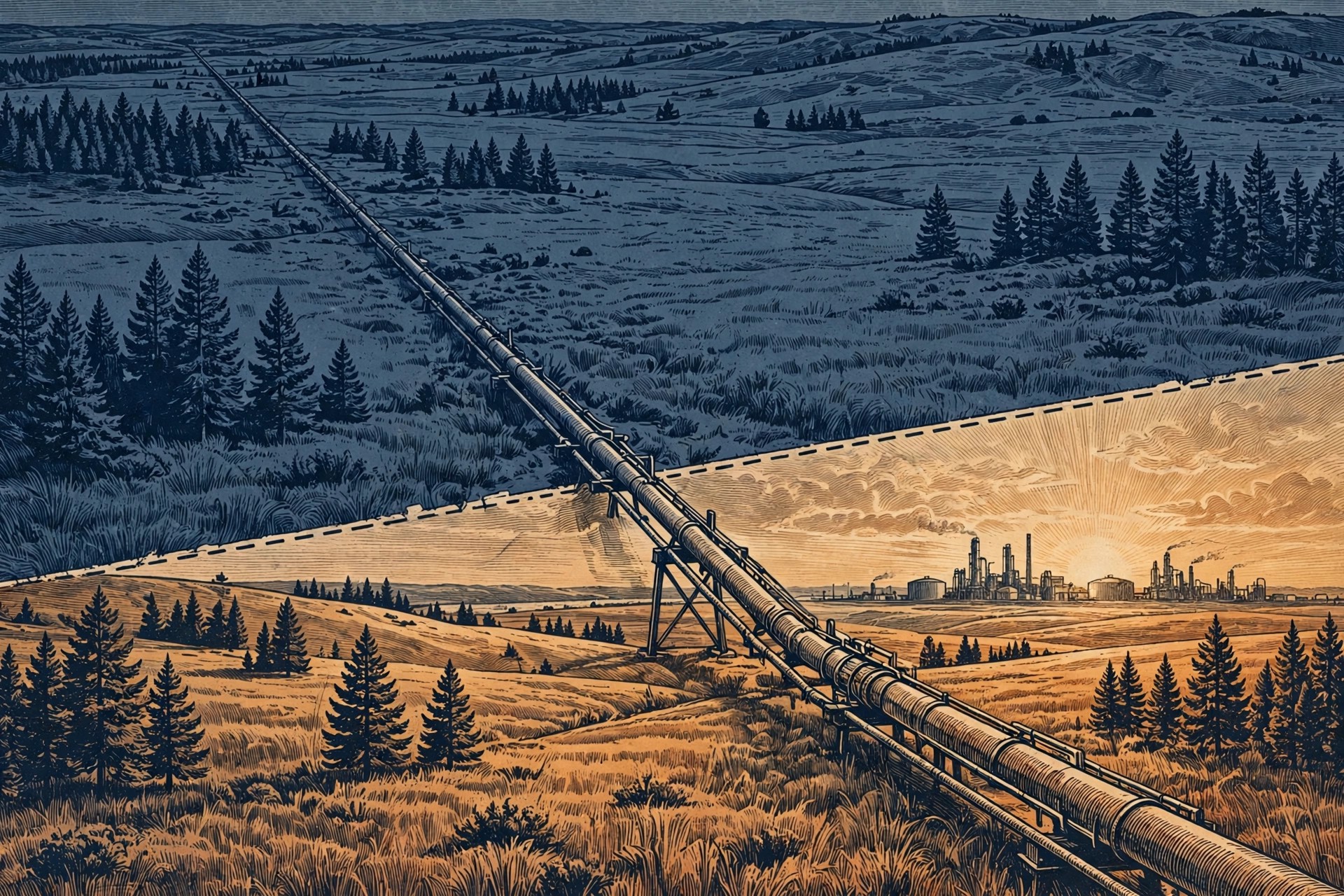
President Donald Trump said on Sunday that the United States and Canada have the outlines of a trade agreement that would include the Keystone pipeline, and that Canada would build the pipeline and pay for it. Speaking to reporters in Dubuque, Iowa, on November 1, Trump said he had spoken again to Canadian Prime Minister Mark Carney the previous day and that the two leaders now had what he called the concept of a deal. He described the prospective agreement as good for American farmers and good for the country, and he put the long-disputed pipeline at the centre of his account of what that deal would contain.
“They’re going to build the Keystone Pipeline,” Trump said, according to reporting of his remarks. “They’re going to pay for it. … We’re going to give them the route, and it’s largely been determined.” That sentence is the clearest statement yet in this second term about how Trump sees a Keystone revival working: Canadian construction, Canadian financing, and an American route. It is also, at this stage, a statement of intent from the American president rather than a published agreement. No signed deal, no final route map, no cost estimate and no construction timetable were released with his remarks, and Canadian officials did not, in their own public statements on Sunday, confirm the pipeline financing terms in the same words.
The distinction matters because the pipeline has been a symbol of the wider United States-Canada relationship for nearly two decades, and because the trade relationship between the two neighbours has been under severe strain from tariffs. A pipeline announcement can therefore be read in two ways at once: as an energy project with a long and contested history, and as a political signal that a broader trade understanding may be taking shape after months in which Ottawa had reported only limited progress. Readers should hold both readings in mind, and should treat the pipeline element as an outline described by Trump, not as a completed bargain, until both governments publish matching details.
What Trump said after his call with Mark Carney
Trump told reporters in Dubuque that he had spoken to Carney again the day before, on Saturday. “I spoke to him again yesterday, and we have the concept of a deal that’s going to be great for our farmers, great for our country, and we’ll be fine for that,” he said. The setting mattered: Dubuque was a campaign stop in Iowa, a farm state where trade, tariffs and agricultural exports are immediate local questions, and Trump framed the prospective deal first in terms of its benefit to farmers and to the country as a whole.
Trump had said last week that a trade deal with Canada was coming soon. That prediction had sat uneasily alongside Ottawa’s own, more cautious account, in which officials had previously reported limited progress in trade talks despite efforts to ease tariffs on steel and autos. Sunday’s remarks therefore represented a step up in optimism from the American side, but they did not by themselves resolve the gap between the two capitals’ public assessments. The Canadian side’s language on Sunday was constructive but general, and it stopped short of endorsing a specific pipeline financing arrangement.
Carney said earlier on Sunday, in a post on social media, that the exchange with Trump “builds on recent constructive discussions on the outlines of a mutually beneficial trade deal” that would create jobs, improve affordability, and fully respect Canada’s languages, culture and sovereignty. He added that the two countries’ teams would now be working in the coming weeks to deliver that outcome. That wording confirms that both leaders are describing the same phase of talks — outlines, not a final text — and it sets out Canada’s stated tests for any deal: jobs, affordability and respect for sovereignty. It does not, in the version reported on Sunday, mention the Keystone pipeline by name, nor does it repeat Trump’s claim that Canada will pay for and build it.
A spokesperson for Dominic LeBlanc, Canada’s minister responsible for trade with the United States, had no further comment on Sunday evening beyond Carney’s remarks, according to the reporting. That silence is not a denial, and it is not an endorsement. It is the normal posture of a government that has agreed to an outline in principle and has not yet settled, or chosen to publish, the detailed terms. For readers, the honest summary is therefore a split one: Trump has described a pipeline deal in specific terms; Carney has described a trade deal in general terms; and the overlap between those two descriptions has not yet been published.
What the Keystone pipeline deal outline would mean for Canada and the US
If the outline described by Trump were carried through, it would reverse the direction of the last major decision on Keystone XL. The original project, a proposed extension of the existing Keystone pipeline system, was designed to carry crude oil from the oil sands of northern Alberta to the major American storage hub at Cushing, Oklahoma, and then on to refineries on the Gulf Coast. Reporting of Trump’s remarks puts the proposed capacity at 830,000 barrels per day. That is a very large volume of oil, and it explains why the project has always been about more than a single stretch of pipe: it would have tied Canadian production more tightly to American refining and export capacity, and it would have given Canadian producers a major new route to market.
The financing claim is the most striking part of Trump’s outline. Keystone XL was, as the reporting notes, a private-sector initiative, led by Canada’s TC Energy. Trump’s formulation — Canada builds it and Canada pays for it — leaves open the central practical question of who, precisely, would do the building and the paying in 2026. It could mean the Canadian government, a Canadian company, or some combination of public and private Canadian money. None of those options was specified on Sunday, and each would carry very different political, legal and financial consequences in Canada, where pipeline projects have long required negotiation with provinces, Indigenous communities, landowners and regulators, as well as federal approval.
The route claim raises a similar set of questions. Trump said the United States would give Canada the route and that it was largely determined. The original Keystone XL route was itself the product of years of permitting, litigation and revision, and the American portion would again require federal permits, including a presidential permit for any cross-border segment, as well as state and local approvals along the way. Saying a route is largely determined is therefore very different from publishing a route, securing its permits and starting construction. Until a route is published, it is not possible to assess which states, communities, waterways and lands it would cross, or what environmental review it would face.
There is also a question of what “Keystone” means in 2026. The original Keystone XL project was terminated by TC Energy after its permit was revoked, and the company later split its liquids pipeline business into a separate company, South Bow. Some of the pipe installed on the Canadian side before cancellation still exists, and other, smaller cross-border proposals have been discussed in the energy industry since then. Reporting of Trump’s remarks explicitly noted that it was not immediately clear how the project would be revived. That uncertainty should be kept in view: a revived project could take the form of the original XL design, a revised design, or a new project carrying the Keystone name, and those are not the same thing.
The long history behind the Keystone XL pipeline
Keystone XL was first proposed in 2008, and it spent more than a decade as one of the most contested energy projects in North America. President Barack Obama declined to grant the cross-border permit for its northern section in 2015, citing climate concerns. President Trump, in his first term, approved a permit in 2017 and then issued a new presidential permit in 2019 after court challenges. Construction began in 2020, but it was halted again when President Joe Biden revoked the key permit on his first day in office, in January 2021, saying the pipeline disserved the national interest. TC Energy then suspended the project and formally terminated it in June 2021, coordinating with regulators and Indigenous groups on a safe exit.
The legal aftermath continued after termination. TC Energy pursued a claim for 15 billion dollars against the United States under an older trade pact, arguing that the permit denial entitled it to damages. An international arbitration tribunal dismissed that claim in July 2024, closing one of the last formal chapters of the original project. The company also recorded large losses connected to the cancellation, including a substantial impairment charge in early 2021. That history is the reason any new Keystone proposal cannot be treated as a simple restart: the original corporate vehicle, permits and financing structure no longer exist in their old form, and a new project would have to be assembled from the beginning, even if some physical pipe or some elements of the old route could be reused.
The opposition that shaped that history has not disappeared either. Landowners, Indigenous nations, environmental groups and some state regulators opposed Keystone XL on grounds that included the risk of spills, the crossing of the Ogallala Aquifer, threats to tribal homelands and cultural sites, and the climate impact of expanding oil sands production. Supporters argued, and continue to argue, that oil from a friendly neighbour would strengthen North American energy security and reduce dependence on more distant suppliers. Both arguments will return in full if a new proposal is formally tabled, and both will be tested through the permitting process rather than settled by a presidential remark at a campaign stop.
Trump himself has kept the idea alive throughout his second term. In August, he said the pipeline “may be awoken from the grave,” a phrase that signalled his personal support for revival without yet presenting a plan. Sunday’s remarks go further than that phrase, because they attach the pipeline to a trade deal outline and to a financing and route claim. They still fall short, however, of a plan: there is no named builder, no published route, no permit application described in the reporting, and no Canadian government statement confirming the financing terms.
Trade tensions give the pipeline talks their context
The pipeline discussion is taking place inside a trade relationship that has been marked, in recent months, by billions of dollars in tariffs imposed by each country on the other. Canada and the United States have been each other’s largest trading partners for generations, with deeply integrated supply chains in autos, steel, aluminium, agriculture, energy and manufacturing. Tariffs on steel and autos have been a particular source of friction, because they hit integrated industries in which parts and finished goods cross the border several times before a final product is sold.
That context helps explain why Trump framed the prospective deal first in terms of farmers, and why Carney framed it in terms of jobs and affordability. For American farmers, access to the Canadian market and the cost of inputs matter directly. For Canadian workers and consumers, the cost of living and the security of export-dependent jobs matter just as directly. A deal that eased tariffs on steel and autos, even partially, would therefore be felt well beyond the negotiating room, in factories, farms and households on both sides of the border. Whether the pipeline is a genuine part of that bargain, or a separate energy proposal that Trump has attached to the trade talks, is not yet clear from the public record.
Canada’s wider diplomatic position also forms part of the background. Ottawa has been diversifying its partnerships as its relationship with Washington has become less predictable, including through closer cooperation with European allies. USN has previously reported on Canada’s new alliance work with the European Union, including a major Ukraine loan arrangement, in a period of strain in United States ties, and readers following that strand can find the background here: Canada and EU launch new alliance with Canada pledging €500 million to €90 billion Ukraine loan as US ties strain (https://usnbreaking.com/canada-and-eu-launch-new-alliance-with-canada-pledging-e500-million-to-e90-billion-ukraine-loan-as-us-ties-strain/). That diversification does not make a United States deal less important for Canada — the United States remains by far its largest market — but it does mean Ottawa enters any negotiation with a broader set of options than it had a decade ago, and with a domestic political audience that is sensitive to any suggestion that sovereignty is being traded away.
Carney’s insistence that a deal must fully respect Canada’s languages, culture and sovereignty should be read in that light. It is a standard Canadian negotiating position, but it has taken on sharper meaning in a period in which Trump has, at various times, made remarks about Canada that many Canadians have found provocative. A Canadian prime minister who returned from talks with Washington perceived to have conceded sovereignty would face a political cost at home that could outweigh the economic benefit of a deal. That domestic constraint is one reason Ottawa’s public language has been careful, general and conditional, even when Washington’s has been specific and confident.
What is not yet confirmed, and what would need to happen next
Several things remain unconfirmed, and readers should not assume them. First, there is no signed agreement. Both leaders are describing outlines and concepts, and Carney’s own timetable is “the coming weeks” of work by negotiating teams. Second, there is no confirmed Canadian commitment to finance or build a pipeline on Trump’s terms. Trump said Canada will pay and build; Canada’s public statements on Sunday did not repeat that commitment. Third, there is no published route, cost, capacity confirmation beyond the historic 830,000 barrels per day figure, or construction start date. Fourth, there is no named private builder, no permit application and no environmental review described in the reporting.
What would need to happen next is, in outline, clear. Negotiating teams would have to turn the concept into a text, and both governments would have to agree on the same text. If a pipeline were genuinely part of that text, a builder would have to be identified, a route published, a presidential permit sought for the cross-border segment, and state, federal and Canadian regulatory processes completed. In Canada, that would involve federal and provincial approvals and consultation with Indigenous communities. In the United States, it would involve environmental review and, on the basis of past experience, almost certainly litigation. None of that can be completed in a weekend, and none of it was claimed to have been completed on Sunday.
The coming weeks will therefore be the test of Sunday’s remarks. If negotiating teams produce a joint statement that mentions the pipeline in matching language, or if a company steps forward with a formal proposal, the outline will have hardened into something concrete. If, instead, the trade deal proceeds without a pipeline element, or if Canadian officials continue to speak only in general trade terms, then Sunday’s pipeline claim will have to be reassessed as an American aspiration attached to a trade negotiation rather than as an agreed project. Either outcome is possible on the present evidence, and USN will report the next published statement from either government as the decisive next step.
For now, the fair summary is this: Trump says the United States and Canada have the concept of a great trade deal, that it will include the Keystone pipeline, that Canada will build and pay for that pipeline, and that the United States will provide a route that is largely determined. Carney says the leaders had a good conversation that builds on constructive discussions about the outlines of a mutually beneficial trade deal, and that teams will work in the coming weeks to deliver it. Between those two statements lies the space in which a real agreement, if there is to be one, will have to be built — and it is in that space, not in a single Sunday remark, that the future of Keystone will actually be decided.
Sources
USN reviewed reporting from multiple outlets for this story. Read more from The Business Times (https://www.businesstimes.com.sg/international/trump-floats-concept-us-canada-deal-includes-pipeline), The Korea Times (https://www.koreatimes.co.kr/amp/world/20261102/trump-floats-concept-of-us-canada-deal-that-includes-pipeline-talking-to-carney) and Harvard Environmental and Energy Law Program (https://eelp.law.harvard.edu/tracker/keystone-xl-pipeline/).