

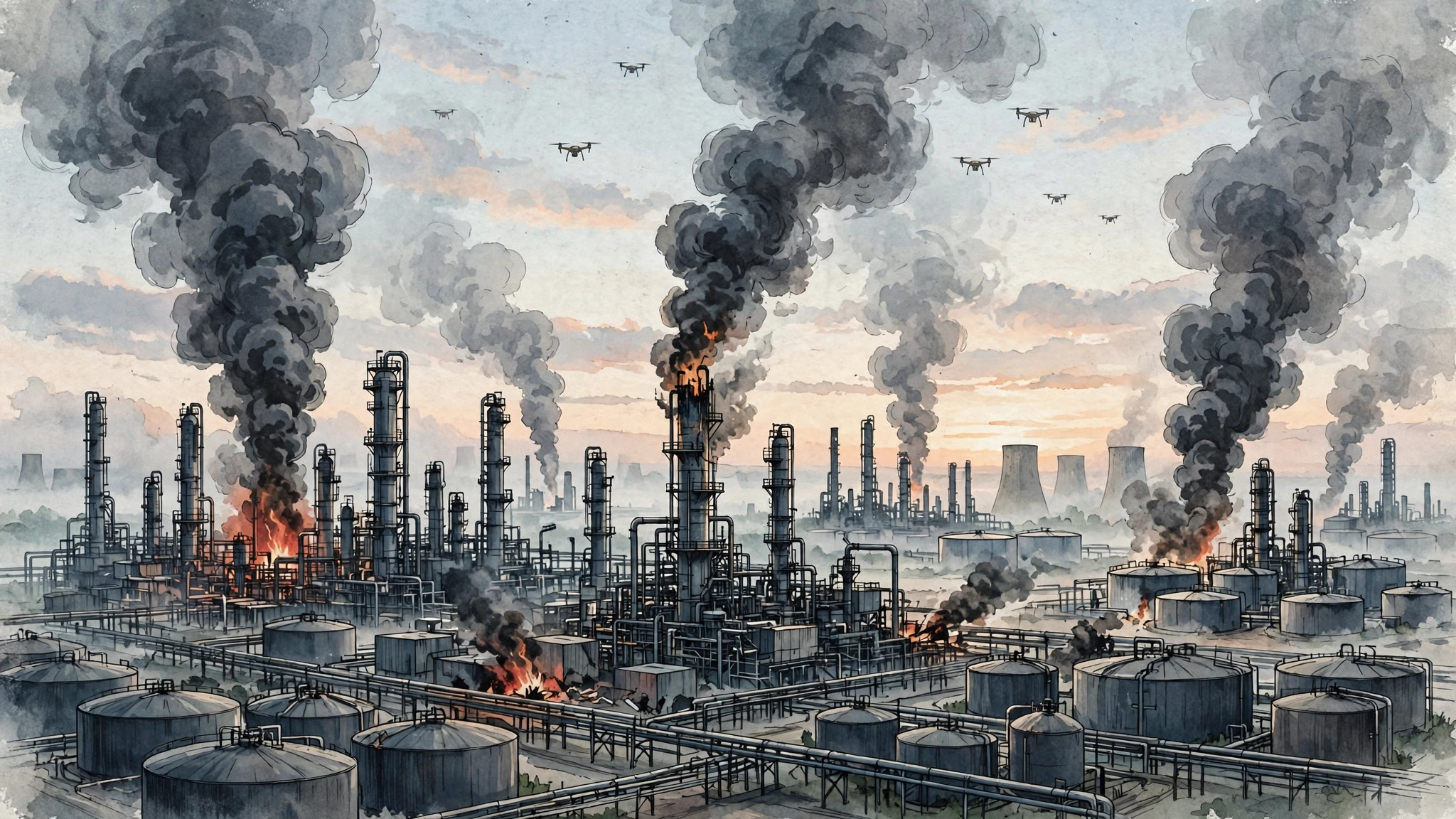
Ukraine struck an oil refinery deep inside Russia early on Friday, 30 October 2026, ending a two-week pause in its campaign against Russian oil infrastructure and defying weeks of heavy pressure from the Trump administration to halt such attacks. Fires broke out at the Novokuibyshevsk refinery in the Samara region after an overnight drone attack, according to footage published by a Ukrainian monitoring channel and reports from local residents, who described explosions and air-defence activity in the early hours. The strike was the first reported attack on a Russian refinery since mid-October, and it came barely a day after The Wall Street Journal revealed that Kyiv had quietly suspended the campaign at Washington’s insistence.
The timing could hardly have been more pointed. On Thursday, the Journal reported that Ukrainian units carrying out long-range strikes had been told in mid-October that the refinery campaign was effectively on hold once missions already under way were completed, and that the unofficial pause was expected to last until after the American midterm elections on 3 November, and potentially deeper into November. The report, citing people familiar with the operations, described a Ukrainian military leadership that had concluded it was best to hold off while relations with Washington were at a low point. Within hours of that report appearing, the refinery in Samara was burning.
What exactly happened on the ground remains, as with so much of this war, partly obscured. The Samara region’s governor, Vyacheslav Fedorishchev, confirmed that the region was repelling a Ukrainian drone attack and urged residents to stay calm and in safe places, but he did not name the facilities hit or describe the damage. The Ukrainian monitoring channel Exilenova+ published photographs and video submitted by local residents that appeared to show widespread fires at the refinery, with drones visible overhead. The Kyiv Independent, which reviewed the material, said it could not independently verify the footage or establish the extent of the damage. Ukrainian defence manufacturer Fire Point later confirmed that Ukrainian forces had struck the refinery using its FP-1 long-range attack drones, with multiple direct hits reported on the site, including a diesel hydrotreating unit.
Ukraine refinery strikes resume after two-week pause
The Novokuibyshevsk refinery matters because of what it makes and whom it serves. Owned by Rosneft, Russia’s state-controlled oil giant, since 2007, it processes about 8.8 million metric tons of crude oil a year and produces petrol, diesel, bitumen, petroleum coke and jet fuel used by Russia’s air force — a direct input into the war machine that has been bombing Ukrainian cities. It has been hit before, most recently in August 2026, when a drone strike caused a fire, and after strikes in April its two main crude distillation units were suspended. Ukraine’s campaign against refineries has always had a stated economic logic: every ton of fuel Russia cannot refine is revenue it cannot spend on missiles, and every fire at a plant deep inside Russia is a reminder that the war is not contained to the front line.
The pause that preceded Friday’s strike had its origins in one of the sharpest crises in the American-Ukrainian relationship since Russia’s full-scale invasion. According to the Journal’s reporting, President Donald Trump had piled pressure on President Volodymyr Zelensky in recent weeks to stop hitting Russian refineries, blaming the strikes for high global fuel prices — a claim energy experts mostly dispute, attributing elevated prices chiefly to the American-Iranian war and its disruption of Gulf shipping. Trump had also called publicly for Zelensky’s removal and blamed him for Russia’s continuing war. At the same time, Elon Musk’s SpaceX imposed speed limits on 14 October on Ukraine’s military-grade Starlink satellite internet service, a restriction that paralysed some drone operations for ten days until the service was restored on 24 October. U.S. envoy Jared Kushner repeated the demand to stop hitting refineries at a meeting with Zelensky in Oslo on 20 October, the Journal reported, citing American officials.
Ukraine’s own account of the pause was more nuanced than a simple order obeyed. Zelensky told reporters in Kyiv on Tuesday that Ukrainian forces had been “a little more careful during these days” but that they did not have an order not to hit refineries. Defence Minister Evgeniy Khmara was reported to have told Zelensky that the military sensed it was best to hold off because of the delicate diplomatic situation. European allies, worried by the heated rhetoric between Trump and Zelensky and by the Starlink disruption, had also nudged Kyiv to pause until after the midterms, according to a European official cited by the Journal. The last attack on Russian oil infrastructure before the pause was a strike on an oil pumping station on the Druzhba pipeline in the Tambov region on 20 October; the last refinery hit before that was on 15 October. Two full weeks then passed without a refinery strike — an unusually long silence in a campaign that had struck with regularity through the summer and autumn.
Why Kyiv defied Washington over Russian oil refineries
Friday’s strike therefore reads as a decision, not an accident. Whether it represents a formal end to the pause or a single operation authorised for its own reasons is not yet clear, and Ukrainian officials had not, by Friday afternoon, publicly claimed the attack in the way they sometimes do. But the choice of target and the confirmation from a Ukrainian defence manufacturer suggest deliberation. Kyiv’s calculation, as Zelensky has stated it, is transactional: Ukraine wants stronger protection for its own energy infrastructure, which Russia has been systematically destroying with missile and drone attacks ahead of winter, in exchange for holding off on Russian refineries. Without such protection, Ukrainian officials argue, a one-sided restraint simply lets Russia degrade Ukraine’s power grid while its own fuel keeps flowing.
That argument has weight on the ground. Russian strikes have hammered Ukrainian power stations, substations and heating plants for months, and winter is now approaching. Ukrainian cities face the prospect of cold and dark if the grid cannot be defended and repaired, while Russian refineries, if left alone, continue to supply the aircraft and vehicles prosecuting the war. From Kyiv’s perspective, the refinery campaign is one of the few levers that imposes direct costs on Moscow, and surrendering it indefinitely in exchange for nothing would be a strategic gift. From Washington’s perspective, the strikes complicate a delicate moment: an administration trying to manage a confrontation with Iran, keep global fuel prices down, and revive peace talks it has championed, while facing voters on Tuesday in elections that will determine control of Congress.
The episode also exposes the limits of American leverage over a partner that depends on American support but is fighting for its own survival. The United States remains Ukraine’s most important backer, and the Starlink episode showed how quickly a technical decision by a private company can bite on the battlefield. Yet Ukraine has repeatedly shown it will push back when it believes its interests diverge from Washington’s — and European allies, who have their own stake in the war’s outcome, have sometimes encouraged that independence. The fact that the pause lasted only until the day after it was publicly reported may be coincidence, or it may reflect a Ukrainian leadership unwilling to be seen, at home or in Moscow, as taking orders on how to fight its own war.
What happens next will be watched in Washington, Moscow and Kyiv alike. If further refinery strikes follow in the coming days, the pause will be judged a brief interlude, and the administration will face a choice between pressing harder — with the risk of a public rupture days before an election — or accepting that Kyiv sets its own targeting policy. If Friday proves to be an isolated strike, the broader restraint may yet hold through the midterms. Either way, the fires at Novokuibyshevsk have already changed the conversation: the question is no longer whether Ukraine paused its refinery campaign under American pressure, but whether that pressure can hold a second time. For the people of Ukraine, heading into another winter of Russian bombardment, the answer will be measured not in diplomatic language but in whether their lights stay on.
Sources
USN reviewed reporting from multiple outlets for this story. Read more from The Wall Street Journal, Reuters and Kyiv Independent.