

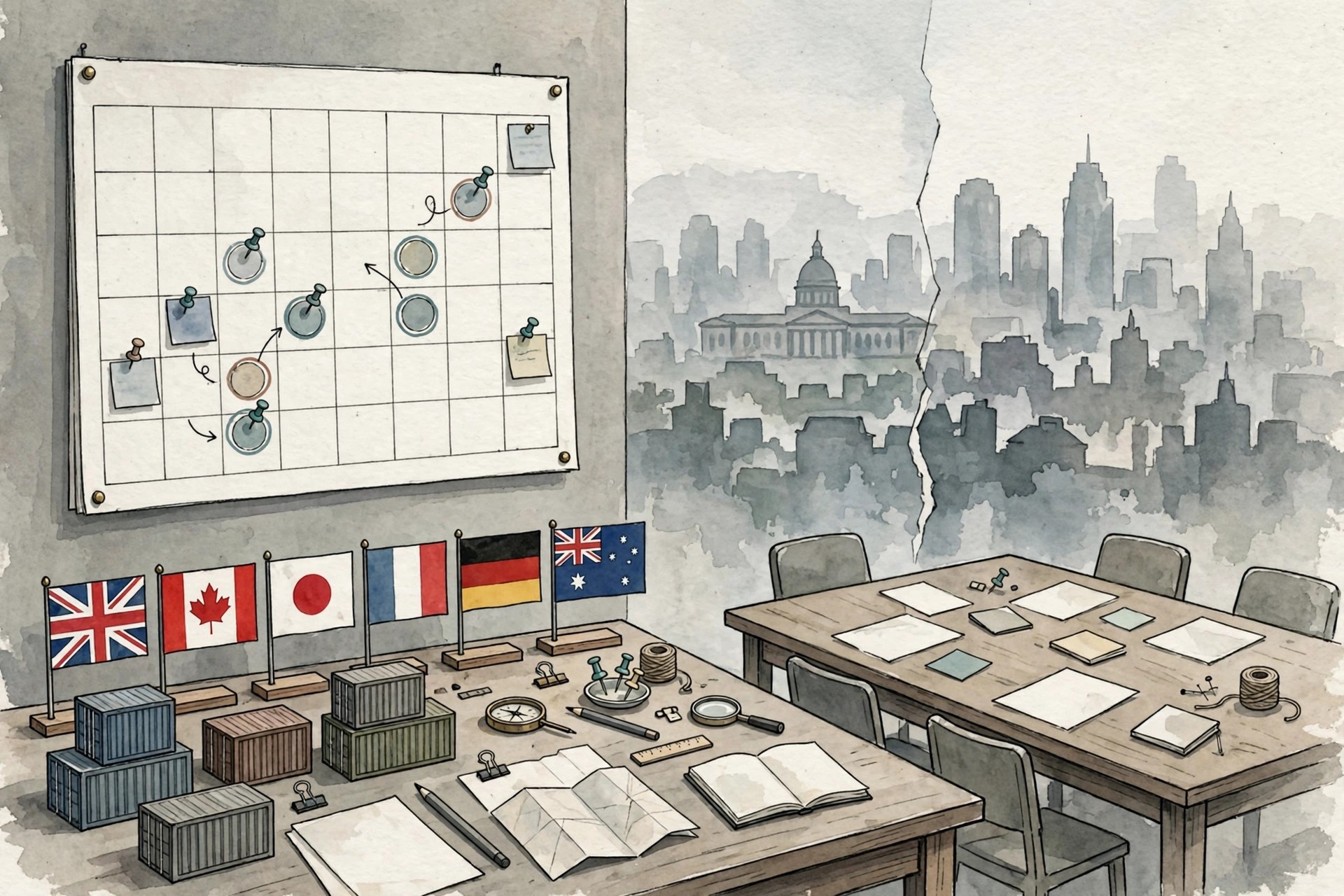
Allied governments are not waiting for Washington to settle its own arguments before they start planning. With control of Congress projected, but not yet certified, to change hands after the 2026 midterms, capitals from Ottawa and Mexico City to Brussels, Tokyo and Canberra are reworking the calendars on which they deal with the United States. The work is quieter than a summit communiqué and less dramatic than a public statement: it is about when to send a delegation, when to hold a decision back, when to lock in a concession, and when to let a deadline do the negotiating for you. In a divided Washington, timing becomes a policy instrument in its own right.
The distinction between projected and certified control matters for every calendar in this story. Projections point to Democratic control of Congress, while the White House remains in Republican hands, but projections are not certificates. States certify their results on their own timetables, running from days to weeks after polling day, and the new Congress — the 120th — is due to convene at noon on 3 January 2027, when members-elect are seated on the basis of state certificates of election. Until then, the outgoing 119th Congress retains its powers in a lame-duck session, including responsibility for unfinished business such as a funding deadline in December. Allied planners therefore have to work in two phases: a lame-duck window in which the old Congress still legislates, and a new-Congress window from January in which committee chairs, legislative priorities and the balance of negotiating leverage change. Planning that ignores the first phase risks missing decisions that will already have been taken by the time the new Congress arrives; planning that ignores the second risks negotiating with the wrong counterparts.
That two-phase reality is reshaping how allies sequence their engagement. Embassies in Washington that once focused primarily on the administration are already widening their contacts to include incoming committee staff, returning members and the policy teams that will shape trade, defence and appropriations legislation. This is not a shift in loyalty from one branch to another; it is a recognition that in divided government, a trade concession agreed with the White House may still need congressional acquiescence, funding or implementing legislation, while a defence commitment may need appropriations that only Congress can provide. Allied governments that deal with Washington regularly understand this dynamic, and the projected change of control increases the value of congressional contacts without diminishing the importance of the administration, which retains broad authority over diplomacy and military command.
US allies divided Washington planning and the USMCA review calendar
North America offers the clearest example of a calendar that is already driving behaviour. The United States-Mexico-Canada Agreement (USMCA) entered into force on 1 July 2020, replacing the North American Free Trade Agreement, and its text committed the parties to begin a first joint review on the sixth anniversary of entry into force, 1 July 2026. At that July 2026 review, the United States declined to renew the agreement in its current form. The agreement remains in force until all parties agree to extend it or it expires in 2036, but the decision not to renew set up a period of annual reviews rather than a settled 16-year term. Analysts at the Center for Strategic and International Studies have described the plausible paths from here as a painful extension negotiated into late 2026 or beyond, serial annual reviews with sustained uncertainty, or a fallback to separate bilateral arrangements if trilateral consensus proves unreachable.
For Canada and Mexico, that structure turns the calendar into a negotiating problem. Annual reviews mean that investment decisions, supply-chain commitments and regulatory alignment cannot be planned on the assumption of a stable long-term framework; they must be planned review by review. Canada’s position has been complicated further by the tariff dispute with Washington: in August 2026, Prime Minister Mark Carney suspended Canada-United States talks aimed at resolving that dispute, saying Washington had asked too much and offered too little, while United States Trade Representative Jamieson Greer countered that Canada had introduced new demands after progress had been made. Whether that account is accepted or disputed, the practical consequence for planners is the same: a negotiating track that was already difficult has become harder to restart, and any restart must now be timed against both the annual USMCA review cycle and the arrival of a new Congress whose trade committees may take a different view of concessions, labour provisions and enforcement.
Mexico faces a parallel calculation, stretched between security cooperation with Washington and domestic reform at home, in the assessment of the same analysts. A new Congress may press harder on labour and enforcement provisions, or may be more willing to approve implementing arrangements, depending on the composition of its committees and the priorities of its leadership. Neither outcome can be assumed in advance, which is why Mexican planners, like Canadian planners, are likely to treat the months between the projected result and the seating of the new Congress as a period for preparation rather than for final commitments: updating negotiating positions, consulting domestic industry, and identifying which concessions can be offered early to a lame-duck Congress and which should be held for the new committees.
Congress itself has a formal role in this calendar that allies cannot ignore. The Congressional Research Service has noted that Congress was active in the negotiations and conclusion of USMCA and continues to oversee its implementation, and that the joint review provision — the first of its kind in a United States free trade agreement — was controversial when it was proposed, with some members warning that it would create uncertainty discouraging investment. A projected Democratic Congress may use oversight hearings, reporting requirements and appropriations to shape the review, even if it cannot unilaterally rewrite the agreement. For allied negotiators, that means the review is not only a trilateral executive exercise; it is also a congressional calendar, with hearings, mark-ups and reporting deadlines that can be anticipated and prepared for, even if their outcomes cannot be guaranteed.
NATO planning and the 2027 to 2029 defence timetable
Security planning has its own timetable, and it runs on a longer fuse than trade. At their 2025 summit in The Hague, NATO allies agreed on a new defence spending goal: 5 per cent of gross domestic product by 2035, comprising 3.5 per cent for core defence and 1.5 per cent for defence-related projects. A major review of progress and of the trajectory and balance of spending is scheduled for 2029. In 2026, all 32 allies except Slovenia were expected to reach the older 2 per cent target adopted in 2014, and a small group of allies — Estonia and Lithuania, already planning to spend 5 per cent or more on hard defence from 2026, and fast-track allies including Denmark, Germany, Latvia, Poland, Sweden and Türkiye, aiming to reach both targets well before 2035 — were moving fastest. The majority, 16 allies, intend to reach the target by the 2035 deadline itself.
For allied defence ministries, a projected divided Washington changes the sequencing of that timetable, not the target itself. The Hague commitment was made by governments, not by a single American Congress, and it is not undone by an American election. What changes is how allies plan their engagement with Washington on burden-sharing, capabilities and the pace of European leadership in conventional defence. American officials have previously pressed Europe to take over the majority of NATO’s conventional defence capabilities by 2027, a deadline that European officials were reported to regard as unrealistic. Whether that 2027 pressure point is pressed again, softened, or reframed by a new Congress will affect how European capitals schedule their own capability decisions, procurement announcements and national spending plans in 2027.
The alliance’s own meeting calendar adds another layer of uncertainty that planners must work around. NATO had previously been expected to hold a summit in Tirana, Albania, in 2027, following the announcement at the 2025 Hague summit. Reports in late October 2026 suggested the alliance was considering dropping the 2027 meeting and moving away from annual summits, and the July 2026 declaration in Ankara notably omitted the previously announced plan to meet in Albania, although Secretary-General Mark Rutte subsequently reaffirmed Albania as the intended venue while saying the timing had yet to be determined. No official announcement cancelling or postponing a Tirana summit had been made at the time of those reports. For allied planners, the practical point is that a summit that was once a fixed point on the calendar has become a variable, and decisions that would normally be timed for a leaders’ meeting — capability announcements, spending commitments, Ukraine support packages — may need alternative venues or dates.
Ukraine support planning sits inside that security calendar, but it follows a different logic. Military assistance, training and funding decisions are made through a mix of executive action and congressional appropriation, and a projected Democratic Congress is widely expected to be more supportive of continued aid than its predecessor. That expectation does not settle the amount, conditions or timing of any package, and allied planners in Europe are therefore likely to sequence their own support decisions to avoid gaps: announcing national contributions in a way that sustains momentum while Washington debates, rather than assuming an American package will arrive on a particular date. The discipline here is to plan for a range of American timelines — prompt, delayed or staged — rather than to bet a national budget on a single Washington outcome.
Tariff authority and the EU trade review windows
Trade with Europe has its own set of dated windows, and they fall awkwardly across the American political transition. The European Union’s side of the framework agreement with the United States, implementing the joint statement of 21 August 2025, entered into force on 1 July 2026, eliminating tariffs on United States industrial goods and providing preferential access for selected agricultural and seafood products. The regulation applies until 31 December 2029, with a comprehensive assessment and possible extension proposal due by 30 June 2029. It also contains safeguards: the Commission can suspend concessions if the United States breaches the deal, rolls back its own concessions, or introduces new measures upsetting the balance, and a specific safeguard applies to steel and aluminium — concessions on those products may be suspended if, by 31 December 2026, the United States continues to apply tariffs exceeding 15 per cent on European exports in those categories.
That 31 December 2026 date is the first hard deadline allied planners must navigate after the American election. It falls in the lame-duck period, before the new Congress takes office, which means any decision about steel and aluminium tariffs taken before it will be taken by the outgoing administration and Congress, not by the incoming one. European planners must therefore decide whether to press for action before the deadline, to allow the safeguard to trigger, or to seek an understanding that carries the issue into the new Congress. Each option has costs: pressing early may produce a concession that a new Congress later questions; allowing a safeguard to trigger may escalate a dispute that a new Congress would prefer to negotiate; deferring the issue may leave European producers exposed in the interim. The calendar does not resolve that choice, but it forces it to be made explicitly.
A second window opens six months after entry into force — that is, around January 2027, just as the new Congress is seated — when the arrangement is subject to an initial review, followed by quarterly reviews. That coincidence of timing is significant. A new Congress arriving in January will find a European review process already under way, and European officials will find a new set of American interlocutors just as they assess whether the balance of the deal is holding. Allied planners who understand that coincidence can use it: by preparing review submissions that speak to both the administration and the incoming Congress, and by timing their own decisions to coincide with review points rather than with news cycles.
Tariff authority in Washington adds a further, longer-term calendar. The Supreme Court ruled in February 2026 that the International Emergency Economic Powers Act did not authorise the President’s broadest tariffs. The administration rebuilt its programme under other authorities, including a Section 122 surcharge that expired at its 150-day statutory limit on 24 July 2026 without congressional extension, and a Section 301 structure that replaced it the same day. A projected Democratic Congress may seek to reclaim tariff authority, to require congressional approval for new tariffs, or to set time limits on emergency tariffs — proposals that have been introduced in various forms, including a Congressional Trade Powers Reform Act introduced by Senator Ron Wyden. None of those proposals can be assumed to pass, and a presidential veto remains a formidable obstacle, but allied trade ministries are now planning for a period in which tariff authority itself is debated in Congress, rather than exercised solely by the executive. That debate will have its own calendar of hearings, committee votes and floor time, and allied submissions to it will need to be timed accordingly.
How allied calendars are being redrawn in practice
Put together, these calendars produce a practical sequence that allied governments are already following, even if they do not describe it in these terms. In the weeks immediately after the projected result, the priority is verification: confirming certified seat counts, identifying committee leadership, and mapping which lame-duck decisions can still be influenced. From December into January, the priority shifts to sequencing: deciding which negotiations to advance with the outgoing Congress, which to pause until the new Congress is seated, and which deadlines — such as the European steel and aluminium safeguard date — cannot be paused at all. From January onwards, the priority becomes engagement with the new legislative calendar: hearings, appropriations cycles, authorisation bills and the annual USMCA review rhythm.
That sequence also affects how allies handle their own domestic calendars. A government that wants to announce a defence spending increase, a trade concession or a Ukraine support package will time the announcement to maximise its effect in Washington — for example, ahead of a congressional hearing, alongside a bilateral visit, or in coordination with other allies making similar announcements. Conversely, a government that faces a difficult domestic decision, such as a procurement choice that Washington dislikes, may time it to avoid a moment when American attention is most focused on that issue. These are not new techniques, but divided government makes them more valuable, because there are now two centres of American power to consider, and a decision timed well for one may be timed badly for the other.
There are limits to what calendar planning can achieve, and allied officials understand them. A new Congress can delay, amend or block legislation, but it cannot replace the President as chief diplomat or commander-in-chief. A trade review can be scheduled, but its outcome depends on economic conditions, court rulings and domestic politics in all three USMCA countries, not only on the date of the meeting. A NATO review in 2029 can assess progress towards the 5 per cent target, but it cannot compel a government to spend money its parliament has not appropriated. Calendar planning is therefore best understood as risk management, not as control: it reduces the chance of being caught by surprise, but it does not guarantee a favourable outcome.
The most honest way to describe the allied position in November 2026 is that governments are planning for a Washington that is more complex, not necessarily more hostile or more friendly. A projected divided government offers allies more points of contact and more potential partners, but also more veto points and more uncertainty about which commitments will survive contact with Congress. The governments that navigate that complexity best will be those that treat the calendar as seriously as the substance — that know when the USMCA review falls, when the European trade safeguards bite, when the NATO review is due, and when the new Congress can actually act — and that sequence their own decisions accordingly. In divided Washington, the question is rarely only what an ally wants. It is also, and often first, when it asks for it.
Sources
USN reviewed reporting from multiple outlets for this story. Read more from CSIS, European Commission and NATO Association of Canada.