

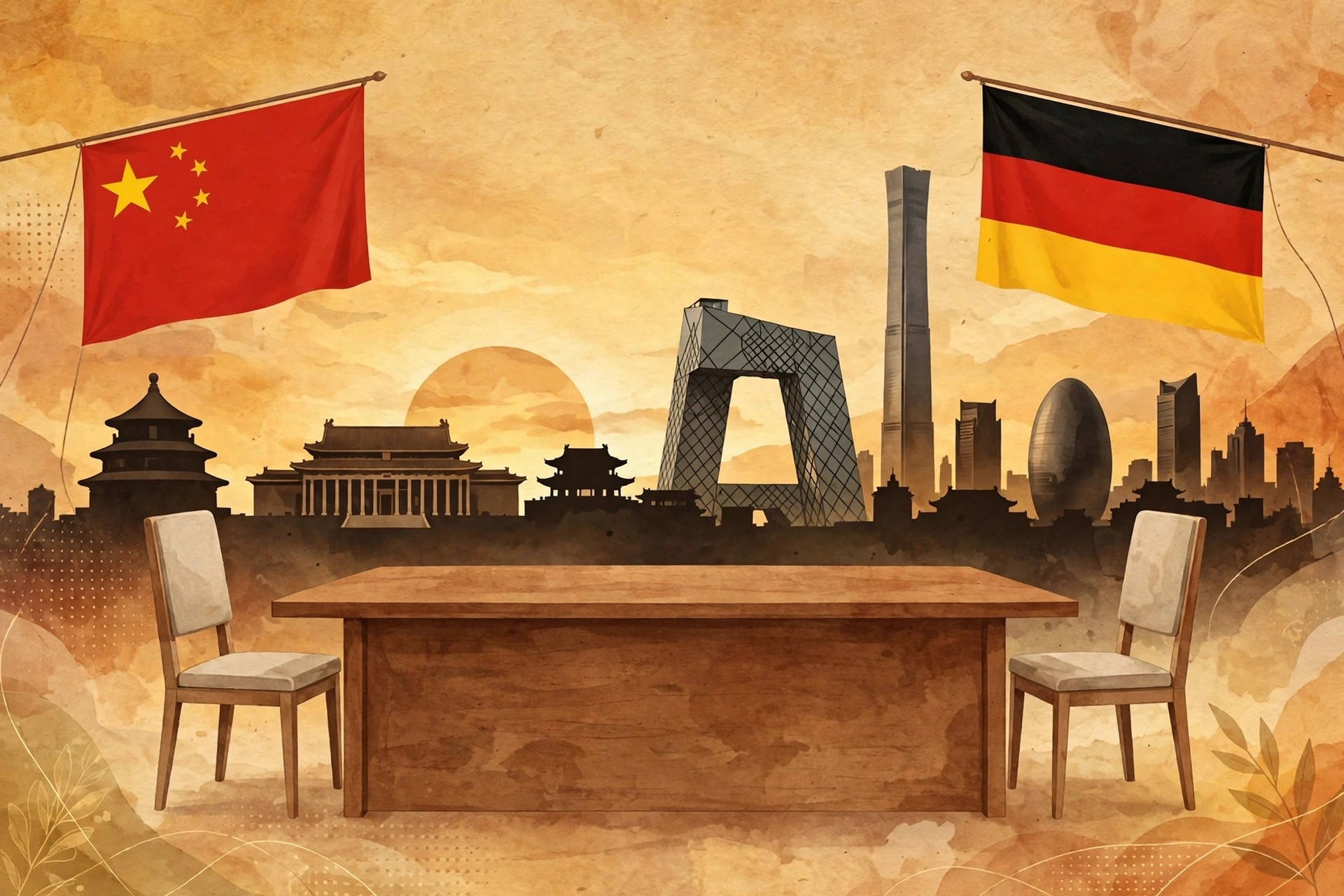
BEIJING — Chinese President Xi Jinping held talks with German President Frank-Walter Steinmeier in Beijing on Friday, October 30, 2026, at the Great Hall of the People, closing a state visit that put the future of China-Germany relations, and of China-Europe relations more broadly, under a sharper spotlight than any German presidential trip to China in years. According to Reuters, Xi used the meeting to urge Germany to pursue what he called a rational, pragmatic and friendly policy towards China, and to welcome what he described as a new chapter in relations between the two countries. Steinmeier, for his part, pressed a very different emphasis in public remarks during the visit: that close trade ties must bring sustainable benefits to both sides, and that a large and growing imbalance in bilateral trade cannot simply be left to widen.
The meeting itself was reported in detail, but readers should be clear about what the public record does and does not show. The reporting reviewed for this article describes welcoming ceremonies, opening statements and the broad themes raised by both leaders. It does not describe a signed communique, a new trade agreement or a joint statement settling the disputes that dominated the visit. Where this article quotes either leader, the words come from those reported opening remarks and speeches. Where it discusses trade figures, European Union policy or the war in Ukraine, it treats that material as context, clearly attributed to its source, rather than as an outcome of the October 30 talks themselves. That distinction matters, because the significance of this visit lies less in any single document signed in Beijing than in the competing messages the two sides chose to send in public at a moment of deep strain in the wider China-Europe relationship.
Steinmeier was welcomed with military honours in front of the Great Hall of the People, including a 21-gun salute, according to reporting by the Korea Times based on Reuters and Yonhap material. In his opening statement for the talks with Xi, Steinmeier said that China’s economic power, its technological capability and its political influence had grown immensely. That acknowledgement framed the rest of his message. Germany, he made clear, does not approach China as a marginal partner. It approaches a country that is, by the German government’s own trade statistics, once again its largest trading partner, and a country whose industrial and technological weight now shapes markets far beyond its own borders. The question Steinmeier posed, in substance, was not whether Germany and China should trade. It was on what terms that trade should continue, and whether the present terms are sustainable for both sides.
The most concrete figure in the public discussion was the bilateral trade imbalance. Steinmeier raised a deficit of almost 90 billion euros, about 100 billion dollars, in the previous year, during his meeting with Xi, according to the Korea Times report. German federal statistics give a closely matching picture for 2025 as a whole. The Federal Statistical Office, Destatis, reported in February 2026 that total goods trade between Germany and China reached 251.8 billion euros in 2025, making China Germany’s most important trading partner again after the United States held that position in 2024. Within that total, German imports from China were 170.6 billion euros, up 8.8 percent on the previous year, while German exports to China were 81.3 billion euros, down 9.7 percent. The resulting goods deficit was 89.3 billion euros, up from 66.9 billion euros in 2024. Those figures explain why Steinmeier’s language about sustainable benefits for both sides carried weight in Berlin, and why European officials have increasingly described the wider European Union deficit with China in similar terms.
That wider European picture is considerably larger than the German bilateral figure alone. The South China Morning Post, reporting on Steinmeier’s visit, said the European Union’s goods trade deficit with China swelled to more than 370 billion euros last year and was on track to surpass 400 billion euros this year, a level European Commission President Ursula von der Leyen has called unsustainable. Reuters reporting on the Xi-Steinmeier talks noted that Brussels has warned it will use every possible means to remedy its widening trade deficit with China. Germany, along with France, has also proposed that the European Union enact a new rapid-action measure against countries that harm it, with China likely in focus, according to that same Reuters reporting. None of those proposals was presented in the reporting as a decision taken during Steinmeier’s talks with Xi. They are, instead, the policy background against which the talks took place, and they help explain why a largely ceremonial presidential visit attracted such close attention from trade officials and businesses across Europe.
What the Xi-Steinmeier talks in Beijing mean for China-Germany relations
Xi’s public message was one of continuity and partnership. According to Reuters, he expressed support for what he called an all-dimensional strategic partnership based on equality, mutual benefit and strategic stability, and he said the new approach sent a positive signal to the world. In the words reported by Reuters, Xi told Steinmeier: “This new paradigm sends a positive signal to the world: we favour openness over closure, and cooperation over confrontation.” Chinese state broadcaster CGTN, citing Xinhua, reported Xi as saying that China’s policy towards Germany is consistent, stable and predictable, and that Beijing is happy to see Berlin play a greater role in European and international affairs. Xi also said, according to CGTN, that China has always viewed the European Union as a partner and is committed to developing China-EU relations with sincerity and goodwill, adding that cooperation outweighs competition and consensus outweighs differences for China and the EU.
Steinmeier’s public message, while also emphasising partnership, was more pointed about fairness. At Peking University on Thursday, October 29, he warned that China’s drive for greater economic self-sufficiency should not come at the expense of other markets, according to Reuters. The South China Morning Post reported him as telling students and academic staff: “Our goal as Europeans is clear. We do not want decoupling from China.” He added, in the same reported remarks, that Europe wanted to shape trade so that it continued to bring benefits to both sides, and that partnership works only when both sides have something to gain. In short, the German president’s formulation was win-win must not turn into win-lose. That phrase captures the central tension of the visit: both leaders spoke the language of partnership, but Steinmeier used that language to argue that the present distribution of benefits is not balanced enough to sustain the partnership in its current form.
The visit also illustrated how much of the China-Germany relationship now runs through industrial policy rather than traditional diplomacy alone. At an earlier meeting with Chinese Premier Li Qiang, Steinmeier expressed confidence that the two countries can resolve trade disagreements, according to the Korea Times report. He pointed to a recently reached agreement concerning the limitation of exports of hybrid cars to the European Union as evidence that there were ways of finding solutions to difficult issues. The South China Morning Post described that agreement, reached earlier in October between Beijing and Brussels, as one that could cut Chinese exports of hybrid cars by more than half, and said European officials described it as a crucial first step in rebalancing trade relations. Deutschland.de, reporting for the German government, likewise quoted Steinmeier as saying the hybrid-car agreement had shown that solutions could be found. The example is instructive precisely because it is limited. It shows that negotiation can produce a sector-specific result, but it does not by itself resolve the broader deficit, the questions around subsidies, or the dispute over market access that European officials continue to raise.
Trade, critical minerals and the de-risking debate
Behind the headline deficit figures lies a second dispute that Steinmeier’s visit brought into focus: the security of supply chains for critical raw materials and advanced manufacturing inputs. The South China Morning Post reported that German Chancellor Friedrich Merz, touring Singapore, Japan and South Korea at the same time, had described economic decoupling from Beijing as a big mistake that would not make Europe safe or more prosperous, while arguing instead for a realistic approach centred on de-risking and diversification to reduce unhealthy, one-sided dependencies in areas such as energy, supply chains and critical raw materials. Steinmeier echoed that distinction in Beijing. According to the South China Morning Post, he said Europe could not allow its industrial base to be lost, adding that China, whose own rise was built on industrialisation, should understand that concern. He also said, in the same reporting, that Germans do not want the world to fracture into blocs or a new bloc confrontation.
That language matters because it defines what European leaders say they are, and are not, seeking. De-risking, in this usage, is not presented as an end to trade with China. It is presented as an effort to reduce dependence in specific sensitive areas, so that a disruption, an export restriction or a sudden change in market conditions does not leave European manufacturers without essential inputs. The South China Morning Post noted that, since the European Union imposed tariffs on Chinese electric vehicles two years ago because of concerns about state subsidies, Beijing has responded with tariffs on European brandy, pork and dairy products and has restricted exports of critical minerals. Those retaliatory and restrictive steps, as reported, are part of why European governments now treat supply-chain resilience as a strategic question rather than a purely commercial one. Again, no new tariff, quota or export control was reported as agreed during Steinmeier’s talks with Xi. The visit restated positions and kept a channel open; it did not, on the public record, rewrite the rules governing any of those sectors.
Volkswagen, cars and why industry sits at the centre of the talks
The industrial stakes are visible in the itinerary itself. A day before Steinmeier arrived to visit Volkswagen’s plant in the eastern city of Hefei, the German automaker’s China unit said it had obtained a permit to conduct Level 3 autonomous-driving road tests in the city, a key step towards its 2027 target for Level 3 readiness, according to Reuters. That detail, small on its own, illustrates the dual character of the relationship. German carmakers remain deeply invested in China as a production base and a market, even as German car exports to China have fallen sharply in recent years and as competition from Chinese electric-vehicle makers has intensified in Europe. For Berlin, the policy challenge is therefore not abstract. It is about whether German industry can remain competitive both inside China and at home, without becoming so dependent on Chinese supply chains, or so exposed to Chinese competition, that its industrial base is hollowed out. Steinmeier’s visit did not settle that question, but it placed it, in public, at the top of the diplomatic agenda.
Ukraine, the rules-based order and where the two sides still differ
Trade dominated the headlines, but Steinmeier also used the visit to raise questions of war, peace and the international order. According to the Korea Times report, Steinmeier recalled the crises and wars in the Near and Middle East, in Sudan and in Ukraine, and appealed to Xi to work together to preserve and strengthen the foundations of the global order. Reuters reported that Steinmeier told Xi the world needed China to play its part in preserving the international order, referring to the rules-based global governance system based on the United Nations Charter. Xi, in his opening remarks, called on both countries to help forge a more equitable and stable system of global governance, according to Reuters, and said it was incumbent on their countries to lead and forge a new model of cooperation based on equality, mutual benefit and strategic stability.
Those two formulations sound similar, but they point in different directions, and readers should not mistake parallel language for agreement. Steinmeier’s emphasis, as reported, was on preserving an existing order grounded in the United Nations Charter. Xi’s emphasis, as reported, was on forging a more equitable system, a phrase that in Chinese diplomacy often signals a desire to reform global governance arrangements that Beijing considers weighted against developing countries. The South China Morning Post reported that Steinmeier, in his Peking University speech, urged Beijing to use its diplomatic weight and work with other countries to get Russia to halt its attacks on Ukraine and enter serious peace negotiations. The public reporting reviewed for this story did not describe a joint agreement on Ukraine arising from the October 30 talks, and no joint statement on the war was reported. That absence is itself informative. It suggests that, even where both leaders spoke about global order, they did not publicly converge on a shared approach to the war, and that China-Germany diplomacy on Ukraine remains a matter of appeals and parallel statements rather than a negotiated common position.
The wider diplomatic calendar adds further context, but it should not be overstated. The South China Morning Post noted that the push on Ukraine came ahead of a possible Asia-Pacific Economic Cooperation summit in Shenzhen, and that Russian state news agency Tass had cited the Kremlin as saying a three-way meeting involving China, Russia and the United States was possible, while also noting that no final agreement had been reached. That is a reported possibility, not a confirmed summit, and this article does not present it as a settled event. Similarly, Beijing’s hosting of Swiss President Guy Parmelin to sign an upgraded free trade accord, and its welcome for Iceland’s foreign minister with a new flight connection linking Beijing with Reykjavik, were reported by Reuters as part of a broader Chinese diplomatic push to shore up ties with European countries. Those parallel engagements show that Steinmeier’s visit was not an isolated event, but one element in a wider Chinese effort to stabilise relations with Europe at a time of mounting scrutiny of its trade practices. They do not, on their own, prove that the wider effort has succeeded.
A first presidential visit in almost eight years, and what to watch next
The symbolism of the visit should not be underestimated, even if its concrete outcomes remain limited on the public record. Deutschland.de reported that this trip is the first visit of a German Federal President to China in almost eight years, and that Steinmeier and Xi have known each other for close to two decades, dating from Steinmeier’s time as foreign minister. That long personal acquaintance, and the formal welcome at the Great Hall of the People, gave the visit a weight that a routine ministerial trip would not have carried. At the same time, Steinmeier’s presidency is approaching its end, and the day-to-day direction of German China policy rests primarily with Chancellor Merz and his government. A presidential visit can set a tone and open doors, but it cannot by itself commit a future government to a particular trade strategy, and readers should not read the October 30 talks as a substitute for the governmental negotiations that will determine tariffs, quotas, investment rules and supply-chain policy in the months ahead.
What, then, should readers watch next? First, whether the hybrid-car agreement cited by Steinmeier proves to be a template for further sector deals, or remains a one-off result. Second, whether Brussels follows through on the warnings reported by Reuters about using every possible means to remedy the trade deficit, and whether the rapid-action measure proposed by Germany and France advances from proposal to policy. Third, whether German and European concerns about critical minerals translate into concrete diversification steps, such as new supply agreements, recycling capacity or alternative processing, rather than remaining at the level of diplomatic language. Fourth, whether Beijing’s language about a new chapter is matched by market-access steps that European businesses can point to in practice, such as fairer treatment in procurement, licensing or joint ventures. And fifth, whether the appeals on Ukraine lead to any visible diplomatic initiative, or whether the two sides continue to speak past each other on the war while cooperating, where they can, on trade.
For now, the fairest summary of the October 30 talks is a restrained one. Xi and Steinmeier met, they spoke warmly about partnership and a new chapter, and they stated their positions clearly and publicly. Steinmeier pressed for a reduction in a trade imbalance approaching 90 billion euros and for a rules-based order in which China’s rise does not come at the expense of other markets. Xi pressed for a rational, pragmatic and friendly German and European policy, and for a partnership based on openness and cooperation rather than closure and confrontation. Neither side, on the public record, announced a breakthrough that resolves the underlying frictions. The visit kept the conversation open at the highest level, and it clarified, in public, exactly where the two sides agree on the value of the relationship and where they still disagree on its terms. In a relationship as large and as contested as China-Germany relations, that clarification may prove to be the visit’s most durable result, even if it is not the kind of headline that a signed agreement would have provided.
Sources
USN reviewed reporting from multiple outlets for this story. Read more from Reuters, The Print and Korea Times.