

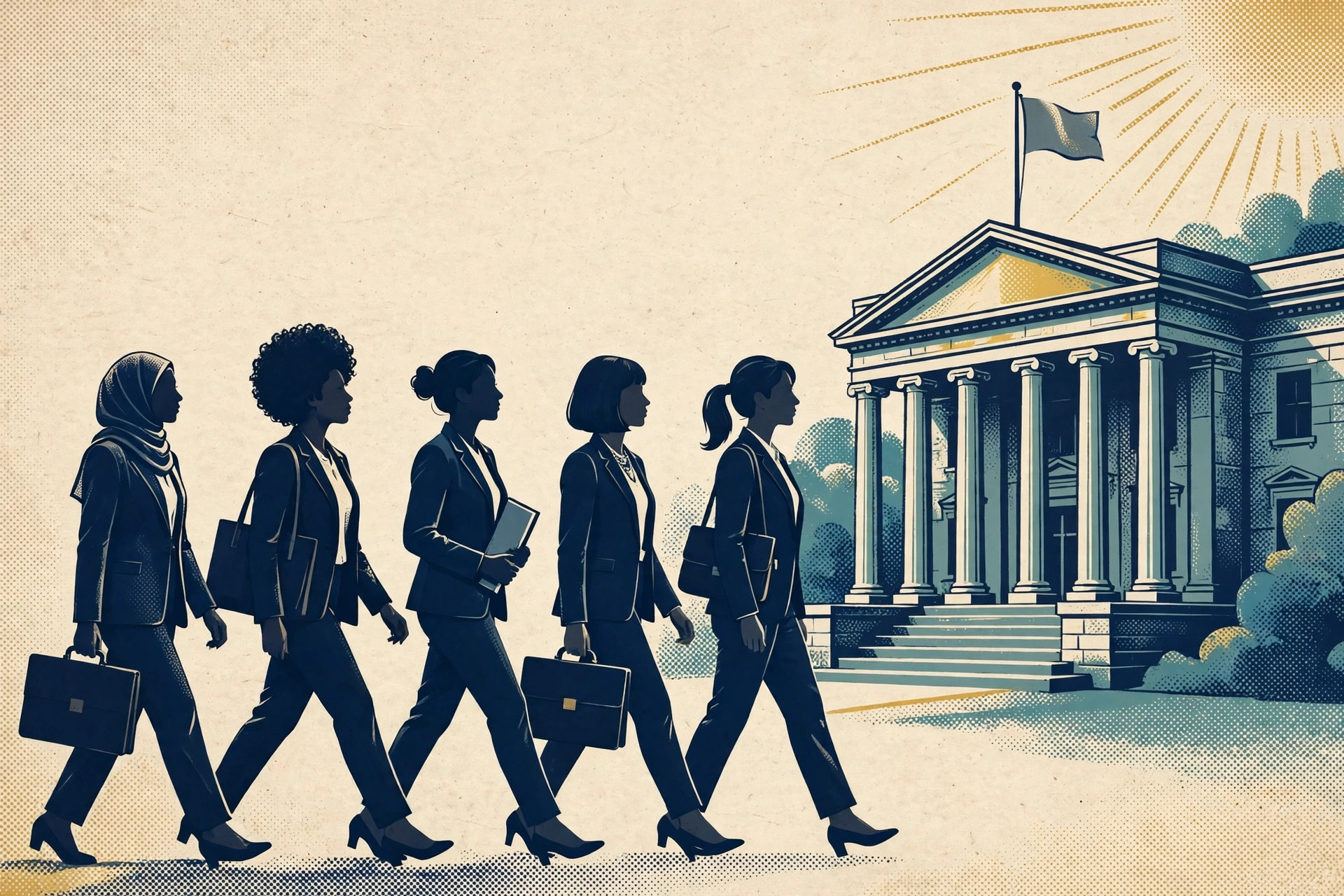
Women now hold just 17.4 percent of Cabinet and Cabinet-level positions in President Donald Trump’s second administration, down from 52 percent under President Joe Biden, according to a new report by Democrats on the Senate Foreign Relations Committee. The report, released on October 30 by the committee’s ranking Democrat, Senator Jeanne Shaheen of New Hampshire, together with Senators Tammy Duckworth of Illinois and Jacky Rosen of Nevada, argues that the decline is part of a broader dismantling of programmes, offices and expertise that supported women and girls at home and abroad.
The report is titled “Trump’s War on Women: The Systematic Dismantling of Decades of Progress at Home and Abroad During the Administration’s Second Term.” Its title alone signals that this is not a neutral audit. It is a partisan document, written by Senate Democrats, and it should be read as such. But its headline figures are specific, its comparisons are drawn from nomination and appointment records, and the White House has responded to it in detail rather than dismissing it outright. That combination — a sharp Democratic critique and a substantive administration defence — makes it a useful window into how the two sides now argue about representation, merit and foreign policy.
Shaheen, the first woman to lead the Foreign Relations Committee in either party’s senior ranks, framed the findings in security terms rather than purely as a question of fairness. “Supporting women and girls is not separate from advancing American interests — it is how we prevent conflict, strengthen our partners and compete,” she said in a statement to CBS News, adding that the report documents what she called the devastating consequences of the administration’s actions and makes clear the impact on America’s national security. That argument — that women’s participation is a strategic asset, not a symbolic one — runs through the report and is the basis for its claim that the changes matter beyond the personnel charts.
The White House rejected that framing. Spokeswoman Olivia Wales said in a statement: “President Trump is a champion for women and moms across this country.” A White House official pointed to domestic initiatives including the “Keeping Men Out of Women’s Sports” executive order, the expansion of the child tax credit, the creation of the Trump Accounts child savings programme, and the recent establishment of a White House Women’s Health Task Force to help women access high-quality healthcare. The administration’s case, in short, is that its record for women should be judged by policies affecting families and health at home, not by the share of senior national-security posts held by women.
WOMEN IN TRUMP’S CABINET: THE 17.4% FIGURE IN CONTEXT
The central figure in the report is the 17.4 percent share of Cabinet and Cabinet-level posts now held by women, compared with 52 percent during the Biden administration. The report does not present that figure in isolation. It places it alongside a series of related measures that, taken together, describe a decline across the senior ranks of government. At the Pentagon, only eight of the 201 candidates considered for senior military positions this year were women, accounting for around 4 percent — less than half the average proportion recorded over the previous decade, according to the report. Currently, no women serve as active-duty four-star officers, and none are in pending appointments for three- or four-star roles.
The diplomatic corps tells a similar story, according to the analysis. When Trump took office in January 2025, nearly half of Senate-confirmed United States ambassadors were women. Today, fewer than 25 United States diplomatic missions around the world are led by women, the report found, and only 13 percent of missions are led by a female ambassador. Those figures use different measurements and come amid widespread vacancies — the American Foreign Service Association has noted that 93 of 196 ambassadorial positions remain unfilled — so the ambassador numbers should be read with that caveat in mind. A vacancy is not the same as a deliberate replacement, and the report’s critics would be right to insist on that distinction. Even allowing for vacancies, however, the direction of travel in the report’s figures is consistent: fewer women in senior diplomatic posts than at the start of the administration.
The nomination pipeline points the same way. Women account for just 35, or 17 percent, of the 206 Trump nominees for State Department positions so far, the report found. During the corresponding period of Trump’s first administration, the figure stood at 26 percent. Under Biden, nearly half of the State Department nominees during the first two years of his administration were women, with 113 women among 245 nominees. The report describes the current result as the lowest percentage of women among nominees to high-ranking positions in 25 years. That historical comparison is one of the report’s strongest claims, because it goes beyond a single administration-to-administration comparison and suggests a break with a quarter-century trend.
The administration’s defenders point to individual appointments as a counterweight to those aggregate figures. The White House official cited Susie Wiles, the first female chief of staff in American history, along with Agriculture Secretary Brooke Rollins, Education Secretary Linda McMahon, CDC Director Erica Schwartz, Surgeon General Nicole Saphier and FDA Commissioner Heidi Overton. State Department principal deputy spokeswoman Paloma Chacon defended the administration’s record separately, saying Trump had appointed women to senior diplomatic and departmental leadership positions, that the department had ended what it considers discriminatory diversity, equity and inclusion hiring practices, and that it was prioritising merit in Foreign Service appointments. That is the core of the administration’s response: senior women are present, it argues, and appointments are now made on merit rather than on diversity targets.
Both sides can therefore point to facts that support their case, which is why the argument is unlikely to be settled by a single report. Democrats can point to the aggregate shares — 17.4 percent at Cabinet level, 17 percent of State Department nominees, 4 percent of senior Pentagon candidates — and argue that a merit-based system that produces those numbers is not, in practice, producing equal opportunity. The administration can point to the women in its most senior roles and to its domestic policies for mothers and families, and argue that representation should be measured by influence and policy outcomes rather than by headcounts. Readers should hold both arguments in mind, because neither, on its own, captures the full picture.
A REVERSAL OF FIRST-TERM POLICIES, THE REPORT ARGUES
One of the report’s most pointed arguments is that the second Trump administration has reversed policies the president himself supported in his first term. In 2017, Trump signed the bipartisan Women, Peace and Security Act, which required the federal government to develop a strategy to increase women’s participation in conflict prevention, peacebuilding and postwar recovery. In 2019, he launched a global women’s economic development initiative led by his daughter and then-senior adviser Ivanka Trump, which aimed to improve economic opportunities for 50 million women in developing countries by 2025. Shaheen herself co-led the Women, Peace and Security Act with Republican Senator Shelley Moore Capito, and the law also had the support of figures now serving in senior administration roles.
According to the report, that infrastructure has now been dismantled. The administration has eliminated the White House Gender Policy Council, the National Security Council Senior Director for Gender Equality and Women’s Empowerment, the United States Ambassador-at-Large for Global Women’s Issues, and USAID’s Senior Coordinator for Women’s Empowerment and Gender Equality. The State Department’s Office of Global Women’s Issues, which led American efforts on women’s economic security, women, peace and security, adolescent girls and gender-based violence, has also been eliminated, with its functions transferred to regional bureaus. Secretary of State Marco Rubio, who co-sponsored the Women, Peace and Security Act as a senator and praised it in April 2025 at the State Department’s International Women of Courage Awards ceremony, saying he was very proud to have supported it, now leads a department that did not organise that awards ceremony this year — the first interruption since it was established in 2007 by then-Secretary of State Condoleezza Rice.
At the Pentagon, the shift has been even more explicit. Defense Secretary Pete Hegseth announced on social media in 2025 that he had “ENDED” the Women, Peace and Security programme within the department, describing it as another woke, divisive and social-justice initiative that overburdens commanders and troops. In a later post, he alleged that the Biden administration had distorted and weaponised the initiative after its launch. Pentagon Press Secretary Kingsley Wilson, in a statement, referred to Hegseth’s recent speech in Quantico, Virginia, where he said recruitment of Black and female personnel had increased, and said the military was more ready, lethal and healthy than ever before, remaining colourblind, gender-neutral and merit-based. “Implementing the Secretary’s initiatives under President Trump’s leadership has allowed women to thrive at the War Department, and the surge in recruitment is proof of that,” Wilson said. That statement did not, however, address questions about the Women, Peace and Security strategy itself. Democrats noted that the administration has not yet used the 112 million dollars approved by Congress for implementing that strategy during fiscal year 2026.
The report also describes how the administration identified programmes for review or elimination. It says officials used keyword searches for terms associated with diversity, equity and inclusion and other topics, including women, female, disability, diversity, discrimination, equity, gender, gender-based violence, minorities, victims and vulnerable populations. The report calls that process arbitrary and argues that it affected policy planning and terminated programmes authorised and funded by Congress. The administration has not, in the material reviewed for this article, directly answered that specific claim about keyword searches, and it is presented here as the report’s allegation, not as an established fact about internal deliberations. What is established is the outcome the report documents: offices closed, personnel dispersed and expertise lost, in the report’s account, across the State Department, the Pentagon and the former USAID.
FOREIGN ASSISTANCE CUTS AND THEIR STATED HUMAN COST
Beyond personnel, the report’s most consequential claims concern foreign assistance. It says the administration’s 2025 aid cuts disproportionately targeted women and girls, cancelling 88 percent of maternal and child health funding, 94 percent of sexual and reproductive health funding and nearly 80 percent of gender-based violence prevention and response funding. A separate summary of the report’s findings on USAID awards put the termination rate for maternal and child health awards at 86 percent, a figure that could potentially disrupt healthcare services for as many as 16.8 million pregnant women annually, according to the Democratic analysis. The two percentages measure slightly different things — overall funding versus awards — and readers should not treat them as interchangeable, but both point to cuts of a similar scale.
The report links those cuts to wider human consequences, drawing on United Nations and academic research. It says deaths among children under five were projected to increase in 2025 for the first time this century, reversing decades of progress, and that United States funding cuts disrupted maternal and child health services in some of the world’s most vulnerable countries. In Afghanistan alone, around 800 health clinics have closed following the funding cuts, and the United Nations Population Fund estimates the loss of United States funding will result in 1,200 additional maternal deaths by 2028. Cuts to contraceptive and family planning services in 2025 are estimated, in the report’s account, to have left 47.6 million people without access to contraceptives and to have resulted in 17.1 million unintended pregnancies and 34,000 maternal deaths.
Those estimates are projections, not counted deaths, and they depend on modelling assumptions that the administration and its supporters would be likely to dispute. They are included here because they are central to the report’s argument that the personnel changes and the aid cuts are not separate stories but two parts of the same policy shift, with consequences that extend far beyond Washington staffing charts. The report also says a 2025 United Nations Women survey found that 90 percent of women-led and women’s rights organisations surveyed in humanitarian settings had been affected by funding cuts, and that nearly half expected to close within six months if funding levels did not improve. It warns that cuts could push six million more children out of school by the end of 2026, approximately one third of them in humanitarian settings, and that failure to invest in girls’ education and in preventing child, early and forced marriage could result in losses of up to 2.5 trillion dollars by 2040.
The administration’s broader case on foreign assistance is that it is cutting wasteful, ideologically driven spending and refocusing American aid on core national interests. That argument is not addressed in detail in the responses to this specific report that were reviewed for this article, but it is the context in which the administration has defended its aid cuts generally. The report, for its part, argues that the cuts were designed to harm women and girls specifically, and that peace agreements are 64 percent less likely to fail when women and civil society participate in them — a statistic it uses to argue that excluding women weakens, rather than strengthens, American security. That claim, like the personnel figures, will be contested. What the report establishes beyond dispute is that a formal Senate committee document, released days before the midterm elections, has put women’s representation and women’s programmes at the centre of the campaign’s final argument about the administration’s record.
The timing matters. The report was released on October 30, just days before voters decide control of Congress, and it arrives as the White House is making its final midterm push on the campaign trail and as Trump and Obama trade blows over the administration’s record. Whether voters treat the 17.4 percent figure as evidence of a broken promise, as a misleading headcount, or as a secondary issue beside the economy and immigration will be tested on Tuesday. What the report has already done is ensure that the question cannot be ignored: in the administration’s second term, the share of women at the top of American national security has fallen sharply by every measure the Democrats examined, while the White House insists that its championing of women should be judged by a different set of measures entirely. That disagreement, stated plainly, is now part of the record voters will carry into the midterm election.
SOURCES
USN reviewed reporting from multiple outlets for this story. Read more from Senate Foreign Relations Committee, WION and Winneba News.